Caleb Mercer had not come to the auction looking for ghosts. He came because his hay baler needed a new hydraulic cylinder, and rural auctions were still the best place to find something useful if a man knew where to look. The yard outside Topeka was crowded with pickup trucks, muddy boots, old toolboxes, hay wagons, rusted implements, and classic cars lined in rows like somebody had emptied half the county’s barns into one gravel lot. Caleb parked his farm truck near the back fence, stepped out in his faded denim vest, and told himself he would only stay an hour.
That was what farmers always told themselves before auctions. One hour became three when someone found a box of old wrenches, a spare carburetor, or a wagon jack that looked better than the one leaning against the shed. Caleb knew the danger of lingering near old iron. Every machine had a story, and stories could pull money out of a pocket faster than any salesman.
He was fifty-six years old, broad-shouldered, sun-browned, with hands that looked older than his face because farm work had never cared about birthdays. His farm sat forty miles west, on land his father, Earl Mercer, had nearly lost twice and saved both times with stubbornness and beans planted in ground too dry for optimism. Caleb had inherited the farm, the debt, the tools, and the quiet habit of listening to engines like they were animals with moods. What he had not inherited was the red car his father had loved more than any machine except his first tractor.
The car had been a 1966 Chevrolet Chevelle, red with a black interior and a small dent near the driver-side rear quarter panel. Earl had bought it used in 1973 after a good wheat year and drove it every Sunday to church, every Saturday to town, and once all the way to Colorado because Caleb’s mother wanted to see mountains. On the farm, it was more than a car. It was the proof that a man could work himself half to death and still keep one beautiful thing for joy.
Then, in 1984, the Chevelle disappeared. Someone stole it from the Mercer farm on a September night while Earl and Caleb were hauling late hay from the south pasture. They came home after midnight to find the barn door open, the gravel scraped near the drive, and the empty space where the red car had always slept beneath a canvas cover. Earl stood there for ten minutes without speaking, holding the flashlight like it had become too heavy.
Caleb was seventeen then. He remembered his father walking to the county sheriff’s office the next morning with the title, insurance card, and a handwritten list of every identifying mark on the car. Earl had written down the hidden VIN location, the dent, the repaired seat seam, and the small mark under the dash where Caleb had once scratched the paint with a screwdriver when he was ten. The sheriff took the report, promised to look, and filed it into a system that never looked hard enough.
For years, Earl searched. He stopped at junkyards, checked newspaper ads, asked mechanics, visited swap meets, and stared too long whenever a red Chevelle passed on the highway. Caleb hated those moments because hope entered his father’s face and left it older each time. By the time Earl died, the car had become a wound nobody mentioned unless they were ready for silence.
Caleb had kept the police report in a metal box with farm deeds, old seed receipts, his mother’s wedding photo, and the folded title that had never been replaced. He did not know why he kept it nearby after all these years. Maybe farmers kept records because records were the only way to prove something had existed before weather, debt, or thieves tried to erase it. Maybe he kept it because his father never stopped believing the car would surface somewhere.
At the auction yard, Caleb walked past two rows of tractors first. One had a cracked manifold, another had rear tires worth more than the engine, and a third looked clean enough to be hiding a serious problem. He inspected the hydraulic cylinder he had come for and decided the seal scoring was worse than advertised. He was about to leave when a flash of faded red caught his eye beyond a line of pickups.
The Chevelle sat three cars down from a blue Ford Galaxie, its hood raised, its driver door open, and its paint weathered but still stubbornly red beneath the dust. Caleb stopped so suddenly that a man behind him nearly bumped into his shoulder. At first, his mind refused to make sense of it. Old red Chevelles existed. Not every red Chevelle was his father’s.
He stepped closer anyway. The gravel crunched under his boots, but the sound felt far away. The car’s front fender had been repainted at some point, and the chrome around the grille had a dull, tired shine. The interior smelled of old vinyl, dust, and trapped summers. Caleb placed one hand on the open driver door and felt his chest tighten.
The dent was still there. Smaller than memory, dulled under old paint, but there, just above the rear wheel on the driver side. His father had made that dent backing into a fence post after a long day hauling feed, then laughed so hard his mother refused to ride with him for a week. Caleb reached for the door frame, his fingers moving toward the hidden VIN plate Earl had once shown him.
“Careful with that,” a voice snapped behind him. Caleb turned and saw Grant Keller, the auction organizer, walking toward him with a clipboard tucked against his chest. Grant was a thick man in a gray work jacket, clean boots, and the irritated look of someone who had spent all morning keeping poor men from touching things they could not afford. “You here to bid or just put fingerprints on inventory?” he asked.
Caleb did not answer immediately. He was staring at the VIN plate inside the door frame. The last six digits matched the numbers he had memorized as a boy because his father made him read them aloud at the sheriff’s office. His mouth went dry. The noise of the auction yard seemed to bend around him.
“This car was stolen,” Caleb said. Grant blinked once, then laughed without humor. “That one’s new.” “From my father’s farm in 1984,” Caleb said, his voice rough. “I have the report.” Grant looked over his shoulder at a few bidders already watching. “Sir, don’t start that here.”
Caleb straightened. “I’m not starting anything. I’m telling you this car was stolen.” Grant’s smile vanished. “And I’m telling you this vehicle cleared consignment intake. We have paperwork, and it sells today.” He tapped the clipboard twice as if paper in his hand mattered more than the metal in front of them.
Caleb looked back at the Chevelle. His father’s car had not become beautiful with age. It had become tired, wounded, and passed through hands that had not loved it. That made him angrier than if it had been polished for a collector. Neglect had a way of insulting the dead.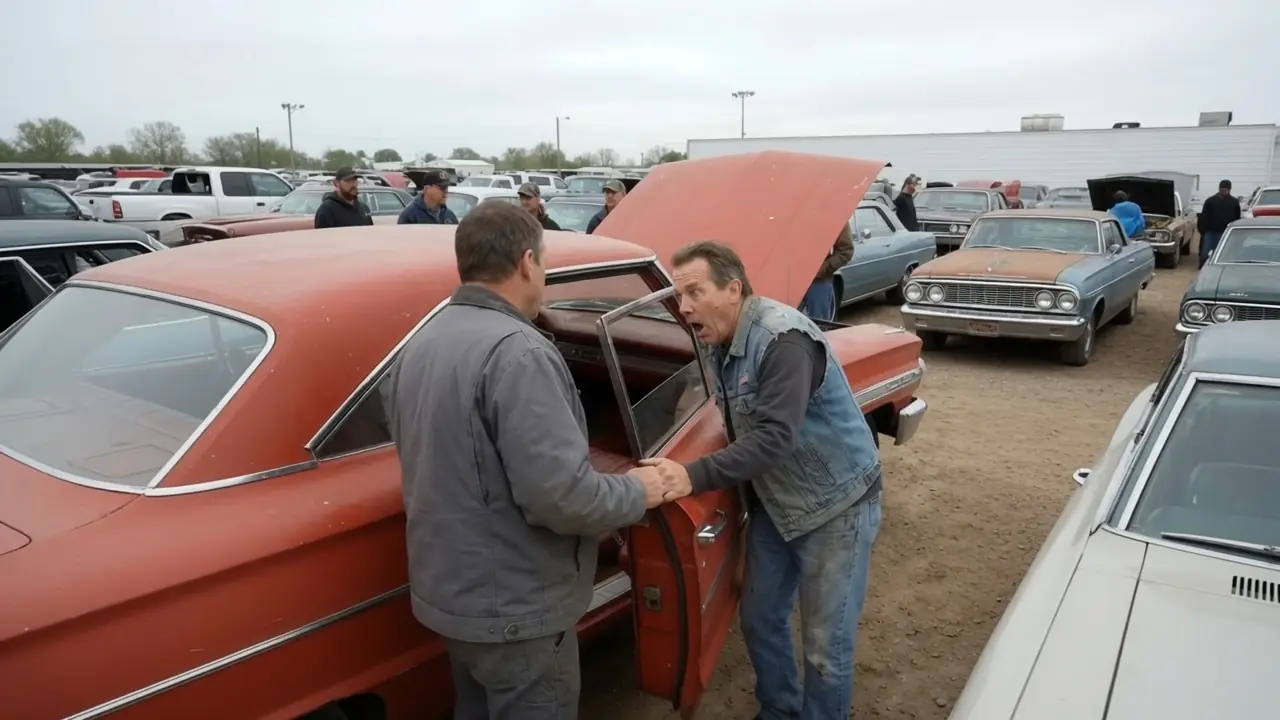
“Who consigned it?” Caleb asked. Grant’s eyes narrowed. “Private seller.” “Name?” “Not your business unless you win the bid.” Caleb stepped closer, enough that Grant’s clipboard shifted against his chest. “It became my business the night somebody drove it out of my father’s barn.”
Grant lowered his voice. “Listen, farmer, I get it. These old cars stir up memories. But a rusted memory won’t stop my sale today.” The word farmer came out like an insult, as if Caleb’s boots made him less capable of reading numbers. A few men nearby chuckled, and that sound snapped something loose inside him.
Caleb walked to his truck without another word. Grant called after him, “Auction starts in ten minutes. Don’t waste my time.” Caleb did not turn around. He opened the glove compartment, pulled out the metal document envelope he always carried during auctions, and removed the old folded police report from between insurance papers and spare registration forms.
His hands shook as he unfolded it. The paper had yellowed at the edges, and the sheriff’s ink had faded, but the numbers were clear. 1966 Chevrolet Chevelle, red, black interior, stolen from Mercer Farm, September 14, 1984. Hidden VIN ending in 742819. Caleb stared at the numbers until his breathing steadied.
When he returned, Grant was already standing beside the Chevelle with the auctioneer. A small crowd had gathered because nothing attracts rural people faster than the smell of conflict and the possibility of a story. The auctioneer lifted his microphone and said, “Next up, lot seventy-two, 1966 Chevrolet Chevelle, running condition unknown, clean consignment paperwork.” Caleb pushed through the front line and slammed the police report against the open driver door.
“This sale stops right now,” he said. The microphone crackled as the auctioneer lowered it. Grant’s face flushed. “You touch that car again and I’ll have you removed.” Caleb pointed to the VIN plate. “Read the last six digits, Grant. Then read this report.”
The crowd went quiet. Not polite quiet, not church quiet, but the kind of farm-auction quiet that happens when everybody realizes something valuable is about to become complicated. Grant did not move. Caleb grabbed the report and held it up so the men closest to him could see. “My father reported this car stolen forty years ago. Same color, same interior, same hidden VIN, same dent over the rear quarter.”
A bidder in a ball cap leaned in and squinted at the door frame. “Numbers match,” he said. Grant turned on him. “You don’t know what you’re reading.” The man lifted both hands. “I can read six digits.”
Grant tried to laugh, but it came out thin. “Even if this is true, and I’m not saying it is, this is a civil matter.” Caleb’s face hardened. “No. Stolen property is not a civil matter just because it showed up with a shiny lot number.” The auctioneer slowly stepped backward from the car.
Grant leaned toward Caleb, his voice low and angry. “You are not shutting down my auction over some story your daddy told you.” Caleb’s hand closed around the police report. “My father died still looking for this car.” His voice did not rise, but it carried. “So you better choose your next words like the sheriff is already standing behind you.”
Someone in the crowd had already called. Caleb saw a woman by a pickup speaking into her phone, eyes fixed on the Chevelle. Grant saw it too, and panic flashed across his face before he buried it under anger. “All right,” he said loudly. “We’ll pause this lot and move on.”
“No,” Caleb said. “You move on, and that car disappears before noon.” Grant’s mouth tightened. “Are you accusing me?” Caleb looked him straight in the eye. “I’m accusing this auction of trying to sell a stolen car after being shown proof.”
The words hit the crowd hard. Bidders shifted, some stepping away from the cars they had been inspecting. Trust was everything at an auction. Without trust, every title became suspicious, every serial number became a question, and every organizer became a man with something to hide.
Grant’s assistant hurried over, whispering into his ear. Grant snapped, “Not now.” The assistant whispered again, glancing at Caleb. Grant’s face changed. Caleb caught only one phrase: seller wants it gone today. The words landed like another confirmation.
Caleb turned toward the assistant. “Who wants it gone?” The assistant went pale and looked away. Grant shoved the clipboard against his chest and said, “Nobody talks to my staff like that.” Caleb took one step toward him. “Then start talking yourself.”
The sheriff arrived twelve minutes later, though it felt longer to Caleb. Deputy Martin Hayes stepped from his cruiser with one hand resting near his belt and the weary face of a man who had been called to too many disputes where both sides claimed to have paperwork. He knew Caleb from grain elevator meetings and county fairs. He also knew Grant Keller from auction permits and complaints that never quite became charges.
“What’s going on?” Hayes asked. Grant rushed to speak first. “We have a bidder disrupting an auction with an old family story.” Caleb handed the deputy the police report without looking at Grant. “That car was stolen from my father’s farm in 1984. The hidden VIN matches.”
Hayes read the report, then crouched by the open door frame. He wiped dust from the plate with his thumb. The crowd watched every movement. Hayes read the numbers once, then again, then stood slowly. “Auction’s paused,” he said.
Grant’s face went stiff. “Deputy, you can’t just—” Hayes cut him off with a look. “I can, and I just did.” Then he turned to the auctioneer. “No bids move until I verify this title and consignment chain.”
A murmur rolled across the yard. Caleb leaned one hand against the door frame because his knees had gone weaker than he wanted anyone to see. The car was real. The match was real. His father had not been chasing smoke for all those years.
Hayes asked Caleb to show the rest of the identifying marks. Caleb pointed to the rear dent, the repaired seat seam, and the scratch beneath the dash. He had to kneel awkwardly to show the last one, reaching under the steering column until his fingers found the small scar in the paint. “I did that,” he said quietly. “My father made me sand and repaint the toolbox for scratching it, but he left the mark in the car because he said every machine keeps its stories.”
The deputy’s expression softened for the first time. “Stay here,” he said. “Do not let anyone move this vehicle.” Caleb almost laughed. “Nobody’s moving it unless they move me with it.”
Grant stepped away to make a phone call, but Hayes stopped him. “Put it on speaker.” Grant’s face hardened. “This is business.” Hayes held out his hand. “Then conduct it where stolen property can hear you.”
The crowd loved that, though nobody laughed out loud. Grant reluctantly placed the call on speaker. A man answered after two rings, voice nervous and irritated. “Is it sold?” Grant closed his eyes. Caleb watched him like a hawk. Hayes stepped closer and said, “This is Deputy Martin Hayes. I need your full name and proof of ownership.”
The line went silent. Then it disconnected. That was all the crowd needed.
Within twenty minutes, a second patrol car arrived. Hayes began photographing the VIN, the report, the title paperwork Grant provided, and the auction records. The Chevelle was taped off with yellow evidence ribbon that looked strange against its red paint. The auction did not resume. It could not.
Caleb stood beside the car while bidders drifted through the lot, whispering. Some came over to apologize, though they had done nothing but watch. Others said they remembered stories of stolen farm cars in the eighties, when property theft got swallowed by hard times and bad paperwork. One old man said he knew Earl Mercer and remembered the Chevelle.
“He loved that car,” the old man said. Caleb nodded, his throat too tight for words. The old man touched the roof gently. “Looks like it found its way back late.” Caleb looked at the faded hood, the worn trim, the dusty windshield. “Late is better than never.”
The investigation did not finish that day. Stolen property, old titles, expired registrations, and decades of transfers created a knot that took weeks to untangle. Caleb spent hours at the sheriff’s office giving statements and providing old documents from his father’s box. He found photographs he had forgotten existed: Earl leaning against the Chevelle in 1976, his mother smiling from the passenger seat, Caleb at twelve sitting on the hood with a grin he no longer recognized.
The seller turned out to be a man from Missouri who claimed he had bought the car from an estate. The estate had bought it from another man, who had bought it from someone else, and the paper trail collapsed somewhere in the early nineties. The thief was likely dead or impossible to prove. But the VIN, police report, and original title were enough to establish that the Chevelle had been stolen property when it entered the chain.
Grant Keller denied knowing anything. He said he trusted the consignment paperwork. He said Caleb had embarrassed him unfairly. But the sheriff’s office found messages showing Grant had been warned about irregularities in the title and planned to push the sale quickly anyway. His auction license came under review, and the rural gossip network did the rest.
When the county finally released the car to Caleb, he brought it home on a flatbed trailer under a gray morning sky. He parked it in the same barn bay where it had last sat forty years earlier. The concrete floor had changed, the walls had been repaired, and his father’s workbench had been moved twice, but the space remembered. Caleb stood in the doorway for a long time before stepping inside.
His wife, Anna, came out with two cups of coffee and stood beside him. “You okay?” she asked. Caleb looked at the Chevelle, at the dust on its hood, at the driver door that still creaked when opened. “I don’t know,” he said honestly. “Feels like bringing home somebody who survived but won’t tell you where they’ve been.”
Anna slipped one hand into his. “Your dad would have cried.” Caleb smiled faintly. “He would have pretended something was in his eye.” They both laughed softly because that was exactly true.
The restoration took two years. Caleb did not rush it because farmers understand that some things return in seasons, not days. He rebuilt what he could himself, hired specialists for what he could not, and refused to erase every scar. The rear dent stayed because it belonged to Earl. The scratch beneath the dash stayed because it belonged to Caleb.
Every part removed was tagged, recorded, and placed on shelves like evidence in a case. Caleb found old straw beneath the rear seat, a 1982 wheat receipt folded into the glove box lining, and a rusted fence staple near the trunk seam. Those small things hit harder than the car itself sometimes. They proved the Chevelle had carried farm life before it carried loss.
When the engine finally turned over for the first time, Caleb sat behind the wheel with both hands gripping it too tightly. The starter groaned once, twice, then the V8 caught with a deep rough sound that filled the barn. Caleb closed his eyes. For a moment, he was seventeen again, standing beside his father in the yard on a Sunday morning, hearing that same sound before church.
He drove it first down the farm lane, slowly, dust lifting behind the tires. Anna watched from the porch, crying openly. Caleb did not go far. Just to the mailbox and back, past the fields his father had planted and the barn where the car had vanished.
A month later, the county fair invited Caleb to show the Chevelle during the antique vehicle parade. He almost refused. The car felt too personal, too heavy with old grief. Then he remembered how his father used to take it to town every Saturday, not to show off, but because joy shared becomes stronger.
So Caleb polished the red paint, cleaned the black interior, and placed a small sign in the windshield. Stolen from Mercer Farm, 1984. Found at auction, 2024. Returned home.
People stopped to read it all day. Some remembered Earl. Some remembered the auction confrontation. Some only saw a beautiful old car and learned the story from the sign. Roy Jenkins, an elderly neighbor who had known Caleb’s father, stood beside it for nearly ten minutes before saying, “Your dad never gave up on that car.”
Caleb leaned against the fender. “I thought maybe he should have.” Roy shook his head. “No. Some things are worth being stubborn for.” Caleb looked toward the fairground, where children ran with snow cones and farmers argued gently over tractor pulls. “He was stubborn about everything.”
Roy smiled. “That’s why you still have the farm.” Caleb had no answer to that, because it was true.
That evening, Caleb drove the Chevelle back home under a wide Kansas sky. The road ran between fields turning gold in the late light, and the engine hummed beneath him with a steadiness that felt like forgiveness. He did not pretend the car erased the years his father spent searching. It did not give Earl back the Sundays he missed, the hope that hurt him, or the silence in the barn after the theft.
But it returned one piece of the story to the right ground. It proved the old police report mattered. It proved that the numbers Earl wrote down in 1984 had not been wasted ink. It proved that memory, when held long enough, could become evidence.
Caleb parked the Chevelle in the barn and left the driver door open for a while, just as it had been at the auction. This time, though, the open door did not mean theft, confusion, or a fight in a gravel lot. It meant arrival. It meant the car was home and nobody had to chase it anymore.
He placed the old police report in a frame and hung it on the barn wall beside a photograph of Earl standing next to the Chevelle in younger days. Beneath it, Anna added a small brass plate with four words: He remembered. It returned. Caleb stared at the plate longer than he expected.
The farm moved on, because farms always do. Hay still needed cutting, fences still broke, calves still escaped through places that seemed too small, and rain still came either too early or too late. Yet every time Caleb walked past the barn bay and saw the red Chevelle waiting there, he felt something in him settle. Not heal completely, but settle.
At the next auction he attended, men treated him differently. Some joked carefully. Some asked about the car. Grant Keller was no longer running sales by then, and nobody mentioned his name unless they wanted the conversation to sour.
Caleb still bought parts, still inspected machinery, still trusted old tools more than new promises. But now he carried the knowledge that not every auction lot held junk. Sometimes it held proof. Sometimes it held a father’s unfinished hope behind a raised hood and a faded coat of red paint.
Years later, when Caleb’s grandson asked why the Chevelle mattered so much, Caleb opened the driver door and showed him the hidden VIN plate. Then he showed him the scratch beneath the dash. “That mark is mine,” he said. The boy touched it with one finger, wide-eyed and careful.
“Did great-grandpa really look for it his whole life?” the boy asked. Caleb nodded. “He did.” “And you found it?” Caleb smiled softly. “No, son. It found us when somebody finally remembered enough to stop the sale.”
The boy thought about that as only children do, seriously and completely. Then he said, “So remembering is important.” Caleb looked across the barn, past the framed report, past the photo of Earl, and out toward the fields. “On a farm,” he said, “remembering is how you keep things from being stolen twice.”
The Chevelle stayed in the Mercer barn after that, clean but not hidden, restored but not made perfect. Caleb drove it on Sundays when the weather was fair, sometimes alone, sometimes with Anna, sometimes with his grandson beside him asking questions about carburetors and family history. He never drove fast. He had spent forty years waiting for that car to come home, and he was in no hurry anymore.
People at the auction had seen only a red classic. Grant had seen a lot number, a commission, and a sale he wanted finished before questions caught up. Caleb had seen a door frame, a hidden number, a dent, and the shape of his father’s old grief. That was the difference between owning something and belonging to it.
The Chevelle had belonged to Earl Mercer, then to loss, then to strangers, then finally to the farm again. And every time its engine started inside that barn, Caleb heard more than horsepower. He heard his father’s stubborn hope coming home at last.