The excavator bucket struck something beneath the cornfield with a sound unlike stone.
Stone cracked.
Tree roots tore.
This sound rang through the machine’s steel frame like a church bell buried beneath the earth.
Elias Mercer immediately lifted his foot from the control pedal.
The excavator stopped.
For several seconds, the only movement came from dry corn leaves shifting in the October wind.
Elias leaned forward inside the cab and looked down into the shallow trench.
A curved piece of dark metal protruded from the soil.
He assumed it was part of an abandoned tractor.
Old farms collected machinery the way beaches collected driftwood. Previous generations buried broken plows, fuel drums, fencing, and anything else too heavy to haul away.
Elias lowered the bucket carefully and removed another layer of earth.
More metal appeared.
Not flat.
Curved.
Thick as his forearm.
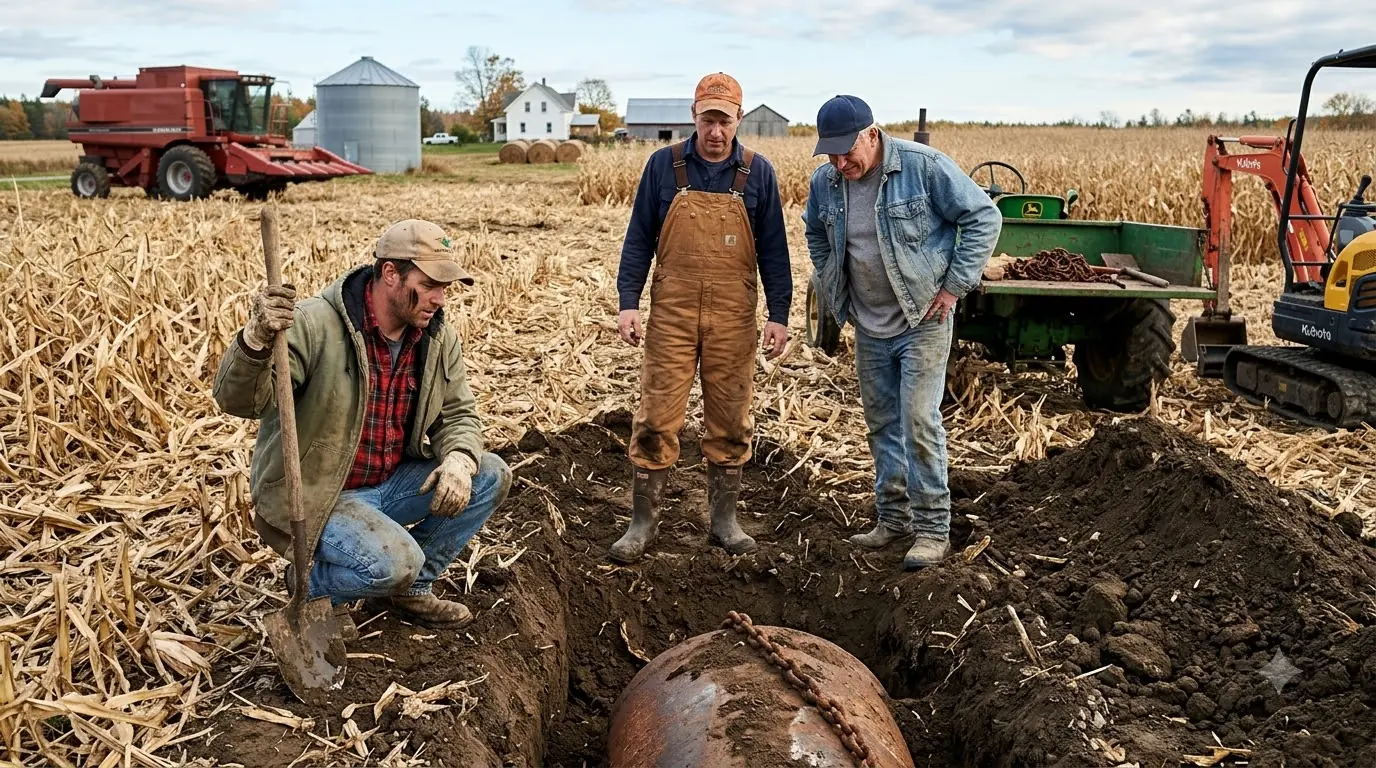
He climbed from the excavator and entered the trench with a shovel.
The soil was dark and damp beneath the dry surface. He cleared it by hand, following the metal until he uncovered the point of a massive iron fluke.
Elias stopped digging.
He stepped backward and stared.
“That can’t be right.”
He cleared another section.
A second fluke emerged.
Then part of a long shank coated in orange rust and hard black scale.
By noon, Elias could no longer pretend he had found farm equipment.
There was a ship’s anchor buried in the middle of his cornfield.
It was larger than his pickup truck.
Its iron stock stretched nearly twelve feet across, and the shank disappeared deeper into the ground at an angle. A length of heavy chain remained attached to the ring at the top.
Each link was longer than Elias’s hand and thick enough that he could not wrap both fingers around it.
The chain did not lie coiled beside the anchor.
It continued beneath the soil toward the eastern edge of the property.
Toward the ocean.
Elias Mercer was sixty-three years old and had farmed the land outside Bellweather, Maine, for most of his life.
His grandfather purchased the original one hundred acres after returning from Europe in 1946. Elias’s father expanded the property, drained the lower fields, and planted corn where scrub trees and marsh grass once grew.
The Mercer farm now covered nearly three hundred acres.
The nearest open ocean lay more than four miles away.
Between the field and the coastline stood woods, a county road, several rocky ridges, and a stretch of abandoned timberland.
No ship could possibly have reached the place where Elias stood.
Not even during the worst storm.
His neighbor, Owen Barrett, arrived shortly after lunch.
Owen was sixty-eight and lived on the farm north of Elias’s property. He wore the same faded green jacket in nearly every season and carried a thermos wherever he went.
Elias had called him with a simple request.
Come look at this before I convince myself I’m losing my mind.
Owen parked beside the trench and climbed out.
He stared at the exposed iron.
“That’s an anchor.”
“I know.”
“A large one.”
“I also know that.”
Owen removed his cap and scratched his head.
“You planning to start a navy?”
Elias did not laugh.
He pointed toward the chain disappearing into the soil.
“That goes east.”
Owen walked around the trench.
He tapped one of the links with the toe of his boot.
A dull metallic note sounded beneath the rust.
“Could be decorative.”
“It weighs several tons.”
“Rich people decorate with strange things.”
“My grandfather wasn’t rich.”
“Maybe he stole it.”
“With what? A wheelbarrow?”
Owen crouched beside the anchor ring.
Beneath layers of corrosion, something had been stamped into the iron.
The two men used wire brushes and penetrating oil until several markings became visible.
BAY STATE IRON WORKS
1942
18,600 LB
Owen’s expression changed.
“This was built during the war.”
Elias looked toward the distant tree line.
“My grandfather bought the farm in 1946.”
“Did he ever mention finding it?”
“Never.”
“What about your father?”
“He complained about rocks, drainage, taxes, and politicians. He never mentioned a ship’s anchor.”
They stood beside the trench while wind moved through the corn.
Owen poured coffee into the thermos cap.
“What are you going to do?”
“Follow the chain.”
Owen handed him the coffee.
“Of course you are.”
Elias began the following morning.
He used the excavator to open a narrow trench along the chain’s direction.
The work moved slowly.
He did not want to break anything, though the links appeared capable of surviving more punishment than his equipment could deliver.
The chain lay between three and six feet beneath the surface.
In some sections, it ran straight.
Elsewhere, it curved around buried stones or descended into layers of dark clay.
By the end of the first day, Elias had exposed nearly forty feet.
By the third, the trench stretched across part of the field like an open scar.
People began stopping along the county road.
A teenager took photographs.
A local reporter called and asked whether Elias had found a pirate ship.
He hung up.
On the fifth day, Owen arrived carrying an old metal detector borrowed from his brother-in-law.
“What for?”
“In case the chain stops.”
“It’s eighteen thousand pounds of iron. I think we’ll notice.”
“You never know.”
They continued digging.
At one hundred and twelve feet from the anchor, the chain turned sharply south.
At one hundred eighty feet, they discovered a section wrapped around a buried granite block the size of a washing machine.
The stone appeared deliberately placed.
A groove had been worn into one side by years of pressure.
“That wasn’t dragged here casually,” Owen said.
“No.”
“Someone used the stone as an anchor point.”
“Or a turn.”
“For what?”
Elias looked back at the enormous anchor lying in the original trench.
“I don’t know.”
By the end of the week, the chain had crossed more than three hundred yards of field.
Then it ended.
The final link was broken.
Not cut cleanly.
Torn apart.
One side had stretched into a long iron hook before failing. The surrounding soil contained rotted wood, rusted bolts, and fragments of thick cable.
Elias spent half a day searching beyond it.
The metal detector found nails, old fencing wire, and one horseshoe.
Nothing connected to the chain.
The mystery should have ended there.
Instead, it became impossible for Elias to ignore.
For several nights, he remained awake inside the farmhouse, thinking about the anchor.
His wife, Margaret, had been dead for six years.
When she was alive, she would have told him he had already lost too much sleep over ordinary farm problems to surrender more to something that had been buried peacefully for eighty years.
Then she would have made coffee and helped him investigate.
Elias missed that contradiction about her.
She criticized every bad idea while participating fully in most of them.
On Thursday, he drove to the Bellweather Historical Society.
The society occupied the second floor of the old town hall. Its archive consisted of metal cabinets, cardboard boxes, rolled maps, newspaper clippings, and the permanent smell of dust.
A volunteer named Clara Hensley listened while Elias described the anchor.
Clara was a retired librarian who wore a pencil through her hair and treated local records with the seriousness of federal evidence.
“Where exactly is the field?” she asked.
Elias pointed to the location on a modern county map.
Clara looked at him over her glasses.
“That land did not always look like that.”
She disappeared into the archive room.
Twenty minutes later, she returned carrying a rolled survey map dated 1898.
They spread it across a large table.
Elias recognized the road and several property lines.
The landscape did not match what he knew.
A narrow tidal inlet once extended nearly two miles inland from the coast.
It ended less than half a mile from his field.
“What happened to it?” Elias asked.
“The hurricane of 1938 altered much of the coastline. Then a timber company filled sections of the marsh to build an access road.”
Clara traced a dotted line.
“This was the old Blackridge logging route. It passed directly across what later became your eastern field.”
Elias followed the line toward the coast.
It ended at a place labeled Widow’s Cove.
He had heard the name.
Almost everyone in Bellweather had.
Few people knew exactly where it was.
The modern shoreline contained steep cliffs, private timberland, and unstable rock ledges. The old road had vanished decades earlier.
Clara brought out another map.
This one had been produced by the Army Corps of Engineers in 1945.
Widow’s Cove appeared behind a narrow opening in the cliffs.
Several handwritten marks had been made near it.
SALVAGE ACCESS
TEMPORARY WINCH ROAD
CLOSED 1945
Elias felt the hair rise along his arms.
“Do you have anything about a shipwreck?”
Clara searched the newspaper index.
Two hours later, they found a short article from November 1944.
FREIGHTER LOST OFF BELLWEATHER COAST
The article reported that the SS Northern Crown, a wartime cargo vessel, disappeared during a severe Atlantic storm while traveling north under naval escort.
Debris washed ashore near Bellweather.
The military released no cargo information.
Thirty-eight crewmen were presumed dead.
A second article published six months later stated that a private salvage contractor had been granted limited access to an unidentified wreck near Widow’s Cove.
The operation ended after an equipment failure injured two workers.
No further details appeared.
Elias looked at the map.
“The anchor in my field belonged to that ship.”
Clara did not answer immediately.
“It may have.”
“Why would anyone drag it inland?”
“During wartime, steel was valuable. So were ship fittings, machinery, copper cable, and cargo.”
She adjusted her glasses.
“Salvage crews used whatever routes existed. If the logging road reached the marsh, they may have tried hauling heavy pieces toward solid ground.”
“The chain snapped.”
“That would explain why they abandoned the anchor.”
Elias pointed toward the cove.
“What happened to the ship?”
Clara searched through the remaining records.
Nothing answered the question.
No report described the wreck’s final location.
No photograph showed the salvage site.
The Northern Crown simply disappeared from local history.
Elias called Owen from the parking lot.
“We’re going to the coast.”
Owen sighed.
“When?”
“Tomorrow.”
“I have a dentist appointment.”
“Move it.”
“I’ve already moved it twice.”
“Then you should be practiced.”
The next morning, they drove east in Owen’s truck.
Clara had given them copies of the old maps.
A logging trail began behind an abandoned sawmill property now owned by the state. The gate was locked, so they continued on foot with permission from the regional land office.
The trail had almost disappeared.
Young trees grew through sections of the old road. Fallen branches covered the ground. In several places, the men found rotted timbers arranged parallel beneath the soil.
Remnants of the wartime salvage route.
Elias also found pieces of corroded cable and a rusted pulley wheel half buried beside a boulder.
The land rose sharply near the coast.
They climbed through spruce and pine until the sound of waves became louder than the wind.
At the top of the ridge, the path appeared to end against a wall of rock.
Owen checked the map.
“The cove should be below us.”
Elias walked north along the cliff.
After fifty yards, he found a narrow gap between two outcroppings.
Cold air moved through it carrying the smell of salt and seaweed.
They squeezed between the rocks and followed a steep path downward.
The cove appeared suddenly.
It was nearly invisible from the open ocean.
High cliffs surrounded a basin of dark water. The entrance was only wide enough for a medium-sized ship to pass under calm conditions.
No houses overlooked it.
No modern road reached it.
At low tide, a strip of black stones curved along the inner shore.
Owen stopped.
“There.”
At first, Elias saw only rock.
Then the shape separated from the cliff.
A wall of rusted steel rose from the far side of the cove.
It was enormous.
The forward section of a ship lay tilted against the rocks, half buried beneath decades of fallen stone and vegetation. Part of the hull had collapsed. Ribs of corroded metal showed through openings where plates had torn away.
Trees grew from the upper deck.
A cargo mast leaned against the cliff like a dead branch.
The stern remained beneath the water, but the vessel’s bow rested high enough to reveal rows of openings along the side.
Even after eighty years, the wreck appeared too large for the cove.
Elias moved closer.
A faded name remained barely visible beneath rust and marine growth.
NORTHERN C—
Owen removed his cap.
“My God.”
They followed the shoreline until they reached a section of old salvage machinery.
A large winch sat bolted to a concrete foundation. Thick cable remained wound around its drum.
Nearby, the remains of wooden sledges and rollers extended toward the vanished logging road.
Elias understood.
The salvage crew had attempted to remove the ship’s anchor by hauling it from the cove, across the tidal inlet, and inland toward the road.
The anchor reached what later became his field.
Then the chain failed.
But something about the scene did not fit.
The anchor chain attached to the Northern Crown’s bow remained visible, descending into the water.
The anchor in Elias’s field could not have been the ship’s only anchor.
He climbed carefully over the rocks toward the hull.
Owen caught his sleeve.
“We’ve seen enough.”
“I want to find the name plate.”
“The structure could collapse.”
Elias stopped.
A rectangular opening in the hull revealed part of the cargo deck.
Inside, several long cylindrical objects rested beneath fallen beams.
Their shape made Owen step backward.
“Those aren’t pipes.”
Elias stared through the opening.
Each cylinder had metal fins on one end.
Faded yellow bands remained visible on several.
Military ordnance.
The Northern Crown had not been carrying ordinary freight.
Elias removed his telephone.
“We need to leave.”
Owen was already moving.
They climbed out of the cove and called the county sheriff from the ridge.
The sheriff contacted the Coast Guard.
The Coast Guard contacted state police, the Navy, and a federal explosive-ordnance team.
By late afternoon, authorities had closed the coastal access area.
Elias and Owen gave statements from behind a temporary perimeter while helicopters photographed the wreck.
The following morning, specialists entered the cove.
They confirmed that the cylinders visible inside the hull were wartime naval munitions.
Most were badly corroded.
Some remained potentially dangerous.
The Northern Crown had been carrying replacement aircraft parts, fuel-system components, medical supplies, and ammunition for Allied operations in the North Atlantic.
Its cargo remained classified for decades because military officials feared enemy intelligence might identify vulnerable shipping routes.
The ship’s final hours slowly emerged from naval archives.
On November 19, 1944, the Northern Crown encountered a powerful coastal storm.
Its steering system failed.
The captain attempted to shelter inside Widow’s Cove, but the freighter struck submerged rock near the entrance.
The collision opened part of the lower hull.
With the ship taking on water, the captain ordered both bow anchors deployed.
One caught outside the cove.
The other was released too late and became trapped near the rocky shore.
Several crewmen reached land.
The official assumption that all thirty-eight died had been wrong.
Fourteen survivors took shelter inside an old logging camp and were rescued two days later by a military patrol.
Their survival had been suppressed at the time because several were questioned regarding lost munitions and security procedures.
Twenty-four men remained missing.
The salvage effort began the following spring.
Workers removed accessible equipment and attempted to drag the trapped shore anchor inland along the temporary logging road.
The anchor reached the edge of what later became the Mercer property.
During the final pull, the chain broke.
A worker lost part of his leg when the failed cable struck him.
The project was abandoned soon afterward because of the dangerous cargo remaining aboard the wreck.
Military engineers sealed the accessible sections and removed the cove from civilian coastal maps.
Over time, the route disappeared.
The hurricane-altered inlet filled with sediment.
The Mercer family drained the land without knowing what lay beneath it.
For eighty years, the anchor remained exactly where the salvage crew left it.
The authorities declared both the wreck and the anchor part of a protected archaeological site.
Elias was instructed not to move the anchor, remove any metal, or continue excavating without supervision.
Survey teams entered his field.
Archaeologists photographed every exposed link.
Historians interviewed Elias repeatedly.
Government representatives discussed easements, preservation zones, and controlled access.
One official finally told him that the anchor technically belonged to the state as part of the protected wreck.
Elias looked across the trench that now divided his cornfield.
“So I found it.”
“Yes.”
“I uncovered it.”
“Yes.”
“I paid for the excavator fuel and damaged half an acre of crop.”
The official shifted uncomfortably.
“We can reimburse documented agricultural losses related to the investigation.”
“But there’s no finder’s fee.”
“No.”
“Not even for calling before Owen and I climbed inside?”
“That was appreciated.”
“Appreciated doesn’t replace corn.”
The official almost smiled.
“No, sir.”
Elias did not become wealthy from the discovery.
He received compensation for damaged crops, temporary land access, and restoration work.
Nothing more.
Reporters arrived from Portland and Boston.
One asked how it felt to discover a historic shipwreck.
“I discovered an anchor,” Elias replied. “The ship was exactly where it had been for eighty years.”
Another asked whether he regretted calling the authorities after learning he would receive no reward.
Elias looked at her.
“There were old munitions inside that wreck. What was I supposed to do, put them in the barn?”
The Northern Crown became the subject of a major historical investigation.
Divers documented the submerged stern without disturbing the dangerous sections.
Human remains were discovered inside a collapsed compartment.
They were treated with military honors.
Using dental records and preserved personnel files, investigators eventually identified five crewmen.
Their descendants were contacted.
One family came to Bellweather from Ohio.
Their grandfather had spent his life wondering what happened to his older brother, Seaman First Class Andrew Palmer.
Now, nearly eight decades later, they had an answer.
Elias attended the memorial service held above the cove.
Twenty-four names were read.
A bell sounded after each one.
Owen stood beside him wearing a tie that looked as though it had last been used at a wedding in 1987.
Clara Hensley sat in the front row with a folder of copied records on her lap.
When the service ended, an elderly woman approached Elias.
Her name was Helen Palmer.
Andrew had been her uncle.
“My father used to leave a chair empty at Christmas,” she said. “He said Andrew might still come home.”
Elias removed his cap.
“I’m sorry it took so long.”
She looked toward the cove.
“At least he isn’t missing anymore.”
The anchor remained in the field for another year while preservation experts decided what to do with it.
Removing it would require cranes, reinforced roads, and equipment capable of moving nearly ten tons without causing further damage.
Leaving it exposed invited corrosion and vandalism.
In the end, the state funded a small protective pavilion at the edge of the Mercer property.
The anchor was raised only enough to place it on a reinforced foundation.
A section of the original chain remained displayed inside the trench where it was found.
The rest of the chain was carefully reburied.
A plaque explained the story of the Northern Crown, the wartime wreck, the failed salvage operation, and the twenty-four sailors who never returned.
At the bottom appeared one final line.
Rediscovered in 2024 by Elias Mercer while clearing farmland.
Elias read it on the morning the pavilion opened.
“That’s all I get?”
Clara stood beside him.
“You wanted a finder’s fee.”
“I still do.”
“Your name is on a plaque.”
“My name was already on the mailbox.”
Owen laughed.
School groups began visiting in spring.
Elias initially disliked the buses.
Children stepped too close to his crops, asked whether pirates had owned the anchor, and occasionally left candy wrappers near the fence.
Then one teacher invited him to explain how he found it.
Elias stood before twenty students and described the sound the excavator made when it struck the iron.
He showed them the old maps.
He explained how landscapes changed, roads vanished, and history could remain buried beneath ordinary soil.
A boy raised his hand.
“Were you scared when you saw the bombs?”
“They weren’t bombs,” Elias said. “They were naval munitions.”
“Were you scared?”
“Yes.”
“What did you do?”
“I left.”
Several children appeared disappointed.
The teacher smiled.
“That was the intelligent decision.”
Elias nodded.
“The older you become, the more you appreciate intelligent decisions.”
He began speaking to each group.
Not because he enjoyed attention.
Because the children listened.
Some returned with parents.
Local volunteers cleared part of the original logging road and created a historical trail leading toward an overlook above Widow’s Cove. The wreck itself remained closed to the public.
On certain mornings, when fog moved inland from the sea, Elias could stand beside the anchor and imagine the salvage crew working across the old marsh.
Engines straining.
Cables tightening.
Men shouting.
The enormous anchor sliding foot by foot toward solid ground.
Then the chain breaking.
Everything abandoned.
Years passing.
Water receding.
Corn growing over iron.
After the memorial pavilion opened, Elias found a small envelope attached to his front door.
Inside was a photocopy of a letter written by one of the Northern Crown survivors in 1945.
The letter had been provided by the sailor’s granddaughter.
The survivor described the wreck and the men who did not escape.
Near the end, he wrote:
Maybe someday someone will find the old Crown and remember that she carried more than steel and ammunition. She carried men who had families waiting for them.
Elias placed the letter beside Margaret’s photograph.
That evening, he sat at the kitchen table and looked toward the dark field.
For months, people had asked whether he felt cheated because he received no reward.
The answer depended upon the day.
On days when government trucks damaged irrigation lines, he felt cheated.
When officials sent him another form, he felt cheated.
When schoolchildren left gates open, he felt especially cheated.
But then Helen Palmer returned.
She brought flowers to place beside her uncle’s name.
Elias watched her stand before the anchor with one hand resting against the iron.
For her, the object was not a historical curiosity.
It was the final piece of a family story interrupted in 1944.
No finder’s fee could measure that.
The following October, one year after the excavator struck metal, Elias harvested corn around the protected site.
He adjusted the rows so the machinery passed safely beside the pavilion.
At sunset, he stopped the combine and climbed down.
The anchor rested beneath its roof, dark against the evening sky.
Visitors had gone home.
The field was quiet.
Elias placed one hand against a rusted fluke.
The iron felt cold.
For eighty years, the anchor had been treated as a failed piece of salvage—too heavy to move, too damaged to recover, too inconvenient to remember.
Then a farmer’s excavator struck it by accident.
The discovery did not make Elias rich.
It did not change the mortgage, improve the harvest, or replace the wife who would have loved every frustrating minute of the mystery.
It gave twenty-four missing sailors a known resting place.
It returned names to families.
It placed a forgotten ship back into history.
Elias looked toward the eastern horizon, where the hidden cove lay beyond the trees and cliffs.
“You were right,” he said quietly.
He imagined Margaret asking what she had been right about.
“It was worth digging.”
Wind moved through the dry corn.
No voice answered.
But Elias stood there a little longer, one hand resting on an anchor that had traveled from a wartime freighter, across a vanished inlet, beneath a forgotten road, and into the middle of his field.
Sometimes history was not waiting inside museums or books.
Sometimes it lay beneath ordinary ground, attached to a chain no one remembered laying.
And sometimes the reward was not owning what you found.
It was making certain the people attached to it were no longer forgotten.