The stain appeared at 6:12 on a Monday morning.
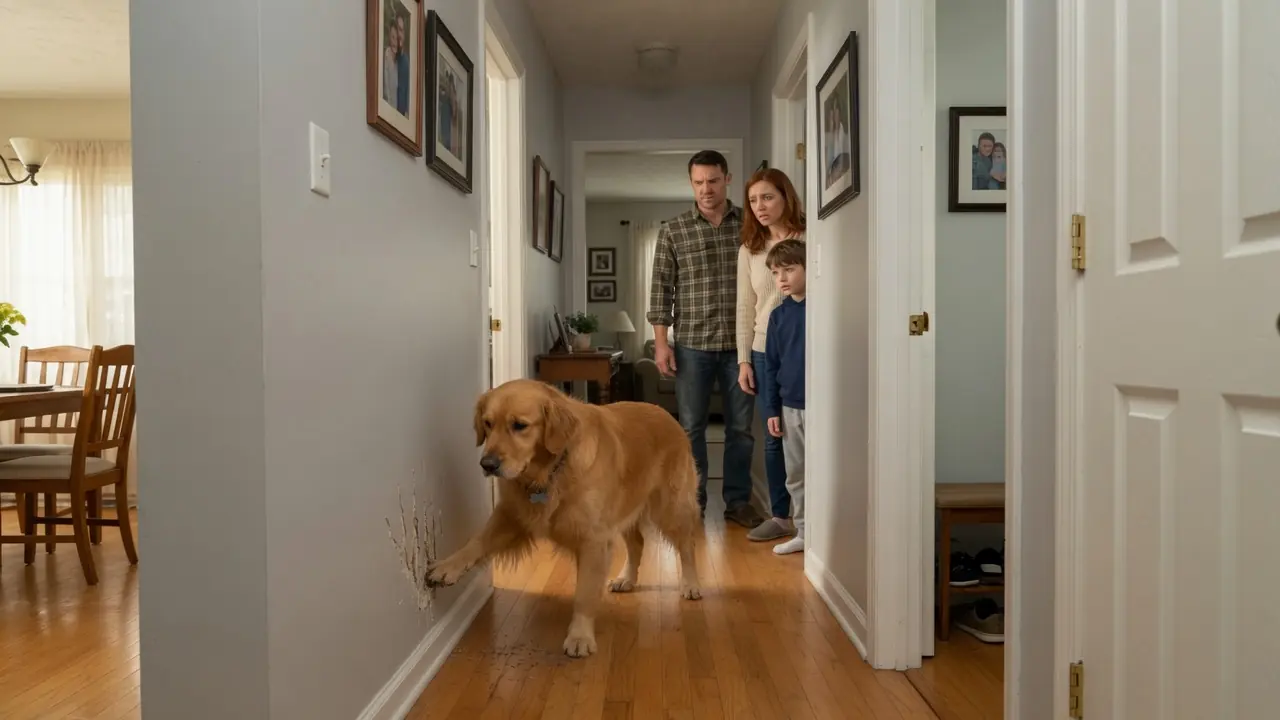
It was no larger than a dinner plate at first, a dark gray bloom spreading through the hallway wall exactly where Max had scratched every day for nearly two years.
Daniel Mercer noticed it while walking barefoot toward the kitchen.
He stopped so suddenly that the floorboard creaked beneath him.
Max sat six feet away.
The eight-year-old Golden Retriever was no longer scratching.
For the first time in months, he was perfectly still.
His head remained lowered, his amber eyes fixed on the stain.
“Laura,” Daniel called.
His wife answered from upstairs.
“What?”
“You need to see this.”
The house still carried the sounds of the storm that had passed during the night. Rainwater dripped from the gutters. Wind moved through the maple trees outside. Somewhere near the back porch, a loose piece of metal tapped irregularly against the railing.
Laura came down wearing her robe.
Their twelve-year-old daughter, Sophie, followed behind her, rubbing sleep from her eyes.
Daniel pointed toward the wall.
Laura’s expression changed.
“Oh no.”
The stain had already widened.
A thin brown line now ran from its lower edge toward the baseboard.
Max rose.
He stepped forward and pressed his nose against the drywall.
Then he gave one short bark.
Not loud.
Urgent.
Sophie looked at her parents.
“That’s the spot.”
They all knew.
For two years, Max had scratched the exact same section of wall every morning.
Always between six and seven.
Always with his right paw.
Always until someone pulled him away.
At first, the family believed he smelled a mouse.
Daniel set traps in the attic and basement.
Nothing.
They hired an exterminator.
No droppings.
No nesting material.
No insects.
The wall was scanned with a small thermal camera and checked with a handheld moisture meter.
Everything appeared normal.
Max continued scratching.
When Daniel repaired the damage, the dog began again before the joint compound had fully dried.
They tried covering the area with a wooden panel.
Max scratched the panel.
They placed a bench in front of it.
He crawled beneath the bench.
They blocked the hallway with a child gate.
He waited until someone opened it, then rushed directly to the same place.
Longer walks did not help.
New toys did not help.
A professional trainer taught Max to stop on command, but the moment no one watched, he returned to the wall.
Daniel eventually decided the behavior was compulsive.
Laura called it grief.
Max had belonged to Daniel’s father, Arthur Mercer, before Arthur died.
The dog arrived at the Mercer home six weeks after the funeral, along with a faded collar, two stainless-steel bowls, and a handwritten note from Arthur’s attorney.
Take care of him. He notices more than we do.
Daniel had read the note once and placed it in a desk drawer.
At the time, he thought it was simply something his father wrote because he loved the dog.
Now Max stood beside the spreading stain as if he had been waiting for the wall to prove him right.
Daniel touched the surface.
It felt cold.
And damp.
“I’m calling a plumber.”
Laura looked toward the ceiling.
“Could it be a pipe?”
“There shouldn’t be one there.”
Their bathroom was on the opposite side of the house. The kitchen plumbing ran beneath the floor, and the upstairs radiator lines followed the exterior walls.
But water had come from somewhere.
By 8:30, the stain reached the baseboard.
At 9:15, a white van pulled into the driveway.
He was fifty-two, compactly built, and had the careful manner of a man who disliked making unnecessary holes in expensive homes.
Daniel led him into the hallway.
Max followed.
Miguel crouched near the stain and ran an electronic moisture meter across the surface.
The device beeped immediately.
“Very wet.”
“Pipe?”
“Maybe.”
“There shouldn’t be one behind that wall.”
Miguel looked toward the ceiling.
“What’s above us?”
“Guest room.”
“Any bathroom nearby?”
“Not for twenty feet.”
Miguel checked both sides of the wall.
The opposite side opened into a narrow closet beneath the stairs.
He moved coats and storage boxes, then inspected the interior.
Dry.
“That’s strange,” he said.
Max entered the closet.
He sniffed the back wall, turned, and returned to the hallway side.
Then he sat beneath the stain.
Miguel looked at the dog.
“He always do that?”
“For two years,” Sophie said.
Miguel glanced at Daniel.
“You’re serious?”
Daniel showed him photographs.
The first image dated twenty-three months earlier. Max had scratched through the paint near the baseboard.
Another showed the repaired section.
Then fresh scratches.
The damage always appeared in the same place.
Miguel studied the wall again.
“Did anyone ever open it?”
“No.”
“Why not?”
Daniel felt defensive.
“Because every inspection said there was nothing there.”
Miguel nodded.
“That happens.”
“What does?”
“People trust the instrument because it gives an answer.”
He tapped the wall gently with his knuckles.
Most of it produced a hollow sound.
The section near the stain sounded denser.
Miguel moved several inches to the left.
Hollow.
Back to the center.
Dense.
“There’s something behind this.”
Daniel crossed his arms.
“A stud?”
“Too wide.”
Miguel removed a small inspection camera from his toolbox. He drilled a hole near the upper edge of the stain and inserted the flexible lens.
The screen showed wet insulation.
Then darkness.
He adjusted the angle.
“What is that?” Laura asked.
Miguel moved the camera closer.
Something metallic appeared beneath layers of insulation.
Not a pipe.
A flat surface.
Miguel withdrew the camera.
“I need to open the wall.”
Max stood.
His tail did not wag.
Daniel moved the dog into the living room.
Max immediately tried to return.
Sophie held his collar.
“It’s okay,” she whispered. “They’re listening now.”
Miguel cut a square through the drywall.
Wet plaster crumbled onto the protective sheet beneath him.
A sour smell escaped.
Damp wood.
Old paper.
Something metallic and faintly chemical.
Miguel removed the first section.
Behind it was not the open wall cavity he expected.
A second barrier had been built between the studs.
Thin plywood.
Painted black.
Daniel leaned closer.
“What is that?”
Miguel wiped moisture from the surface.
A rusted metal handle emerged.
The wall did not conceal plumbing.
It concealed a narrow door.
Laura stepped backward.
“Daniel?”
“I didn’t know.”
“This is your father’s house.”
“It was my grandmother’s before that.”
The Mercer family had owned the property for nearly seventy years.
Daniel inherited it after Arthur’s death.
He grew up there, left for college, returned with Laura after Sophie was born, and moved back permanently when his father’s health declined.
He knew every room.
Every loose board.
Every winter draft.
Or believed he did.
Miguel removed more drywall.
The black-painted panel measured roughly three feet high and two feet wide.
A metal latch sat near the center, but no hinges were visible.
“Could be an old access panel,” he said.
“To what?” Daniel asked.
“Only one way to know.”
He reached toward the handle.
Max barked from the living room.
Once.
Then again.
Sophie let go of his collar.
The dog rushed into the hallway and stopped beside Miguel.
He did not scratch.
He stared at the panel.
Miguel pulled the handle.
Nothing moved.
He examined the edges.
“Sealed from inside or swollen shut.”
Daniel brought a pry bar from the garage.
Together, they worked the blade into the lower seam.
The wood resisted.
Then something released with a deep cracking sound.
The panel swung inward.
Cold air flowed through the opening.
Miguel aimed his flashlight inside.
For several seconds, he said nothing.
“What is it?” Laura asked.
He reached through the gap.
His arm disappeared almost to the shoulder.
Then he slowly turned toward the family.
In his hand was a child’s red rain boot.
The rubber had faded pink with age.
Mud still clung to the sole.
Sophie stared.
“Why is that in the wall?”
Miguel placed it on the floor.
He looked through the opening again.
“There’s a space behind here.”
“How big?” Daniel asked.
“Bigger than the wall cavity.”
Daniel crouched.
Beyond the hidden panel, the flashlight revealed a narrow vertical shaft descending into darkness.
A wooden ladder had been fixed to one side.
Water glistened on the rungs.
Miguel pointed the light downward.
The beam ended on a dirt floor approximately ten feet below.
A small underground chamber extended beneath the staircase.
Laura covered her mouth.
“There’s a room under our house?”
Daniel shook his head.
“The basement plans don’t show one.”
Max stepped toward the opening.
Daniel grabbed his collar.
The dog pulled hard.
Harder than Daniel had felt him pull in years.
“Max, stop.”
The dog whined.
Not from excitement.
Distress.
Sophie knelt beside him.
“He wants to go down.”
“No one is going down until we know it’s safe.”
Miguel checked the air with a gas detector.
Oxygen levels were acceptable.
No dangerous methane or carbon monoxide.
The chamber still contained standing water from the storm, but the wooden ladder appeared intact.
Daniel called the police.
He expected them to say it was a construction issue.
Instead, the dispatcher sent two officers after hearing about the hidden space and the child’s boot.
Officer Jenna Collins arrived first.
Her partner, Officer Malik Turner, followed.
They photographed the panel, the boot, and the shaft.
Collins looked at Daniel.
“How long have you owned the house?”
“Four years.”
“Who lived here before?”
“My father.”
“And before him?”
“My grandmother.”
“Any children reported missing from this address?”
Daniel felt the question in his chest.
“Not that I know of.”
Collins requested records.
Turner secured a harness and descended the ladder.
Everyone remained above.
His flashlight moved across the chamber.
“What do you see?” Collins called.
“Storage.”
“What kind?”
“Old cans. Blankets. Shelves.”
A pause.
“There’s a small bed.”
Laura gripped Daniel’s arm.
Turner continued deeper.
“Wooden box.”
Another pause.
“Photographs.”
Daniel leaned toward the opening.
“Of who?”
Turner did not answer immediately.
When he climbed back up, his expression had changed.
He carried a metal document case.
Water dripped from its bottom.
“There’s no body,” he said quickly.
Laura exhaled.
“But this needs detectives.”
“What did you find?” Daniel asked.
Turner looked toward Sophie.
“We should discuss it away from your daughter.”
“I’m staying,” Sophie said.
Laura placed a hand on her shoulder.
“Sophie.”
“Max found it.”
No one corrected her.
Inside the case were photographs wrapped in waxed paper.
Most had survived the damp.
The first showed Daniel’s father, Arthur, as a teenager.
He stood in the backyard beside a younger girl.
She appeared about seven or eight.
Dark hair.
Freckled face.
Red rain boots.
Daniel looked at the boot on the floor.
“Who is she?”
No one answered.
More photographs followed.
The girl sitting at the kitchen table.
The girl holding a birthday cake.
The girl sleeping beside a Golden Retriever that was not Max but looked remarkably similar.
On the back of one image, someone had written:
Arthur and Evelyn, 1964.
Daniel stared at the name.
“My father never had a sister.”
Detective Rebecca Sloan arrived before noon.
She was in her mid-forties, direct but patient, and had spent twelve years working missing-person cases.
She asked the family to sit in the kitchen while technicians examined the chamber.
Max refused to leave the hallway.
He lay beside the opened wall with his head on his paws.
Sloan placed the photographs on the table.
“Your father did have a sister.”
Daniel looked at her.
“How do you know?”
“County records.”
She turned her tablet toward him.
Evelyn Marie Mercer.
Born June 3, 1956.
Daughter of Walter and Rose Mercer.
Reported missing September 18, 1964.
Age eight.
Daniel read the entry twice.
“There was no Evelyn in our family.”
“The record was sealed after 1972.”
“Why?”
Sloan looked toward the hallway.
“Your grandfather was a deputy sheriff.”
Daniel felt suddenly cold.
Walter Mercer had died before Daniel was born.
Family stories described him as strict, respected, and private.
A man who believed children should obey and neighbors should mind their own affairs.
“What happened to her?” Laura asked.
“The official report says Evelyn disappeared during a storm.”
Sloan read from the file.
“She was last seen wearing a yellow raincoat and red boots. Search teams checked the woods, creek, and surrounding farms.”
“Was she found?”
“No.”
Daniel looked toward the hidden panel.
“Then why are her things under our house?”
“That’s what we’re trying to determine.”
The storm had damaged part of the underground chamber.
Water entered through a cracked foundation drain and pushed against the interior panel. Moisture eventually spread through the drywall.
Without that storm, the hidden room might have remained concealed for years.
Without Max, the family might still have dismissed the stain as a sudden leak.
Technicians removed boxes from the chamber throughout the afternoon.
Children’s books.
Clothing.
A small wooden horse.
Blankets.
Canned food from the 1960s.
A battery lantern.
Several notebooks.
The room had not been used merely for storage.
Someone had lived there.
On one wall, pencil marks measured a child’s height.
E.M. appeared beside three of them.
The latest mark was dated October 1964.
Nearly a month after Evelyn was officially reported missing.
Daniel stood in the hallway watching each item emerge.
His father had known.
Arthur had been sixteen when Evelyn disappeared.
He lived in the house.
He must have known the hidden room existed.
Detective Sloan opened the oldest notebook.
The handwriting belonged to a child.
Most entries were short.
Dad is angry.
Arthur brought bread.
Mom cried upstairs.
I can hear people calling my name outside.
Daniel closed his eyes.
Laura read over his shoulder.
“They were searching while she was inside?”
Sloan turned another page.
Dad says I have to stay until I learn.
Arthur says he will get help.
The next pages had been torn out.
A later entry read:
Arthur tried to open the door but Dad caught him.
Daniel pushed away from the table.
“My father would have told someone.”
“He was sixteen,” Sloan said.
“He became an adult.”
“Yes.”
“He lived here for another fifty years.”
Sloan did not defend him.
That silence hurt more.
The final pages had been written by someone older.
Not Evelyn.
Arthur.
Daniel recognized his father’s blocky handwriting from birthday cards and repair notes.
I was told she ran after Dad opened the room. I believed him because I needed to.
Years later, I found the boot beneath the stairs. He lied.
I searched the chamber but found no body.
Mother made me swear never to speak of it.
Daniel read aloud without realizing.
“Why would he hide the notebook?”
Sloan pointed toward the bottom of the case.
Another envelope remained.
It was addressed to Daniel.
His name had been written by his father.
Daniel opened it with shaking hands.
Son,
If Max is still alive when you read this, trust him before you trust what I told you about this house.
Daniel stopped.
Max lifted his head in the hallway.
Laura touched Daniel’s shoulder.
He continued.
I should have told you about Evelyn. I should have told the police long after my father was dead and could no longer hurt anyone. I told myself there was no proof. The truth is that I was ashamed.
Dad locked her in the shelter after she broke one of his radios. He called it discipline. The storm began that night. Searchers came because Mother reported her missing, but Dad said Evelyn had run away before dark.
I knew she was below us.
I brought her food through the closet panel when I could.
On the fourth night, I tried to release her. Dad found me. He beat me and locked my bedroom door.
The next morning, the shelter was empty.
Dad said Evelyn escaped through the exterior tunnel.
Daniel looked toward Sloan.
“Exterior tunnel?”
The detective nodded.
“Technicians found a collapsed passage leading toward the woods.”
He returned to the letter.
I spent years believing she escaped and died somewhere outside. Mother refused to talk. After Dad died, I searched the woods, the creek, every abandoned building I could find.
Then, in 1989, a woman wrote to me from Oregon.
Daniel stopped again.
Laura leaned closer.
“What woman?”
He turned the page.
She said her name was Evelyn Mercer.
The room became completely still.
Daniel read faster.
She remembered Arthur. She remembered the shelter. She remembered climbing through the drainage tunnel while Dad was upstairs.
She had reached the highway and hidden in a delivery truck. A couple found her three counties away. She gave them a false name because she believed Dad would kill her if she went home.
The couple eventually adopted her through records that were not legal.
She spent twenty-five years believing our family chose not to look for her.
Sloan placed another document on the table.
A photocopied letter from Oregon.
The handwriting was adult and careful.
Arthur,
I found your name through a newspaper article about the old house. I do not know whether you remember me as your sister or only as a problem everyone wanted gone.
I survived.
I have a husband, two sons, and a life that belongs to me.
I do not want contact with Walter or Mother.
If they are dead, perhaps one day I will speak to you.
Do not tell anyone where I am.
Daniel looked up.
“She was alive.”
“In 1989,” Sloan said.
“What happened after that?”
“There are more letters.”
Arthur and Evelyn had corresponded for nearly twelve years.
At first, the letters were cautious.
Then warm.
They wrote about childhood memories, guilt, and the strange difficulty of loving someone connected to the worst part of your life.
Arthur asked to meet.
Evelyn refused repeatedly.
Then, in 1998, she agreed.
They met at a diner in Idaho.
A photograph showed them sitting in a booth.
Arthur, gray at the temples.
Evelyn, forty-two, with the same freckles she had as a child.
Daniel stared at the woman who had been erased from every family story.
“She was my aunt.”
“Yes.”
“Why didn’t he tell me?”
The final letter answered.
Daniel,
Evelyn made me promise not to reveal her identity while she lived. Her adoptive records could create legal problems, and she feared public attention.
She died in 2018.
Cancer.
I was with her sons when we scattered her ashes along the Oregon coast.
I planned to tell you afterward.
Then I lost my nerve.
The hidden room still existed. Every time I tried to open it, I became sixteen again.
Max began scratching the wall six months ago.
At first, I thought he heard mice.
Then I realized he smelled the old things below.
He kept returning to the place I spent my life avoiding.
I covered the panel.
He scratched harder.
Daniel looked toward the wall.
Max had begun scratching before Arthur died.
The letter continued.
He knows something is there.
Maybe not the history.
Maybe only the damp wood, old leather, and rot.
But he knows I am afraid of it.
Dogs do not understand why people build walls around guilt.
They only know something behind the wall needs attention.
If I die before I show you, open it.
Tell Evelyn’s story.
Not the story Dad put in the newspaper.
The real one.
And do not blame Max for ruining the wall.
He was trying to save what I buried.
Daniel lowered the letter.
No one spoke for a long time.
Sophie entered from the hallway.
She had been listening.
“Grandpa knew she lived.”
“Yes,” Daniel said.
“Then why did he leave the boot down there?”
“Because he couldn’t face the room.”
“That’s not fair.”
“No.”
“He let everyone think Max was bad.”
Daniel looked toward the dog.
Max had scratched through paint.
Drywall.
Wood paneling.
He had endured scolding, gates, training sessions, and repeated attempts to stop him.
Yet every morning, he returned.
Not because he understood the letters.
Not because he knew Evelyn’s name.
He detected dampness.
Old scents.
Perhaps mold.
Perhaps the hollow space.
Perhaps something in Arthur’s behavior whenever he passed that section.
Whatever Max knew, he refused to ignore it.
The police investigation continued for weeks.
No criminal charges were possible.
Walter and Rose Mercer were dead.
Arthur was dead.
The people who informally adopted Evelyn had also passed away.
But the county amended the missing-child record.
Evelyn Mercer was no longer listed as vanished and presumed dead.
Her identity was restored.
Her sons in Oregon were contacted.
Daniel spoke with them by video call.
Michael and David Porter were both in their fifties.
They had known their mother’s childhood was complicated, but not the full story.
“She never called herself Evelyn,” Michael said. “She used Elaine.”
“She kept one picture of a boy,” David added. “We assumed it was a cousin.”
Daniel held up the photograph of Arthur and Evelyn near the kitchen table.
Both men became silent.
“That’s it,” Michael whispered.
They visited Connecticut one month later.
The hidden chamber had been stabilized but not restored.
Daniel considered sealing it permanently.
Michael asked him not to.
“Our mother spent four nights down there believing no one would come,” he said. “Do not make it disappear again.”
They transformed the room.
Not into a memorial for Walter’s cruelty.
Into a record of Evelyn’s survival.
The red boot was placed inside a glass case.
The photographs were copied.
Her letters were preserved.
A panel explained the truth in simple language.
Evelyn Mercer escaped abuse in 1964. She survived by refusing to return to the people who harmed her. Her official story remained false for fifty-nine years.
Arthur’s role was included too.
His fear.
His silence.
His eventual contact with his sister.
The family did not turn him into a hero.
Nor did they erase his remorse.
“He was a child when it happened,” Daniel said.
“He was not a child for the next fifty years,” Laura replied.
Both things could be true.
Arthur had tried to help Evelyn.
Arthur had also allowed shame to become another wall.
Max became the center of attention after the discovery.
Local news called him the dog who solved a fifty-nine-year-old mystery.
Daniel disliked the exaggeration.
Max had not solved anything.
He had refused to accept that the wall was meaningless.
The distinction mattered.
Reporters arrived.
Sophie enjoyed telling them how everyone ignored him.
“He kept saying something was wrong,” she explained. “He just didn’t use words.”
Max sat beside her during interviews, accepting treats without embarrassment.
The plumber, Miguel Alvarez, appeared in one report.
A journalist asked what he thought when he reached inside and found the boot.
Miguel considered the question.
“I thought the dog had been more patient with the family than the family had been with him.”
Daniel heard the comment.
It hurt.
Because it was true.
For two years, Daniel interpreted persistence as disobedience.
He believed Max’s behavior needed correction.
He never considered that his own understanding might be incomplete.
The family repaired the wall differently.
Instead of covering the hidden panel, they framed it.
A small wooden door replaced the drywall.
It could be opened easily from the hallway.
Above it, Sophie painted a sign.
LISTEN BEFORE YOU CORRECT.
Max stopped scratching immediately.
Every morning, he walked to the door.
Sniffed along the edge.
Then continued toward the kitchen for breakfast.
The behavior that had seemed compulsive ended the moment the barrier became accessible.
One autumn morning, Daniel found Max lying beside the open panel.
The dog was older now.
His muzzle had turned nearly white.
Daniel sat on the floor beside him.
“I’m sorry.”
Max rested his head on Daniel’s knee.
“You were right.”
The dog closed his eyes.
Daniel smiled faintly.
“You probably don’t care about being right.”
Max’s tail struck the floor once.
Evelyn’s sons brought more photographs during later visits.
Their mother gardening.
Holding her first grandson.
Standing beside the Pacific Ocean with her hair blown across her face.
She looked happy.
Not untouched by what happened.
But not defined only by it.
Sophie chose one photograph for the hallway.
Evelyn stood barefoot on a beach at sixty years old, holding her red shoes in one hand.
Beneath the frame, Sophie wrote:
SHE GOT OUT.
That sentence mattered more than the details of the room.
The family received letters from strangers after the story spread.
Adults who had escaped violent homes.
People whose childhood records contained lies.
Men and women who spent decades fearing that revealing the truth would destroy the family rather than expose what had already damaged it.
Daniel answered as many as he could.
He never claimed expertise.
He told them only what he had learned.
Secrets do not remain still because no one speaks.
They shape rooms.
Relationships.
Habits.
They teach children where not to look and adults which walls should never be opened.
Sometimes the truth announces itself through documents.
Sometimes through water stains.
Sometimes through a dog who scratches the same place every morning until someone finally stops calling him difficult.
Max lived another two years.
His health declined slowly.
Arthritis made the stairs difficult. Sophie placed rugs across the hallway so he would not slip.
On his final morning, he rose before sunrise.
Daniel heard his nails against the floor.
Max walked to the small wooden door.
He touched it once with his nose.
Daniel opened it.
The dog looked into the chamber.
Then he turned away.
He spent the rest of the morning beneath the kitchen table while the family sat around him.
That afternoon, he died with Sophie’s hand on his shoulder.
They buried him beneath the maple tree in the backyard.
Michael and David came from Oregon.
Miguel attended.
Detective Sloan stood near the back.
Sophie placed the original sign from the hallway beside the grave.
LISTEN BEFORE YOU CORRECT.
Daniel read Arthur’s note aloud.
Take care of him. He notices more than we do.
This time, the words no longer sounded sentimental.
They sounded like a confession.
The family preserved Max’s scratched section of drywall.
Daniel had planned to throw it away.
Sophie stopped him.
The white paint was torn.
The paper surface shredded by hundreds of patient strokes.
They placed it in a simple frame near Evelyn’s photograph.
Visitors sometimes asked why the family displayed damaged drywall.
Daniel would look toward the hidden door.
“Because damage is not always destruction.”
Years passed.
Sophie became a social worker specializing in children from unstable homes.
During training, she often thought about Evelyn beneath the stairs.
A missing child hidden inside the same house from which searchers called her name.
She also thought about Arthur.
A frightened boy who tried once, failed, and then built an entire life around not returning to the moment.
Most of all, she remembered Max.
He could not read the letters.
He could not explain history.
He only knew there was something behind the wall that did not belong forgotten.
When Sophie inherited the house decades later, she renovated the kitchen, replaced the roof, and added insulation.
She left the hallway unchanged.
The wooden door remained.
So did the red boot.
The photograph on the beach.
The framed drywall.
Children who visited often asked about the scratches.
Sophie told them a dog made them.
“Was he bad?” they asked.
“No.”
“Then why did he ruin the wall?”
Sophie always gave the same answer.
“He wasn’t ruining it.”
She opened the hidden door.
“He was showing us where the truth was.”
The powerful storm had caused the stain.
The plumber had cut the drywall.
The police had opened the records.
But Max began the work two years earlier.
Every morning.
One paw against the same spot.
Again.
Again.
Again.
While the family bought toys, hired trainers, built barriers, and repaired what they believed was damage, the Golden Retriever continued pointing toward the one place in the house everyone before them had taught themselves not to see.
When the wall finally opened, it did not reveal treasure.
It revealed something more difficult.
A child’s fear.
A brother’s guilt.
A father’s silence.
And a woman who survived long enough to reclaim a life beyond all of them.
For two years, the Mercer family believed Max had a problem.
In the end, they understood the truth.
Max had been the only one in the house who knew the problem was not the dog.
It was the wall.