The sign had not been there the week before.
Officer Patricia Taylor noticed it before she noticed the man standing beside it. It was taped crookedly to a metal post near the employee parking area behind Maple Plaza, the kind of paper sign someone printed in a hurry and laminated badly at a copy shop. EMPLOYEES ONLY had been written in block letters so oversized they looked almost angry. The edges curled in the afternoon heat, and one corner flapped every time the breeze moved through the narrow alley between the grocery store and the pharmacy.
Patricia had parked in that same space for nearly four years. On her days off, she came to Maple Plaza for coffee, groceries, and sometimes a quiet walk around the small bookstore at the corner. The employees knew her. The security guard knew her. Even the old man who sold flowers from a folding table near the curb knew her. She had never once seen that sign before.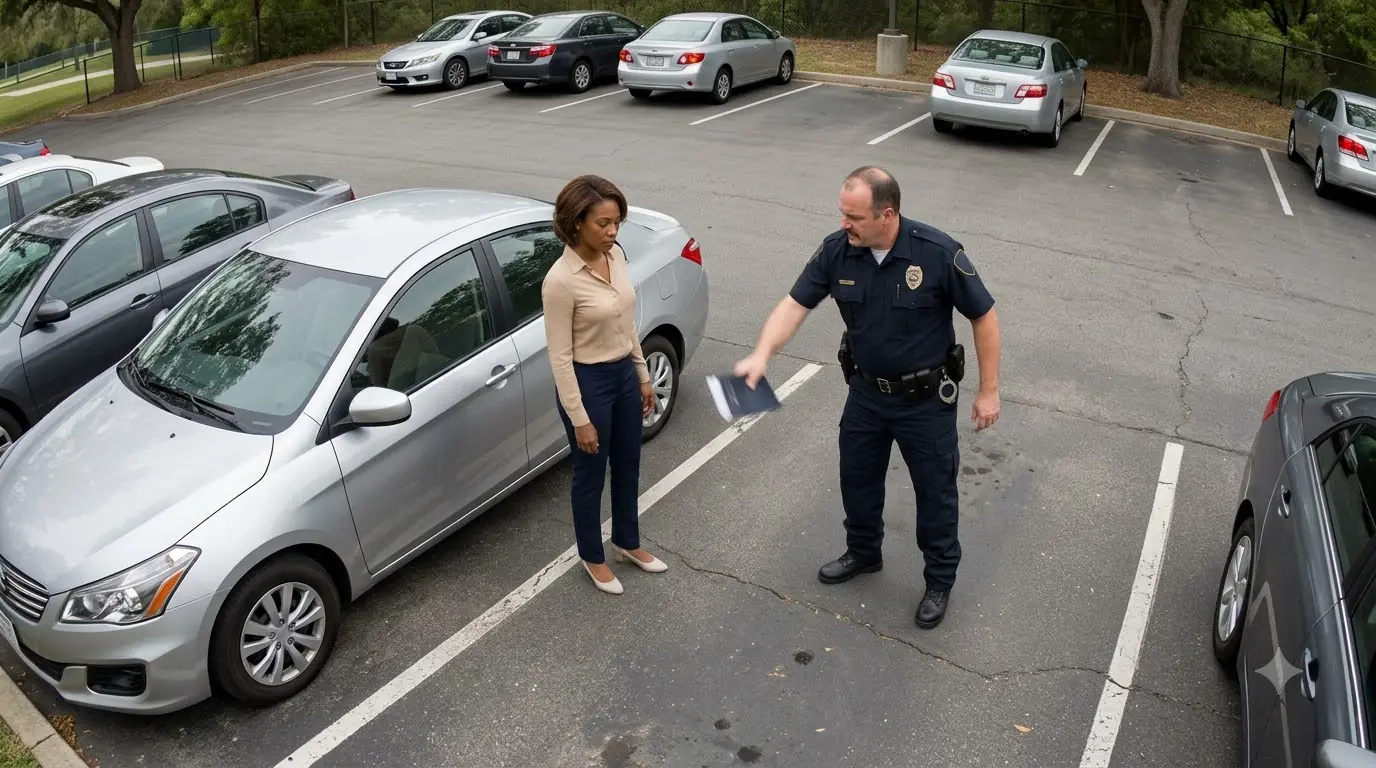
Still, it was her day off, and she had no interest in arguing over parking. She had enough arguments at work. She wore jeans, white sneakers, and a navy jacket over a plain T-shirt. Her police badge was clipped inside her jacket, hidden from view, because she had promised herself that she was off duty unless someone truly needed help.
She stepped out of her car, locked it, and reached for her canvas shopping bag from the passenger seat. That was when a voice snapped behind her.
“Excuse me, miss. Where do you think you’re going?”
Patricia turned.
A man stood near the back of her car with his hands planted on his hips. He was somewhere in his mid-thirties, broad but soft around the middle, with shiny black shoes, dark sunglasses, and a stiff navy shirt that looked like it had come from a costume rack. A silver badge hung from his chest, slightly crooked. A pair of handcuffs dangled from his belt, though the chain between them looked too bright, too new. A plastic-looking radio clipped to his shoulder had no visible cord, no proper microphone, and no department markings.
Patricia looked at him once, then at the sign, then back at him.
“Are you talking to me?” she asked.
“Well, I don’t see anyone else around,” he said, making the words heavier than they needed to be. “You can’t park there.”
Patricia kept her expression calm. “Why not?”
“Those spaces are reserved for employees only.”
“Since when?”
He pointed sharply at the crooked sign. “Since the sign went up. Didn’t you see it? It clearly says employees only.”
Patricia glanced at the sign again. The tape was fresh. The paper had no city seal, no property management logo, no warning about towing, no reference to any ordinance, and no official formatting. A private property sign could be informal, but this one looked less like a rule and more like a threat someone had invented.
“I’ve never seen that before,” she said.
“Well, it says it now.”
“That’s fine. I’ll just move my car.”
The man stepped forward, pleased with himself. “I’m afraid it’s too late for that.”
“Yes. I’m going to need to write you up.”
“Write me up?”
He pulled a small pad from his shirt pocket and clicked a pen with theatrical seriousness. “You illegally parked your vehicle, ma’am. Now I need to issue a citation.”
Patricia looked at him for a long second. “Seriously?”
“Does it look like I’m joking?”
The answer was yes. Everything about him looked like a joke, but not the harmless kind. It looked like the kind of joke that could turn dangerous if the wrong person believed it.
Patricia took one step closer, not aggressively, just close enough to study the badge. It had the word POLICE stamped across it, but the engraving was shallow and uneven. Underneath, in smaller letters, it appeared to say Lieutenant Daniels. No city. No county. No badge number. No department.
“Are you okay?” she asked.
His face tightened. “Excuse me?”
“Are you some kind of mall cop?”
His cheeks flushed red. “No, I am not some stupid mall cop. I’m a police officer. Lieutenant Daniels. Now, if you’ll follow me, please.”
Patricia’s eyes stayed on his badge. “Lieutenant Daniels?”
“Yes.”
“Which department are you with?”
“The Maine Police Department.”
Patricia nearly smiled. They were not in Maine. They were in Mingle Park, Florida, on a humid Saturday afternoon with palm trees bending over the plaza and traffic crawling down Cypress Avenue. But she let him continue.
“The Maine Police Department,” she repeated.
“Yeah.”
“Which precinct?”
He blinked. “What?”
“Which precinct are you assigned to?”
“The department downtown.”
“What’s the precinct number?”
“What’s with all the questions?” he snapped. “You need to follow me so I can write you up.”
Patricia adjusted the strap of her shopping bag. “That’s not going to happen.”
The man stared at her as if she had broken a rule he had just invented. “Excuse me?”
“Let me tell you something,” Patricia said. Her voice remained even, but the warmth had left it. “I’m a police officer. Officer Patricia Taylor. Mingle Park Police Department.”
For the first time, uncertainty cracked his performance. His eyes moved quickly over her jacket, her face, her hands. He swallowed once, then forced a smile.
“Oh,” he said. “Well. Surely I can let this one slide for a fellow officer of the law. You know how it is. Us blue bloods have to watch out for one another.”
Patricia nodded slowly. “Sure. And since you’re with the downtown department, you must know Commander Woodford.”
His face brightened with false recognition. “Commander Woodford? Yes, of course.”
“And Detective Beam?”
“Detective Beam, absolutely. I’ve known him for years. We go way back.”
Patricia folded her arms. “Wonderful. I’ll be sure to say hello to them for you.”
“Yeah, yeah,” he said quickly. “You do that.”
“I’m just wondering how I’m supposed to say hello to them when I made them both up.”
His smile vanished.
Patricia continued before he could recover. “Commander Woodford. Detective Beam. Those are whiskey names, just like Lieutenant Daniels. What’s your first name? Jack?”
“It’s John,” he muttered.
“Of course it is.”
His hands curled into fists. “Look, you don’t know what you’re talking about.”
“I know exactly what I’m looking at.” Patricia pointed toward his shirt. “That patch is sewn on crooked. That radio isn’t connected to anything. Your cuffs look like they came from a novelty store. Your badge has no department, no badge number, and no proper seal. And you just claimed to work for a department that doesn’t exist here.”
His face twisted with anger. The act was gone now. What remained underneath was smaller, meaner, and more dangerous.
“Fellow officer or not,” he said, grabbing for the handcuffs on his belt, “I’ve had enough. You are under arrest.”
Patricia stared at him. “You cannot be serious right now.”
“Oh, I’m as serious as a heart attack.”
He lunged toward her wrist.
Patricia moved faster.
She stepped aside, caught his arm, turned his momentum, and pinned his wrist behind his back before he had time to understand what had happened. The cheap handcuffs clattered onto the pavement. He cried out, half from pain and half from embarrassment. A woman walking out of the grocery store froze with a carton of eggs in her arms. A teenager near the bike rack raised his phone and started recording.
“Let go of me!” the man shouted. “You can’t do this!”
Patricia held him firmly but did not slam him to the ground. “Stop resisting.”
“I am a police officer!”
“No,” Patricia said. “You are a man wearing a costume.”
He tried to twist free. Patricia tightened her grip just enough to remind him that pretending to be law enforcement and physically resisting a real officer were two very different mistakes.
“With my left hand,” she said calmly, “I am reaching for my badge.”
She pulled it from inside her jacket and held it where he could see it.
“This is a real badge,” she said. “These are real handcuffs.” She unclipped her own cuffs with one hand. “And this is a real arrest.”
His breathing quickened. “Wait. Wait, we can talk about this.”
“We already did.”
“Look, I was just trying to keep people from parking where they shouldn’t.”
“No, you were detaining people without authority, pretending to issue citations, and attempting to arrest someone while impersonating a police officer.”
The woman with the eggs whispered, “Oh my goodness.”
The teenager recording said, “This is wild.”
Patricia secured the man’s wrists behind his back. “What is your real name?”
He said nothing.
“Let me guess,” she said. “Johnny Walker?”
A few bystanders laughed. The man glared over his shoulder.
“Shut up.”
“My mistake,” Patricia said. “Maybe Jose Cuervo.”
“That’s not funny.”
“It’s a little funny.”
His anger flared again. “I want my lawyer.”
“You can call your lawyer after processing.”
“I have the best attorney in the state.”
“Of course you do.”
“I’ll have your badge for this.”
Patricia looked down at him with a tired smile. “You should probably focus on keeping yourself out of prison first.”
She moved him toward the curb, away from traffic, then called dispatch.
“This is Officer Taylor,” she said into her phone. “I’m off duty at Maple Plaza, rear employee lot. I have one adult male in custody for impersonating a law enforcement officer and attempted unlawful detention. I need an on-duty unit for transport.”
The dispatcher recognized her voice immediately. “Are you safe?”
“I’m fine. Subject is secured.”
“Any injuries?”
“None reported.”
“What’s the suspect’s name?”
Patricia looked at him. “We’re still working on whether he’s Jack, John, or Daniels.”
The dispatcher paused, then said, “Copy that.”
Within minutes, two marked patrol cars rolled into the lot. Officer Sanchez stepped out first, shaking his head before he even reached Patricia.
“I thought you were supposed to be off today,” he said.
“I was,” Patricia replied. “He ruined it.”
Sanchez looked at the man in costume. “This is the guy?”
“This is Lieutenant Daniels from the Maine Police Department downtown.”
Sanchez lifted one eyebrow. “That’s impressive. I didn’t know Maine opened a downtown precinct in Florida.”
The second officer, Lewis, walked around the suspect and inspected the fake uniform. “Badge looks like something from a Halloween clearance bin.”
“It’s real,” the man snapped.
Lewis looked at Patricia. “Please tell me he didn’t say that to you.”
“He said a lot of things.”
Sanchez searched the suspect properly while Lewis photographed the fake badge, handcuffs, radio, and the crooked employee-only sign. In the man’s pocket, they found a stack of printed warning notices. Each one demanded a two-hundred-dollar parking compliance fee payable through a payment app under the name Daniels Security Services. Another pocket held three cash receipts from people who had apparently already paid him to avoid being “cited.”
Patricia’s expression darkened.
“This wasn’t just dress-up,” she said.
“No,” Sanchez answered. “This was a scam.”
The suspect, whose real name turned out to be Ryan Kessler, immediately started talking over himself.
“I didn’t force anyone to pay,” he said. “I just warned them. They chose to pay. That’s not illegal.”
Sanchez stared at him. “You pretended to be a police officer.”
“I never said city police.”
“You said Maine Police Department,” Patricia reminded him.
“I meant main, like main security. Main police. Like the main authority in the lot.”
Lewis laughed once. “That is the worst explanation I’ve heard all week.”
Ryan turned on Patricia. “This is entrapment.”
“I was buying groceries,” she said.
“You tricked me with fake names.”
“You lied first with a fake badge.”
He looked toward the growing group of bystanders as if searching for sympathy. None appeared.
An older man came out of the pharmacy and pointed at Ryan. “That’s him. He made me pay fifty dollars last month because he said my handicap placard was hanging wrong.”
A young woman holding a toddler stepped forward. “He threatened to tow my car two weeks ago. Said he had police authority.”
A delivery driver raised his hand. “He stopped me behind the pizza place and said I needed a commercial access permit. I paid him twenty-five dollars.”
The story expanded with every voice.
Ryan had been haunting Maple Plaza for weeks, appearing in different parts of the parking lot with his fake badge and stiff authority. He had targeted elderly shoppers, delivery drivers, young women, immigrants, and anyone who looked too nervous to challenge him. He never stayed long. He never approached the store managers. He used confusion as a weapon and fear as a uniform.
Patricia listened as the complaints came forward. Her irritation cooled into something more serious. This was not merely a foolish man pretending to be important. This was a predator who had discovered that people obey badges before they read them.
Sanchez placed Ryan in the back of the patrol car.
“You can’t do this to me,” Ryan said through the open door. “I’m not some criminal.”
Patricia leaned slightly toward him. “You used the trust people have in law enforcement to scare them out of their money. That makes it worse, not better.”
Ryan’s mouth opened, but no clever answer came out.
Sanchez closed the door.
At the station, the case became larger than anyone expected. Detectives found that Ryan had ordered fake badges, uniform shirts, toy radios, and novelty handcuffs online. They found social media posts where he bragged about “keeping order” at shopping centers. They found payment app records showing dozens of small transfers from people he had intimidated. Some notes attached to the payments read parking fine, police warning, lot citation, and please do not tow.
Most victims had never reported him because they were embarrassed. A few had suspected something was wrong but decided paying twenty or fifty dollars was easier than risking arrest or towing. One elderly woman admitted she cried after giving him cash because she thought she had broken a law and would lose her license.
That detail bothered Patricia most.
She visited the woman herself two days later. Her name was Mrs. Alvarez, and she lived three blocks from the plaza in a small house filled with plants and framed photographs of grandchildren. She apologized three times before Patricia even sat down.
“I should have known,” Mrs. Alvarez said.
“No,” Patricia answered. “He should not have used fear against you.”
“He looked official.”
“That was the point.”
Mrs. Alvarez’s hands trembled around her teacup. “I felt stupid.”
“You weren’t stupid. You were respectful to someone you believed had authority. He abused that.”
That visit changed how Patricia thought about the case. At first, she had joked because Ryan had been ridiculous. The whiskey names, the fake department, the toy handcuffs, the crooked sign. But the damage behind the ridiculousness was real. People had been frightened. People had been humiliated. People had handed over money because Ryan borrowed the shape of authority and used it like a weapon.
The district attorney charged Ryan with impersonating a law enforcement officer, attempted unlawful detention, fraud, and theft by deception. More charges followed as victims came forward. The payment app records made the pattern clear. The videos from the plaza made the intimidation clear. Patricia’s body of testimony made the moment of arrest clear.
Ryan’s attorney tried to argue that he was merely acting as private security. That argument collapsed quickly. He had no security license, no contract with Maple Plaza, and no authority from any business on the property. The property manager testified that he had never met Ryan and never authorized any parking enforcement. The fake employee-only sign had not come from plaza management. Ryan had printed it himself.
When prosecutors played a bystander’s video in court, the room grew quiet. It showed Ryan squaring his shoulders in front of Patricia, claiming to be Lieutenant Daniels, pretending to know imaginary officers, then trying to arrest her after she exposed him. The video would have been funny if the rest of the case had not been so ugly.
Ryan accepted a plea agreement. He avoided the maximum sentence but did not avoid accountability. He received probation, community service, restitution to the victims, and a permanent prohibition from possessing or using any law-enforcement-style equipment. He also had to write apology letters to the people he had intimidated, though Patricia suspected the letters meant less than the restitution checks.
Maple Plaza changed afterward.
The property manager installed clear official parking signs with the plaza logo and a phone number for questions. Store managers trained employees to report suspicious enforcement activity immediately. Officer Sanchez helped organize a community information session at the plaza about how to verify a real officer’s identity, when to call dispatch, and how to report impersonation safely.
Patricia attended, though it was supposed to be another day off.
Mrs. Alvarez came. So did the delivery driver, the young mother, and several people who had paid Ryan without telling anyone until after his arrest. Patricia stood near the front of the small crowd, holding her badge in one hand and her identification card in the other.
“A real officer should be able to identify their department,” she explained. “They should have a badge number, an agency, and a supervisor you can contact. If something feels wrong, you can call dispatch and verify. Do it calmly. Do it safely. But do it. Real authority does not need fake confusion to work.”
A teenager in the front row raised his hand. “What if they get mad when you ask?”
Patricia thought about Ryan’s face when she asked which precinct he belonged to.
“Some might,” she said. “But a real professional understands why trust matters. And if someone wearing a badge gets angry because you ask basic questions, that is exactly when you should pay attention.”
After the session, Sanchez walked beside her through the parking lot.
“You know,” he said, “only you could go grocery shopping and come back with a felony arrest.”
Patricia laughed. “I didn’t even get the groceries.”
“You want to try again?”
She looked around the lot. New signs stood straight on metal posts. Shoppers moved through the afternoon without fear. Mrs. Alvarez waved from near the pharmacy door. The flower seller lifted two fingers in greeting. The crooked fake sign was gone.
“Maybe tomorrow,” Patricia said.
Sanchez grinned. “Day off?”
“Supposedly.”
A week later, Patricia finally returned to Maple Plaza with no incident. She parked in a proper customer space, bought coffee, picked up groceries, and stopped at the bookstore. On her way back to the car, she noticed a man standing too close to a young delivery driver near the alley.
For half a second, her body prepared itself for trouble.
Then the man laughed and handed the driver a forgotten bag of takeout.
Everything was fine.
Patricia kept walking.
Near her car, the plaza manager had installed one final sign beside the employee entrance. It was professionally printed, bolted into place, and impossible to confuse with Ryan’s paper threat.
AUTHORIZED PARKING ENFORCEMENT IS HANDLED BY PROPERTY MANAGEMENT ONLY.
IF SOMEONE CLAIMS TO BE POLICE, YOU MAY CALL DISPATCH TO VERIFY.
Patricia smiled at it.
Authority, she knew, was not a costume. It was not a badge bought online, a fake title, or a voice made loud enough to frighten strangers. Real authority carried responsibility. It invited accountability. It told the truth when questioned because truth could survive questions.
Ryan had wanted the power of a uniform without the duty that came with it.
He had chosen the wrong parking lot.
More importantly, he had chosen the wrong woman.
Patricia placed her groceries in the trunk, got behind the wheel, and started the car. As she pulled out, Mrs. Alvarez crossed the sidewalk and called after her.
“Officer Taylor!”
Patricia rolled down her window.
“Yes, ma’am?”
Mrs. Alvarez smiled. “You parked correctly today.”
Patricia looked at the space, then back at her.
“I was hoping someone would notice.”
They both laughed.
For once, Patricia drove home on her day off with nothing dramatic in the rearview mirror. No fake lieutenant. No crooked badge. No paper sign taped to a post.
Just a parking lot a little safer than it had been before, and a community that knew the difference between someone demanding trust and someone who had earned it.