Blood ran between the boards of Silas Pendleton’s porch and disappeared beneath the freezing rain.
By morning, there would be almost no trace of it.
The storm would wash the wood clean. The wind would scatter the leaves that had caught against the steps. Mud would cover the tire marks on the road below.
But Silas would remember every drop.
At seventy-two, he had believed the part of his life involving blood had ended for good.
He had spent four years as a combat medic in Vietnam, where young men called for their mothers beneath monsoon rain and helicopters carried away those lucky enough to still be breathing. After returning home, he worked thirty years as a trauma nurse in one of Chicago’s busiest emergency rooms.
He knew what a body sounded like when it was failing.
He knew how fear changed a person’s eyes.
He knew the terrible silence that came after a doctor stopped trying.
By the time he retired, Silas had seen enough pain for several lifetimes.
Then Helen became ill.
His wife had been the one person who could pull him back from the memories he carried. She had stayed with him through the nightmares, the long shifts, and the years when he spoke more easily to dying strangers than to the woman waiting for him at home.
Pancreatic cancer took her in eleven months.
Five years after her death, Silas still sometimes reached toward her side of the bed before remembering the truth.
He sold their home, gave most of the furniture to his daughter, and moved to a cabin deep in northern Arizona’s Coconino National Forest.
The nearest town was nearly an hour away.
His closest neighbor lived fourteen miles down a dirt road that became almost impassable during winter storms.
Silas powered the cabin with solar panels, a generator, and stubbornness. He grew vegetables in summer, cut his own firewood, and drove into town only when supplies ran low.
His only constant companion was Barnaby, a three-legged golden retriever Silas had found injured beside a highway.
Barnaby understood silence.
That was one reason they got along.
On the night of October 14, a storm rolled over the mountain with unusual violence.
Wind screamed between the ponderosa pines. Branches struck the cabin roof. Freezing rain battered the windows so hard it sounded like handfuls of gravel being thrown against the glass.
The generator had failed shortly after midnight.
Silas sat beside the fireplace reading an old western novel by the light of a kerosene lamp. Barnaby slept near his boots, his remaining back leg twitching whenever thunder shook the floorboards.
At 1:42 in the morning, the dog raised his head.
Silas continued reading.
Barnaby’s ears turned toward the front door.
A low growl came from his chest.
“What is it, old boy?”
The dog stood.
His fur lifted along his spine.
Then someone struck the front door.
Not a polite knock.
A heavy, desperate impact rattled the oak frame.
Silas put down the book.
Another blow came.
Then a woman screamed.
Barnaby began barking.
Silas crossed the room quickly and pulled back the deadbolt.
The door flew inward beneath the wind.
A young woman collapsed across the threshold.
She wore a black leather motorcycle jacket over a white maternity shirt. Her blond hair was plastered against her face. Her skin looked almost gray beneath the porch light.
Blood covered the front of her body.
“Help me,” she whispered.
Then her knees gave way.
Silas caught her beneath the arms before her head struck the floor.
The cold air carried the smell of wet leather, mud, and copper.
Blood.
A great deal of it.
“They’re coming,” the woman gasped.
Silas kicked the door shut and locked it.
“Barnaby, back.”
The dog retreated toward the fireplace but did not stop growling.
Silas dragged the woman away from the entrance and lowered her onto the rug. He crossed to a cabinet beside the kitchen and pulled out the canvas trauma bag he had carried for decades.
He kept it stocked because isolated places punished people who believed emergencies happened only to others.
When he knelt beside the woman, the old part of him returned.
Not the grieving widower.
Not the retired man who spoke to a three-legged dog.
The medic.
His hands became steady.
His voice lost all hesitation.
“My name is Silas. Can you hear me?”
The woman’s eyelids fluttered.
“Chloe.”
“Chloe, stay with me. Where are you hurt?”
She touched the right side of her chest.
“My baby.”
Silas opened the oversized jacket.
Only then did he see the full curve of her abdomen.
She was pregnant.
At least seven months.
The blood did not appear to be coming from the pregnancy. It spread from a jagged wound beneath her right collarbone.
Silas cut away the fabric.
The edges of the shirt were scorched.
Gunshot wound.
Close range.
He checked beneath her shoulder and found an exit wound near the shoulder blade.
The bullet had passed through.
That was both good and bad.
There was no round trapped inside her body, but the bleeding remained severe.
“Who shot you?”
“Black SUV.”
Her teeth chattered.
“They ran me off the road.”
Silas placed a thick trauma dressing against the entry wound and pressed down.
Chloe screamed.
“I know,” he said. “I know it hurts. Keep breathing.”
She grabbed his wrist.
“Don’t let my baby die.”
“I’m not planning to let either of you die.”
Silas applied another dressing to the exit wound, wrapped a compression bandage around her shoulder, and checked her pulse.
Fast.
Weak.
Her body was entering shock.
He covered her with blankets and raised her legs.
As he worked, the jacket slipped farther open.
A large patch covered its back.
A silver wolf’s skull beneath black wings.
Above it were the words:
NIGHT REAPERS
Below it:
ARIZONA CHARTER
Silas recognized the symbol.
The Night Reapers were one of the largest outlaw motorcycle organizations in the Southwest. News reports connected various chapters to weapons trafficking, extortion, and violent feuds, though members publicly described themselves as a brotherhood unfairly targeted by law enforcement.
On the jacket’s front was a smaller patch.
PROPERTY OF THOMAS “IRON” CALLAHAN — PRESIDENT
Silas knew that name too.
Thomas Callahan led the Arizona charter.
Stories about him moved through the region like desert wind. Some described him as a criminal who controlled routes from Phoenix to the northern border. Others spoke of charity rides, missing-child searches, and families quietly receiving money after fires or funerals.
All stories agreed on one point.
Callahan protected his people with frightening intensity.
Silas looked at the wounded woman.
“You’re Thomas Callahan’s wife?”
Chloe’s eyes opened.
“Don’t call him.”
“Wasn’t planning to.”
“They’ll trace me.”
“Who?”
“The men who shot me.”
She coughed.
A small spot of blood appeared near her lips.
Silas listened to her lungs.
Breath sounds on the right side were weaker, but present.
The bullet might have grazed the upper lung.
He needed a hospital.
The landline was dead.
His radio received only static.
The storm had blocked the road and likely taken down the cell tower.
Silas glanced toward the windows.
“How far did you walk?”
“I don’t know.”
“Where’s your vehicle?”
“Below the ridge.”
“Anyone following?”
“Yes.”
The answer came immediately.
No uncertainty.
Silas checked the wound again.
The dressing was holding.
Then Chloe’s body stiffened.
She grabbed the sides of her abdomen and cried out.
Silas placed a hand against her stomach.
The muscles had become hard.
“Contraction?”
She shook her head frantically.
“No. Too early.”
Another wave seized her.
When it passed, Chloe stared down at the blanket beneath her.
The fabric was wet.
Her face filled with terror.
“My water broke.”
The grandfather clock struck two.
Silas closed his eyes for one brief moment.
Gunshot wound.
Blood loss.
Hypothermia.
Premature labor.
No power.
No ambulance.
Armed men somewhere on the mountain.
He had handled worse combinations.
Just not at seventy-two.
“Chloe, I’m going to move you to the table.”
“I can’t.”
“You can, and you will.”
Silas lifted her carefully.
Pain had made her light, almost weightless in his arms.
He carried her to the heavy oak dining table and covered it with clean sheets.
He built the fire higher and hung blankets over the windows so the light would not escape into the forest.
Then he boiled water on the wood stove, opened sterile instruments, and began preparing for a delivery he hoped would not come soon.
Between contractions, Chloe spoke in broken sentences.
Her husband’s club had forced a rival criminal organization known as the Navarro Syndicate out of several smuggling routes near Flagstaff. The syndicate avoided attacking the Night Reapers directly.
Instead, it targeted their families.
Chloe had been driving home from a prenatal appointment in Phoenix when a black SUV began following her on Route 89.
At first, she thought the driver wanted to pass.
Then bullets struck the rear window.
She accelerated.
The SUV hit her vehicle from the side and pushed her toward the edge of the mountain road.
Her car broke through a barrier and rolled down an embankment.
Chloe survived because the vehicle landed against several trees before reaching the ravine.
She crawled from the wreckage while the men searched above.
One found her and fired.
The bullet passed through her shoulder.
She rolled into the darkness and played dead until the men moved away.
Then she climbed.
She followed the glow from Silas’s porch light through the storm.
“Tommy gave me a satellite beacon,” she said.
Her hand moved weakly toward a device clipped near her belt.
“I pressed it after the crash.”
“Did it transmit?”
“I don’t know.”
Silas examined the communicator.
A red indicator flashed.
Either the signal had gone out or it was still trying.
“Your husband will look for you.”
“If the syndicate doesn’t find me first.”
Another contraction struck.
Chloe screamed and gripped the table.
Silas counted the seconds.
They were becoming closer.
The baby had decided not to wait.
“Listen to me,” he said when she could breathe again. “You are injured, but the bullet missed the largest vessels. The bleeding is slowing. Your child is early, but not impossibly early.”
“What if he can’t breathe?”
“Then I help him breathe.”
“What if I start bleeding again?”
“Then I stop it again.”
“How can you know?”
Silas looked into her eyes.
“I don’t know. But panic won’t improve our odds.”
Barnaby growled.
Silas turned.
The dog stared at the front wall.
His ears pointed toward something beyond the storm.
Silas could hear only wind.
Then a faint mechanical rumble reached the cabin.
An engine.
Moving slowly along the muddy driveway.
Silas covered Chloe with another blanket.
“Don’t make a sound.”
Her eyes widened.
“They found me.”
Silas opened the drawer beneath the kitchen counter and removed an old Colt 1911.
The pistol had been with him since the 1970s. He rarely touched it except to clean it.
Tonight, it felt familiar in his hand.
He approached the front window and lifted one corner of the blanket.
Two white headlights moved through the trees.
A black SUV appeared beyond the porch.
It stopped with the engine running.
Two men got out.
Both wore dark raincoats too expensive for the wilderness.
One held a powerful flashlight.
The other carried a compact firearm beneath his coat.
Silas checked the pistol’s chamber.
Then he went outside.
The wind struck him immediately.
Freezing rain soaked his flannel shirt and gray hair.
He kept the Colt behind his back.
The man with the flashlight aimed it at Silas’s face.
“Evening, old timer.”
Silas squinted as though confused.
“You boys selling something?”
The second man scanned the porch.
“We’re looking for a woman.”
“That so?”
“Blond. Pregnant. She had an accident down the road.”
“Sounds like she needs a hospital.”
“We’re trying to help her.”
Silas cupped one hand behind his ear.
“What?”
The man with the flashlight stepped closer.
“We asked whether you’ve seen a woman.”
Silas allowed his shoulders to sag.
“Only woman who’s been here in years was my wife. She’s dead.”
The flashlight moved over the porch.
Most of Chloe’s blood had washed between the boards.
A pale pink streak remained near the door.
The man noticed it.
“What’s that?”
Silas looked down.
“Blood.”
Both men became still.
Silas scratched his cheek.
“Cleaned a deer yesterday.”
“In the middle of the porch?”
“I’m old. I do foolish things.”
The armed man moved toward the steps.
“We’re going to look inside.”
“No.”
The man smiled.
“That wasn’t a request.”
He placed one boot on the first stair.
Silas brought the Colt from behind his back.
The muzzle pointed directly at the man’s chest.
The old, confused widower disappeared.
Silas stood straight.
His hands did not tremble.
“You take another step with that weapon,” he said, “and I’ll put two rounds through your heart before your friend drops that flashlight.”
The men froze.
Rain ran from the Colt’s barrel.
The armed man studied Silas’s stance.
Noticed his grip.
His breathing.
His eyes.
“You military?”
“Once.”
“You’re making a mistake.”
“I’ve made many. This won’t be one of them.”
The flashlight shifted toward Silas’s face again.
“Move that light,” Silas said.
The man lowered it.
The armed attacker stepped backward from the stairs.
“Whoever she is, she’ll die without help.”
Silas said nothing.
The man with the flashlight smiled coldly.
“If she came here, we’ll find out.”
They returned to the SUV.
Silas kept the weapon raised until the vehicle disappeared down the mountain.
He remained on the porch for another thirty seconds.
Then he heard Chloe scream from inside.
“Silas!”
He rushed back into the cabin.
Chloe gripped the edge of the table.
“The baby’s coming.”
The next four hours passed without shape.
There was no past.
No future.
Only the immediate problem in front of him.
Blood pressure.
Breathing.
Contractions.
Temperature.
The child’s position.
Chloe’s pulse.
Silas moved between the gunshot wound and the delivery, adjusting the compression bandage when the bleeding increased and coaching her through each contraction.
“You need to push.”
“I can’t.”
“You already are.”
“I’m too tired.”
“Then be tired after.”
She screamed at him.
Cursed him.
Begged him.
Silas accepted all of it.
He had heard soldiers curse medics for saving them.
He had heard mothers swear they would never forgive nurses who told them to push.
Pain needed somewhere to go.
He allowed himself to become its target.
Near dawn, the child’s head appeared.
Silas worked carefully.
One more push.
Then another.
At 5:48 in the morning, a baby boy entered the world inside a remote cabin while the final thunder rolled away across the mountains.
For one terrible second, the child made no sound.
Silas cleared his airway.
Rubbed his back.
Gave two gentle breaths.
“Come on,” he whispered.
The baby coughed.
Then cried.
The sound filled the cabin.
Chloe began sobbing.
Silas wrapped the child in a warm towel and placed him against her chest.
“He’s small,” she said.
“He’s angry.”
“Is that good?”
“It’s excellent.”
The newborn’s cry grew stronger.
Chloe kissed his forehead.
Silas tied and cut the cord.
Then he checked her shoulder again.
The bleeding remained controlled.
Her color was still poor, but she was conscious.
Against every reasonable expectation, both mother and child were alive.
“What should I name him?” Chloe asked.
Silas sank into a chair.
“That decision is above my pay grade.”
She looked toward him.
“What was your wife’s name?”
“Helen.”
Chloe smiled faintly.
“If he had been a girl…”
“Don’t name your child after people you met while bleeding.”
She laughed once, then winced.
“What about Samuel?”
“Why Samuel?”
“My grandfather.”
“Sounds safer.”
Silas leaned back.
Exhaustion pressed against him like deep water.
For the first time all night, he allowed his eyes to close.
The peace lasted less than an hour.
At seven, Barnaby stood and began whining.
Cups rattled inside the cabinet.
The cast-iron skillet vibrated on the stove.
Silas opened his eyes.
The floor trembled.
At first, he thought it was an earthquake.
Then he recognized the rhythm.
Engines.
Not one.
Many.
The sound grew until the windows shook.
Silas crossed the room and pulled back the blanket.
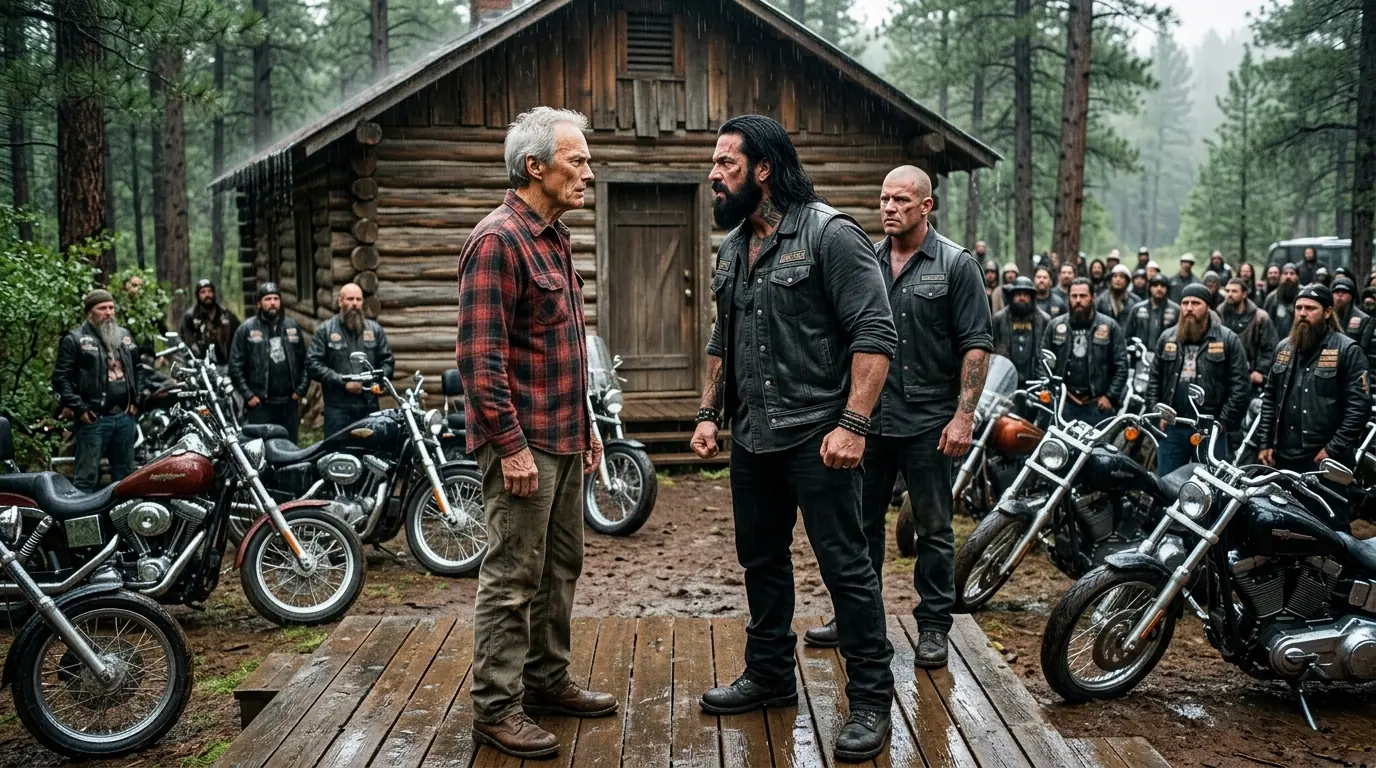
Motorcycles filled the mountain road.
They emerged between the pines in long, disciplined lines. Black leather. Chrome. Headlights. Club patches.
Hundreds of machines climbed toward the cabin.
The ground itself seemed to move beneath them.
There were motorcycles across the driveway, beside the trees, and along the edges of the clearing.
Silas stopped counting after two hundred.
More continued arriving.
Later, someone would say nearly eight hundred members from multiple Night Reapers chapters answered the emergency call.
At that moment, the exact number did not matter.
It was an army.
At the front rode Thomas Callahan.
He was enormous, even seated on the motorcycle. A thick black beard covered most of his face. Tattoos climbed his neck. A president’s patch marked the front of his leather vest.
He stopped twenty yards from the porch.
The engines behind him shut off in waves.
Silence returned to the forest.
Then hundreds of boots touched the ground.
Callahan dismounted.
A revolver hung in his right hand.
Behind him, two bikers dragged a man from the back of a van.
Silas recognized the raincoat.
The attacker who had carried the flashlight.
His face was swollen and bloody.
One eye had closed completely.
Silas looked toward Chloe.
She tried to sit up.
“Tommy?”
“Stay here,” Silas told her.
“He thinks you hurt me.”
“I know.”
Silas placed the Colt on the kitchen counter.
Walking outside armed would accomplish only one thing.
He opened the door and stepped onto the porch with empty hands.
Thomas Callahan moved toward him.
The bikers behind him watched in absolute silence.
Up close, Callahan’s anger seemed almost physical.
His eyes were dark and sleepless.
Mud covered his boots and jeans.
He had probably ridden through the storm all night.
“My wife’s beacon stopped transmitting near this cabin,” he said.
His voice remained low.
That made it more dangerous.
Silas nodded.
Callahan pointed toward the blood on the porch.
“We found her car below the ridge.”
Silas said nothing.
The captive attacker laughed weakly.
“I told you what happened.”
Callahan looked at him.
The man spat blood onto the ground.
“We chased her here. The old man got to her first. We heard her screaming inside.”
Callahan turned back toward Silas.
The revolver came up.
Its barrel pressed against the center of Silas’s forehead.
Hundreds of men shifted behind him.
Hands moved toward weapons.
“You have five seconds,” Callahan whispered, “to tell me where my wife is.”
Silas looked beyond the gun and into the man’s eyes.
He saw rage.
But beneath it, terror.
Not a gang president’s terror.
A husband’s.
“If I had killed her,” Silas said, “I wouldn’t have spent four hours delivering your son.”
Callahan’s breathing stopped.
The revolver lowered less than an inch.
“What did you say?”
“Your wife is alive.”
“You’re lying.”
“She was shot beneath the right collarbone. The bullet exited near the shoulder blade. She lost blood, went into premature labor, and delivered a boy shortly before six.”
Callahan stared at him.
Silas continued.
“I served as a combat medic and worked thirty years in emergency trauma. Now remove that weapon from my face, wipe the mud from your boots, and come meet your family.”
The revolver lowered.
A biker behind Callahan stepped forward angrily.
“You don’t talk to the president that way.”
“Boone,” Callahan said.
The biker stopped.
“Stand down.”
Callahan holstered the weapon.
His hands began shaking.
Silas noticed because he knew how much effort it took for a powerful man to allow others to see fear.
He opened the door.
Callahan entered.
The cabin looked like a battlefield.
Bloodstained towels lay near the dining table. Surgical instruments rested inside a metal bowl. The floor beneath the table remained dark with water and blood.
Callahan saw it and stopped.
For one second, the attacker’s lie returned to him.
Then the baby cried.
Callahan turned toward the fireplace.
Chloe lay on the sofa beneath several blankets. Her skin remained pale. An improvised IV line ran into her arm. A compression bandage covered her shoulder.
She held the newborn against her chest.
“Tommy,” she whispered.
Callahan’s face collapsed.
The man who had approached Silas with a revolver dropped to his knees.
He crossed the remaining distance without standing.
Chloe reached for him with her uninjured arm.
Callahan buried his face against her shoulder and began sobbing.
Not quietly.
Not with dignity.
With the helpless grief of someone who had spent the night certain his family was dead.
Chloe touched his hair.
“He saved us.”
Callahan looked toward Silas.
“The Navarro men ran me off the road,” Chloe said. “They shot me. I climbed here.”
Her voice weakened.
“Silas stopped the bleeding. They came back. He stood outside and made them leave.”
Callahan looked at the tiny child.
“Is he…”
“He’s early,” Silas said. “But his breathing is strong. Both of them need a hospital immediately.”
Callahan extended one finger.
The newborn wrapped his hand around it.
A strange stillness entered the room.
Silas had seen it before.
A grown man becoming quiet before a child too small to understand fear.
“What’s his name?” Callahan asked.
Chloe smiled.
“Samuel.”
Callahan nodded as though the name carried great weight.
Then he stood and crossed toward Silas.
Silas expected a handshake.
Instead, Callahan wrapped both arms around him.
The embrace nearly lifted Silas off the floor.
“I owe you everything,” Callahan said.
“You owe me new porch boards.”
Callahan pulled back.
Silas pointed toward the mud tracked across the cabin.
“And teach your friends to wipe their boots.”
For the first time, Callahan laughed.
The sound broke something loose inside the room.
He walked outside.
Hundreds of bikers waited.
Callahan raised both arms.
“She’s alive!”
The forest erupted.
Men shouted.
Helmets lifted into the air.
Motorcycles roared.
Some bikers embraced one another.
Others lowered their heads, overcome by relief.
“I have a son!” Callahan shouted.
The cheering grew louder.
Silas stepped onto the porch.
“Keep it down,” he called. “The baby just fell asleep.”
The cheering stopped almost immediately.
Nearly eight hundred outlaws stood in embarrassed silence.
Silas looked at Callahan.
“That’s better.”
A medical transport vehicle arrived within forty minutes, driven by a club member who had once worked as a paramedic. Two nurses came with him.
They stabilized Chloe and Samuel before transporting them to a secure hospital in Phoenix.
Before leaving, Callahan pressed a heavy brass coin into Silas’s palm.
A wolf’s skull appeared on one side.
The Arizona charter emblem marked the other.
“Any man wearing our patch will help you,” Callahan said. “Anywhere. Any time.”
Silas tried to return it.
“I don’t need an army.”
“You had one the moment you opened that door.”
Silas looked toward the hundreds of motorcycles covering his land.
“They’re destroying the grass.”
“I’ll replace it.”
“You’ll reseed it yourself.”
Callahan smiled.
“Yes, sir.”
The captive attacker was taken away in a separate vehicle.
Silas did not ask where.
He did not want to know.
What happened between the Night Reapers and the Navarro Syndicate during the following months became the subject of rumor throughout Arizona.
Warehouses were raided by federal agents after anonymous tips.
Trafficking routes collapsed.
Several syndicate leaders were arrested.
Others disappeared.
Silas read the reports without satisfaction.
He had spent too much of his life watching violence create reasons for more violence.
When Callahan visited the cabin three weeks later, Silas told him exactly that.
They sat on the porch drinking coffee while Barnaby slept between them.
“You saved my family,” Callahan said. “You can ask anything.”
“Then listen.”
Callahan did.
“If you turn what happened to Chloe into an excuse to fill more homes with widows, you learned nothing from it.”
Callahan stared into his coffee.
“These men tried to kill my wife and child.”
“I know.”
“What would you do?”
“I stood on this porch with a pistol.”
“Exactly.”
“To protect someone in immediate danger.”
Silas leaned forward.
“That is different from spending months feeding anger because it makes you feel powerful.”
Callahan’s jaw tightened.
“You don’t understand our world.”
“No.”
Silas looked toward the forest.
“But I understand revenge. I watched it swallow countries.”
Callahan remained silent for a long time.
“I can’t promise forgiveness,” he said.
“I didn’t ask for forgiveness.”
“What did you ask?”
“That you remember what your son’s first sound was.”
Callahan looked at him.
“A cry.”
“Life,” Silas said. “Not gunfire.”
Callahan carried those words away with him.
Silas never learned how much they changed.
Perhaps not enough.
Perhaps more than he expected.
What he did know was that the Night Reapers began appearing at his cabin every Sunday.
Never hundreds.
Usually two.
They brought groceries, dog food, medical supplies, and firewood.
Silas complained each time.
They came anyway.
When the generator failed during a January blizzard, six bikers arrived with an industrial replacement before the repair company returned his call.
When the porch roof began leaking, a club member who owned a construction business replaced it.
When Barnaby developed arthritis, a veterinarian from the Phoenix charter drove three hours to examine him.
Silas’s daughter visited in spring and found two enormous tattooed men splitting logs beside the cabin.
She stopped her car at the end of the driveway and called her father.
“Dad, there are bikers at your house.”
“I’m aware.”
“Should I call the police?”
“No.”
“What are they doing?”
“Arguing about the correct way to stack firewood.”
One of the men waved.
Silas’s daughter lowered the phone.
“Who are these people?”
Silas looked toward the brass coin hanging beside the door.
“Friends, apparently.”
Chloe and Samuel visited when the boy was six months old.
Chloe’s shoulder had healed, though she still lacked full movement in her right arm.
Samuel was healthy and loud.
Callahan carried him into the cabin with a tenderness that seemed impossible in such large hands.
Chloe stood on the rug where she had nearly died.
She looked toward the dining table.
Silas had cleaned it many times, but a faint dark stain remained near one leg.
“I remember the door,” she said.
“Which part?”
“Seeing the light.”
She touched Samuel’s cheek.
“I thought I was dying. Then I saw your porch light through the trees.”
Silas looked toward the kerosene lamp on the shelf.
“I almost didn’t light it that night.”
“Why?”
“Trying to save oil.”
Chloe smiled.
“Funny how small things decide everything.”
She gave Silas a framed photograph.
In it, Chloe sat beside Callahan holding Samuel. The child wore a tiny knitted cap. On the back she had written:
To the man who opened the door.
Silas placed the photograph beside one of Helen.
For years, he had believed saving lives belonged to an earlier version of himself.
A young medic beneath jungle rain.
A trauma nurse beneath fluorescent lights.
A husband who could not save his wife.
Helen’s death had convinced him that all his training had limits too cruel to accept.
He had moved into the wilderness because silence asked nothing from him.
Then Chloe arrived.
Bleeding.
Pregnant.
Terrified.
And his hands remembered.
Not only how to stop blood.
How to offer calm when another person had none.
How to stand between danger and someone who could not defend herself.
How to bring life into a room prepared for death.
One autumn evening, nearly a year after the storm, Silas sat on the repaired porch while Barnaby slept beside him.
A biker named Marcus stacked firewood near the shed.
He was covered in tattoos and wore the Night Reapers patch. In town, people moved away from him in grocery aisles.
At Silas’s cabin, he split wood with almost artistic precision.
Samuel’s photograph rested inside near the window.
The sun lowered between the pines.
“Marcus,” Silas called.
The biker stopped.
“Yes, sir?”
“You stacked the oak with the pine.”
Marcus looked at the woodpile.
“Is that bad?”
“Yes.”
“Why?”
“One burns longer.”
“Which one?”
Silas sighed.
“How long have you been doing this?”
“About three hours.”
“And you didn’t think to ask?”
“You told us not to bother you.”
Silas pushed himself from the chair.
“Move over.”
Together, the retired medic and the outlaw biker restacked the wood.
Barnaby watched them with mild disappointment.
The forest remained quiet except for the sound of logs and distant birds.
Silas had moved there to be alone.
Instead, one storm brought a wounded stranger to his door and tied his life to hundreds of people he would never otherwise have met.
He did not approve of everything they were.
They did not understand everything he had been.
But they brought groceries.
They repaired fences.
They remembered Helen’s birthday because Chloe had asked.
They came when snow blocked the road.
They called him when a rider’s child was injured and the parents needed someone calm on the phone.
Silas had saved two lives that night.
In return, he had gained something he never requested.
Not an army.
A family, though none of them used the word at first.
Months later, Callahan returned alone.
He sat beside Silas on the porch while the evening cooled.
“Samuel started crawling,” he said.
“Then your peaceful days are over.”
“He pulls everything from the shelves.”
“Good.”
Callahan looked toward the mountains.
“I think about that gun against your forehead.”
“So do I.”
“You weren’t afraid.”
“I was.”
“You didn’t look afraid.”
“That’s training.”
Callahan rubbed his beard.
“What would you have done if Chloe hadn’t cried from inside?”
“Told you the truth.”
“And if I didn’t believe you?”
Silas looked at him.
“You would have had to decide whether grief made you stupid.”
Callahan laughed quietly.
Then his expression became serious.
“I almost killed the man who saved everything I love.”
“Yes.”
“I can’t forget that.”
“Good.”
Callahan nodded.
The sun disappeared behind the trees.
After a moment, Silas said, “Your son’s first birthday is next month.”
“We’re having a party.”
“I don’t attend biker parties.”
“You’re the guest of honor.”
“No.”
“Chloe already decided.”
Silas sighed.
“Then why are you asking?”
“I’m learning manners.”
Silas looked down at Barnaby.
“Your friends better stay off the lawn.”
Callahan smiled.
On Samuel’s first birthday, more than three hundred motorcycles gathered at a rented ranch outside Flagstaff.
Silas attended wearing the same flannel shirt he had worn during the storm.
Chloe placed Samuel in his arms.
The boy grabbed Silas’s beard and refused to let go.
Around them stood men and women whom newspapers described with words like dangerous, violent, and feared.
That day, they watched a baby destroy a birthday cake with both hands.
Callahan raised a glass.
“To Silas Pendleton.”
Silas shook his head.
Callahan continued.
“The man who opened a door when he had every reason to keep it locked.”
The riders lifted their glasses.
Silas looked at Chloe.
At Samuel.
At the faces surrounding them.
Then he thought about Helen.
She would have laughed at the absurdity of it.
Her quiet husband standing before hundreds of bikers while a baby smeared blue frosting across his shirt.
Silas raised his coffee cup.
“To opening doors,” he said.
It was not a grand speech.
It was enough.
Years later, when Samuel was old enough to ask why an elderly man living alone in the forest had a photograph beside his grandmother’s portrait, Chloe told him the story.
She told him about the storm.
The crash.
The gunshot.
The porch light.
The old medic who carried her inside without asking who she was.
She told him how Silas stood against armed men and then brought Samuel into the world with nothing but experience, courage, and a trauma kit.
Samuel listened with wide eyes.
“Were all the motorcycles real?” he asked.
“Yes.”
“How many?”
“Too many.”
“Did Grandpa point a gun at Silas?”
Chloe hesitated.
“Yes.”
“Why?”
“Because fear can make good people dangerous.”
“Was Grandpa bad?”
“No.”
She thought carefully.
“He was afraid, and he was wrong.”
“Did Silas forgive him?”
“Silas made him restack firewood for three years.”
Samuel considered that.
“That sounds worse.”
Chloe laughed.
Then she pointed toward the photograph.
“Silas taught your father that strength is not the same as anger.”
“What did he teach you?”
She looked toward the old cabin visible in the distance.
“That sometimes the door you think is the end of the road is the beginning of your life.”
Silas Pendleton had moved into the wilderness believing the world had already taken everything meaningful from him.
He was wrong.
Meaning came pounding against his door in the middle of a storm.
It arrived covered in blood.
Terrified.
Carrying another heartbeat inside it.
And though the rain eventually washed the porch clean, Silas never forgot what remained after the storm.
A mother.
A child.
A man humbled by gratitude.
Hundreds of motorcycles fading down a mountain road.
And the quiet understanding that a life devoted to saving others did not end simply because the hands had grown old.