Two hundred forty-three motorcycles waited beneath the Arizona morning sun when Tyler Callahan arrived on his uncle’s rebuilt Shovelhead.
He had expected sixty riders.
Perhaps eighty if word traveled farther than Phoenix.
Instead, motorcycles filled the staging area beside Route 89 and stretched along the frontage road in rows of polished chrome, weathered leather, faded paint, and machines that had crossed more miles than anyone could count.
Arizona plates stood beside motorcycles from New Mexico, California, Nevada, Texas, Colorado, Utah, and one rider who had come all the way from Montana.
Some had known Roy Callahan for forty years.
Others had never met him.
They had come because they had heard what happened during the final days of his life.
Tyler guided the 1978 Harley-Davidson Shovelhead toward the front of the gathering.
The engine moved beneath him with a deep, uneven rhythm that seemed less like mechanical noise than a pulse.
Nine days earlier, the motorcycle had been rusted, cracked, silent, and covered beneath a sheet inside an abandoned garage.
Four professional mechanics had declared it beyond repair.
Now it idled beneath Tyler as if the seventeen years of silence had been no more than a long night.
A silver-haired woman wearing a Nevada chapter patch approached.
“You’re Roy’s nephew?”
“Yes, ma’am.”
She looked at the motorcycle.
“My name is Carol Reeves. I rode beside Roy during a Sedona rally in 1991.”
Tyler nodded.
“He mentioned that rally.”
“He remembered everybody.”
Her eyes moved toward the engine cases.
“This is the bike?”
“This is it.”
“I heard about the retired mechanic.”
“Walter Briggs.”
“Is he here?”
Tyler looked across the crowd.
Walter stood beside an old pickup with a battered metal toolbox resting near his boots. At seventy-two, he was tall, broad-shouldered, and carried himself with the disciplined posture of the Marine he had once been.
A line had already begun forming around him.
Riders approached one at a time.
They shook Walter’s hand.
They thanked him.
Walter gave nearly everyone the same answer.
“I did what anyone should have done.”
And each person answered in some version of the same way.
“No. You did what very few people actually do.”
Tyler watched another man step forward.
He had a gray beard reaching the center of his chest and wore an Arizona patch faded almost white from sunlight.
“I rode with Roy in seventy-nine,” the man told Walter. “I heard you spent four days on that bike.”
Walter nodded.
“There were other people.”
“I know.”
The rider held Walter’s hand a moment longer.
“But you came first.”
Walter did not know what to say to that.
He released the man’s hand and looked toward the Shovelhead.
Tyler understood.
Walter had not restored the motorcycle because he expected hundreds of people to know his name.
He had done it because a dying man wanted to hear one particular sound before leaving the world.
That was all.
The ride began at seven thirty.
When 243 engines started almost simultaneously, the desert seemed to shake.
Tyler led the procession north on Route 89.
The Shovelhead’s exhaust note moved ahead of the column, rough and deep, the unmistakable voice of an old Harley engine that had been built before computers, sensors, and electronic diagnostics.
Behind him, the road filled with riders.
Fifty miles later, they reached a mountain overlook known among Arizona bikers as Roy’s Corner.
A small metal plate had been attached to a weathered wooden post years earlier.
ROY CALLAHAN’S CORNER.
Tyler stopped the Shovelhead and looked toward the mountains.
For the first time since his uncle died, he stopped managing arrangements, telephone calls, hospital forms, funeral decisions, and the hundred administrative details created by death.
He simply allowed himself to miss him.
The riders gathered silently.
Then, somewhere near the center of the group, one motorcycle engine rose briefly.
A single turn of the throttle.
Another rider answered.
Then another.
The sound traveled through the gathering one motorcycle at a time.
Two hundred forty-three individual acknowledgments.
We remember you.
We rode with you.
You were here.
Tyler remained seated on the Shovelhead as his body began to tremble.
No one told him to control himself.
No one looked away.
In that community, grief was not considered weakness.
It was the price paid for having loved someone honestly.
When the final engine became quiet, Tyler placed one hand against the fuel tank.
The metal vibrated faintly beneath his palm.
He remembered how the bike had looked when he first pushed it into Briggs & Sons Motorcycle Repair.
Dead.
At least, that was the word every other mechanic had used.
Four days before Roy heard the engine run, Tyler had stood inside the repair shop with both hands clenched at his sides.
“I don’t care what it costs,” he said.
His voice cracked.
“I don’t care if every mechanic in Arizona says it’s finished.”
Marcus Webb, the shop’s head mechanic, remained beside the motorcycle.
Tyler continued.
“My uncle is dying. The doctors say three days, maybe four.”
No one in the shop moved.
“The last thing he asked for—the only thing he asked for—was to hear this engine run one more time.”
The 1978 Shovelhead stood inside the first repair bay like a grave marker that had not yet been engraved.
Its fuel tank was dull beneath dust.
The wiring had been chewed by rodents.
Rust covered the exhaust.
Old oil had hardened inside the engine.
A crack ran along the lower section of the left case.
Marcus crouched beside it.
He was forty-three and had spent most of his adult life repairing motorcycles other people considered impossible.
He had rebuilt old carburetors, fabricated unavailable parts, and kept machines running long after their manufacturers stopped supporting them.
Even Marcus remained silent longer than Tyler liked.
Finally, he stood.
“Who is your uncle?”
“Roy Callahan.”
Something moved across Marcus’s face.
Roy’s name carried weight in the Southwest motorcycle community.
He was a Vietnam veteran with two tours behind him and a Purple Heart he almost never mentioned. He began riding with the Phoenix chapter in the early 1970s and spent nearly fifty years earning a reputation not through noise, but through presence.
Roy organized fuel runs for stranded riders.
He appeared when someone needed money, tools, a ride home, or a person willing to sit beside a hospital bed through the night.
He rarely made speeches.
He simply came.
Now he was seventy-one and lying inside Desert Springs Hospital while doctors discussed time instead of recovery.
“He doesn’t know I brought the bike,” Tyler said. “He thinks it’s still in storage.”
Marcus rested one hand on the engine case.
“How long since it ran?”
“Seventeen years.”
A younger mechanic named Darnell Cruz walked around the motorcycle.
Darnell was twenty-six, confident enough to ask questions and still young enough to believe every problem must have a clear solution.
He pointed toward the engine.
“The carburetor is seized.”
“I see it,” Marcus said.
“The oil pump too.”
“I know.”
“And that crack—”
“I see the crack.”
Darnell looked toward Tyler.
“What happened to it?”
“Time.”
Marcus straightened.
“Leave it here.”
Tyler’s shoulders lowered slightly.
“Can you fix it?”
“I said leave it here.”
“That isn’t an answer.”
“It’s the only honest answer I can give today.”
Marcus looked toward the motorcycle.
“Give me until tonight to determine what we have.”
Tyler placed a card on the workbench.
“That’s my number.”
He walked toward the door, then stopped.
“My uncle asked me this morning whether I remembered the sound.”
Marcus looked at him.
“I said I did.”
Tyler lowered his eyes.
“I lied. I was too young the last time he rode it.”
He left the shop.
By sunset, Marcus had a list.
The carburetor required complete rebuilding.
The oil pump was mechanically seized.
The ignition points had corroded beyond use.
The primary chain had become brittle enough to break under pressure.
Most of the electrical harness needed reconstruction.
Then there was the engine case.
The crack measured two inches and showed signs of old oil seepage.
A replacement original case had not been manufactured in decades. An aftermarket case could possibly be adapted, but not within three days and not without introducing additional risks.
The original would need to be repaired.
Marcus sat alone after the others left.
He read Tyler’s final message three times.
Roy had a difficult afternoon. Still asking about the bike.
Marcus picked up his phone and called a number he had not used in nearly four years.
Walter Briggs answered after two rings.
“Marcus Webb.”
His voice sounded like gravel softened by genuine pleasure.
“Don’t tell me you found an old Shovelhead.”
“Nineteen seventy-eight.”
A brief silence followed.
Then Walter asked, “Roy Callahan’s?”
Marcus sat straighter.
“You know the bike?”
“I saw him ride it outside Tucson in eighty-three.”
Walter’s tone changed.
“I heard about Roy’s condition last week.”
Marcus described the carburetor, wiring, seized oil pump, damaged primary chain, and cracked case.
Walter listened without interruption.
When Marcus finished, another silence followed.
“How bad is the crack?”
“Two inches. Lower left case. Old seepage. Not fully through, but it has propagated.”
“I can look at it.”
“You’ve been retired four years.”
“I know exactly how long I’ve been retired.”
“Walter—”
“Roy Callahan is dying, and the last thing he wants is to hear that engine.”
Walter’s voice remained calm.
“Are we really discussing whose shop it is?”
Marcus looked toward the silent motorcycle.
“What time?”
“I’ll be there at seven.”
Walter arrived at 6:52 the following morning.
That was exactly like him.
He carried a metal toolbox purchased sometime before several people in the shop had been born. Every latch worked. Every drawer was organized.
Walter placed the box on the bench and walked directly toward the motorcycle.
He did not greet anyone first.
He crouched beside the case and ran one scarred finger along the crack.
Then he closed his eyes.
Darnell and Ethan Parker, the shop’s third mechanic, exchanged a glance.
Ethan was thirty-one and approached mechanical work with the care of a surgeon. He believed every machine revealed its failures through the way it came apart.
Walter remained still for nearly a minute.
Then he stood.
“It can be done.”
Darnell could not stop himself.
“The crack or the whole bike?”
Walter looked at him.
“The whole bike.”
He pointed toward the timing case cover.
“This is warped. If you reinstall it like this, oil will find the crack before the engine reaches temperature.”
Darnell leaned closer.
He had not noticed the distortion.
Walter opened the toolbox.
“How much time?”
“Three days, possibly four,” Marcus said.
Walter removed his first tool.
“Then stop talking.”
For the next eighteen hours, the shop became a classroom.
Walter explained that old engines were not merely earlier versions of modern ones. They had been designed, assembled, and repaired according to a different language.
There were no electronic error codes.
No computer diagnostics.
A mechanic listened.
He felt vibration through metal.
He recognized problems by smell, resistance, color, and the way components responded beneath his fingers.
Marcus understood much of that language because another mechanic had taught him at nineteen.
His name was Gerald Oaks.
Gerald ran a small shop and allowed Marcus to work without pay. He never offered formal lessons. He spoke while repairing motorcycles, and Marcus learned by remaining close enough to listen.
Gerald died in 2009.
Before he did, he made certain someone else carried what he knew.
“That is the only way real knowledge survives,” Marcus told Darnell. “One person at a time.”
Walter worked despite the pain in his knees.
He never complained.
When Darnell asked why the project mattered to someone who had never met Roy, Walter sat beside the workbench and considered the question.
“My closest friend in the Marines was Carl Drew,” he said. “He came home and lived until sixty-eight.”
Darnell waited.
“Before he died, he called me. Said the one thing he regretted was never returning to Birmingham to see the house where he grew up.”
Walter picked up the component he had been cleaning.
“He kept believing there would be another year.”
Darnell understood.
“You don’t want Roy to leave with the same kind of regret.”
“If there is anything these hands can do about it, Roy Callahan will hear his motorcycle.”
Darnell returned to work harder than before.
The next morning, the project received help from outside the shop.
A retired rider in Albuquerque had an untouched 1978 oil pump inside its original packaging.
When Walter explained why it was needed, Guillermo Reyes refused to trust the part to a courier.
He drove four hours to Phoenix.
A supplier in Nebraska located a new old-stock primary chain and shipped it without charge.
A mechanic in El Paso found original ignition points.
Someone in Flagstaff searched through storage for pieces of the wiring harness.
Every call produced another person willing to help.
“Word travels fast,” Darnell said.
Marcus looked toward Walter.
“He has been working the phone since before arriving here.”
At 10:47 that morning, Walter found the problem that nearly ended everything.
The crack had grown.
It now measured nearly three inches, with a narrow branch moving upward through the thinner section of the casting.
Marcus crouched beside him.
“It propagated overnight.”
“Vibration during cleaning,” Walter said. “I should have considered the case position.”
Tyler had returned to the shop and was sitting near the wall.
“What does it mean?”
Walter did not soften the answer.
“The repair just became much more dangerous.”
“Can it still be welded?”
“Yes.”
“And if the weld fails?”
“The case may split when the engine starts.”
The shop became quiet.
Tyler lowered his head.
“So that’s it.”
“No,” Walter said.
Tyler looked up.
Walter rose slowly, both knees protesting.
“It means our margin for error is zero.”
He turned toward Ethan.
“You have done aluminum TIG work?”
“Some.”
“Most difficult repair?”
“A cracked frame on a 1937 Knucklehead. Thin original metal.”
“Did it hold?”
“Three years so far.”
Walter studied him.
Then he opened his toolbox and began setting out equipment.
“I will guide you.”
Ethan stared at him.
“You’re not doing the weld?”
Walter held both hands in front of him.
A slight tremor moved through his fingers.
“For most work, this does not matter.”
He lowered them.
“For this repair, it matters.”
There was no embarrassment in his voice.
Only fact.
“My knowledge. Your hands.”
Ethan looked toward the engine.
Walter stepped closer.
“If you do exactly what I tell you, that engine will run.”
Ethan looked toward Tyler.
Then Marcus.
Then the crack.
“I’m ready.”
Walter nodded.
“Good. Then we prepare instead of rushing.”
He explained that old aluminum carried decades of heat cycles, stress, expansion, and vibration inside its grain structure. It did not respond to heat with the consistency of new material.
The entire case would require a controlled preheat.
Contact temperature readings every five minutes.
The correct filler rod.
A constant arc length.
No guesswork.
Walter asked Ethan whether he was nervous.
“Yes.”
“Good.”
Ethan appeared surprised.
Walter continued.
“A man who is not nervous either does not understand the risk or does not care about the result.”
He rested one hand on Ethan’s shoulder.
“Let the nerves slow you down. Do not let them rush you.”
The case preheated for fifty-five minutes.
When the temperature was uniform, Ethan put on his helmet and gloves.
Everyone gathered at a safe distance.
Tyler stood near the wall with his hands pressed against his knees.
Guillermo, who had arrived carrying the oil pump inside a cigar box, stood beside Marcus.
Walter positioned himself behind Ethan’s right shoulder.
“Start at the oldest part of the fracture,” he said. “Build a stable puddle before approaching the branch.”
Ethan struck the arc.
Blue-white light filled the bay.
The filler metal flowed correctly across the first inch.
Walter watched the heat behavior.
“Good.”
Ethan continued.
His hand moved slowly and evenly.
At the intersection where the main fracture divided, he adjusted his wrist almost imperceptibly.
Walter said nothing.
Ethan had seen the change in the puddle and corrected it without instruction.
The second pass followed the branch.
Then Ethan stopped the arc.
He straightened and took three controlled breaths.
No one spoke.
Walter examined the weld beneath a flashlight.
Then with a magnifying glass.
He moved from one end to the other.
Ethan lifted his helmet.
Sweat ran along his forehead.
Walter finally stood.
“No voids.”
Tyler’s hands tightened.
“Penetration is complete.”
Walter looked at Ethan.
“That is a clean weld.”
Marcus crossed the bay and struck Ethan once between the shoulders.
“Good work.”
Ethan’s eyes shone.
He turned back toward the engine.
“What’s next?”
Everything else.
Guillermo’s oil pump was installed.
The ignition points arrived from El Paso.
Marcus rebuilt the primary system.
Darnell reconstructed the wiring harness one connection at a time, using a forty-year-old photocopied diagram filled with handwritten notes.
By evening, most of the motorcycle had returned to working order.
Tyler called the hospital.
Roy had been awake for several hours.
“He keeps asking whether it runs,” Tyler said.
Walter looked toward the engine.
“Tomorrow afternoon.”
Tyler calculated the hours remaining.
Doctors had said three days, perhaps four.
They were already entering the third.
The primary chain arrived before six the next morning.
Marcus had slept on a cot in the office and heard the delivery truck outside.
By ten forty, Darnell completed the final wire.
The carburetor was installed.
The oil system was pre-lubricated.
Every connection was inspected twice.
Marcus walked around the motorcycle.
“I think we’re ready.”
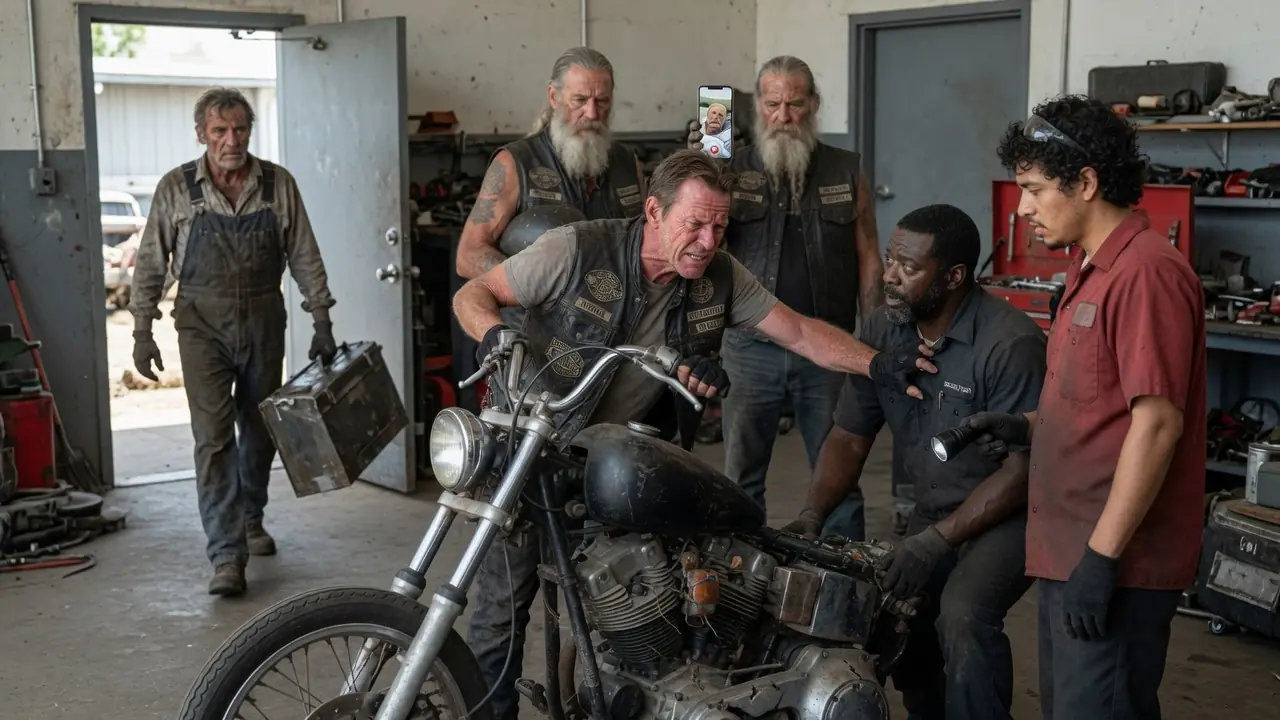
Walter looked toward Tyler.
“Call your uncle.”
A nurse answered in Roy’s hospital room.
When Tyler asked whether they could arrange a video call, she gave a quiet laugh.
“He has been asking since eight this morning. The tablet is already beside him.”
Five minutes later, Roy appeared on the screen.
Illness had narrowed him. The man once known for filling doorways now seemed almost lost beneath the hospital blankets.
Yet his eyes remained dark, clear, and completely present.
“Tyler.”
“I’m here, Uncle Roy.”
Tyler turned the camera through the shop.
He introduced Marcus.
Darnell.
Ethan.
Then Guillermo appeared.
Roy became still.
“Guillermo?”
The older rider stepped toward the screen.
“Hey, brother.”
Roy produced a rough laugh.
“You old dog. Where did you come from?”
“Albuquerque.”
“You drove all the way here?”
“Brought your oil pump.”
Roy’s face changed.
Gratitude mixed with memory.
“You still had it?”
“Twenty years. I was waiting for the right reason.”
Tyler moved the camera toward Walter.
The two veterans studied each other through the screen.
“You’re Walter Briggs,” Roy said.
“Yes, sir.”
“Marine?”
“First Battalion, Seventh Marines. Seventy-one to seventy-five.”
“Army. Twenty-Fifth Infantry. Two tours.”
They did not need to explain the recognition passing between them.
“Thank you,” Roy said.
Not casually.
Completely.
Walter nodded once.
“We are not finished yet.”
Roy looked beyond him.
“Is she there?”
Tyler turned the camera.
The Shovelhead stood inside the bay.
Fully assembled.
Not polished into something false or new, but alive in appearance again.
Roy whispered.
“There she is.”
Walter moved near the motorcycle.
“We are going to attempt the start.”
“She’ll run.”
Roy’s voice carried absolute certainty.
Walter almost smiled.
“I believe you.”
Ethan was given the kickstarter.
“You repaired the part that made this possible,” Walter told him. “You wake her.”
Ethan mounted the motorcycle.
He brought the engine carefully through compression until reaching top dead center.
Then he kicked.
The engine turned but did not fire.
“Again,” Walter said.
The second kick produced a sharp cough from the exhaust.
Roy’s voice came through the phone.
“She’s thinking about it.”
Ethan positioned the engine again.
He kicked a third time.
The Shovelhead erupted.
The exhaust cracked through the repair bay, and the engine settled into a deep, uneven idle unlike any modern motorcycle.
Tools rattled on the workbench.
The walls vibrated.
Darnell shouted.
Marcus turned away for several seconds, pressing one fist against his mouth.
Guillermo allowed tears to run openly through his gray mustache.
Walter stood behind the motorcycle with one hand resting lightly against the rear fender.
His expression held no triumph.
Only completion.
Tyler held the phone toward the running engine.
“Uncle Roy, can you hear it?”
Inside the hospital room, Roy closed his eyes.
The phone speaker could not reproduce the full depth of the engine. It could not carry the physical vibration or the way the exhaust note pressed into a person’s chest.
It carried enough.
Roy’s lips moved.
The nurse beside him leaned closer.
“There you are,” he whispered.
He was not speaking to Tyler.
He was speaking to the twenty-three-year-old version of himself who returned from Vietnam with a Purple Heart, bought a motorcycle, and discovered that the road could make him feel free again.
In his mind, he was riding through the Arizona desert at sunset.
His brothers beside him.
The air clear and cold.
Nothing ahead but highway.
“There you are,” he repeated.
The engine ran for eleven minutes.
Roy listened with his eyes closed.
His breathing became slow.
His heart rate remained steady.
The nurse later said he appeared not to be leaving the world, but returning briefly to a place inside it that had always belonged to him.
When he opened his eyes, he looked toward Walter.
“How long?”
“Four days.”
Roy smiled faintly.
“Four days for seventeen years of silence.”
He listened to the engine.
“You know what that means?”
“What?”
“She wanted to run.”
Walter placed one hand against the tank.
“She was waiting for the right reason.”
Roy nodded.
“Let her run a little longer.”
They did.
When the engine was finally shut off, the silence inside the shop carried physical weight.
Tyler went to the hospital that evening.
Roy asked him to recount every moment.
Walter’s arrival at 6:52.
The call to Albuquerque.
The crack spreading.
Ethan’s weld.
Darnell rebuilding the wiring.
Marcus refusing to declare the machine finished.
Roy listened with his eyes closed.
“It all connects,” he said.
“What does?”
“Gerald Oaks taught Marcus.”
Tyler leaned forward.
“You knew Gerald?”
“He repaired my carburetor at a Tucson rally in eighty-three.”
Roy smiled at the memory.
“Gerald taught Marcus. Marcus called Walter. Walter taught Ethan. Ethan repaired my engine.”
He looked toward Tyler.
“Everything worth knowing travels through people.”
Three days later, Roy Callahan died at 4:17 in the morning.
Tyler was asleep in the chair beside him.
The nurse touched his shoulder, and he knew before she spoke.
Roy’s hand remained warm.
Tyler sat beside him for a long time.
He thought about the engine.
About his uncle’s closed eyes.
About the words there you are.
Roy had reached the road one final time.
That had to be enough.
It was.
Before dying, Roy left two messages.
For Marcus:
Gerald Oaks would be proud.
For Walter:
A Marine keeps his word. So does a brother.
Marcus delivered the second message in person.
Walter listened inside his quiet kitchen with both hands wrapped around a coffee cup.
“I only knew him for eleven minutes,” Walter said.
“Some people spend a lifetime together and never know each other that well.”
Walter looked through the window.
“He carried his life honestly. No distance between the man he claimed to be and the man he actually was.”
Marcus placed a legal pad on the table.
“I wrote down everything you taught us.”
Walter looked at the pages.
“I want to make it into a curriculum. Old engines. Original repair methods. The knowledge that is disappearing.”
Marcus met his eyes.
“I want you to teach with me.”
Walter remained silent.
“Two mornings a week,” Marcus continued. “Bring your own tools. Criticize Darnell whenever he deserves it.”
The corner of Walter’s mouth moved.
“He may not survive.”
“He’ll adapt.”
Walter looked toward the old toolbox resting near the kitchen door.
“Tuesday and Thursday.”
“Seven in the morning?”
“Six fifty-two.”
Six weeks after the memorial ride, Walter entered Briggs & Sons carrying that toolbox.
A rusted 1974 Ironhead Sportster waited on the lift.
Its engine was seized.
The frame was corroded.
The wiring looked as though animals had lived inside it.
A note from the owner rested on the fuel tank.
I know it looks impossible. I’m trusting you.
Walter walked around the motorcycle.
He placed one hand on the engine case.
Then he looked toward Ethan and Darnell.
“Who taught you Ironheads?”
“Nobody,” Ethan answered.
“Good.”
Walter opened the toolbox.
“Then no one has taught you incorrectly yet.”
Three months after Roy’s death, the Shovelhead stood inside the Phoenix chapter garage.
Not inside a glass case.
Not beneath a cover.
It occupied a working space on an oil-stained floor.
A plaque hung beside it.
ROY CALLAHAN
VIETNAM VETERAN
ARIZONA ROADS FOREVER
HE CAME BACK FOR HIS BROTHERS.
HIS BROTHERS CAME BACK FOR HIM.
Tyler started the motorcycle once each month.
The Shovelhead led a ride on Roy’s birthday every year.
The original scratches remained on the tank.
No one attempted to erase them.
They belonged to the life the motorcycle had carried.
On one quiet evening, Tyler mounted the bike and kicked it.
The engine started on the first attempt.
Its rhythm filled the garage.
Tyler rested both hands on the grips and felt the vibration travel through his arms and into his chest.
Roy had said the patch was never truly about the patch.
It was about showing up.
Guillermo drove four hours with an oil pump.
A supplier in Nebraska shipped a rare chain for free.
A retired mechanic arrived before seven with tools he had spent fifty years learning to use.
A younger man made the most difficult weld of his life because an older man trusted his hands.
Marcus called the right person at the right moment.
And Tyler refused to accept that the motorcycle was dead simply because several experts had said so.
That was brotherhood.
Not a slogan.
Not clothing.
Not noise.
It was knowledge carried forward.
Time given without being counted.
Work completed without demanding recognition.
It was one man kneeling on a concrete floor because another man’s final wish deserved every skill he possessed.
The Shovelhead continued running beneath Tyler.
Roy Callahan had heard its voice before he died.
For eleven minutes, he had been young again.
Back on the highway.
Back beneath the desert sky.
Back among the people who always came when called.
Tyler closed his eyes.
Inside the engine’s deep, uneven rhythm, he could almost hear his uncle’s voice.
There you are.