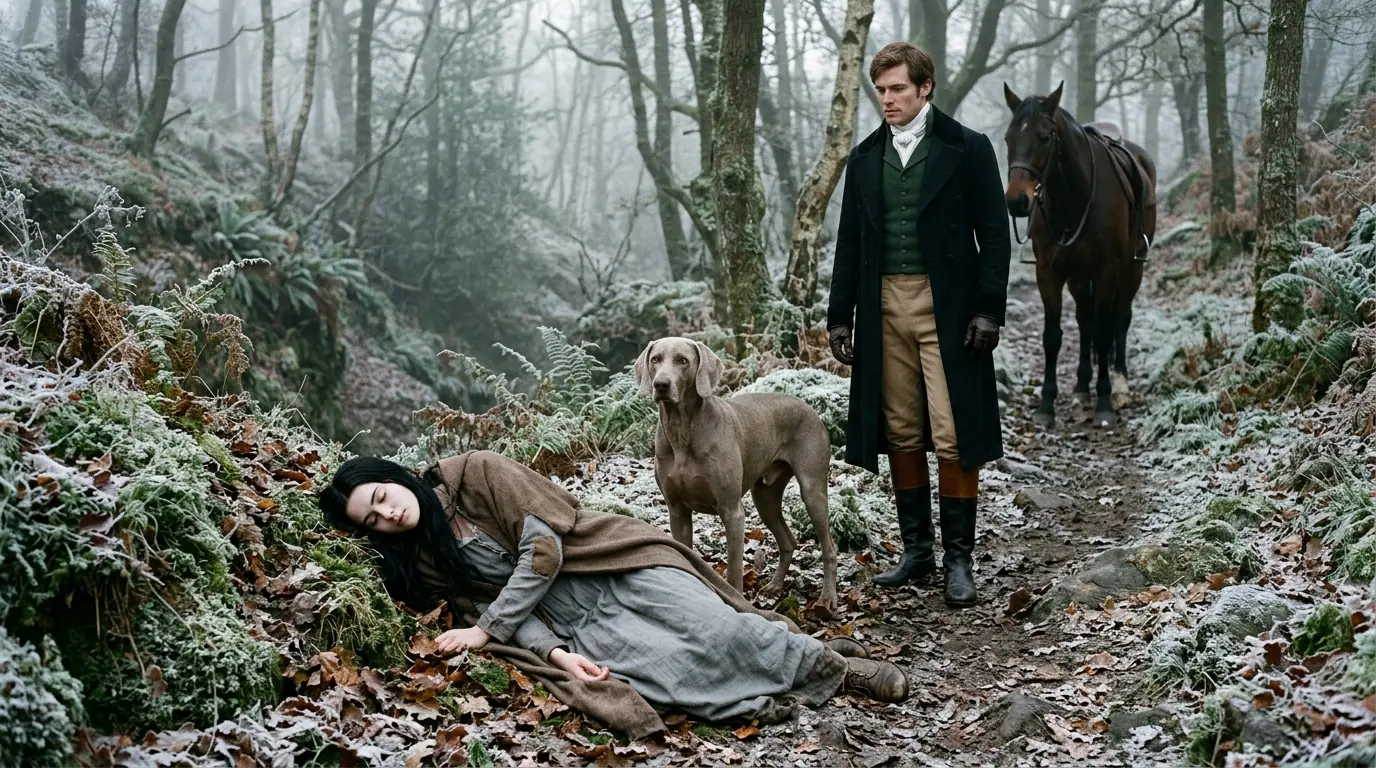
The frost had not yet lifted from the ferns when Duke Kalin Ashcroft first heard his hound whine. It was a sound he had never heard from the beast before. Bramble was a Weimaraner of six winters, bred by his late father, and in all their morning rides across the border woods of the Ashcroft estate, the dog had never once broken from Kalin’s heel without command. Yet on that gray October morning, with the mist still clinging low between the oaks, Bramble stopped in the middle of the bridle path, lifted his silver head, and began to whimper as though something in the ravine below had spoken to him alone. “Bramble!”
Kalin tightened the reins of his black hunter. “To me, boy.” The hound did not obey. Instead, he darted off the path and vanished down the slope of wet leaves. Kalin muttered a soft curse and swung down from the saddle.
His polished riding boots sank an inch into the mulch. He tethered his horse to a low branch, adjusted the collar of his dark great coat against the damp, and followed the sound of the dog’s barking down into the hollow. The ravine was shallow, no deeper than the height of a tall man, but its floor was thick with moss and rotting acorns. Bramble had planted himself at the bottom, ears flat, tail rigid. He was standing guard over something.
Kalin slowed as he came near. At first, in the dim light, he thought it was only a bundle of pale cloth caught among the roots. A traveler’s cloak, perhaps, torn free in the wind. Then he saw the delicate curve of a hand, half buried in the leaves, and the loose spill of dark hair across the moss. A young woman.
She lay very still. Kalin was on his knees before he knew he had moved. He brushed the leaves from her face with the back of his gloved hand. She was no older than twenty with fine drawn features and lashes damp against her cheeks. Her dress was a plain gray muslin patched at the elbow, and the hem was soaked through with dew.
There was a thin mark at her temple where she must have struck her brow against one of the flint stones jutting from the embankment above. He pulled the glove from his right hand and pressed two fingers to the side of her throat. A pulse, faint, but steady. Relief moved through him so sharply that it startled him. He was by nature and by station a man not easily moved.
He had held his father’s hand through his final hour at the age of eleven, had ridden with the county hunt since he could sit a pony, and had learned early that a duke’s face must not betray him. Yet at the beat of that stranger’s pulse beneath his fingertips, he felt his own heart catch like a horse, shying at a fence. “You are alive, then!” he murmured. “That is something.” He shrugged out of his great coat and laid it across her from throat to ankle.
From the small kit strapped to his belt, he took a folded strip of linen, wetted against the dew on the ferns, and cleaned the mark at her temple as carefully as he might have cleaned a portrait. The knock was small, nothing to alarm a physician. She had slipped, he judged, from the ridge above, tumbled down the slope, and struck her head as she fell. Exhaustion had done the rest. Her cheekbones were sharp beneath the skin, and the knuckles of her clenched hand were raw with old scrapes from long walking.
She had been on the road a great while before she fell, days perhaps. He was tying the linen gently at her brow when his knuckle brushed against something firm beneath the collar of her dress. He paused. He was a gentleman, and he did not permit himself to look. But whatever the object was, it had shifted with her fall, and one edge of it now lay visible against the pale skin of her throat, catching the weak morning light, a chain, silver and finer than any peasant girl had cause to wear.
Kalin hesitated. Then, with the tip of one finger, he drew the chain a half inch clear of the fabric. A pendant hung from it, a ring in truth, threaded through the links, as though the wearer had feared to keep it upon her finger, and had hidden it near her heart instead. It was old work. The silver darkened at the edges, but the seal set into its face was cut deep and clean, a stag beneath a rising sun, and around the border in a script Kalin had last seen at his father’s writing desk when he was a boy of nine.
The words read, “Fide et Fortitudine—by faith and courage.” It was the motto of the house of Calum. Kalin did not move for a full breath. Bramble whined at his shoulder. The wind stirred the oaks above, and a single yellow leaf drifted down and settled on the linen at her brow.
The house of Calum. The Earl of Calum had been his father’s oldest friend. Their two houses had signed a betrothal contract when Kalin was fourteen, and the earl’s daughter was nine. A small, dark-eyed girl he had met only twice. Once at a summer garden party in Hertfordshire, and once briefly at her mother’s funeral.
Her name had been Anna, and when the Calum fortune had collapsed six winters past, when the earl had been found dead of grief in his study, and the girl had vanished from her guardian’s household, in the dead of night, Kalin had ridden out three times with his own men to search the northern roads for her. They had found nothing, not a trace. Half the county had come to believe she had walked into the sea. He looked down at the sleeping face beneath his great coat. In six years, he had grown from a young man of one-and-twenty into a duke of seven-and-twenty.
And in all that time he had carried without ever quite naming it a small, clean grief for a girl he had scarcely known and had somehow failed to protect. She was here in the leaves of his own woods with his hound standing sentry at her feet as though the beast had been sent to find her. Kalin closed his fingers around the little ring and drew a long unsteady breath. Then he gathered her up into his arms as gently as if she were made of paper and glass. She weighed almost nothing at all.
He climbed the slope with slow, careful steps, and Bramble padded after him without a sound. “Home, boy,” Kalin said quietly, though the word felt strange in his mouth. “Home! We are taking her home.” The ride back to Ashcroft Manor was the longest three miles Kalin had ever known.
He kept his hunter at a walk, one arm braced across the girl where she lay before him in the saddle, her head resting against the shoulder of his waistcoat. Bramble trotted at the horse’s fetlocks, glancing up every few strides as though to confirm the bundle in his master’s arms had not slipped away. The sun rose slowly behind the oaks, but the mist did not lift. It clung to the hedge and blurred the outline of the great stone house as it rose at last above the Elm Avenue. The stable boy who came running at the sound of hooves nearly dropped the bridle when he saw what the duke carried.
“Fetch Mrs. Halvern,” Kalin said before the lad could speak. “And send a rider for Dr. Warrick. Quietly, William, do you understand me?” “Quietly, Your Grace.” “Not a word to anyone below stairs.”
“Not the footmen, not the grooms.” The boy nodded and bolted. Kalin carried her himself through the servants’ passage rather than the great hall, past the still room and up the narrow back stair to the small infirmary chamber his mother had kept for tenants during her lifetime. It had not been used in nine years. The bed was aired only once a fortnight, out of habit rather than need, but the linens were clean and smelled faintly of lavender from the sachets Mrs. Halvern insisted upon.
He laid her down upon the coverlet with a care that surprised him. Mrs. Halvern arrived within the minute, her cap slightly askew, her sleeves already pushed back to the elbow. She was a woman of five and fifty, broad in the shoulder and quick in the eye, and she had known Kalin since he was little. She took one look at the girl on the bed, another at the duke standing over her, and asked no questions at all. “Warm water,” she said briskly, “and the good flannel from the press.”
A housemaid was dispatched, and within a quarter of an hour the girl had been washed of the forest mud, her damp gown exchanged for a clean linen shift, and the small mark at her temple bathed with witch hazel. Mrs. Halvern examined the bruise with the practical calm of a woman who had seen a hundred kitchen burns and stable falls in her time. “It is nothing to fear, Your Grace,” she said at last. “A slip and a knock. She is thin as a wren, poor lamb.”
“It is the hunger that has pulled her under more than the blow. Broth when she wakes, and quiet, and she will do.” “You are certain?” “As certain as any woman may be before Dr. Warrick has his say.” Kalin inclined his head.
“Sit with her, Mrs. Halvern. Do not leave her until the doctor comes. And speak of her to no one.” “Not a syllable, sir.” He hesitated at the threshold.
The girl’s face upon the pillow looked younger now that the mud was gone, and paler, too. Her dark hair had been combed back from her brow and lay in a loose plait across her shoulder. She stirred once beneath the coverlet, murmured something he could not catch, and settled again into sleep. Kalin went down to his study. The room was on the west side of the house, oak paneled and cold at that hour, and he did not ring for the fire to be lit.
He crossed to the great desk, took a small brass key from his waistcoat pocket, and unlocked the lowest drawer of the cabinet behind him. From it he drew three heavy volumes bound in red morocco leather, the ledgers of alliance and estate that his father had kept, and his grandfather before him. He laid the silver ring upon the desk beside them. Dr. Warrick arrived an hour later, was received in the infirmary, and confirmed Mrs. Halvern’s judgment in gentler words. The doctor prescribed rest, broth, a little laudanum if she woke distressed, and no visitors.
Kalin thanked him at the door, pressed a folded note into his hand, and reminded him of the discretion that had always existed between their families. The doctor bowed and departed without curiosity. Alone again in his study, Kalin sat down at last. He opened the second ledger and turned the pages slowly past the marriage records and the tenancy renewals until he came to a document folded into a linen sleeve near the back. The paper was yellowed at the edges.
The seal at the foot was a stag beneath a rising sun. The articles of betrothal had been entered in his father’s steady hand on the fourteenth day of April in the year of our Lord 1811, between the right honorable Edmund Ashcroft, Duke of Ashcroft on behalf of his son and heir Kalin Edmund Ashcroft and the right honorable Henry Vale, Earl of Calum on behalf of his daughter Anna Elizabeth Vale. Kalin laid the ring beside the paper. He drew the candle nearer. The stag on the seal matched the stag on the ring line for line down to the small curl of the tongue and the seven points of the antlers.
There were only three such rings in existence cast for the daughters of the house of Calum three generations back, and every one of them had been accounted for at the time of the family’s fall. Two had gone to the earl’s elder sisters. The third had passed to his only daughter on the morning of her ninth birthday. Kalin had seen it once on a small hand held out at a garden party in Hertfordshire sixteen summers ago. He sat back in his chair.
Outside the mist had begun to lift at last. A blackbird sang from the yew hedge below the window. Upstairs, in a room that had stood empty for the better part of a decade, the promised bride his father had chosen for him lay sleeping beneath his own roof, breathing softly, and no one in England knew that she was alive, except him. She woke a little after noon on the second day. Kalin was not in the room.
He had left instructions with Mrs. Halvern that he was to be sent for the moment the girl stirred and he was in the east gallery reviewing the quarter’s tenancy accounts with his steward when the maid appeared at the door with a curtsy and a whispered word. He set down his pen at once. “That will be all for this morning, Mr. Prine.” The steward bowed and gathered his papers, and Kalin was already three strides down the corridor before the door had closed behind him. He slowed as he reached the infirmary.
It would not do to arrive at a run. He drew a breath, adjusted the cuff of his coat, and knocked twice before he entered. She was propped against the pillows with her dark hair loose about her shoulders. Mrs. Halvern’s shawl was drawn across her thin frame. A bowl of broth sat half-finished on the tray beside her.
Her eyes, when they lifted to his face, were the color of tea steeped strong, a deep russet brown he did not remember from the garden party of long ago. She flinched at the sight of him. “Please,” he said quickly, and stopped at the foot of the bed. “You have nothing to fear here. I am Kalin Ashcroft.”
“This is my house. My hound found you in the ravine at the border of the woods yesterday morning.” She said nothing. Her hand had crept up to her collarbone, seeking. When it did not find what it looked for, her face went very still.
“It is safe,” Kalin said gently. “The ring. I have it in my study. I shall return it to you the moment you are well enough to rise.” Her lips parted.
“How did you—?” “I recognize the seal. Do not distress yourself. We shall speak of it when you have strength.” She looked down at the coverlet.
Her fingers pleated the linen once, twice. When she spoke again, her voice was thinner than her hands. “I do not know how I came to your wood, sir. I remember walking. I remember rain.”
“I remember a hedgerow and a milestone. And after that—” She lifted her hand and let it fall. “After that, there is very little.” “You struck your head as you fell.” Dr. Warrick said, “Some fog of memory is common with such a knock.”
“It will pass.” “And my name?” “You do not know it?” She was quiet for a long moment. “Anna,” she said at last, as if testing the sound.
“I know I am Anna. The rest is—” She shook her head. Kalin felt something tighten behind his ribs. He wished to tell her the rest. He wished to say, “You are Lady Anna Vale of Calum, and sixteen years ago our fathers set our hands together upon a paper you have never read.”
But she was pale as the pillow beneath her, and the doctor had cautioned quiet, and he thought a truth so large might be a cruelty poured out all at once. “Then we shall let the rest return in its own time,” he said. He was about to say more when he heard from the sweep of gravel below the sound of a carriage coming up the drive at speed. Kalin crossed to the window in three strides. A black chaise had drawn up at the front steps, drawn by two grays lathered at the neck.
Four men in the livery of a neighboring estate were dismounting, and stepping from the carriage, cane in hand, hat tipped back upon his silver head, was a figure Kalin knew before he had seen the face, his father’s younger brother. Lord Vain. Kalin’s jaw set. “Mrs. Halvern,” he said. The housekeeper was at the door in an instant.
“My uncle has come. I do not know why, and I do not intend to permit him to find out. Take—” He caught himself. “Take our guest into the library through the servants’ passage. Now, if you please.”
“The dust sheets are still upon the far cases. Put her in the alcove behind them. Bring her broth, say nothing, admit no one, and if you hear a boot upon the floor above, do not answer it.” Mrs. Halvern did not ask a single question. She simply drew back the coverlet and helped the girl to her feet, an arm firm about her waist, and the two women moved through the door before Kalin had reached the stair.
He met Lord Vain in the great hall, buttoning his coat as though he had only that moment risen. “Uncle, this is an early call.” “Kalin, my dear boy.” Vain’s smile was thin and quick. He struck the marble floor lightly with the tip of his cane.
“Forgive the intrusion. There has been an unpleasantness on the northern road. A vagrant girl was seen loitering near my boundary two nights ago, and my gamekeeper reports she may have crossed onto your land. A common thief, we believe. My men have been searching since dawn.”
“A thief?” “A dangerous one, I am told. I felt it my duty to warn you and to ask that your gates be watched.” Kalin let a pause fall. He had not seen his uncle for eleven months, and he found in that instant that he could read the man’s face as easily as he read a hound.
The little pulse at the temple, the careful cut of the smile. His uncle was not searching for a thief. His uncle was searching with four armed men at his back for a girl. Kalin inclined his head with perfect courtesy. “How singular,” he said.
“My groom rode in from the western meadow at first light and reported a woman answering that description upon the Bedington Road, heading north, he thought, toward the coast.” Vain’s eyes sharpened. “The Bedington Road?” “I would ride at once if I were you.” “You are very good, nephew.”
“Not at all.” He watched from the top step until the black chaise had turned out of the avenue and was lost among the elms. Only then did he permit himself to breathe. Kalin did not sleep well that night. He sat until past two in the library in the deep chair beside the banked fire, watching the girl breathe upon the small cot Mrs. Halvern had made up behind the dust sheets.
She did not stir. Bramble lay at her feet, his silver head upon his paws, and every quarter hour the old case clock in the corner struck softly, and the dog’s ear lifted once, and settled again. By morning Kalin had made his decision. He waited until she had taken her breakfast, a proper one this time, with buttered toast and a coddled egg and half a cup of tea, which she drank with both hands cupped about the china, as though she had forgotten warmth was a thing one might hold. Then he asked whether she felt strong enough to walk a little in the sun.
She did. Mrs. Halvern found a morning gown of soft blue wool that had belonged to Kalin’s cousin the summer she was married and altered the sash at the waist with three quick stitches. A shawl went about the girl’s shoulders. Her hair was pinned up simply with a fillet of black ribbon. When she came down the small stair on Kalin’s arm and stepped out into the walled courtyard behind the library, the change in her was such that he had to look away and pretend to fasten his cuff.
The courtyard was old and quiet and altogether hidden from the drive. A stone bench stood beneath a pear tree at its center. A robin sang from the top of the wall. He led her to the bench and sat down beside her, leaving a proper distance between them. “I have not been quite truthful with you,” he said.
She looked at him. She did not speak. He drew the silver ring from his waistcoat pocket, laid it upon the flat of his palm, and held it out to her. “Your father was Henry Vale, the Earl of Calum. Your mother was Elizabeth of the Marchmont family in Kent.”
“You were born in the spring of 1802 at Calum House upon the coast. Your ninth birthday was marked with a garden party at which I was present with my own father. We spoke to one another twice, I believe. You told me you did not care for iced cake.” A soft sound broke from her.
It might have been a laugh or it might have been a small caught breath. Her hand rose slowly and took the ring from his palm. “On that same afternoon,” Kalin went on, “our fathers signed a paper in your father’s study. It bound our two houses in a betrothal to be honored when you came of age. I was fourteen.”
“You did not know of it.” “I think I did, though I confess I gave it very little thought at that age.” “Six years afterward, your father was ruined. His estates were declared insolvent. He was found dead within the week of a failure of the heart.”
“And you vanished from your guardian’s house upon the same night. I rode out three times to search the northern roads. I found nothing at all.” She was quiet a long while. Her thumb moved slowly across the seal upon the ring.
“I remember the garden party,” she said. “There was a boy in a green coat who was very tall for his age, and he fetched me a lemon ice because he saw I did not care for the cake.” Kalin told her that he had been the boy, and she answered yes as she closed her fingers around the ring. “My father did not fail, and I remember that now,” she said, her voice steadied. “There was a night when I was fifteen, and he came into my room very late.”
“He woke me and said, ‘Anna, if ever you are told that I have been careless with what belongs to us, you are to remember the loose stone.’” He made me repeat it back to him. “The loose stone in the study behind the shelf where the atlas is kept.” “He said the true deeds and the true ledgers were there, and that if ever a day came when I could not find him, I was to find them.” Kalin felt his breath still. “You know where the proofs are.”
“I know where he told me to look. I have not been to Calum House in six years.” She lifted her eyes to his. “Who benefited, sir, from my father’s ruin? Whose name lay upon the papers that undid him?”
Kalin thought of a silver head bent beneath a black hat upon his own front step. “My uncle, Lord Vain.” She did not weep. She did not cry out. She only closed her eyes for a slow count of three.
And when she opened them again, there was something in them that had not been there before. A steadiness and resolve had appeared; he thought, watching her, that whatever the last six years had put her through, they had not put out the light behind her face. They had banked it only as one banks a fire against the morning. “Then he will come again,” she said. “He will, and this house is not safe.”
“It is not. He has an informer among my grooms. I have long suspected it, and yesterday confirmed it. Whatever we do, we must do without the household’s knowledge.” She nodded once.
“We must go to Calum House.” “We must. We leave tomorrow before dawn, on horseback and dressed plainly. I shall tell Mr. Prine I am riding to inspect the coastal farms and shall be absent a week. Mrs. Halvern will know the truth and no one else.”
“Very well.” A pause fell between them. The robin sang again from the top of the wall. She was still holding the ring, and now she slipped it slowly upon the fourth finger of her right hand, where it settled as though it had never left. “Kalin,” she said.
It was the first time she had used his name. “Yes.” “Thank you for looking for me, even when there was nothing to find.” He could not answer that. He only bowed his head, and after a moment she laid her hand briefly upon his sleeve, and drew it away again.
They rode out at half past four the following morning, while the great house still slept. Mrs. Halvern had seen to their dress herself. Kalin wore a plain brown riding coat borrowed from his under steward, a shirt of coarse linen, and a soft felt hat that shadowed his face. Anna was in a gray traveling gown, a shawl of brown wool, and a bonnet of dark straw with a wide brim. To any traveler upon the road, they would appear as a country gentleman of small means and his young wife, riding to visit her people at the coast.
Two saddlebags carried bread, cold ham, a flask of cider, a purse of coin, and a pair of loaded pistols wrapped in oilcloth that Kalin did not mention, and hoped he would have no cause to use. Bramble had been left behind, howling softly at the stable door. A silver hound at a country gentleman’s heel would have undone the disguise before they passed the first toll gate. The lane was still dark when they turned out of the back drive. A thin mist lay upon the fields.
Somewhere a cock crowed and was answered, and the world began to move. They kept to smaller ways at first, the drovers’ tracks and the old bridleways that skirted the parish villages. By the time the sun came up above the hedge, they were ten miles from the manor, and there was nothing behind them but a green quiet. “Do you ride often?” Kalin asked when they had settled into a walk along a broad heath.
“I did as a girl, every morning before breakfast with my father. I have not sat a horse in six years.” “You would not know it to look at you.” “The body remembers what the mind forgets. My father always said so.”
She was riding a bay mare called Sorrel, the gentlest creature in the Ashcroft stables, and she sat her well, her back straight, and her hands quiet upon the reins. Kalin watched her from the corner of his eye, and thought that a great deal of what had been broken in her these last years had begun, quietly to knit itself again beneath the plain gray gown. They stopped at midday at a small wayside inn called the Plowman’s Rest on the edge of a beechwood. Kalin took a private parlor and paid for it in silver. They ate a plain dinner of mutton pie and small beer, and the innkeeper’s wife asked no questions and offered no gossip, and they were on the road again within the hour.
By late afternoon, the country began to change. The hedge gave way to stone walls. The soil grew thin and pale beneath the horse’s hooves, and the wind carried for the first time a faint clean bite of salt. “The sea,” Anna said quietly. She had not spoken for some miles.
“You feel it?” “I remember it. It smells of home.” They came down into a coastal valley, as the light was failing, and took shelter at a small posting inn upon the cliff road, where a room was engaged under the name of Mr. and Mrs. Ashley. The innkeeper glanced once at the gold band Kalin had slipped upon Anna’s finger before they dismounted and glanced no more.
They dined together at a small table by the fire. “I have a confession,” Anna said when the plates had been cleared, and the innkeeper had retreated. Her fingers turned the little band upon her knuckle. “This is the first meal I have eaten across a table from another soul in more than three years.” Kalin set down his cup.
“Where have you been, Anna?” She was quiet for a while, looking into the fire. “After my father died,” she said, “my guardian was a cousin of his upon my mother’s side. A Mrs. Prow of Lello. She was not unkind at the first, but within a month of my coming to her house, a letter arrived.”
“I never saw who it was from, and after that she would not meet my eye. She told me one morning that I could no longer be kept, and gave me the fare to a place of employment in the north. I went. It was a laundry in a mill town. I worked there four years.”
“When I could bear it no longer, I left.” “And I have been walking south since April. Since April, I meant to reach the coast. I meant to find Calum House. I did not remember then that it lay to the east of your woods and not to the west.”
“I took the wrong road at Hartsmere and walked three days beyond where I ought to have turned.” “That is how I came to your ravine.” Kalin did not answer at once. He was looking at his hands. “If I had known,” he said at last, “if any word had come to me—” “You could not have known.”
“My guardian was paid to hide me, and she was paid well. I understood that afterward. I was fifteen and I did not understand it then.” “Paid by whom?” She met his eye.
“I think we both know.” He nodded slowly and after a moment reached across the small table and set his hand briefly over hers. She did not draw it away. The fire cracked softly in the grate, and outside, far below the cliff, the sea went in and out upon the shingle. “Tomorrow,” he said, “we shall have the proofs in our hands.”
“And then—” “And then the law is the law, Anna, even for the uncles of dukes. I shall see him answer for every year of it.” She looked at him for a long moment across the small table. Whatever she saw in his face seemed to satisfy her, for she gave a small nod, and drew her hand gently back, and folded it with the other upon her lap. They spoke no more that night.
They parted at the door of the little chamber. She within, he to a settle in the parlor below, and the inn grew quiet, and the sea kept its slow council against the shingle, in and out, in and out till dawn. They came within sight of Calum House. A little before noon, the road down from the cliff was narrow and much overgrown, and Kalin dismounted twice to lead Sorrel past a fallen elm and a patch of loose scree. Anna rode a length ahead of him now.
She had grown quieter since dawn, and he did not press her. A woman returning after six years to the house of her childhood did not need conversation. She needed only for the horse behind her to keep pace and be patient. The house appeared at last through a gap in the hawthorn. It stood upon a shoulder of the coast, a long low manor of gray stone with a slate roof and tall square chimneys, one of which had fallen in upon itself in some winter storm.
Ivy had climbed to the upper windows. The lawn before the house was waist high in dry grass and thistle. A single crow rose from the chimney stack as they approached, called once, and flew off toward the sea. Anna reined in at the edge of the drive. She did not weep.
She only sat very still, her hands loose upon the reins, and looked at the house for a long moment, as if measuring something in herself against what she saw. “It is smaller than I remembered,” she said. “Houses are, when one comes back to them.” “Yes.” She swung down from the saddle without waiting for his hand.
They tethered the horses in what had once been the stable yard, where a broken pump still stood above a stone trough. The great front door was locked, as was to be expected, but Anna walked past it without a glance, and led him around the eastern side of the house, through a tangle of gooseberry and old rose, to a small side door, half hidden beneath a wooden porch. She lifted a flat stone at the foot of the step. Beneath it, green with damp but intact, lay a heavy iron key. “He put it there the summer I was seven,” she said.
“It was in case we ever came home late from the harvest supper and Mrs. Bright had gone to bed,” she explained. The key turned stiff, but it turned. The door swung inward upon a hall that smelled of dust and sea damp, and the sweet dry smell of old timber. Anna crossed the threshold as though the last six years had folded up quietly behind her. She led him without hesitation, down a passage paneled in oak, past a morning room whose furniture was draped in yellowed sheets, up a short flight of stairs, and along a corridor whose windows looked out upon a walled garden gone entirely to nettle.
Kalin followed a pace behind, saying nothing. The study was at the end of the corridor. It was a small square room with a bay window facing the sea. The desk still stood beneath it, its inkwell empty and its blotter dry. Two walls were lined floor to ceiling with bookcases, and every shelf was still full.
The books furred with mold at their tops, but standing yet, as though their owner had only stepped out an hour before, and had meant to come back. Anna stood a moment in the doorway. Then she crossed to the leftmost bookcase and laid her hand upon its side high up where a small brass rosette was set into the wood. “He showed me only once,” she said. “I was fifteen.”
“He made me practice it three times, and then he told me never to speak of it and never to try it unless I could not find him.” She pressed the rosette. There was a small dry click within the wall. The bookcase did not move. Anna crouched down at its foot, and Kalin saw now that one of the floorboards beneath the lowest shelf lay slightly proud of its neighbors.
She slid her fingers beneath its edge and lifted. The board came up cleanly. Beneath it was a cavity lined with lead, no larger than a hatbox, and inside the cavity lay a flat oilcloth bundle tied with waxed string. Anna lifted it out with both hands. She carried it to the desk and set it down.
Kalin came to stand beside her. She untied the string with fingers that did not quite shake, folded back the oilcloth, and there lay within a small stack of papers, three deeds sealed in red wax, and a slim ledger bound in dark green calf. She opened the ledger first. It was written in a firm sloping hand. “My father’s hand,” she said quietly, without looking up.
Page after page of columns in ink that had faded only a little. Rents received, rents paid out, ships freighted and their cargoes, and from a date some eighteen months before the ruin, a second column had begun. Sums paid out under her father’s name, but not by her father’s authority. Signatures at the foot of each, not the earl of Calum, but a hand Kalin knew as well as his own. He drew a slow breath.
“He was writing your father’s name.” “Yes.” “For a year and a half?” “Yes.” The deeds beneath the ledger were the original grants of the Calum lands, sealed and witnessed and undisputed.
Beside them lay a letter, brief, dated three days before the earl’s death, and addressed to whomsoever shall find this after me. Kalin read it standing, and when he had finished, he folded it very carefully and set it back upon the oilcloth. “He knew,” Kalin said. “He knew he had been beaten. He did not know he had been poisoned through his drink, if he was.”
“I have long thought he must have been. His heart was as sound as a bell.” “We shall not prove that today.” “No, but we shall prove the rest.” She tied the bundle again with steady hands and slipped it inside the lining of her cloak where a pocket had been sewn for the purpose that morning at the inn.
She looked once about the little study, at the empty inkwell, at the sea beyond the bay window, and then she turned and walked out and did not look back. They rode through the night. Kalin had judged it the safer course. A country inn upon the coastal road would be watched by dawn, if his uncle had any wit at all, and by his uncle’s reckoning, they had now been absent from Ashcroft, two days too long to be inspecting farms. So they took a cold supper in the saddle, changed horses at a small posting house upon the downs, where Kalin’s coin bought silence as easily as fresh beasts, and pressed on inland by the light of a waning moon.
Anna bore it better than he had feared. She had asked when he first proposed it whether he thought her equal to a night’s ride, and he had answered honestly that he did not know. But she had set her jaw at that, and by three in the morning, when they crossed the high ridge above the wold, and saw the lights of a distant village pricking below them like fallen stars, she was still upright in the saddle, and her voice, when she spoke, was steady. “Two more days,” Kalin said, “and we shall be at the regional council. Once the papers are in the magistrate’s hands, no man in England can touch you.”
“Two more days,” she said. “Very well.” They came down toward the great river at dawn. The river ran broad and slow across the low country, the color of pewter beneath the pale sky. The road they were upon led to the stone bridge at Marley Crossing, the only crossing for eleven miles in either direction, and the sole practicable route to the town of Havering, where the council sat.
The mist was thick upon the water when Kalin first saw the bridge. He drew rein at once. Anna had seen them at the same instant. Six horses upon the far bank, four men on foot before them, and a black chaise drawn up upon the verge, its lamp still lit against the fog. The livery of the men was not his uncle’s, but the shoulder knots of the two officers standing by the chaise were.
Vain had hired outside his own household this time. He had taken counsel then from someone shrewder than himself. Kalin backed his horse quietly into the cover of a stand of alder. “They will have descriptions of us.” “Yes, and there is no ford within a day’s ride.”
Anna did not answer at once. She was looking not at the bridge but downstream where the river curved away between low banks toward a dense stand of willow. Her lips had parted a little, and there was in her face the same quiet gathering he had seen when she had pressed the rosette upon the bookcase. “There is a barge passage,” she said. “A what?”
“An old stone tunnel beneath the river. My grandfather’s father built it when the wool trade was at its height, so that the bales might be brought under the road without paying the crossing toll. My father took me down to see it when I was ten. He said it had not been used in fifty years, but that the water still ran through it, and that a shallow boat might yet pass. Anna, it is a mile downstream.”
“The mouth of it is hidden under the willows on this bank. There is a keeper’s cottage above it, or was.” Kalin looked at her a long moment. Then he turned his horse. The willows were thicker than she had remembered, and it took them the better part of an hour to work their way down along the bank without breaking cover.
The keeper’s cottage, when they came to it, was a roofless ruin of blackened stone, standing upon the low bluff, but below it, half choked with brambles, and quite invisible from the road, was a broad stone arch set into the bank at the waterline. A rusted iron ring was fixed in the keystone. A small flat-bottomed boat lay drawn up upon the mud beside it, its timbers gray with age but sound. A single long punt pole lay across its thwarts. “Someone comes here still,” Kalin said quietly.
“An eelman, most likely. It is no matter. It floats.” They tethered the horses in a hollow behind the ruined cottage and covered the saddles with fern. Kalin took the punt pole.
Anna sat forward in the boat with the oilcloth bundle beneath her cloak and one hand upon the gunwale. He pushed off and the boat slid out into the current and the mouth of the tunnel took them in. The dark was total for a moment. Then his eyes adjusted and he saw that a thin gray light seeped in from vents cut through the stone above their heads spaced at intervals along the vault. The water was slow here, and the passage broad enough for two boats abreast.
He set the pole against the wall and pushed, and the little craft moved as steadily as a swan. Above them, muffled by the weight of both the road and the river, he heard the sound of hoofbeats crossing the bridge. Anna did not move. She sat very still in the bow, with her hand upon the bundle at her breast, and her face in the dim gray light, was the face of a woman who had passed beyond fear into something colder and clearer than fear. The tunnel was some four hundred yards.
It felt longer. When the far arch opened at last, and the pale light of morning came in upon them across the water, Kalin let out a breath he had not known he was holding. They came out among reeds upon the eastern bank, hidden by a low headland from any eye upon the bridge. Kalin drew the boat up quietly. He handed Anna out onto the turf.
“There will be a farm within a mile,” he said. “We shall buy horses and be at Havering by nightfall.” “Yes.” She stood a moment upon the bank, looking back at the dark mouth of the tunnel. Then she turned inland and did not look back.
The assembly hall at Havering stood upon the market square, a broad building of pale stone with a pediment above its double doors and a stone lion cushant upon either side of the steps. It was the seat of the regional high council at which the magistrate and his four assessors sat in judgment upon all matters of estate, tenure, and title in the eastern counties. It met upon the second Wednesday of each month. That Wednesday was the day Kalin and Anna rode into the town. They had reached a farm at Netherfold by midday of the day before, where Kalin’s silver had bought them two fresh horses and a change of clothes befitting their business.
Anna was now in a gown of dark green silk that had been the farmer’s daughter’s wedding dress, altered in the small hours by the farmer’s wife, with an art that would have shamed a London modiste. A traveling cloak of black wool went over it. Her hair had been dressed simply and coiled at the nape of her neck. About her throat, upon a fresh silver chain hung the ring of Calum. In view for the first time in six years, Kalin wore his own coat, which had been carried folded in a saddlebag since the morning they left Ashcroft.
It was black broadcloth cut in the London fashion, with the small pin of his order at the collar. He was the Duke of Ashcroft again, and he meant to be seen as such the moment they crossed the threshold. The hall was already full when they arrived. Kalin had timed it so. The clerk at the door glanced up, saw the pin at his collar, and rose so quickly that his chair scraped upon the flags.
“I shall require a word with the magistrate. At once.” “He is in session, Your Grace. There is a matter before the bench.” “I am aware of the matter before the bench.”
“It concerns me, and it concerns the lady upon my arm. Have the courtesy to announce us.” The clerk had the wit not to argue. They entered by the great doors at the rear of the hall. The chamber was long and high, paneled in oak to the height of a man’s head.
The five members of the council sat upon a raised bench at the far end in black robes and gray wigs, and before them stood a rail behind which the parties to the current cause were assembled. A clerk was reading from a document in a level voice. Kalin heard the words, “The vacant and abandoned estate of Calum, and no living issue of the late earl having come forward within the statutory period, the petitioner therefore prays that the reversion be granted to him as the nearest—” At the rail stood Lord Vain. He had his back to the doors. He wore a dove gray coat, and his silver head was bowed a little as he attended to the clerk’s reading.
Beside him stood a solicitor Kalin recognized, a thin man of the Havering bar, whose name had lately begun to appear in matters that would not bear a strong light. The clerk at the door struck his staff once upon the floor. “His Grace the Duke of Ashcroft,” he announced, “and Lady Anna Vale of Calum.” The chamber went perfectly silent. Lord Vain turned.
Kalin had wondered upon the long ride down what he would feel at the moment his uncle first saw the girl he had believed six years dead. He had thought he might feel triumph. He had thought he might feel anger. In the event he felt nothing at all except a very cold and very steady clarity. And he found afterward that he was glad of it.
Vain’s face did not lose its color. He had, whatever else might be said of him, the nerve of a gambler. He only inclined his head with the smallest of smiles, as if to say, “Well played, nephew,” and turned back to the bench. “My lords,” he began. “This young woman—” “My lords.”
Kalin’s voice cut through the chamber like a bell. “Before my uncle speaks another syllable, I ask leave to lay before the council certain documents that have this day come into my possession.” The magistrate was a stout man of sixty called Sir Hugh Farington, who had known Kalin’s father. He looked from Kalin to Vain and back, and after a moment inclined his head. “Leave is granted, Your Grace.”
“Approach the bench.” Kalin and Anna walked the length of the chamber together. Kalin laid the oilcloth bundle upon the clerk’s table. Anna, at his nod, drew back her cloak and lifted the ring upon its chain into the light. The magistrate leaned forward.
He examined the seal of the ring first, holding it beside a wax impression that the clerk brought from a great ledger at his elbow. He examined the deeds next, each in turn, breaking the seals with his own hand. He examined the ledger last, and this took him the longest, for he turned page after page, and his face grew grave, and once he glanced up at Lord Vain, and did not glance at him again. He set the ledger down. “Lady Anna Vale of Calum,” he said, “the council receives you.”
Anna curtsied. She did not speak. Sir Hugh looked at Lord Vain. “My lord, the signatures in this ledger are not in the late earl’s hand, and they are very like your own. The council will require an explanation of them.”
“The petition before us is dismissed. The reversion is refused. Constables, you will attend upon Lord Vain and see him conveyed to the county jail at Havering pending examination.” Vain’s smile did not quite go. It only thinned to the edge of a blade.
“Nephew,” he said quietly as the constables came forward. Kalin looked at him. “Uncle.” That was all that passed between them. Vain was led out through the side door.
The chamber rose in a low murmur that swelled and did not cease, and Kalin offered Anna his arm, and together they walked back down the long hall into the pale October light of the market square. Three days later, the notice was posted at the door of every parish church in the eastern counties. By decree of the regional high council at Havering, the name and heritage of Lady Anna Elizabeth Vale of Calum are hereby restored in full, together with all lands, rents, and appurtenances belonging to the said estate. Given under the hand of Sir Hugh Farington, magistrate, this fifteenth day of October. Anna read it once at the church door in the village nearest Calum House, and then she folded her gloved hands together and walked back to the carriage without a word.
She had returned to the coast the day after the hearing. There was much to be done, and she wished to be there while it was doing. Kalin had ridden back to Ashcroft to set his own affairs in order and to write the necessary letters to his aunt in Bath, who had never loved her brother-in-law, and who received the news of his disgrace with a composure that did her credit, to his cousin at the Admiralty, to the family solicitors in Lincoln’s Inn. He wrote none of these letters with pleasure, but he wrote them all. And when the last was sealed, he closed the study door behind him and rode east.
He came within sight of Calum House upon an afternoon four days later. The change in it in so short a time was such that he reined in at the turn of the drive and simply looked. The waist high grass had been cut back. The fallen chimney had been shored with fresh timber. Ladders stood against the eastern gable, and two men in shirt sleeves were replacing slates upon the roof.
The ivy had been stripped from the upper windows, and the windows themselves stood open to the salt wind. A cart of stone had drawn up at the stable yard, and a stonemason was measuring a broken sill with a length of twine. Anna was in the garden. He saw her before she saw him. She was standing at the edge of what had once been a herb bed in a gown of soft gray and a straw hat with a broad brim, giving instruction to an old man in a smock who was leaning upon a spade.
The old man was nodding. When Anna turned and caught sight of Kalin at the gate, she did not run. She only lifted her hand once and smiled and finished what she was saying to the gardener. Then she came down the path. “You are ahead of your letter,” she said.
“I rode faster than the post.” “That was very extravagant of you.” “I thought so myself, halfway down the way. But here I am.” She laughed.
It was the first time he had heard her laugh, and the sound of it stayed with him afterward, longer than he expected. She showed him the garden first. It had been her mother’s, she said. The roses along the south wall were the old damasks her mother had brought from Kent as a bride, and though they had gone half wild in six years, the gardener said they might yet be saved with a hard pruning in the spring. The herb bed was to be replanted with lavender and rosemary and thyme.
The old dovecote at the corner of the wall was to be repaired. There would be a pond again in time where her father had once kept carp. She spoke of it all in the same steady, practical voice with which she had opened the vault beneath the study floor. And Kalin thought, listening to her, that whatever the last six years had taken from her, they had also given her something, a knowledge of what a life was worth, a clear eye for what could be mended and what could not. They walked to the low wall at the end of the garden, where the ground fell away toward the sea.
The tide was out. The sun was beginning to set upon the water and the light lay long and gold across the shingle. They stood a while in silence. “Kalin,” she said at last. “Yes?”
“When our fathers signed that paper, I was nine years old.” “I know.” “I did not choose it.” “Neither did you.” “No.”
She turned to face him. The brim of her hat cast a shadow across the upper half of her face, but her eyes beneath it were very clear. “I have thought a great deal about this since Havering. If I am to be Lady Anna of Calum again, then I am not a girl to be given away by a paper signed by a man who has now been dead for six years. That paper is nothing.”
“I have no claim upon you by it, and you have no claim upon me.” Kalin inclined his head. “That is true.” “So I release you from it freely, and before witnesses if you require them, though I hope you will not.” “I do not.”
“Very well.” She was quiet a moment. The wind lifted a loose strand of her hair from beneath the hat, and she put it back with her gloved hand. “And having released you,” she said, “I should like to say that if you were, of your own choosing and mine, to ask a question of me one day, I should not be sorry to hear it. I should not be sorry at all.”
Kalin looked at her. Then he smiled, a slow smile that began in his eyes and did not reach his mouth till the last. “Lady Anna.” “Your Grace.” “When your roses have been pruned in the spring, your dovecote is mended, and your gardener has your pond stocked again with carp, I shall come down and ask it.”
“That will do very well,” she said. “That will do very well indeed.” They stood a while longer at the low wall, watching the tide come in below. Bramble, who had ridden the last mile at the heel of Kalin’s horse, came padding round the corner of the house at last, and settled his silver head against her hand, as if he had known her all his life. Somewhere behind them, on the roof, a slate was set into its place and tapped home.