Five women came to Oakhaven in the dead of winter, lured by the promise of a ducal title. Five women took one look at the rotting roof, the mud-choked courtyard, and the grim, silent man waiting in the hall. Five carriages turned right back around. They wanted a fairy tale.
They wanted silk and orchestras. They didn't want the Duke of Oakhaven. But Nora didn't want a fairy tale. She just wanted a roof, even a leaking one.
The letters were not written on perfumed stationery. They were drafted on heavy, cheap parchment, the kind usually reserved for grocer's ledgers. Adrian, the Duke of Oakhaven, possessed a title that dated back four centuries and a bank account that couldn't cover the cost of a new plow. He wrote the letters himself.
His solicitor had provided a list of eligible women from respectable, if slightly desperate, families. Women who might overlook a crumbling estate in exchange for the social elevation of becoming a duchess. Adrian's terms were blunt. He did not offer love. He did not offer London, seasons, ball gowns, or carriage rides through Hyde Park.
He offered his name, a legal share in whatever meager harvests the Oak Haven lands produced, and a request for a meager dowry to fix the roof of the West Wing. It was a business transaction stripped of all polite societal artifice. He sealed five letters with plain red wax. He expected nothing. He was a cynical man, hardened by his late father's gambling debts, and the bitter Yorkshire winds that seemed to blow straight through the stone walls of his ancestral home.
200 miles away, in a drafty parlor in Bath, Nora Finch read her letter. She was not the intended recipient. The letter had been addressed to her cousin, Clara, a girl of 19 with a modest inheritance and a penchant for fainting spells. Clara had opened it, read the first three sentences, and laughed until she choked on her tea. She tossed the parchment into the fire grate.
Nora fished it out before the flames could catch the edges. At 26, Nora was a ghost in her aunt's house. She was the poor relation, the unpaid companion, the one who mended the hems and sat in the corner during dinners, invisible and silent. She had 50 pounds to her name, left by a forgetful godmother. When her aunt politely informed her that she would soon be sent to a parish poorhouse to make room for Clara's new spaniels, Nora knew she had run out of time.
She read Adrian's blunt, unvarnished words. "The estate requires management. The climate is harsh. You will not find comfort here, only work. In return, I offer the protection of my name."
It was the most romantic thing she had ever read. Not because it promised affection, but because it promised a transaction. It was honest. Society men spoke of eternal devotion while looking over a woman's shoulder to praise her father's horses. This duke promised misery and work.
Nora knew misery. She knew work. She packed her single trunk, took her 50 pounds, and bought a one-way ticket on the mail coach heading north. She did not ask for permission. She simply walked out the back door while Clara was fussing over a velvet ribbon.
The journey took 3 days. The cold seeped into the marrow of Nora's bones. The landscape outside the coach window shifted from rolling green hills to jagged gray moors beneath a bruised low-hanging sky. She did not feel fear. She felt a profound heavy resignation.
She was trading one prison for another. But at least in this new prison, she would be the warden. The rutted dirt road leading to Oakhaven was a graveyard for carriage wheels. Nora's hired hackney jolted violently, throwing her against the cracked leather seat. Outside, the rain was not falling.
It was being driven sideways by a vicious wind, slicing through the bare branches of ancient dying oaks. As they rounded the final bend, the estate came into view. Oakhaven was massive, but it looked less like a manor and more like a fortress that had lost a war against time. Half the windows on the upper floors were boarded shut. The stone was blackened with damp.
Ivy crawled up the walls, thick and invasive, resembling the veins on an old man's hand. Just as Nora's carriage pulled into the muddy courtyard, another carriage was frantically trying to leave. It was a grand thing, painted gloss black with gold trim. The horses were panicking in the mud. As the two vehicles scraped past each other in the narrow drive, Nora caught a glimpse of the woman inside the departing carriage.
She was beautiful, swathed in fur, and her face was pale with absolute horror. She was weeping into a lace handkerchief. Nora watched the carriage flee back down the road. That made five, according to the driver who had gossiped at the village inn. Five women who had arrived, seen the reality of the duke's poverty, and run for their lives.
The hackney came to a halt. The driver refused to step down into the ankle-deep muck. Nora didn't ask him to. She opened the door herself, the wind immediately tearing her woolen bonnet from her head. She let it go.
She stepped down. The mud sucked at her worn leather boots. She reached into the carriage, dragged her heavy trunk to the edge, and let it drop into the sludge with a wet thud. She paid the driver, who looked at her as if she were a woman walking to the gallows. He whipped the horses and turned away, desperate to leave the cursed grounds.
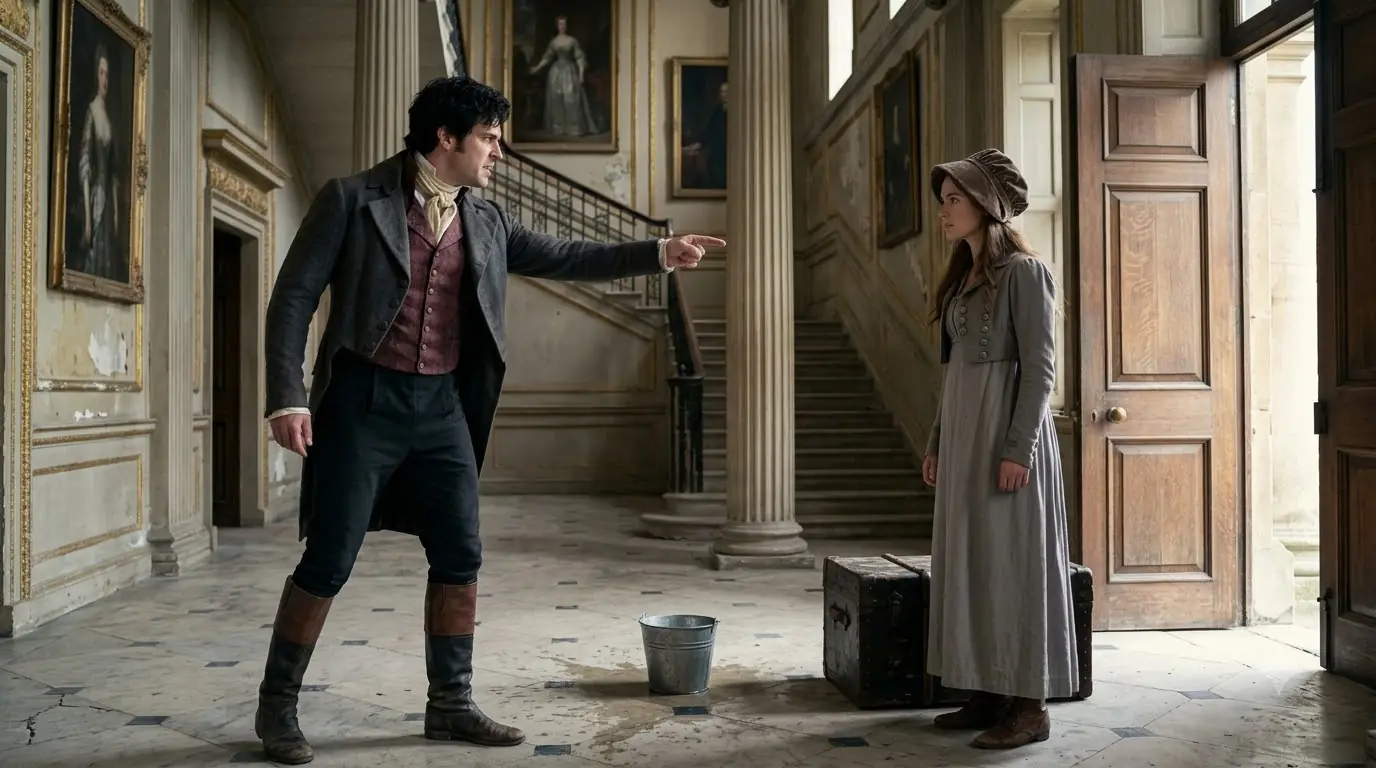
Nora stood alone in the rain. She looked at the massive oak front doors. One was slightly off its hinges. There was no knocker. She walked up the crumbling stone steps and pushed the door open.