Sarah Whitmore saw the rider before anyone else did. She was standing in the dusty yard of the family homestead, shaking flour from her apron after finishing the morning bread, when a dark figure appeared at the far edge of the road. The farmhouse behind her was old, white paint peeling from the boards, the porch sagging slightly on one side, and the fields beyond it looked tired from another dry Kansas season. At first, she thought it was another traveler passing through, but then the horse slowed, and the man lifted his head toward the house as if he knew every inch of the place.
Sarah’s breath caught before she understood why. The man wore a black hat, a long dark coat, leather gloves, and dusty trousers, but it was the way he sat in the saddle that pulled an old memory out of her chest. Ten years had passed since Caleb Reed vanished from the Whitmore farm without farewell, leaving behind only rumors and one broken promise. Back then, he had been a quiet hired boy with restless eyes, and Sarah had been sixteen, too young to know that silence could hurt worse than goodbye.
Now he was a grown man, thirty-two by her guess, taller and harder than the boy she remembered. His face was weathered from open country, his jaw dark with stubble, and his eyes carried the look of a man who had seen too much road and trusted very little of it. He stopped his horse near the porch and swung down without asking permission. Sarah stood facing him in the yard, her hands closing tightly around the sides of her apron.
The front door opened behind her, and Daniel Whitmore stepped onto the porch with their widowed mother beside him. Daniel was older than Sarah by five years, broad-shouldered and quick-tempered, with their father’s stubborn chin and none of his patience. Their mother, Ruth Whitmore, stood pale and uncertain in her beige dress, one hand pressed against the doorframe. Daniel took one look at Caleb and pointed toward him like he had spotted a thief.
“You disappeared for ten years,” Daniel shouted, his voice cracking across the yard. “Now you come back wanting our land?” Caleb did not flinch, though Sarah saw one muscle tighten in his jaw. He looked past Daniel to the house, then back to Sarah, as if the sight of her standing there made the past more difficult to carry. “I came back because your father left me something you never knew about,” he said.
Sarah felt the words strike the yard like a thrown stone. Her father, Samuel Whitmore, had been dead for eight months, buried beneath the cottonwood tree beyond the barn with his hat resting on the coffin because Ruth could not bear to part with it. He had left behind debts, failing fences, three tired horses, and land the bank had already begun circling like buzzards. He had not left behind secrets, or at least Sarah had never believed he had.
Daniel stepped down from the porch, fury stiffening his shoulders. “My father left you nothing,” he said. “You were a hired boy he fed when nobody else would, and you repaid him by running off before harvest.” Caleb’s eyes hardened, but his hands stayed at his sides. “I ran because he told me to.”
Sarah stared at him, confused and shaken. “Papa told you to leave?” Caleb finally looked fully at her, and the old ache between them stirred like dust under a door. “He put me on a horse before dawn and told me if I cared about you, I would never come back without proof.” Sarah’s fingers twisted into her apron, her face tightening with hurt. “Proof of what?”
Caleb reached inside his coat and pulled out a folded packet wrapped in oilcloth. Daniel moved toward him as if he might snatch it away, but Caleb lifted one gloved hand in warning. “Not here,” Caleb said. “Your father said this should be opened in front of family, but not in front of anger.” Daniel gave a bitter laugh. “Then you came to the wrong house.”
Ruth’s voice trembled from the porch. “Daniel, let him speak.” Her son turned sharply, surprised by the command, because their mother had barely raised her voice since Samuel died. Ruth kept her eyes on Caleb, and Sarah saw fear there, not of the drifter, but of what he carried. “If Samuel gave him something, then I want to know why.”
They gathered inside the kitchen because it was the only room that still felt like the heart of the house. The table was scarred from twenty years of meals, mending, arguments, and prayers, and Sarah had scrubbed it that morning until the wood shone in pale streaks. Caleb stood near the stove, keeping distance between himself and everyone else, while Daniel remained by the door with arms crossed. Ruth sat slowly at the head of the table, exactly where Samuel used to sit when he read the Bible on Sundays.
Caleb placed the oilcloth packet on the table. “Samuel wrote me three months before he died,” he said. “I was in Wyoming then, working cattle near Laramie, and the letter took weeks to reach me.” Sarah watched his hands as he untied the string, noticing the scars across his knuckles. “He said if I ever cared for this family, I would come back after he was gone.”
Daniel scoffed. “Convenient that a dead man can speak in your favor.” Caleb ignored him and unfolded the first paper. The handwriting was Samuel’s, uneven near the end but unmistakable, with the same hard slant Sarah remembered from feed orders and birthday notes. Ruth reached for it with shaking fingers, then pressed the paper to her chest before reading aloud.
“To Caleb Reed, if this reaches you, then I have less time than I hoped.” Ruth’s voice broke, but she forced herself to continue. “I did wrong by you, and I did worse by Sarah when I sent you away without letting either of you understand why. I believed I was protecting my daughter from a life of hardship, but hardship came anyway, and now I fear the truth may be the only thing that saves what remains.” Sarah sat down heavily, her legs suddenly weak beneath her.
The letter explained what Samuel had hidden for ten years. Caleb’s father, Nathan Reed, had once been Samuel’s partner, not merely a wandering laborer, and together they had purchased the first eighty acres of the Whitmore farm. Nathan had died before filing the final documents, and Samuel had taken the land fully into his own name, promising himself he would make it right when Caleb came of age. Instead, fear and pride kept him silent.
Daniel’s face changed as Ruth read. He looked angry at first, then confused, then deeply unsettled. “That is not true,” he said, but his voice had lost force. Caleb reached into the packet and laid out the old deed, a partnership note, and a signed confession from Samuel. “Your father said the north acreage belongs to the Reed name as much as the Whitmore name.”
Sarah looked across the table at Caleb. “So you did come to claim the farm.” The hurt in her voice made Caleb flinch for the first time. “No,” he said quietly. “I came because your father said the bank was using a false debt to take everything, and the only proof that could stop them was tied to my father’s share.” Daniel grabbed the edge of the table. “What false debt?”
Caleb explained that Samuel had written about a man named Amos Kincaid, the banker who had been pressing the Whitmores to sell. Kincaid claimed Samuel had borrowed against the land two years earlier, but Samuel insisted the loan was never made and the note had been forged after his health failed. The problem was that Samuel’s name alone on the deed made the farm vulnerable. If Caleb proved Nathan Reed’s ownership stake, the bank could not seize the whole property under a debt tied only to Samuel.
Ruth began to cry silently, one hand covering her mouth. Daniel paced the kitchen, his boots striking the floorboards with sharp, angry sounds. Sarah stayed seated, staring at the documents as her entire understanding of the farm shifted beneath her. This land had always been her father’s legacy, but now she learned it was also the legacy of a man whose son had been driven away.
“Why did Papa send you away from me?” Sarah asked, her voice barely above a whisper. Caleb did not answer quickly. He looked toward the window, where the barn stood against the pale sky, then back at her. “Because I told him I loved you, and I asked for permission to court you.”
The room went still. Sarah felt heat rush to her face, then pain, old and sudden, rose behind her ribs. Daniel looked between them with shock, while Ruth lowered her eyes as though she had suspected something long ago. Caleb swallowed hard and continued.
“Samuel said I had nothing to offer but poverty and trouble,” Caleb said. “He said if I stayed, you would choose me out of kindness and throw away any chance at a better life.” Sarah’s eyes filled, but she refused to let the tears fall. “So you left without a word.”
“I was eighteen and scared,” Caleb said. “Your father gave me twenty dollars, my father’s old saddle, and a warning that if I came back empty-handed, he would make sure you hated me.” He unfolded another paper, smaller and more worn than the rest. “I wrote you letters for the first year, but none were answered.”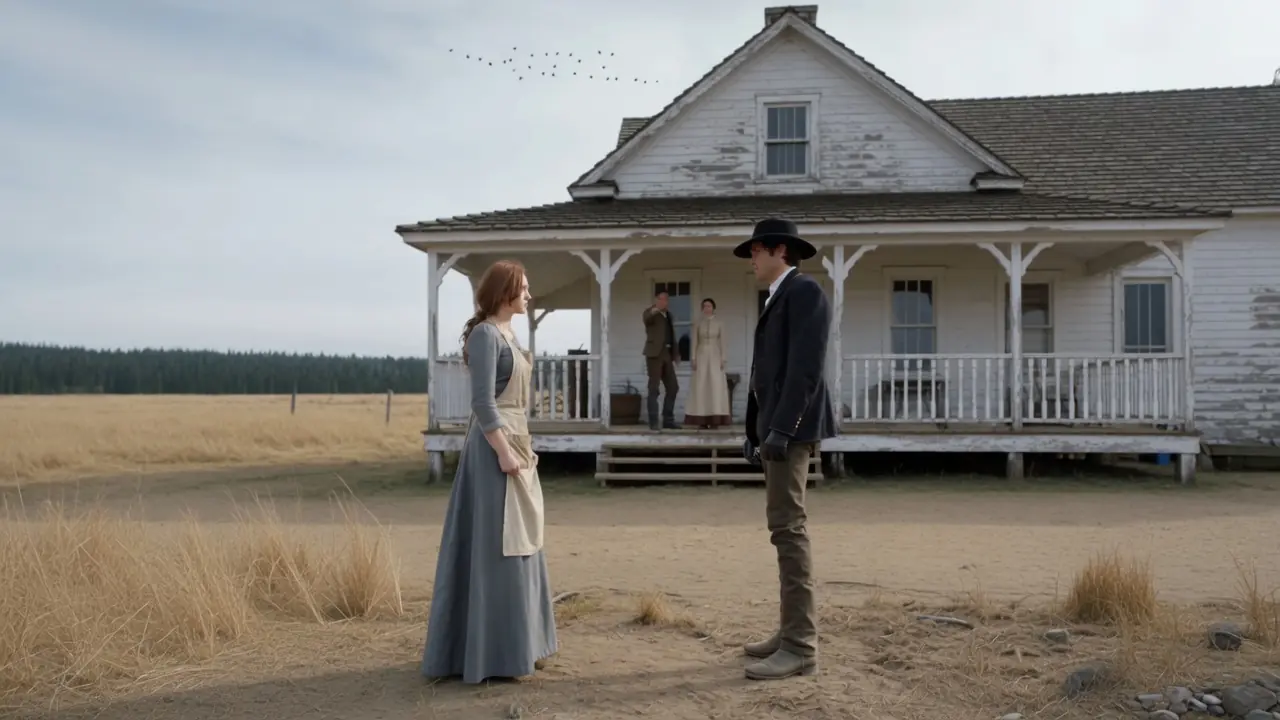
Sarah stood so fast her chair scraped the floor. “I never received any letters.” Caleb’s eyes closed briefly, as if the answer hurt even though he had expected it. Ruth looked toward the stove, shame passing across her face. “Samuel burned them,” she whispered.
Daniel turned to his mother. “You knew?” Ruth wiped her cheeks, her hands trembling in her lap. “I knew after the third one. Your father said he was doing what was best for Sarah.” Sarah pressed one hand against the table, feeling as if the house had tilted around her. For ten years, she had believed Caleb left because she meant nothing to him.
Caleb’s voice softened. “I stopped writing because silence seemed like your answer.” Sarah looked at him then, really looked, and saw the boy she had loved buried under a decade of weather, labor, and loneliness. “You should have come back sooner,” she said. “I know,” he answered.
Before more could be said, hoofbeats sounded outside. Daniel moved to the window and cursed under his breath. A black carriage rolled into the yard, followed by two riders wearing the bank’s colors. Amos Kincaid stepped down in a fine gray suit, brushing dust from his sleeves like the farm had already offended him. His smile was thin, polished, and hungry.
Caleb folded the documents quickly and placed them back inside the oilcloth. “Did you send for him?” Daniel demanded. Caleb shook his head. “No.” Sarah looked toward the yard, where Kincaid was already walking toward the porch. “Then he knew you were coming.”
Kincaid entered without knocking, as if ownership had already transferred. He removed his hat and smiled at Ruth with false sympathy. “Mrs. Whitmore, I apologize for the intrusion, but matters of property rarely wait for comfortable timing.” His eyes moved to Caleb and sharpened. “Mr. Reed, I presume.”
Caleb stepped forward. “You know my name.” Kincaid smiled wider. “Men asking about land records attract attention.” Daniel moved beside Caleb despite his earlier anger. “This is still our house, Kincaid. Say what you came to say.”
The banker placed a folded notice on the kitchen table. “I have come to inform you that foreclosure proceedings will begin at noon tomorrow unless the outstanding debt is paid in full.” Ruth gasped, and Sarah felt the blood drain from her face. Daniel snatched the paper and read it, his jaw tightening. “You told us we had thirty days.”
“Circumstances changed,” Kincaid said smoothly. His gaze rested on Caleb’s coat pocket, where the documents were hidden. “Certain claims have surfaced that may complicate the title, and the bank prefers to settle matters before confusion spreads.” Caleb’s expression darkened. “You mean before the truth spreads.”
Kincaid’s smile disappeared. “Truth is what can be proven in court, Mr. Reed, not what drifters carry in their pockets.” He looked at Sarah then, and his voice became oily. “Miss Whitmore, I hope you will encourage your family to be practical. Pride will not keep a roof over your mother’s head.”
Sarah stepped closer, her hands curled at her sides. “Neither will surrendering to a thief.” Daniel glanced at her in surprise, but she did not look away from Kincaid. For years, she had kept peace, swallowed fear, and let men decide what danger meant. That moment ended in her kitchen.
Kincaid’s eyes hardened. “Be careful, Miss Whitmore.” Caleb moved slightly, not in front of Sarah, but near enough to stand with her. “She is being careful,” he said. “She is choosing her words better than you deserve.” Kincaid studied them both, calculating. “Noon tomorrow,” he said, then turned and walked out.
After he left, the kitchen remained silent for several long seconds. Then Daniel struck the table with his fist. “We cannot fight the bank by noon.” Ruth closed her eyes, whispering a prayer. Sarah looked at Caleb. “Can your documents stop him?”
“If we get them before Judge Hanley in town by morning,” Caleb said. “But Kincaid will try to stop us before we reach him.” Daniel gave a bitter laugh. “So now we trust the man who may own half our farm to save all of it.” Caleb met his stare. “You do not have to trust me. Trust your father’s handwriting.”
They spent the afternoon preparing as if for battle. Ruth copied Samuel’s confession in case the original was stolen, Daniel cleaned his rifle, and Sarah packed food, water, and a small Bible her father had carried during storm seasons. Caleb checked the horses and studied the back roads to town. He chose the creek trail instead of the main road because it passed through trees and would be harder to watch.
Near dusk, Sarah found Caleb by the barn. He was tightening a saddle strap, but his hands paused when he heard her approach. For a moment, neither of them spoke, and the quiet between them felt crowded with ten missing years. Sarah finally said, “I waited for you.”
Caleb looked down. “I hoped you would not.” She almost laughed because the answer was so painfully like him. “That is a cruel kind of mercy.” He lifted his eyes to hers, guilt written across his face. “I thought if you forgot me, you might have a life.”
Sarah looked toward the farmhouse window where her mother’s lamp glowed. “I had a life,” she said. “It was work, grief, debt, and wondering why the one person who looked at me like I mattered left without goodbye.” Caleb’s face tightened, and he stepped back as if the truth had struck him. “I am sorry, Sarah.”
She wanted to stay angry. She wanted to hold the hurt like a weapon because it was the only thing that had belonged fully to her for ten years. But looking at him, she saw a man who had been wounded by the same choice that wounded her. Her father had tried to protect her by breaking both their hearts. Now the broken pieces had returned carrying proof.
Before dawn, they left for town. Caleb rode ahead, Daniel followed with the documents hidden beneath his coat, and Sarah rode beside her brother despite his protests. Ruth remained at the farm with the copy and a shotgun Caleb had quietly placed by the door. The sky was still pale when they entered the creek trail, and every birdcall sounded like a warning.
They were halfway through the cottonwoods when the first shot cracked through the trees. Caleb’s horse reared, and Sarah ducked low over her saddle as bark exploded from a trunk beside her. Daniel shouted and pulled his rifle free. Two men rode out from the brush, faces covered with bandannas, pistols raised.
Caleb turned his horse hard and drew his revolver, firing once into the dirt near the nearest rider’s horse. The animal spooked, throwing the man sideways into the brush. Daniel fired over the second rider’s head, forcing him to wheel back. Sarah’s horse bolted, and for one terrible moment she lost the reins.
Caleb reached her before she fell. He leaned from his saddle and caught her bridle, pulling her horse steady with one strong hand. “Look at me,” he said sharply. Sarah’s breath came fast, but she fixed her eyes on him. “You are all right.”
The second rider fled, leaving the first groaning in the dirt. Daniel dismounted and tore away the man’s bandanna. “Kincaid’s clerk,” he said, disgust twisting his face. The man refused to speak, but a bank envelope in his pocket said enough. Caleb took it and found instructions to stop them before they reached Judge Hanley.
By the time they reached town, the sun had risen fully. Judge Hanley was eating breakfast at the hotel when they found him, and he looked irritated until Sarah placed Samuel’s confession, Nathan Reed’s partnership note, and Kincaid’s written instructions on the table. The judge read in silence, his expression shifting from annoyance to attention, then to anger. He sent a deputy to fetch the sheriff before the coffee cooled.
Kincaid arrived at the courthouse an hour later, summoned under pretense of clarifying the foreclosure. He entered confidently, but his face changed when he saw Caleb, Sarah, Daniel, and the captured clerk. Judge Hanley held up the forged debt note and the partnership records. “Mr. Kincaid, it appears your bank has been attempting to seize land it does not hold lawful claim over.”
Kincaid tried to smile. “Your Honor, these are complicated matters.” The judge leaned forward. “Forgery is not complicated.” The sheriff stepped beside Kincaid, and the banker’s polished confidence finally cracked. Sarah watched him reach for excuses, influence, and threats, but none came fast enough.
By noon, foreclosure was suspended, Kincaid was under arrest pending investigation, and the Whitmore farm was safe for the moment. The judge ordered the land office to recognize Nathan Reed’s original partnership claim, meaning Caleb legally owned half the north acreage. Daniel looked as if he had swallowed a stone. Sarah felt relief, confusion, and fear all at once.
Outside the courthouse, Daniel faced Caleb in the street. “So what now?” he asked. “You take your half and ride away?” Caleb looked toward Sarah before answering. “No. I sign my claim into a shared trust with the Whitmore family, unless Sarah and Ruth object.” Daniel blinked. “Why would you do that?”
“Because my father helped build that farm,” Caleb said. “And Samuel Whitmore kept it alive, even after doing wrong.” He took the folded deed from his coat. “The land belongs to both histories. It should not be split by bitterness.”
Sarah’s eyes burned. “And what do you want in return?” Caleb looked at her for a long moment. “A chance to earn what I lost when I left.” Daniel muttered something under his breath, but Ruth, who had arrived by wagon after hearing the news, touched her son’s arm. “Sometimes land is easier to mend than people,” she said softly. “But both can be mended if someone starts.”
Caleb stayed through the next weeks, repairing fences, rebuilding the barn roof, and helping Daniel untangle the farm accounts from Kincaid’s fraud. At first, Daniel treated him like an unwanted guest, but work has a way of sanding down pride. By the second week, the two men were arguing about fence posts instead of the past. By the third, Daniel admitted Caleb had a better eye for water lines than anyone he knew.
Sarah worked beside Caleb whenever she could. They spoke little at first, but the silence changed shape over time. It no longer felt like a wall, only a field waiting to be crossed. One evening, while they mended a gate near the pasture, Caleb handed her a nail and said, “I still have the first letter I wrote you.”
Sarah looked up, startled. “Why?” He smiled faintly, sad and shy all at once. “Because I never stopped needing proof that I tried.” She took the nail from his hand, and their fingers brushed. This time, neither pulled away.
Autumn came slowly to the Kansas homestead. The bank scandal spread across the county, and other farmers came forward with stories of false debts and pressured sales. Kincaid’s power collapsed under the weight of his own paper. The Whitmore farm, once nearly lost, became the case that helped save half a dozen others.
One Sunday after church, Daniel shook Caleb’s hand in front of half the town. It was awkward, stiff, and far from warm, but it was real. Ruth cried quietly into her handkerchief, and Sarah looked away before anyone saw her smile. Caleb stood beside the wagon afterward, looking more surprised by forgiveness than he had been by gunfire.
That evening, Sarah found him at the cottonwood tree near her father’s grave. He had removed his hat and was standing silently, his dark coat moving slightly in the wind. “I told him I was angry,” Caleb said when she came near. “Then I told him I understood.”
Sarah stood beside him. “Do you forgive him?” Caleb looked at the grave for a long time. “Not fully. But I think I can stop letting his choice decide the rest of my life.” Sarah nodded, feeling the truth of it settle between them. “I would like that too.”
Caleb turned to her then. “Sarah, I cannot give you back the ten years.” She looked into his face, seeing the boy, the man, the wound, and the hope all together. “No,” she said. “But maybe we can decide what to do with the years left.”
He reached for her hand slowly, giving her time to refuse. Sarah did not refuse. His palm was rough, warm, and familiar in a way memory alone could not explain. Behind them, the farmhouse glowed under the evening light, no longer just a place of grief and secrets, but a home fighting its way back to life.
The next spring, the north acreage was planted again. Caleb and Daniel worked it together under a shared agreement, Ruth kept the household accounts with sharper eyes than any banker, and Sarah began teaching local children in the front room twice a week. The farm did not become rich, and life did not become easy. But it became honest, and that was worth more than comfort.
Caleb did not ask Sarah to marry him quickly. He courted her slowly, openly, with patience that made Daniel roll his eyes and Ruth hide smiles behind her sewing. He brought her wildflowers from the creek trail, walked with her after supper, and read aloud the letters he had written years ago. Some made her cry, some made her laugh, and all of them helped return what silence had stolen.
A year after Caleb rode back into the yard, he stood with Sarah on the same dusty ground where Daniel had accused him of stealing the land. The farmhouse still needed paint, the porch still creaked, and the fields still demanded more work than any family could comfortably give. But the place felt different now. Secrets had been dragged into daylight, and the truth had made room for something new.
Caleb removed his hat, nervous in a way Sarah had never seen from him before. “I came back with papers because your father asked me to,” he said. “But I stayed because I love you, and because this is the only place that has ever felt like home.” Sarah’s eyes filled, but her smile did not tremble. “Then stay,” she said. “Not because of the land. Because of me.”
He did. And in the years that followed, people in the county would tell the story of the drifter who returned to claim a farm and ended up saving it. They would talk about forged debts, hidden deeds, and the banker who thought grief made families weak. But Sarah knew the deeper truth.
Caleb had not returned only for land, revenge, or a dead man’s confession. He had returned carrying the past in his coat pocket, hoping it was not too late to repair what pride had broken. And Sarah, who had waited ten years for an answer, finally learned that love does not always arrive on time. Sometimes it comes back covered in dust, holding the truth, asking for one more chance.