A Dog Begged Beneath the Statue of Jesus Every Morning — Then an Elderly Woman Followed Him Into the Woods
Every morning before sunrise, the dog appeared beneath the statue of Jesus.
He always came alone.
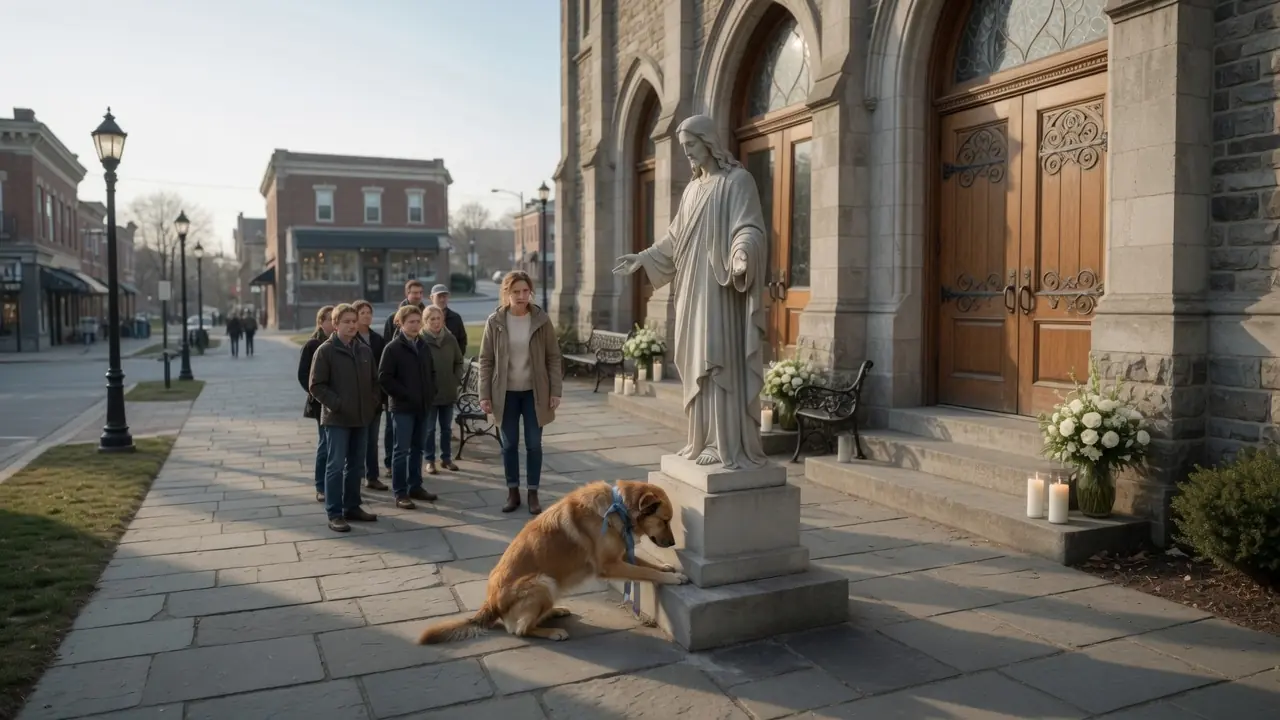
He would cross the empty churchyard, climb the three stone steps leading toward the statue, and lower himself onto his front legs.
Then he would place both paws against the base of the figure and lift his face toward the outstretched hands above him.
From a distance, it looked as though he were praying.
But those who came close enough could hear the truth.
The dog was crying.
Not barking.
Not howling.
Crying.
Soft, broken sounds escaped his throat as he stared upward, his thin body trembling beneath a coat matted with dirt and dried mud.
For eleven mornings, people in the small town of Willow Creek watched him.
Some stopped to take photographs.
Others recorded videos.
A few left food beside the church steps.
The dog never touched it.
As soon as the church bell rang at seven, he would turn, cross the cemetery behind the chapel, and disappear into the woods.
By the time townspeople began arriving for work, he was gone.
People created explanations.
Perhaps his owner had died and been buried near the church.
Perhaps someone had abandoned him there.
Perhaps he had been trained to kneel.
One local teenager uploaded a video with the caption:
THE DOG THAT PRAYS TO JESUS.
Within two days, it had thousands of views.
People called it beautiful.
A sign from heaven.
Proof that animals had souls.
Only seventy-nine-year-old Evelyn Harper noticed that the dog did not look peaceful.
He looked desperate.
Evelyn had lived across from Saint Matthew’s Church for nearly forty years.
Her husband, Walter, had built the wooden fence surrounding their little house. Their two daughters had been baptized inside the chapel. After Walter died, Evelyn continued attending Sunday services alone, always sitting in the last pew near the aisle.
Age had slowed her steps, but not her attention.
She noticed things most people hurried past.
A child who arrived at school without a coat.
A mailbox overflowing at a neighbor’s house.
A cashier blinking back tears behind the grocery counter.
And the way the stray dog kept looking over his shoulder while kneeling beneath the statue.
He was not simply praying.
He was waiting.
The first morning Evelyn approached him, the sky was still dark.
A thin layer of frost covered the grass.
The dog stood beneath the statue, front paws pressed against the stone, his muzzle pointed toward the face of Jesus.
“Hello, sweetheart,” Evelyn said.
The dog turned sharply.
He was a German Shepherd mix, perhaps three years old. His ribs showed beneath his coat, and a frayed blue rope circled his neck in place of a collar.
Evelyn stopped several yards away.
“I brought you something.”
She placed a bowl of chicken near the bottom step.
The dog stared at it.
His nose moved.
But he did not approach.
Instead, he looked toward the cemetery.
Then back at Evelyn.
“What is it?”
The dog whined.
He moved down one step, stopped, and looked behind him again.
Evelyn took another careful step.
The dog backed away.
“All right.”
She raised both hands.
“I won’t come closer.”
The dog turned and ran.
He crossed between the gravestones and vanished beyond the tree line.
The chicken remained untouched.
The following morning, Evelyn returned.
This time she brought no food.
She stood beneath an oak tree and watched.
The dog arrived at six twenty-three.
He approached the statue.
He lowered himself.
But now that Evelyn was closer, she saw details the videos had missed.
The dog’s paws did not rest randomly against the stone.
They pressed beside a carved image near the base.
A small child kneeling beneath Jesus.
The animal touched his nose to the child’s carved face.
Then he scratched once at the stone.
He looked behind him.
Waited.
Scratched again.
Evelyn’s skin prickled.
“You are not asking him, are you?” she whispered.
The dog turned his head toward her.
“You are asking us.”
The dog stepped down.
He moved a few feet toward the cemetery.
Then stopped.
He looked back at Evelyn.
When she remained still, he returned and pulled gently at the bottom of her coat.
Evelyn’s heart began beating faster.
“You want me to follow you?”
The dog released the fabric.
He moved toward the graves.
Then looked back again.
Every sensible thought told Evelyn to remain where she was.
The woods behind Saint Matthew’s stretched for miles. The ground was uneven, and she walked with a cane when her knees became stiff.
No one knew she had left home.
Her phone had only half a battery.
She was nearly eighty years old, and the sun had not yet risen.
The dog whined.
Then he disappeared between the gravestones.
Evelyn gripped the handle of her cane.
“Walter would call this foolish.”
She began walking.
The dog waited beyond the cemetery fence.
When she reached him, he moved ahead.
Not quickly.
He seemed to understand that she could not keep pace.
Every twenty yards, he stopped and looked back.
Evelyn followed him through the woods.
Dead leaves cracked beneath her shoes. Bare branches formed dark shapes against the gray morning sky.
The path narrowed.
Then disappeared entirely.
“Where are you taking me?” she asked.
The dog continued.
After nearly twenty minutes, Evelyn considered turning back.
Her knees hurt.
Cold air burned inside her lungs.
Then she heard something.
At first, she thought it was a bird.
A faint sound came from somewhere ahead.
High.
Weak.
Almost swallowed by the wind.
Evelyn stopped.
The dog stopped too.
There it was again.
A cry.
Not an animal.
A child.
Evelyn’s fingers tightened around her cane.
“Oh, dear God.”
The dog ran forward.
Evelyn followed as quickly as her legs allowed.
They reached an old service road hidden beneath weeds and fallen branches. At the far side stood a building Evelyn had never seen before.
An abandoned hunting lodge.
Its wooden walls had turned gray with age. Several windows were covered with boards. A rusted chain hung from the front gate.
The dog squeezed through an opening beneath the fence.
Evelyn searched for another entrance.
“Hello?”
No answer.
The crying came again.
This time, there was no doubt.
A child was inside.
Evelyn pulled out her phone and called emergency services.
“My name is Evelyn Harper,” she said breathlessly. “I am in the woods behind Saint Matthew’s Church. A dog led me to an old building, and I can hear a child crying.”
The dispatcher asked for her location.
Evelyn could not provide an address.
She used the emergency location function on her phone.
“Officers are on their way,” the dispatcher said. “Do not enter the building.”
The dog barked from the other side of the fence.
Then he disappeared through a broken section of wall.
The child cried again.
Evelyn looked toward the woods.
Police could take fifteen minutes.
Perhaps more.
The temperature was below freezing.
She found a gap beside the gate and forced her body through.
Her coat snagged on the wire.
She tore it free.
The lodge door was locked.
“Can you hear me?” she shouted.
The crying stopped.
For a moment, there was complete silence.
Then a child’s voice answered.
“Buddy?”
Evelyn moved closer.
“My name is Evelyn. I’m here to help you.”
“Where’s Buddy?”
“The dog?”
“Yes.”
“He brought me.”
A sob came from inside.
“He came back.”
Evelyn circled the building.
Near the rear, one window had lost half its boards.
The dog stood beneath it, barking.
Evelyn placed her cane against the wall and pulled at the remaining wood.
The first board did not move.
She pulled harder.
Pain shot through her shoulder.
“Please,” she whispered.
The nails finally broke free.
Evelyn pushed the board aside and looked into the room.
A little girl lay on a stained mattress in the corner.
She appeared six or seven years old.
Her brown hair was tangled. Her face was pale, and both wrists were tied with plastic cord to a metal bed frame.
The dog stood beside her licking her cheek.
Evelyn covered her mouth.
The girl wore a thin pink nightgown.
No socks.
No shoes.
Dark bruises covered one arm.
“Sweetheart.”
The child looked toward the window.
“Are you real?”
“Yes.”
“Did Jesus send you?”
Evelyn’s eyes filled with tears.
“The dog did.”
The little girl looked at the animal.
“I told Buddy to find the church.”
Evelyn reached through the window.
“I called the police. They are coming.”
The child began crying harder.
“No. He’ll come back.”
“Who?”
“The man.”
“What man?”
The girl shook her head violently.
“He said if I talked, he would hurt Buddy.”
The dog pressed closer to her.
Evelyn tried the window.
The opening was too small for her to climb through.
She looked for something to break the remaining boards.
Her cane.
Evelyn swung the metal handle against the wood.
Once.
Twice.
The board cracked.
Her hands began trembling from the effort.
Inside, the girl flinched with each strike.
“It’s all right,” Evelyn said. “I am making the opening larger.”
The dog barked.
Not at Evelyn.
Toward the woods.
His ears lifted.
His body stiffened.
Then Evelyn heard an engine.
A vehicle was approaching along the hidden service road.
The little girl screamed.
“He’s coming!”
Evelyn looked toward the gate.
A dark pickup emerged through the trees.
Her heart seemed to stop.
The dispatcher’s voice came through the phone in her pocket.
“Mrs. Harper? Are you still there?”
“Yes,” Evelyn whispered.
“The officers are approximately seven minutes away.”
“I don’t think we have seven minutes.”
The truck stopped near the lodge.
A man stepped out.
He was tall, perhaps in his forties, with a thick beard and a hunting jacket. He carried a paper grocery bag in one hand.
When he saw Evelyn, he froze.
“What are you doing here?”
Evelyn gripped her cane.
“I got lost.”
Then toward the dog.
His expression changed.
“You followed that animal.”
“No.”
The man dropped the grocery bag.
Cans rolled across the frozen ground.
“You called someone?”
Evelyn said nothing.
He moved toward her.
“Give me the phone.”
She stepped backward.
“I don’t have one.”
He looked at the shape inside her coat pocket.
“Give it to me.”
The dog rushed from beneath the window.
He positioned himself between Evelyn and the man.
His lips pulled back.
A deep growl rolled from his chest.
The man stopped.
“Buddy.”
The dog’s growl became louder.
“Get over here.”
Buddy did not move.
The man reached inside his jacket.
Evelyn saw the handle of a knife.
She raised her cane.
The movement looked almost ridiculous.
An elderly woman holding a thin metal walking stick against a younger man with a weapon.
But she did not lower it.
“You stay away from that child.”
The man laughed without humor.
“You don’t know anything.”
“I know she is tied to a bed.”
“She belongs to me.”
Children did not belong to anyone that way.
The man stepped closer.
Buddy lunged.
He did not bite.
He snapped near the man’s hand and forced him backward.
The knife fell into the leaves.
The man kicked the dog hard in the ribs.
Buddy yelped and rolled across the ground.
Evelyn swung her cane.
The metal handle struck the man across the side of his head.
He staggered.
For a second, both seemed equally surprised.
Then rage filled his face.
“You stupid old woman.”
He grabbed the cane.
Evelyn refused to release it.
He jerked it from her hands and shoved her.
She fell against the lodge wall.
Pain exploded through her hip.
The man turned toward the window.
Buddy rose unsteadily.
Blood marked the fur near his mouth.
He placed himself between the man and the building again.
The child screamed from inside.
“Buddy, run!”
The dog did not run.
The man reached for the fallen knife.
A siren sounded faintly in the distance.
He stopped.
Evelyn heard it too.
Then another siren joined the first.
The man looked toward his truck.
He made his decision.
He ran.
Buddy chased him.
“No!” Evelyn called.
The man reached the driver’s door.
Before he could climb inside, Buddy caught the bottom of his jacket and pulled.
The fabric tore.
The man kicked backward.
Police vehicles burst through the trees.
One cruiser blocked the service road.
The man turned and ran into the woods.
Two officers chased him.
Another rushed toward Evelyn.
“Where is the child?”
“Inside.”
Firefighters arrived minutes later.
They broke through the lodge door.
The little girl was carried out wrapped in a thermal blanket.
Buddy tried to follow the stretcher but collapsed.
A paramedic knelt beside him.
Evelyn watched as they lifted the dog carefully onto another blanket.
“Will he live?”
“We need to get him to an emergency veterinarian.”
The girl reached toward him.
“Don’t leave Buddy.”
Evelyn took her hand.
“He didn’t leave you.”
The child looked at her.
“He went every morning.”
“What?”
“I told him there was a church through the woods.”
Her voice shook.
“My mom used to take me there.”
“Saint Matthew’s?”
The girl nodded.
“She said if I was ever scared, I should ask Jesus for help.”
Evelyn looked toward the dog.
“You told Buddy to go?”
“I opened the window a little and helped him squeeze out.”
“Why did he return?”
“He wouldn’t leave me.”
The girl began crying.
“I told him to find somebody, but he kept coming back alone.”
Buddy had gone to the church each morning.
He had pressed his paws against the statue.
He had cried.
He had waited.
And every day, when no one understood, he had returned to the lodge rather than abandon the child.
Until Evelyn followed.
At the hospital, the little girl finally gave police her name.
Grace Miller.
Seven years old.
She had been missing for forty-three days.
Her face had appeared on television, posters, and online alerts throughout the state.
Police believed she had been taken while walking home from her school bus stop in a neighboring county.
Thousands of volunteers had searched roads, parks, drainage channels, and abandoned properties.
No one had searched the old hunting lodge because county records listed it as demolished fifteen years earlier.
The man who abducted Grace was named Calvin Roark.
He had once worked as a maintenance contractor at her school.
He watched children arrive and leave.
He noticed which ones walked home alone.
Grace remembered him because he had repaired a classroom door.
The afternoon she disappeared, he claimed her mother had sent him to pick her up.
Grace did not believe him.
He forced her into the truck anyway.
Buddy had been with Grace that day.
The small dog chased the vehicle for nearly half a mile before disappearing.
Everyone assumed he was lost.
No one knew he had followed the truck by scent.
Calvin tried to chase him from the property.
Buddy hid in the woods.
At night, he returned to the lodge.
Grace fed him pieces of bread through the damaged window.
Eventually, Calvin believed the dog had left.
Buddy remained close.
He slept beneath the lodge.
He found water in a creek.
He dug through trash near a gas station for food.
And when Grace told him to seek help at the church, he began making the long journey every morning.
Calvin Roark was captured before sunset.
Police found him hiding in a drainage tunnel less than two miles from the lodge.
Inside his truck were photographs of other children.
Maps.
School schedules.
News clippings.
The discovery turned Grace’s rescue into the beginning of something much larger.
Investigators searched Roark’s home and a second property in another state.
They found evidence connecting him to the disappearances of three children over a period of nine years.
Two had never been found.
One had been discovered beside a highway, and her death had remained unsolved.
The old lodge was not the only place he used.
Grace had not simply been one missing child.
She was the surviving witness who could expose a predator hidden behind ordinary jobs and familiar faces.
That was the earth-shattering secret Buddy had been trying to lead someone toward.
The dog people believed was praying had been begging the town to follow him before another child disappeared.
Grace remained in the hospital for twelve days.
She suffered dehydration, malnutrition, frostbite in two toes, and severe emotional trauma.
Her mother, Rebecca Miller, rarely left her bedside.
The reunion was not shown to reporters.
Rebecca refused every interview.
She spent hours holding Grace, apologizing for not finding her sooner.
Grace always gave the same answer.
“Buddy found me.”
Buddy underwent surgery at a veterinary hospital.
Two ribs were broken.
One lung had been bruised.
A cut near his mouth required stitches.
The veterinarian said he had been severely underfed long before the kick.
He had survived on almost nothing while continuing to travel between the lodge and the church.
Evelyn visited him every afternoon.
She sat beside his kennel and read aloud from whatever book she happened to bring.
Sometimes the Bible.
Sometimes mystery novels.
Once, a gardening catalog.
Buddy did not care.
He rested his head near her chair and listened to the sound of her voice.
On the fifth day, Grace visited in a wheelchair.
Buddy heard her before seeing her.
He struggled to stand.
When the door opened, his entire body began shaking.
Grace climbed carefully from the chair and knelt beside him.
“You did it.”
Buddy pressed his face against her chest.
Everyone in the room cried.
Even the police officer standing near the door.
The video of Buddy beneath the statue had already spread around the world.
But now people watched it differently.
Before, they had seen a mysterious dog apparently praying.
Now they saw a messenger nobody had understood.
The church released security footage from all eleven mornings.
Each recording showed the same pattern.
Buddy arrived exhausted.
He pressed his paws against the statue.
He cried.
He approached people.
He pulled gently at coats.
He ran toward the cemetery.
Most people petted him.
Some photographed him.
One man gave him a sausage.
No one followed.
Until Evelyn.
News programs praised her as a hero.
She rejected the word.
“I was curious,” she told a reporter.
“You entered an abandoned building and faced an armed man.”
“I was foolish.”
“You saved a child.”
“The dog saved her.”
“Why did you follow him?”
Evelyn looked toward the statue.
“Because everybody else was looking at what the dog appeared to be doing.”
She paused.
“I looked at what he was asking us to do.”
Saint Matthew’s Church created a fund for Grace’s recovery and for families of missing children.
The statue became covered with flowers, letters, dog toys, and photographs.
People traveled from other states to see the place where Buddy had waited.
The priest eventually placed a small plaque beneath the statue.
It read:
HE COULD NOT SPEAK.
HE STILL ASKED FOR HELP.
SHE WAS THE FIRST TO LISTEN.
Evelyn objected to the final line.
“I was not the first to hear him,” she said.
“What should it say?” the priest asked.
She thought for a moment.
Then the plaque was changed.
HE COULD NOT SPEAK.
HE STILL ASKED FOR HELP.
SHE WAS THE FIRST TO FOLLOW.
Grace and Buddy returned home in January.
The house had been filled with welcome banners and balloons.
Grace disliked the attention.
She slept poorly.
She avoided closed doors.
For several weeks, she refused to let Buddy leave the room.
Rebecca contacted Evelyn often.
At first, to thank her.
Then for advice.
Evelyn had no experience helping a rescued child recover from trauma, but she understood silence and patience.
She visited once a week.
She never asked Grace to explain what happened.
They baked bread.
Worked on puzzles.
Painted small stones.
When Grace wanted to speak, Evelyn listened.
When she did not, Evelyn spoke about her garden.
Buddy followed them everywhere.
One afternoon, Grace asked Evelyn a question.
“Did Jesus really send you?”
Evelyn placed down her paintbrush.
“What do you think?”
Grace looked toward Buddy sleeping beside her chair.
“I asked Jesus to send help.”
“Yes.”
“But Buddy went.”
“He did.”
“And you followed.”
“Yes.”
Grace thought carefully.
“Maybe that is how he sends people.”
Evelyn smiled.
“Perhaps.”
The criminal investigation continued for nearly two years.
Calvin Roark refused to admit involvement in the other children’s disappearances.
But forensic evidence connected his properties and vehicles to all three cases.
He was sentenced to life in prison without the possibility of parole.
During the trial, prosecutors showed the video of Buddy leading Evelyn toward the woods.
The defense objected, claiming it was emotionally manipulative.
The judge allowed only the sections relevant to the rescue timeline.
Grace did not testify in open court.
Her earlier recorded interviews were used instead.
Evelyn attended the final day of trial.
When the sentence was announced, she felt no satisfaction.
Only relief.
A dangerous man could no longer watch children from school hallways and pretend to be harmless.
The secret beneath the lodge had not ended with Grace’s rescue.
It gave three families answers they had spent years fearing they would never receive.
The remains of the two missing children were eventually recovered.
Their parents held funerals.
Evelyn attended both.
She did not know the families.
She sat quietly in the back.
At one service, a grieving mother approached her afterward.
“Why did you come?”
Evelyn looked toward Buddy, who waited outside with Rebecca.
“Because your daughter was part of where he was trying to lead us.”
The woman embraced her.
Years passed.
Grace grew.
The injuries healed before the fear did.
But the fear softened.
At ten, she returned to school.
At twelve, she began volunteering at an animal shelter.
At sixteen, she helped establish a program teaching children how to identify safe adults and seek help in emergencies.
Buddy remained beside her.
His face grew pale around the muzzle.
His steps slowed.
But every December, on the anniversary of Grace’s rescue, they visited Saint Matthew’s.
Buddy would approach the statue.
He no longer stood on his hind legs or scratched the stone.
He would simply lie down beneath the figure of Jesus and rest his head on his paws.
Grace sat beside him.
Evelyn joined them whenever her health allowed.
People often gathered at a respectful distance.
Some prayed.
Some cried.
Some only watched.
On Buddy’s final visit, he was nearly fifteen years old.
Grace was nineteen.
Evelyn was ninety-one and used a wheelchair.
Snow fell lightly across the churchyard.
Buddy walked slowly toward the statue.
Grace supported him with a harness.
When they reached the steps, he lowered himself.
He looked toward the woods.
Then at Grace.
His tail moved once.
Grace knelt beside him.
“You don’t have to go anywhere now.”
Buddy placed his head in her lap.
He died three days later at home.
Grace buried his ashes beneath a dogwood tree near the church cemetery, with permission from the parish.
The stone placed there contained no mention of heroism.
Grace chose the words herself:
BUDDY
HE KEPT ASKING UNTIL SOMEONE FOLLOWED.
Evelyn died the following spring.
At her funeral, Grace stood before the same statue and told the story of the morning an elderly woman decided a dog’s strange behavior meant more than it appeared.
“She did not know who I was,” Grace said.
“She did not know what waited in the woods.”
Her voice trembled.
“She only knew that something frightened and desperate was asking her not to walk away.”
Grace looked toward Evelyn’s daughters in the front row.
“Everyone saw Buddy kneeling.”
She paused.
“Evelyn was the one who understood that prayer sometimes requires feet.”
After the service, people remained in the churchyard.
They placed flowers beside Evelyn’s grave.
A small child walked toward the statue and touched the carved figure of Jesus.
His mother stood behind him.
“Is this where the dog prayed?” he asked.
The woman looked toward the woods.
“Yes.”
“Did Jesus answer?”
She glanced at Buddy’s tree.
Then toward Evelyn’s grave.
“Yes,” she said softly.
“But not all at once.”
For eleven mornings, the people of Willow Creek saw a dog kneeling beneath a statue.
They thought they were witnessing devotion.
Some called it beautiful.
Some called it a miracle.
Most recorded it and moved on.
The truth was far more urgent.
Buddy was not performing for the crowd.
He was not seeking food.
He was not mourning an owner buried nearby.
He was begging.
Behind the church, deep inside the winter woods, a little girl waited tied to a bed while a dangerous man prepared to hide evidence of crimes stretching back almost a decade.
Buddy had no words.
No map.
No way to explain what he had seen.
He had only memory, loyalty, and the hope that somewhere near the statue Grace trusted, a human being might finally understand.
Many people noticed him.
Only one followed.
And because one elderly woman chose curiosity over indifference, a child came home, a predator was exposed, and several families finally learned the truth.
Sometimes the answer to a prayer does not descend from the sky.
Sometimes it appears as an old woman in a torn coat, following muddy pawprints into the woods.