“License and registration. Now.”
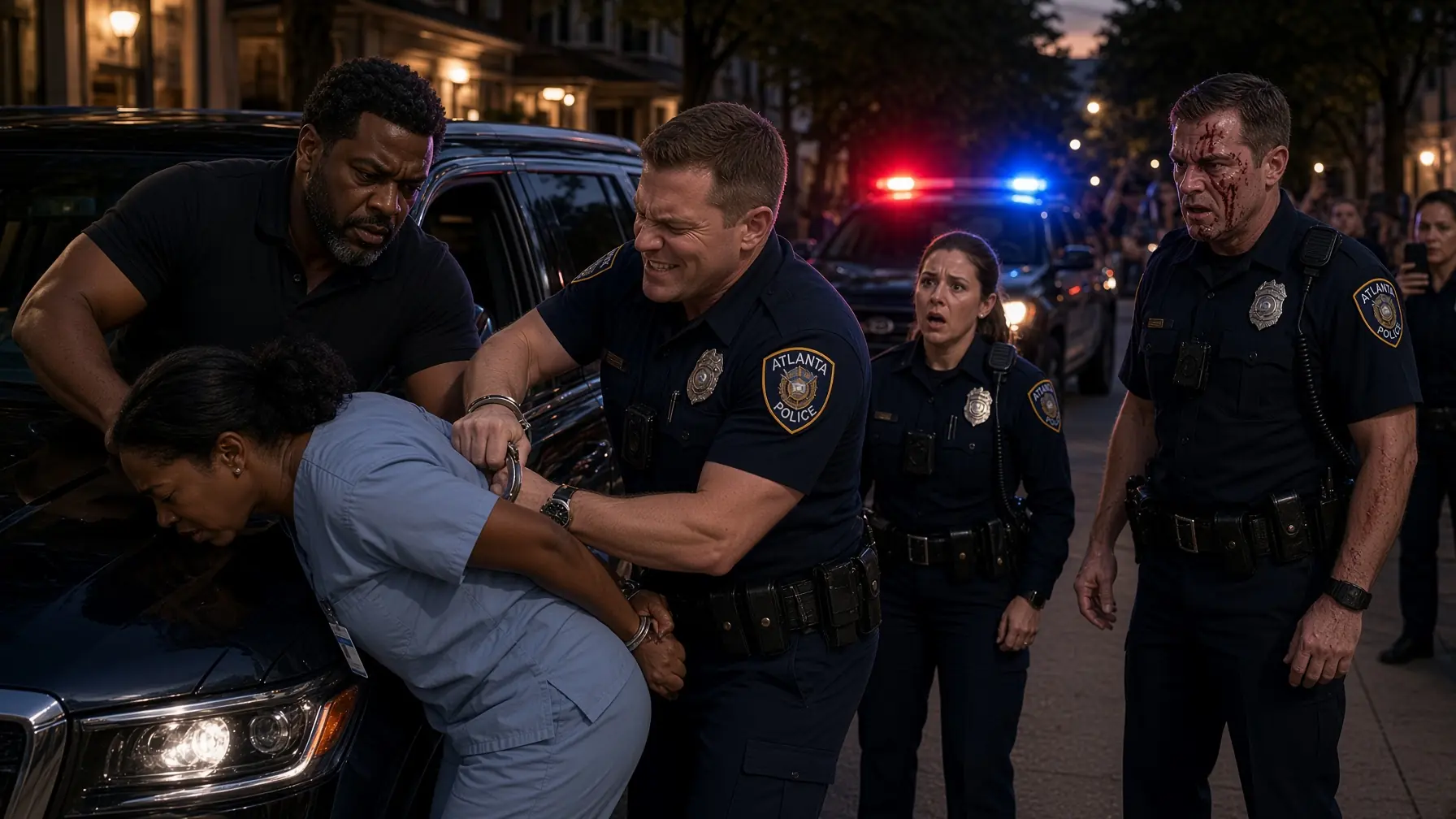
Dr. Serena Howard kept both hands visible on the steering wheel. The red and blue lights behind her Cadillac Escalade painted the windshield in alternating flashes, but she resisted the urge to look in the mirror. Her voice remained measured. “Good evening, Officer. May I ask why you stopped me?”
Officer Kyle Brennan leaned closer to the open window and aimed his flashlight directly into her face even though the Georgia evening still held plenty of light.
“Did I say you could start asking questions?”
Serena blinked against the beam but did not move her hands. Twelve hours earlier, those same hands had been inside the chest of a six-year-old boy repairing a congenital heart defect. Three hours after that, they had helped stabilize a premature infant whose heart was barely the size of a walnut. Now she was carefully controlling every movement because a police officer seemed to be waiting for one he could misunderstand.
Brennan looked around the leather interior.
“Nice ride.”
Serena said nothing.
He looked at her again.
“Pretty expensive for a doctor who says she works at a public hospital.”
The wording made Serena’s stomach tighten.
She had not yet told him where she worked.
Beside her, Jerome Howard lowered the tablet resting on his knee.
Brennan’s flashlight swept across him for less than a second. Black man, late forties, dark polo shirt, no visible badge, no uniform. Apparently not worth further examination.
“Who’s this?” Brennan asked.
“My husband.”
Brennan gave a small laugh.
“Sure.”
Jerome turned his head.
Serena recognized the look immediately.
After twenty-one years of marriage, she knew nearly every version of his silence. The irritated silence. The exhausted silence. The silence he used when someone said something stupid at a dinner party and he was deciding whether correcting them was worth ruining dessert.
This one was different.
He was studying Brennan.
Not with anger.
With attention.
That made Serena more nervous than anger would have.
Brennan tapped the roof of the Escalade.
“Documents.”
“My wallet is in my purse. I’m going to reach for it slowly.”
“Just do it.”
Serena reached toward the center console, removed her wallet, and handed over her driver’s license and registration.
Brennan looked at the license.
“Dr. Serena Howard.”
“Yes.”
“What kind of doctor?”
“Pediatric cardiac surgeon.”
He stared at her.
Serena could almost see the disbelief become amusement.
“At St. Gabriel Children’s?”
“Yes.”
“Right.”
“I’m sorry?”
“Nothing.”
He handed the registration to the younger officer standing several feet behind him.
Officer Dana Wilson had been unusually quiet since the stop began. She looked twenty-eight at most, maybe younger, and the small green light on her body camera was blinking.
Serena noticed because Brennan’s body camera was blinking too.
The patrol car’s dashboard camera, however, appeared dark.
Jerome noticed that.
He had noticed it before Brennan reached the window.
At 7:41 p.m., exactly sixteen minutes earlier, the evening had felt almost perfect.
The Howards were driving home along Peachtree Heights Road after Serena’s longest surgical shift of the month. She had changed from hospital shoes into sneakers but had not bothered changing out of her navy scrubs. The faint smell of antiseptic still clung to her hair, and the muscles between her shoulders ached from standing over operating tables for hours.
Jerome sat beside her reviewing documents on a city-issued tablet.
He was forty-nine, broad-shouldered, close-cropped gray beginning to show at his temples. Most strangers interpreted his stillness as calm. Serena knew better. Jerome’s mind was rarely still.
He had been appointed chief of the Eastbridge Police Department ninety-three days earlier.
Eastbridge sat along the northeastern edge of metro Atlanta and employed nearly nine hundred sworn officers. It was large enough that Jerome did not personally know every patrol officer, especially those assigned to precincts he had barely visited since taking office.
He had come from outside the department after twenty-four years in law enforcement, most recently as deputy chief in Charlotte. The mayor had hired him after a series of public scandals involving officer discipline, missing evidence, and complaints that had somehow vanished inside the professional standards process.
Jerome’s photograph now hung in every Eastbridge precinct.
Apparently Officer Kyle Brennan had not studied it closely.
Serena had teased her husband about his tablet when they left the hospital.
“You promised me dinner.”
“I’m reviewing one file.”
“You said that in the elevator.”
“It was true in the elevator.”
“And now?”
“Still one file.”
“What kind?”
“Personnel.”
She glanced at the screen at a red header.
BRENNAN, K. — COMPLAINT REVIEW
“You know him?”
“Not personally.”
“That good?”
“No.”
Jerome had been reading the complaint history for nearly a week.
Nine civilian complaints in six years.
A Black college student said Brennan had searched his car after claiming he smelled marijuana. Nothing was found.
A Latino contractor said Brennan had detained him for nearly forty minutes because he did not believe the man owned the truck he was driving.
A white woman complained Brennan had threatened arrest when she refused to stop recording a traffic stop from a sidewalk.
Another Black driver alleged Brennan had deliberately tightened handcuffs after the driver asked why he had been stopped.
Not all complaints were proven.
Two had been closed because body-camera footage was unavailable.
One witness changed his account.
Another complaint clearly exaggerated part of what happened.
Jerome was careful about that.
A pattern was not permission to pretend every accusation was true.
What concerned him was something more objective.
Brennan’s uncle, Lieutenant Raymond Brennan, had served for years in the same command structure that reviewed many of those complaints. Raymond had not formally adjudicated them himself, but emails showed he repeatedly contacted investigators, characterized complainants as “career troublemakers,” and recommended informal dispositions before reviews were complete.
Jerome had scheduled a meeting for Monday with Professional Standards and the city attorney.
Not termination.
Not yet.
A full external review.
That distinction mattered.
Then the lights appeared behind Serena.
She immediately turned on the interior light.
Hands on wheel.
Window down.
Jerome noticed.
“You do that fast.”
She gave him a tired smile.
“Practice.”
“You weren’t speeding.”
“I know.”
“You signaled.”
“I know.”
He looked into the mirror.
The patrol cruiser had pulled from a convenience store parking lot almost immediately after the Escalade passed.
Jerome could have ended whatever came next before it began.
His badge holder rested inside the center console beneath napkins, sunglasses, and a paperback Serena had been trying to finish for two months.
One movement.
One credential.
One sentence.
I’m Chief Jerome Howard.
But the thought bothered him.
If the officer’s behavior improved only after learning who sat in the passenger seat, what would that prove?
Nothing useful.
So Jerome left the badge where it was.
Now, with Brennan standing at Serena’s window, that decision was beginning to feel heavier.
Brennan returned the registration to Dana.
“Know why I stopped you?”
Serena answered carefully.
“No.”
“You changed lanes without signaling.”
Jerome looked toward her.
She looked toward him.
Serena signaled every lane change. Always.
Not because she was unusually obedient.
Because years ago, her father had taught her that the easiest traffic stop to survive was the one nobody had a reason to start.
“I did signal,” she said.
Brennan’s expression changed.
“Excuse me?”
“I signaled before changing lanes.”
“So now I’m lying?”
“No. I’m telling you what I remember doing.”
“That’s calling me a liar with extra words.”
Dana shifted behind him.
“Kyle—”
He looked back.
“I’ve got it.”
Then toward Serena.
“Step out of the vehicle.”
Jerome finally spoke.
“Officer, before she exits, can you clarify whether she’s being detained for the alleged traffic violation or something else?”
Brennan looked through the window as though noticing him for the first time.
“Did I ask you?”
“No.”
“Then stay out of it.”
Jerome remained calm.
“I’m asking what legal basis you’re relying on for expanding the stop.”
Brennan laughed.
“You some kind of lawyer?”
“No.”
“Then don’t practice law from the passenger seat.”
Serena looked at Jerome.
He gave one small nod.
Comply.
She opened the door.
Brennan stepped back.
“Out.”
Serena got out.
The pavement was still warm from the August heat.
“Turn around. Hands on the hood.”
Her stomach dropped.
“Officer, am I under arrest?”
“Not yet.”
“For a turn signal?”
“For your attitude.”
Dana’s head came up.
Jerome heard it too.
Serena placed her hands on the hood.
“Officer Brennan, I am complying. I would like you to explain what you are doing.”
“You keep telling yourself that.”
He patted down her waist.
Serena stiffened.
“I do not consent to a search.”
“This is a frisk.”
“For what weapon?”
Brennan’s hand stopped.
Then continued.
Jerome opened the passenger door.
Brennan spun around.
“Get back in the car!”
Jerome stopped with both hands visible.
“My wife has complied with every instruction.”
“She interfered with my investigation.”
“What investigation?”
“Get back inside.”
“Is she suspected of being armed?”
Brennan stepped toward him.
“You want to join her?”
Dana spoke again.
“Kyle, maybe we should slow this down.”
He turned sharply.
“Wilson, handle traffic.”
“There isn’t traffic.”
“Then stand by the unit.”
Dana hesitated.
Her body camera continued recording.
Jerome looked at Brennan.
“Officer, I’m going to say this once. My wife asked why she was stopped. She gave you her license. She exited when ordered. She has not threatened you, resisted you, or interfered with anything.”
Brennan’s jaw tightened.
“You don’t tell me what happened on my stop.”
Jerome almost smiled.
Not because anything was funny.
Because that sentence told him something.
“I think your body camera might.”
Brennan looked down instinctively.
Then back at Jerome.
“Turn around.”
“Am I detained?”
“Yes.”
“For?”
“Interference.”
“What did I interfere with?”
“That’s enough.”
Brennan grabbed Jerome’s wrist.
Serena turned.
“Don’t touch him!”
“Stay where you are.”
Jerome did not pull away.
He knew better.
Brennan twisted his arm behind his back.
“Hands together.”
Jerome complied.
The first cuff closed.
Then the second.
Across the street, people had begun stopping.
A teenager stood beside a bicycle recording.
Two restaurant employees watched from a doorway.
A woman near a bus stop held her phone at chest level.
Jerome noticed all of them.
He also noticed something else.
Dana was no longer standing by the patrol car.
She was staring at Brennan.
Not confused.
Concerned.
Brennan pushed Jerome toward the front of the Escalade.
“On your knees.”
Jerome looked at him.