A Diner Owner Fired a Pregnant Waitress Over a Broken Plate — Two Hours Later, Eighty Motorcycles Surrounded His Building
Greed had a smell.
It smelled like coffee left burning on a hot plate, cheap pine cleaner, and bleach poured heavily enough to hide the odor of old grease.
For Martin Crowley, that smell meant control.
He had owned Crowley’s Family Diner for nearly eighteen years, and during that time, he had learned exactly how much pressure he could place on people who could not afford to push back.
He charged servers for broken dishes.
He deducted uniform fees from final paychecks.
He cut shifts without warning, then demanded gratitude when employees begged for extra hours.
Martin did not think of himself as cruel.
He thought of himself as efficient.
That Friday afternoon, his efficiency was focused on twenty-nine-year-old Hannah Pierce.
Hannah shifted her weight from one foot to the other while wiping booth four.
At seven months pregnant, standing was no longer effortless. Her lower back had tightened into a constant ache, her ankles had swollen against the sides of her worn sneakers, and every few minutes her unborn son pressed sharply beneath her ribs.
She dragged a damp rag across the cracked laminate table.
It left a greasy streak.
Hannah sighed, folded the rag to a cleaner section, and scrubbed again.
Crowley’s Family Diner sat along an aging stretch of county highway outside San Bernardino, California. The road had once carried tourists and factory workers. Now most traffic came from long-haul truckers, retirees, and people searching for food cheaper than anything near the interstate.
The diner was a faded relic.
Its roof leaked during heavy rain.
Several ceiling tiles were stained brown.
The air conditioner shook loudly but produced little cold air.
Outside, the neon sign had lost two letters, making the word FAMILY look broken after sunset.
The building remained open because Martin refused to spend money replacing anything that had not completely stopped functioning.
That included his employees.
He stood behind the cash register, tapping a plastic coffee stirrer against the counter while examining the afternoon receipts.
His hair was slicked flat with too much gel. White flakes had already begun collecting on the shoulders of his short-sleeved dress shirt.
His eyes moved constantly.
Toward the kitchen.
Toward the dining room.
Toward every employee who stopped moving for longer than a few seconds.
Hannah carried a tray toward the counter.
Three ceramic mugs and a glass coffee pot shifted heavily in her hands.
Her son kicked suddenly.
The pain drove beneath her ribs, stealing her breath.
Hannah leaned one hip against the counter.
“You’re not paid to rest.”
Martin’s voice traveled across the room.
Several customers looked up.
Hannah straightened immediately.
“I’m not resting. The baby moved against a nerve.”
“The baby isn’t on my payroll.”
He did not look at her.
“Booth seven needs wiping, and table two asked for more ice.”
“Yes, Martin.”
“And don’t fill the glasses to the top. Ice costs money.”
Hannah tightened her fingers around the tray.
“Yes, Martin.”
She turned away before her expression could betray her.
For three years, the diner had been her main source of income.
It was supposed to be temporary.
She had planned to finish an associate degree in medical billing, find an office job, and leave food service behind.
Then she became pregnant.
The baby’s father disappeared two weeks after she showed him the test. He removed his belongings from their apartment while she worked a double shift and left behind half a month’s rent and an unplugged telephone charger.
Hannah had not seen him since.
She could not afford to stop working.
She had sixty-three dollars in her checking account, a rent payment due in four days, and a crib waiting on layaway at a discount store.
Temporary had become survival.
At booth six sat two men who did not resemble the diner’s usual lunch customers.
They wore heavy leather vests over dark shirts. Motorcycle club patches covered their backs and chests, though the colors belonged to a fictional regional club known as the Black River Riders.
The older man was named Samuel “Bear” Donovan.
He had broad shoulders, silver hair pulled into a short ponytail, and a weathered face marked by decades of sunlight and wind.
A small patch above his chest pocket read ROAD CAPTAIN.
Across from him sat Thomas Reed, known to the club as Preacher because he spoke rarely and remembered every promise anyone made.
Thomas had a graying beard and faded tattoos covering both forearms.
Hannah approached with fresh coffee.
“Can I warm those up?”
“Please,” Bear said.
His voice was low and rough, but his expression was gentle.
She poured carefully.
Bear noticed how she shifted to reduce the pressure on her lower back.
“Long day?”
“Long month.”
Hannah rested one hand on her stomach.
“He’s decided my ribs are there for practice.”
Thomas smiled.
“I’ve got three daughters. Their mother said the last two months were nature’s way of making women look forward to labor.”
It was the first real laugh she had managed all afternoon.
“She may have been right.”
“Hannah!”
Martin’s voice snapped through the room.
“The food in the window is dying while you socialize.”
Her smile vanished.
“I need to go.”
Bear watched her move away.
Then he looked toward Martin, who had turned his attention to a seventeen-year-old busboy named Eli.
“You used too much soap again,” Martin said.
“I only used one cap.”
“One cap is enough for two buckets.”
“The floor was greasy.”
“The floor is always greasy.”
Martin reached into the mop bucket and lifted the plastic cap.
“This is money. Every time you pour too much, you’re pouring my money down the drain.”
Eli looked at the floor.
“Sorry.”
Bear raised his coffee.
“He’s a bully,” Thomas murmured.
Bear took a slow drink.
“Bullies survive by making sure no one stronger feels responsible.”
The lunch rush arrived shortly before one.
A charter bus had broken down several miles from the interstate, and more than thirty stranded passengers entered the diner searching for food and air conditioning.
Martin had scheduled only Hannah and Eli for the floor.
He had cut another server’s shift the night before because weekday lunches were “never busy enough to justify two salaries.”
Within minutes, nearly every booth was full.
Orders collected in the kitchen window.
Dirty dishes covered the bus station.
The ceiling unit rattled overhead, pushing warm air around the dining room.
Hannah moved between tables as quickly as her body allowed.
She refilled drinks.
Carried plates.
Answered complaints about waiting times she could not control.
Her back became a solid wall of pain.
Sweat dampened the hair along her forehead.
Each time she reached the kitchen window, waves of heat from the fryers struck her face.
“Order up!”
The cook hit the service bell.
An oval platter waited beneath the heat lamp.
Open-faced roast beef.
French fries.
Mashed potatoes.
A heavy bowl of gravy.
“Hannah!” Martin called. “Move!”
“I’m coming.”
She reached for the platter.
The ceramic was painfully hot.
Grease coated the underside near the rim.
Hannah adjusted her grip and turned toward booth nine.
Then her abdomen tightened.
The contraction came suddenly, wrapping around her stomach like a hard band.
Hannah stopped.
Her breath caught.
It was not labor.
Her doctor had explained Braxton Hicks contractions, but knowing the name did not make the pain less frightening when it came without warning.
She closed her eyes.
Breathe.
Wait.
Let it pass.
“Move out of the aisle.”
Martin stepped from behind the register.
“You’re blocking everyone.”
The sharpness in his voice startled her.
Hannah took one hurried step.
The sole of her right shoe caught against a torn section of linoleum.
Her ankle rolled.
The platter tilted.
Instinct overpowered everything else.
Hannah released the food and threw both hands forward to protect her stomach.
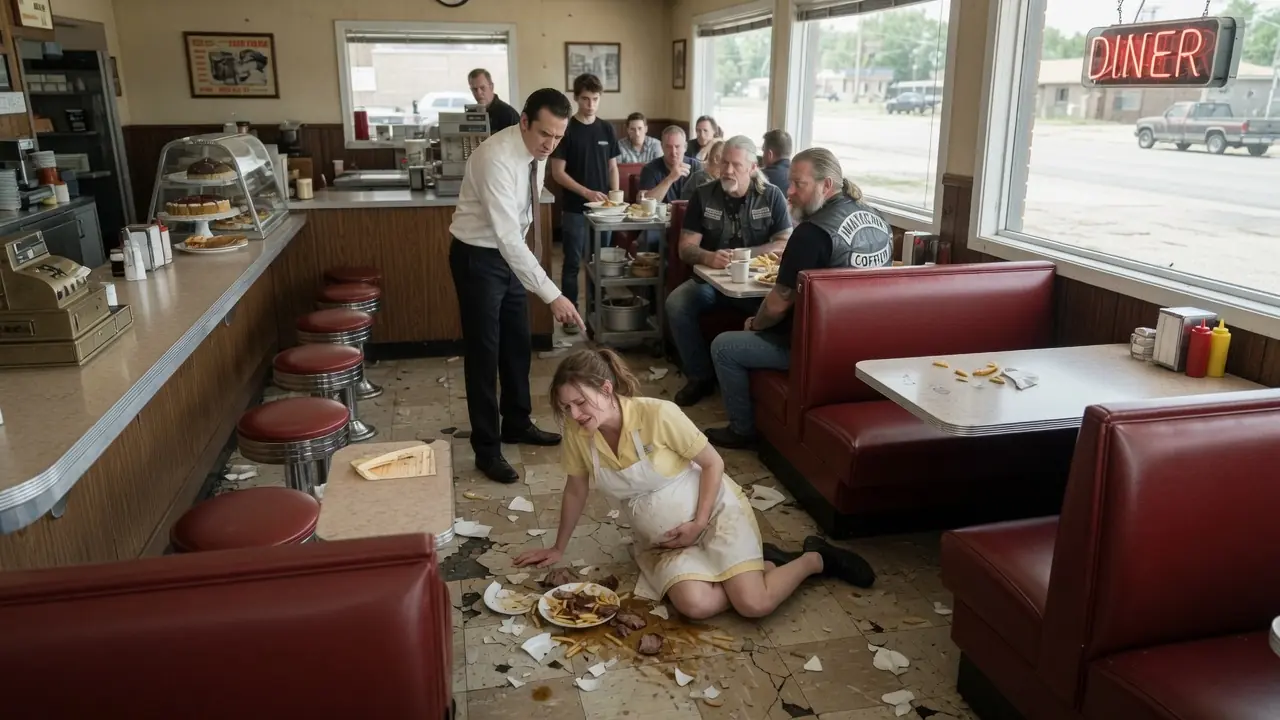
The crash silenced the entire diner.
The ceramic platter shattered against the floor.
Gravy, meat, and fries spread across the linoleum.
Hannah landed heavily on her hands and knees.
Pain shot through her wrists.
Her shoulder jarred.
But her stomach did not strike the ground.
For several seconds, she remained where she had fallen, breathing hard and listening for movement inside her.
The baby kicked.
Relief came first.
Then humiliation.
“Are you serious?”
Martin did not ask whether she was injured.
He stared at the shattered plate.
Hannah tried to stand.
The process was slow and awkward.
“I’m sorry.”
She placed one hand against a nearby chair and pulled herself upright.
“My shoe caught the floor. I had a contraction.”
“That plate costs eight dollars.”
A customer near the spill looked at Martin in disbelief.
Hannah rubbed her scraped palm.
“I’ll clean it.”
“You’re certainly going to clean it.”
Martin pointed at the mess.
“The food comes out of your tips.”
“Martin—”
“Plate too.”
She looked at him.
“The floor is torn.”
“The floor didn’t drop the food.”
A dark flush spread across Hannah’s face.
She gathered paper napkins and lowered herself carefully.
Her knees protested.
Martin stood over her while she wiped gravy from the floor.
“It was an accident,” she whispered.
“Dropping a spoon is an accident.”
His voice grew louder because he had an audience.
“This is what happens when someone is physically incapable of doing the job.”
Hannah stopped wiping.
“I can do my job.”
“You can barely move.”
“I’ve covered every table alone.”
“And look what happened.”
No customer had complained.
No one had asked Martin to fire her.
But he continued as though he were speaking on their behalf.
“I warned you that you were becoming a liability.”
Bear placed his coffee cup on the saucer.
The sound was small but deliberate.
Hannah looked up at Martin.
“I need this job.”
“Not anymore.”
The napkins stopped in her hands.
Martin folded his arms.
“I’m done watching you crawl around this place and cost me money.”
The room remained completely silent.
“You’re fired.”
Hannah’s face lost its color.
“My rent is due Tuesday.”
“Not my problem.”
“My baby is due in two months.”
“Also not my problem.”
She stared up at him from the floor.
“My paycheck from last week—”
Martin laughed.
“You broke company property. You ruined food and damaged your uniform.”
He pointed at the gravy stains on her pants.
“By the time I deduct everything, there won’t be much left.”
“You can’t deduct my entire paycheck.”
“Then sue me.”
He smiled because he knew she could not.
“Leave your apron and get out before I call the police.”
A chair moved behind him.
Bear Donovan had stood.
The room seemed smaller with him upright.
“Nobody complained about her.”
Martin turned.
“This doesn’t concern you.”
“It concerns everyone who just watched a pregnant woman fall while doing the work of three employees.”
Martin lifted his chin.
“My restaurant. My staff.”
Bear’s voice remained calm.
“She asked you for her wages.”
“She owes me for the damage.”
“That’s not how wages work.”
Martin sneered.
“Are you a lawyer?”
“No.”
“Then mind your business.”
Bear looked at the broken plate.
Then at Hannah’s scraped palms.
Finally, he looked at Martin.
“My business is recognizing a coward when I see one.”
The customers reacted with a low murmur.
Martin’s expression hardened.
“You and your friend can leave too.”
Bear did not move toward him.
He did not threaten him.
He only held his gaze long enough to make Martin uncomfortable.
Hannah stood using the edge of the booth.
She untied her apron.
Her hands shook as she folded it once and placed it on the table.
She refused to look at the customers.
Their sympathy felt unbearable.
She went into the small break room and retrieved her purse.
When she returned, Martin had resumed standing behind the register as though nothing significant had happened.
Hannah walked toward the exit.
Eli stood near the mop bucket.
“I’m sorry,” he whispered.
She managed a small nod.
“It isn’t your fault.”
The afternoon heat struck her when she stepped outside.
She reached her old Honda Civic and leaned against the roof.
The metal was hot beneath her forehead.
For several minutes, she tried not to cry.
Then the last of her control disappeared.
The tears came silently.
Not dramatic sobbing.
The exhausted, defeated weeping of a woman who had spent months calculating how little she could survive on and had just lost even that.
She had no savings.
No partner.
No paid leave.
The crib would be returned to the store.
If she missed rent again, her landlord had already warned her that he would begin eviction proceedings.
Hannah pressed one hand to her stomach.
“I’m sorry,” she whispered to her unborn child.
Inside, Martin threw a wet towel toward Eli.
“Clean that mess.”
Eli looked toward the window.
Hannah remained beside her car.
“Now.”
The boy began gathering broken ceramic.
Martin moved from table to table collecting cash left by departing customers.
At booth four, a family had left five dollars beneath a coffee cup.
He placed it in his pocket.
“That goes toward damages.”
Bear watched.
Thomas watched too.
Neither said anything.
Bear removed a worn wallet from his vest and placed a folded one-hundred-dollar bill beside his empty mug.
Then he stood.
Thomas followed.
At the register, Bear placed twenty dollars on the counter.
“Our check.”
Martin looked past him toward the hundred-dollar bill.
“That the tip?”
“The meal is covered with the twenty.”
Bear nodded toward booth six.
“The hundred belongs to Hannah.”
“She doesn’t work here.”
“It still belongs to her.”
Bear leaned forward slightly.
He did not touch Martin.
He did not raise his voice.
But something in his expression erased the owner’s confidence.
“If you put your hand on that bill, you’ll spend the rest of the afternoon wondering whether greed was worth the consequences.”
Martin swallowed.
“Are you threatening me?”
“I’m explaining ownership in words you might understand.”
For several seconds, neither moved.
Then Martin raised his hands.
“Fine. She can have it.”
Bear held his gaze a moment longer.
Then he and Thomas walked outside.
Hannah sat in the driver’s seat with the door open.
She was wiping her face with a napkin from the glove compartment.
Bear stopped several feet from the car.
“Hannah.”
She looked up.
“I’m sorry you had to watch that.”
“You have nothing to apologize for.”
“I ruined everyone’s lunch.”
“Lunch was fine.”
He nodded toward the diner.
“There’s a hundred-dollar bill on our table.”
Her eyes widened.
“Bear, I can’t take that.”
“I didn’t say I left it.”
She stared at him.
“I dropped it.”
Thomas almost smiled.
“Go find it before someone inside mistakes it for his.”
Hannah looked toward the restaurant.
She did not want to return.
She did not want to see Martin.
But one hundred dollars meant groceries.
Gas.
Part of the crib payment.
She pushed herself from the car.
Inside, the room had begun filling with conversation again, though it remained quieter than before.
Hannah walked directly to booth six.
The bill sat beside the coffee cup.
Martin watched from the register.
His eyes narrowed.
Hannah picked up the money.
She did not speak to him.
She turned and walked out.
Bear and Thomas waited near their motorcycles.
She held up the bill.
“Thank you.”
Bear nodded.
“Get home safely.”
“I don’t know how I’ll pay you back.”
“You won’t.”
He looked toward her stomach.
“Take care of yourself and the boy.”
“How do you know it’s a boy?”
“You keep calling him ‘he.’”
For the first time since falling, Hannah smiled.
The men climbed onto their motorcycles.
The engines started with a deep mechanical rumble.
Hannah watched them leave.
Then she sat behind the wheel of her Honda with the hundred-dollar bill pressed between her fingers.
It felt like more than money.
It felt like evidence that someone had seen what happened and believed she did not deserve it.
Two hours later, Martin locked the diner’s front entrance.
The lunch crowd was gone.
Eli had been sent home early so Martin would not have to pay him through closing.
The kitchen staff left through the rear door.
Martin sat alone inside his office counting the day’s cash.
He felt satisfied.
Firing Hannah had been necessary.
She had become slow.
Expensive.
Emotional.
Someone else would take the job by Monday.
Someone who would be grateful for whatever hours Martin offered.
He stacked the bills neatly.
Then he heard thunder.
At least, he thought it was thunder.
The sound grew steadily louder.
The office walls vibrated.
A framed food-service certificate rattled against the wall.
Martin stood and walked toward the dining room.
The noise became a continuous wall of engines.
He pulled back the window blind.
Motorcycles filled the parking lot.
Not ten.
Not twenty.
Row after row of them stood beneath the security lights.
Nearly eighty riders dismounted.
Men and women in leather vests formed a quiet line in front of the diner.
Different chapters of the Black River Riders had arrived from across Southern California.
Their engines shut down one by one.
The silence afterward was more frightening than the noise.
Martin’s mouth became dry.
A heavy knock struck the glass door.
“Open up.”
Martin stepped backward.
The door was locked.
Another knock followed.
No one broke the glass.
No one shouted a threat.
They simply remained outside.
Watching.
Martin reached for his phone.
He considered calling the police.
Then he imagined explaining why dozens of witnesses had watched him refuse a pregnant employee her earned wages.
He moved toward the rear exit instead.
When he opened the back door, Bear Donovan stood in the alley.
Thomas waited beside him.
Several other riders formed a wide semicircle, leaving Martin space but no clear route away.
“Going somewhere?” Bear asked.
“This is private property.”
Bear nodded.
“That’s true.”
“You’re trespassing.”
“Then call the police.”
Martin hesitated.
Bear noticed.
“You fired Hannah over an accident.”
“She dropped company property.”
“She fell because your floor is damaged.”
“She couldn’t perform the work.”
“You scheduled one pregnant server to handle a busload of customers.”
“That’s my decision.”
“You withheld her paycheck.”
“She owes me for damages.”
“No.”
Bear’s voice became firmer.
“She earned that money before the plate broke.”
Martin’s back touched the brick wall.
“What do you want?”
“The wages you owe her.”
“I don’t have her payroll ready.”
“You were counting cash when we arrived.”
“That isn’t payroll.”
Bear studied him.
“You are correct.”
Martin’s shoulders loosened slightly.
“Her payroll should include overtime, because Thomas called two former employees who confirmed you regularly changed the time sheets.”
Martin’s face changed.
Thomas held up a folder.
“People talk when someone finally asks.”
Inside were handwritten statements from three former servers and one cook.
Unpaid overtime.
Illegal deductions.
Tips taken to cover shortages.
Uniform charges never disclosed in writing.
Breaks denied during long shifts.
Martin looked toward the motorcycles beyond the alley.
“You can’t prove any of this.”
Bear nodded toward a small camera above the back door.
“The diner records audio?”
Martin glanced upward.
The security unit had been installed to watch employees near the cash storage area.
“It recorded you telling Hannah her wages were being taken.”
Martin’s mouth opened.
Bear continued.
“Eli also recorded part of the conversation on his phone.”
The boy had started recording when Martin accused Hannah of being incapable of work.
“You have two choices,” Bear said.
“You can correct this tonight, or Hannah can take the recordings and those statements to the labor commissioner tomorrow.”
Martin looked between them.
“Is this blackmail?”
“No.”
Thomas spoke for the first time.
“Blackmail means we demand something we are not legally entitled to.”
He tapped the folder.
“We’re asking you to pay what you already owe.”
Bear crossed his arms.
“Full wages from last week. Every hour from today. No deductions.”
Martin said nothing.
“Eight weeks of severance.”
“That’s insane.”
“Then she files the complaint.”
“I’ll fight it.”
“You can.”
Bear glanced toward the front of the diner.
“Several of the riders outside are union electricians, mechanics, contractors, and small-business owners. One is an employment attorney.”
Martin’s confidence collapsed another inch.
“You brought a lawyer?”
“We brought people who understand the difference between intimidation and accountability.”
Bear stepped closer.
“You’ve spent years assuming your employees could not afford to challenge you.”
His voice lowered.
“You were right about one thing. Most of them couldn’t.”
He nodded toward the folder.
“Now they don’t have to do it alone.”
Martin looked toward his office.
“What exactly do I write?”
Bear followed him inside.
The riders remained outside.
No one damaged the building.
No one touched Martin.
They did not need to.
Under the fluorescent office light, Martin wrote a check covering Hannah’s unpaid hours and eight weeks of severance.
Thomas verified the amount.
Then Bear placed a blank sheet of diner letterhead on the desk.
“Recommendation.”
Martin stared at him.
“What am I supposed to say?”
“The truth.”
“That she dropped a plate?”
“That she worked three years, covered shifts alone, trained new employees, and stayed until seven months pregnant because you refused to hire enough staff.”
Martin’s pen hovered.
Bear waited.
The letter took ten minutes.
When it was finished, Thomas read it carefully.
“Sign it.”
Martin signed.
Bear folded the check and recommendation and placed them inside his vest.
“One more issue.”
Martin looked exhausted.
“What?”
“You took employee tips.”
Martin’s face tightened.
“Tips left without a name belong to the business.”
The employment attorney entered the office.
She was a woman in her fifties named Nora Bell, a longtime rider and partner at a labor-law firm.
“No, they do not,” she said.
She placed a business card on the desk.
“Tomorrow morning, you will receive a records-preservation notice. Do not alter schedules, payroll records, camera footage, or tax documents.”
Martin stared at the card.
“What are you doing?”
“Making sure Hannah is not the only employee who gets paid.”
His knees seemed to weaken.
“This will destroy the diner.”
Nora looked around the neglected office.
“No. Your decisions may destroy the diner.”
She turned toward the door.
“There is a difference.”
Bear stopped before leaving.
“You believed no one would stand beside people who needed the work too badly to complain.”
Martin said nothing.
“Remember tonight the next time an employee asks for a break.”
The riders left the parking lot in small groups.
No windows were broken.
No threats were carried out.
Only the sound of engines remained, rolling into the darkness until the diner became quiet again.
Martin sat alone inside the office.
Stale coffee and bleach filled the air.
For the first time in years, the smell did not remind him of control.
It reminded him that people had been watching.
The following morning, Hannah sat at the kitchen table in her small apartment.
The hundred-dollar bill was tucked inside an envelope marked CRIB.
She had slept badly.
Every time she woke, she remembered Martin pointing at her while she knelt in spilled gravy.
A knock sounded at the door.
Hannah looked through the peephole.
Bear stood in the hallway holding a paper grocery bag.
She opened the door.
“What are you doing here?”
“Delivery.”
He handed her the bag.
Inside were eggs, bread, fruit, milk, and several containers of prepared food.
“Thomas’s wife packed most of it.”
Hannah looked at him.
“You didn’t need to bring this.”
“I know.”
He removed an envelope from his vest.
“This is yours.”
Hannah opened it.
She saw the check first.
Her eyes moved across the amount three times.
Then she unfolded the recommendation letter.
“Where did this come from?”
“Your former employer.”
“He wrote this?”
“Eventually.”
Hannah’s expression changed.
“What did you do?”
“Asked him to obey the law.”
“With eighty motorcycles outside?”
Bear shrugged.
“Some people need visual encouragement.”
She stared at the check.
“This is more money than I’ve had at one time in years.”
“It includes severance.”
“Why would he give me severance?”
“Because the alternative involved several government departments learning how he runs payroll.”
Hannah sat down slowly.
“Bear, I don’t want anyone hurt because of me.”
“No one was hurt.”
“You frightened him.”
“Yes.”
He did not pretend otherwise.
“Fear is not justice.”
“No.”
Bear leaned against the doorframe.
“But sometimes fear makes a man stop long enough for the law to catch up.”
Hannah looked at the recommendation.
“I still don’t have a job.”
“You might.”
She raised her head.
“One of our members owns a motorcycle-parts distribution company. Their office coordinator is leaving next month.”
Hannah shook her head.
“I don’t know anything about motorcycles.”
“You know schedules, customers, invoices, and how to keep moving when a room is falling apart.”
“I didn’t keep moving yesterday.”
“You protected your child when you fell.”
Bear nodded toward the letter.
“And you walked back into a diner after being humiliated because you needed the money on that table.”
He paused.
“That sounds like moving to me.”
Hannah’s eyes filled.
“When is the interview?”
“Monday. Ten in the morning.”
“Are they interviewing me because you asked?”
“They’re interviewing you because I told them to read the letter.”
He gave her a small smile.
“What you do after that is yours.”
Hannah was hired the following week.
The position paid nearly twice what she earned at the diner.
It included health insurance, predictable daytime hours, and paid maternity leave after a short probationary period the company waived because of her pregnancy.
Her desk stood near a wide front window.
She could sit when her back hurt.
Her supervisor asked before assigning overtime.
The first time someone told her to take a break, Hannah nearly cried.
The labor investigation into Crowley’s Family Diner lasted six months.
Martin had altered employee time records for years.
He illegally withheld tips and charged workers for losses that should have been treated as business expenses.
Former employees received back pay.
Eli’s mother filed a separate complaint after discovering he had worked late hours prohibited for minors during the school week.
Martin paid substantial penalties.
The diner did not close immediately.
But it changed.
A payroll company began handling wages.
Cameras no longer recorded audio in employee areas.
Staff received written policies.
Breaks were scheduled.
Martin stopped deducting broken dishes from checks.
He also stopped yelling.
Not because he had become kind.
Because accountability had finally become more expensive than cruelty.
Two months later, Hannah gave birth to a healthy boy.
She named him Samuel, though she told Bear it had nothing to do with him.
He pretended to believe her.
The Black River Riders arrived at the hospital in small groups so security would not panic.
Thomas brought a tiny leather-style baby vest made from soft fabric. The back carried no club insignia, only stitched words:
LITTLE ROAD CAPTAIN.
Bear stood beside the hospital bed holding the baby awkwardly.
“You look terrified,” Hannah said.
“I’ve held engine blocks that made me less nervous.”
Samuel opened his eyes.
Bear became completely still.
“He’s small.”
“That’s generally how babies begin.”
The biker looked at Hannah.
“You have a place for him to sleep?”
She smiled.
“At home.”
The crib had been paid in full.
She had picked it up three weeks earlier and assembled it with help from several riders who spent most of the afternoon arguing over the instructions.
A year passed.
Hannah returned from maternity leave and was promoted to customer-service supervisor.
She completed the associate degree she had abandoned.
Her employer reimbursed part of the tuition.
She moved into a slightly larger apartment with a safer stairwell and a small balcony where Samuel could play.
Every few months, she visited the diner.
Not to eat.
To check on Eli and the other employees.
Martin avoided her whenever possible.
One afternoon, she entered and saw a young server drop a glass.
It shattered behind the counter.
The woman froze.
Martin looked toward the sound.
For a moment, his old expression returned.
Then he noticed Hannah standing near the entrance.
He looked beyond her toward the parking lot.
Only one motorcycle was outside.
Bear sat on it, waiting.
Martin’s shoulders lowered.
“Get the broom,” he told the server.
Then, after an uncomfortable pause, he added, “And watch your hands.”
The young woman nodded.
Hannah turned to leave.
Martin called after her.
“Sus—”
He stopped himself.
“Hannah.”
She looked back.
“I was wrong.”
The words seemed painful for him.
She waited.
He glanced toward the floor.
“I shouldn’t have fired you.”
“No.”
“I was angry about the plate.”
“You were angry because you believed I couldn’t do anything about it.”
Martin did not deny it.
Hannah looked around the diner.
The walls were still faded.
The coffee still smelled burned.
But employees no longer moved as though every mistake might cost them food or rent.
“You didn’t change because you understood what you did,” she said.
“You changed because people made it expensive.”
Martin’s face tightened.
“Does the reason matter?”
“It matters to you.”
She opened the door.
“But the employees are safer either way.”
Outside, Bear waited beside his motorcycle.
“How’d it go?”
“He apologized.”
Bear looked surprised.
“Was it convincing?”
“No.”
He nodded.
“Sometimes practice comes before sincerity.”
Hannah glanced toward the diner window.
“You really brought eighty riders that night?”
“Seventy-eight.”
“The story says eighty.”
“Two arrived late.”
She laughed.
The motorcycles had frightened Martin.
But fear was not the part of the story Hannah remembered most.
She remembered Bear leaving the hundred-dollar bill on the table.
She remembered Thomas speaking to former employees.
She remembered Nora explaining that wages belonged to the person who earned them.
She remembered people using their strength not to destroy a weaker man, but to make sure a weaker woman was no longer standing alone.
Years later, Hannah became an office manager.
She hired several single mothers and created schedules around school pickups and medical appointments whenever possible.
When employees made mistakes, she corrected them privately.
When dishes broke in the small staff kitchen, no one paid for them.
A framed copy of Martin’s recommendation letter hung inside her desk drawer.
She rarely looked at the words.
She kept it because it reminded her how little value praise has when it comes only after pressure.
Beside it remained the first hundred-dollar bill Bear gave her.
She never spent it.
On the back, she had written the date and one sentence:
THE DAY SOMEONE DECIDED MY PROBLEM WAS NOT MINE TO CARRY ALONE.
Martin Crowley believed power meant finding people too desperate to resist.
He believed a pregnant waitress would accept stolen wages, public humiliation, and dismissal because she needed money more than dignity.
For years, he had been right.
Then a coffee cup touched a saucer.
Two quiet bikers stood.
A hundred-dollar bill appeared on a table.
And before the night ended, nearly eighty motorcycles filled his parking lot—not to destroy his business, but to confront the way he had built it.
The broken plate cost him less than four dollars.
His greed cost far more.
And Hannah Pierce, the woman he considered too slow, too pregnant, and too powerless to matter, walked away with her wages, a new career, and something she had nearly forgotten how to feel.
Hope.
Sometimes justice arrives through a courtroom.
Sometimes through a government investigation.
And sometimes, before the paperwork begins, it arrives beneath security lights on a long line of motorcycles, carried by people who understand one simple rule:
Strength means nothing if it is only used for yourself.