The driver had been dead for nearly an hour when Ruth Callaway finally admitted the truth to herself.
If she stayed inside the stranded coach, both of her daughters would die with him.
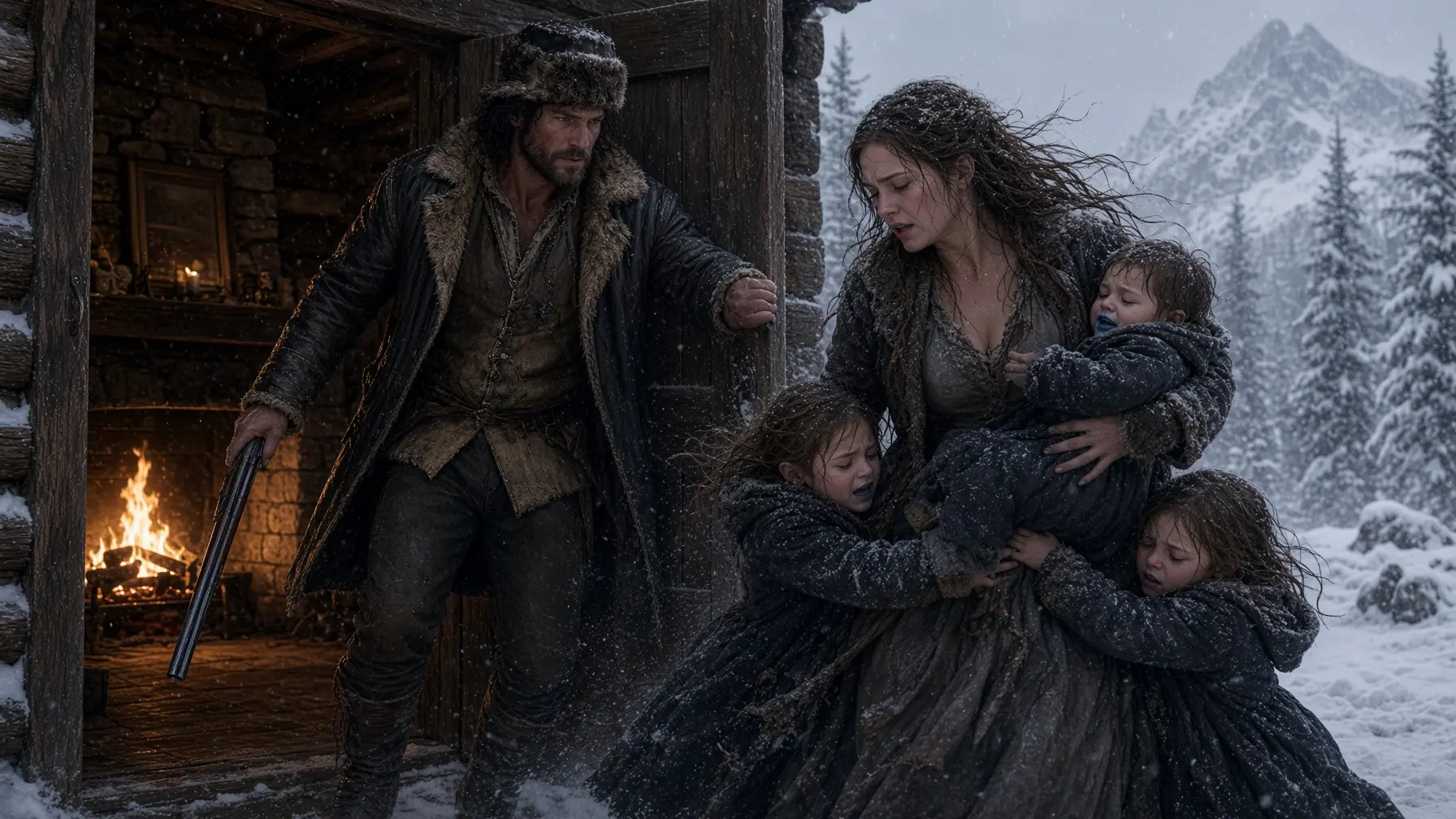
Outside, a Wyoming blizzard had erased the road, the mountains, and almost every sign that another human being had ever crossed that country. Snow struck the coach in violent sheets. Wind pushed against the wooden walls hard enough to make them groan. The horses stood buried nearly to their bellies, heads lowered, no longer strong enough to pull the wheels through the drifts.
Seven-year-old Nora sat pressed against her mother’s side, trying with all the strength in her small body not to look frightened.
Four-year-old Emmy lay across Ruth’s lap.
She was the reason Ruth stopped hoping the storm would pass.
The little girl had stopped shivering.
Ruth had grown up around mining camps in Missouri. Her grandmother had treated men with frozen fingers, infected wounds, broken ribs, and fevers that lasted for days. She had taught Ruth enough to recognize the moment cold stopped hurting because the body had begun surrendering.
Emmy’s lips were blue.
“Give me your blanket,” Ruth said.
“Mama, you’re already freezing.”
“Give it to me.”
Nora obeyed.
Ruth wrapped both blankets around Emmy, then pulled her child against the skin beneath her coat.
Nora looked toward the front of the coach.
“Is Mr. Mercer really dead?”
Ruth closed her eyes for half a second.
“Yes.”
She had promised Nora six months earlier that she would never lie to her again.
Not after Silas.
Not after the nights in Missouri when Nora had lain awake listening through a wall while her uncle threatened Ruth in the next room.
Not after the morning Emmy stopped speaking.
“Are we going to die too?” Nora asked.
Ruth looked at her.
“No.”
It was the first promise she had made that she had no idea how to keep.
Somewhere ahead was a cabin belonging to a man named Jesse Hawkins.
Ruth had never seen his face.
She knew only what he had written in six letters exchanged through a church contact and a trading post. He was thirty-eight. Widowed. Lived alone in the mountains west of the Wind River Valley. Kept horses and two pack mules. Trapped through winter, hunted elk in autumn, cut timber when the weather allowed, and came down to the settlement only when he needed flour, ammunition, lamp oil, salt, or news.
His last letter had been painfully simple.
If you can manage a remote house and aren’t frightened of hard winters, I can offer food, a room, honest work, and a safe roof. I don’t promise comfort. I do promise you’ll never go hungry while I have meat in the smokehouse.
Ruth had written back that she was a widow traveling alone.
That had been the lie.
She had told herself it was necessary. A man living alone in the Wyoming mountains might accept one desperate widow.
Almost no man would willingly accept a widow with two children and a dangerous brother-in-law looking for them.
Now the lie no longer mattered.
Emmy needed fire.
Ruth pushed open the coach door.
The wind nearly ripped it from her hands.
“We walk.”
Nora stared into the white darkness.
“In that?”
“If we stay, Emmy dies.”
That was enough.
Ruth tied Emmy against her chest with a blanket. She took Nora’s hand, stepped into snow above her knees, and began following what remained of a fence line toward the mountains.
They walked for what felt like hours.
Sometimes Ruth could see the next post.
Sometimes she could not.
Twice Nora fell and disappeared almost to her shoulders. Ruth dragged her out and kept moving. Her fingers lost feeling. Ice formed in her hair. Emmy became frighteningly still against her chest.
Then Nora stopped.
“Mama.”
Ruth could barely lift her head.
“What?”
“There.”
Through the snow, something flickered.
Orange.
Then disappeared.
Then returned.
A lantern.
Ruth began walking toward it.
The light belonged to a cabin built beneath a stand of lodgepole pine where the mountain rose sharply behind it. A low stable stood thirty yards away, nearly buried along one wall. Wood was stacked beneath a lean-to. Snowshoes hung beside the porch. Several stretched pelts were secured beneath an overhang beyond the smokehouse.
It did not look like a ranch.
It looked like the home of a man who expected nature to try killing him every winter and prepared accordingly.
Ruth reached the porch and struck the door with the side of her fist.
Nothing.
She struck again.
“Jesse Hawkins!”
The door opened.
The man standing there was larger than Ruth expected.
Not polished. Not handsome in the way women in town described handsome men. His dark hair had grown almost to his collar. A rough beard covered most of his face. He wore wool trousers, an old flannel shirt, and a buckskin vest darkened by years of weather and smoke. A long scar crossed the back of one hand.
His eyes moved first to Ruth.
Then Nora.
Then to the small shape wrapped against Ruth’s chest.
Every trace of confusion vanished.
“Inside.”
Ruth stumbled past him.
Jesse shut the door, dropped the bar into place, then crossed the room in three strides.
“Put the little one by the fire.”
“Not too close,” Ruth said immediately. “She needs warming slowly.”
His eyes flicked toward her.
“You know what you’re doing?”
“My grandmother did.”
“Good.”
He pulled blankets from a chest. Then another quilt. Then a thick bearskin from the foot of his bed.
Nora watched him with the rigid alertness of a child studying a dangerous animal.
Jesse noticed.
He noticed everything.
“Name?”
“Emmy.”
He crouched near the child but did not touch her without asking.
“What do you need?”
“Warm water. Cloth. Something sweet if you have it.”
Jesse was moving before she finished.
For the next hour, neither adult spoke about the lie.
They worked.
Ruth warmed Emmy gradually while Jesse kept the fire steady. He heated water, brought honey, found dry clothes that had once belonged to a woman, then silently moved behind a blanket so Ruth could change herself and the girls.
Finally, Emmy coughed.
The small sound broke Ruth harder than any scream could have.
She bent over her daughter, forehead touching Emmy’s hair.
“That’s right, baby. Come back.”
Emmy shivered.
A weak tremor at first.
Then stronger.
Ruth almost cried from relief.
Jesse stood near the fireplace with his hands hanging at his sides.
Only when he knew the child was no longer dying did his expression change.
He looked at Ruth.
“You told me you were alone.”
There it was.
Ruth stood slowly.
“Yes.”
“You wrote it twice.”
“I know.”
“I prepared for one person.”
“I know.”
Nora moved immediately, positioning herself between Jesse and Emmy.
The movement was so quick it seemed instinctive.
Jesse looked down at her.
Nora’s chin was lifted.
Her whole body trembled.
She did not move away.
Jesse looked back at Ruth.
“Who taught that girl to stand between a grown man and her family?”
Ruth said nothing.
“Who?”
“My husband’s brother.”
The room changed.
Jesse’s anger remained, but it went somewhere colder.
“What did he do?”
“Henry—my husband—died in a mining accident. His brother Silas inherited the house because the papers were in the family company’s name. He wanted us gone.”
“So he threw you out?”
“He tried.”
Ruth swallowed.
“He took the lock off my bedroom door first.”
Jesse’s face became completely still.
Nora was watching him.
“He hit you?” Jesse asked.
“Yes.”
“The girls?”
“No.”
Ruth looked at Emmy.
“Not with his hands.”
Jesse followed her eyes.
“When did the little one stop talking?”
“Three months ago.”
He looked at Nora again.
Then he crouched slowly so he was closer to her height.
The girl immediately stiffened.
“I ain’t him,” Jesse said.
Nora said nothing.
“I’m not asking you to trust me. You don’t know me.”
Still nothing.
“But this is my mountain. This is my cabin. And while you’re inside it, nobody touches you, your sister, or your mama.”
Nora stared at him for a long time.
“I’ll know if you’re lying.”
To Ruth’s surprise, Jesse almost smiled.
“I reckon you will.”
He stood.