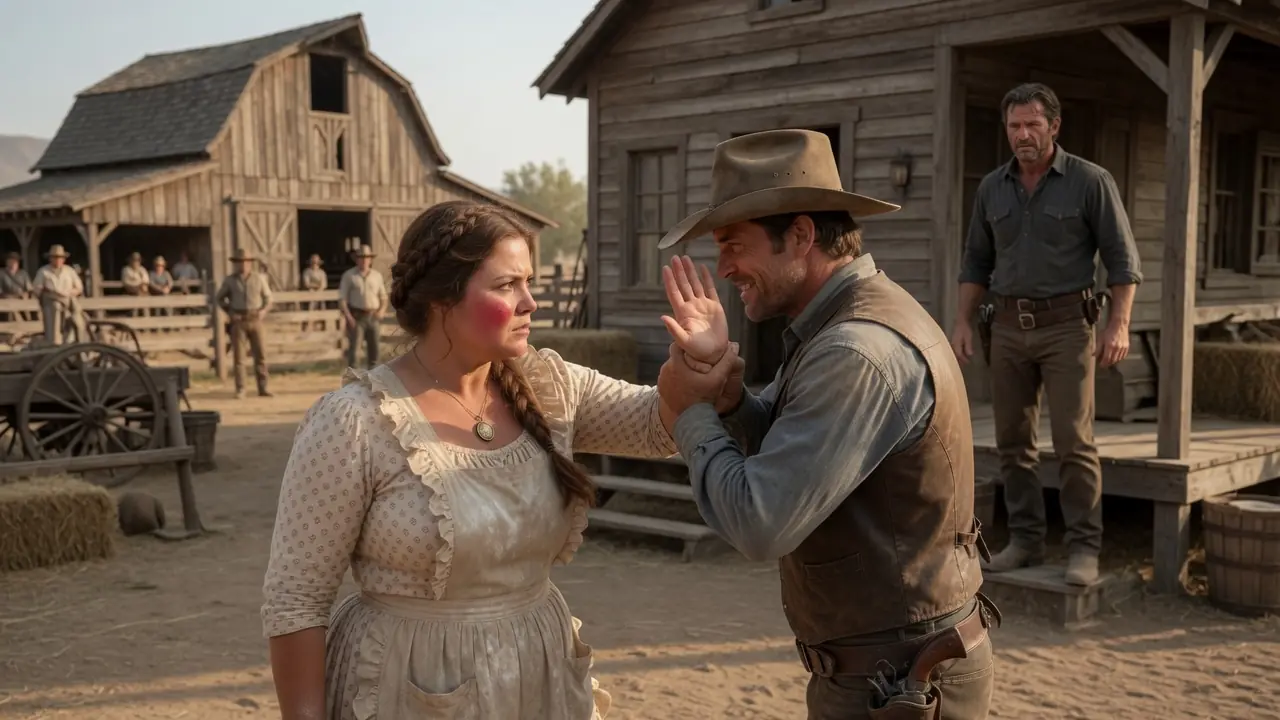
The slap cracked across Blackstone Ranch like a pistol shot.
Every man in the yard stopped moving.
A hammer remained suspended above a horseshoe at the forge. Two ranch hands froze beside the water trough. Even the restless gelding near the barn seemed to settle beneath the sudden silence.
Clara Bennett stood in the middle of the dust with one hand still raised.
Across from her, Roy Maddox slowly turned his face back toward her.
He was nearly twice her size.
Six feet four, heavy through the shoulders, with a reputation for breaking horses through fear and men through humiliation.
A red mark spread across his cheek.
His eyes filled with disbelief first.
Then rage.
“You hit me.”
Clara’s heart pounded so violently she could feel it beneath her ribs, but she did not step back.
“You grabbed me.”
“I was trying to teach you some manners.”
“You put your hands on me.”
Roy looked around at the watching cowboys, suddenly aware that the entire ranch had seen a woman strike him.
His humiliation needed somewhere to go.
He chose anger.
“You think cooking a few decent meals makes you queen of this place?”
“No.”
Clara lowered her hand.
“I think keeping twenty-two men fed while they insult me makes me more patient than I should be.”
A few of the younger hands looked down, hiding smiles.
That made Roy angrier.
He stepped closer.
“You came here with nothing. No family worth naming. No money. No husband. You ought to remember who you are.”
Clara held his stare.
“I remember exactly who I am.”
Roy reached for her again.
A voice came from the shaded porch behind them.
“If you touch her, Maddox, you will leave this ranch without the use of that hand.”
The yard became even quieter.
Nathaniel Shaw stepped out of the shadows.
The owner of Blackstone Ranch did not shout.
He never needed to.
At thirty-seven, Nathaniel had built one of the largest cattle operations in the New Mexico Territory. Men obeyed him because he paid honestly, expected discipline, and rarely made a threat he was unwilling to carry out.
His dark coat was unbuttoned. Dust marked his boots. One hand rested casually near the revolver at his hip.
Roy released Clara’s wrist.
Nathaniel descended the porch steps.
“What happened?”
Roy answered first.
“She forgot her place.”
Nathaniel’s eyes moved toward Clara’s reddened wrist.
Then toward the mark on Roy’s face.
“I asked what happened.”
“She’s been stirring trouble since she arrived. Turning the men against me. Filling your daughter’s head with nonsense. Acting like she owns the kitchen, the bunkhouse, and half the ranch.”
“I run the kitchen,” Clara said. “Because Mr. Shaw hired me to run it.”
Roy pointed at her.
“See? That mouth.”
Nathaniel stopped several feet away.
“Did you touch her?”
Roy hesitated.
“I was moving her out of my way.”
“Did she tell you not to?”
“She doesn’t give orders to me.”
Nathaniel’s expression hardened.
“Answer the question.”
Roy looked around the yard.
Every ranch hand was listening.
“Yes.”
Nathaniel nodded once.
“Then she showed restraint.”
Roy stared at him.
“Restraint?”
“If you had grabbed one of my male employees after he warned you not to, he would have broken your jaw.”
A few men shifted uncomfortably.
Roy’s face darkened.
“You’re taking her side because she’s been warming your bed.”
Clara’s breath caught.
Nathaniel did not move.
For one long moment, the entire ranch seemed to wait.
Then Nathaniel removed the payroll envelope from inside his coat.
He held it toward Roy.
“Your wages through today.”
Roy looked at the envelope but did not take it.
“You’re firing me over a cook?”
“I’m firing you because you placed your hands on an employee, ignored a direct warning, and then insulted my household in front of my daughter.”
Roy glanced toward the main house.
Nine-year-old Rose Shaw stood behind the porch railing.
She had heard everything.
The anger left Roy’s face.
Something closer to shame replaced it.
Only briefly.
“You’ll regret this,” he said.
“Perhaps.”
Nathaniel dropped the envelope into the dust between them.
“But I will regret keeping you more.”
Roy looked toward the cowboys, hoping someone would defend him.
No one did.
He walked to the bunkhouse to collect his belongings.
Clara remained in the yard, suddenly aware that her knees were trembling.
Nathaniel looked at her wrist.
“Are you injured?”
“No.”
“That is not what I asked.”
She examined the red marks left by Roy’s fingers.
“Bruised, perhaps.”
“Mrs. Lin should look at it.”
“I still have supper to prepare.”
“The men can wait.”
“They have already worked ten hours.”
Nathaniel studied her.
Even now, after public humiliation and a confrontation with the ranch’s largest cowboy, Clara’s first thought was whether everyone would be fed on time.
“Why did you slap him?” he asked.
“Because if I had not, I would have spent the rest of my life remembering that I let him make me small.”
Nathaniel’s expression changed.
Not pity.
Respect.
“You did not look small.”
Clara glanced toward the bunkhouse windows, where several men were still watching.
“I may feel differently when my hands stop shaking.”
Nathaniel lowered his voice.
“Courage usually shakes afterward.”
Six months earlier, Clara Bennett had not considered herself courageous.
She considered herself tired.
Tired of stretching one cup of flour into three meals.
Tired of pretending watered coffee did not taste like burnt dirt.
Tired of watching her younger brother destroy himself one bottle at a time while the family farm collapsed around them.
Their father had died beneath an overturned wagon.
Their mother followed seven months later after a winter fever settled into her lungs.
The Bennett homestead had once supported a family.
By the spring of 1874, it consisted of a leaking cabin, one thin horse, and twenty acres of soil exhausted beyond usefulness.
The bank gave them three weeks.
Then it would take the land.
Clara’s brother, Owen, delivered the news by slamming his fist against the kitchen table.
“You’re going.”
Clara continued scraping the final two eggs from the skillet.
“Where?”
“Blackstone Ranch.”
She looked up.
Owen was twenty-three but appeared ten years older. His eyes were bloodshot. His hands trembled.
“What is at Blackstone Ranch?”
“A job.”
“For you?”
“For a cook.”
“Then learn to cook.”
“They want a woman.”
“They want someone they can pay less.”
“They’re offering forty-five dollars a month with room and board.”
Clara’s hand stopped.
Forty-five dollars was more than she had earned in the previous year.
Owen pulled a folded advertisement from his coat.
“Six-month contract. The ranch is twenty-five miles north. Mrs. Bell at the boardinghouse knows the owner’s housekeeper. She says the work is hard, but the pay is honest.”
“Why has no one taken it?”
“Four people took it.”
“And?”
“They left.”
Clara stared at him.
“One hated the isolation. One drank. One could not feed that many men. The last fought with the foreman.”
“That sounds encouraging.”
Owen leaned over the table.
“We lose the farm in three weeks.”
The anger in his voice cracked.
Beneath it, Clara heard fear.
She had practically raised him since their mother became ill. She remembered the boy who used to sleep near the stove during storms.
Now he smelled of whiskey before breakfast.
“If I go,” she said, “every dollar I send home goes to the bank.”
“Yes.”
“Not the saloon.”
“Yes.”
“You find steady work.”
“I will.”
“You stop drinking.”
His eyes moved away.
“Owen.”
“I’ll try.”
“That means no.”
“It means I don’t know how.”
For the first time that morning, he sounded honest.
Clara looked around the failing kitchen.
The empty flour barrel.
The cracked wall.
Her mother’s recipe book resting beside the stove.
Six months at a remote ranch could save the homestead.
It might also save her from spending another year watching her brother disappear.
“When do they expect me?”
“Monday.”
“That is two days from now.”
“I know.”
Clara closed her eyes.
“Write the agreement.”
“What?”
“You said the wages are honest. I want the amount, the contract period, and the payment schedule in writing.”
Relief crossed Owen’s face.
“You’ll go?”
“I will work for six months.”
She looked at him carefully.
“What happens to the farm afterward depends on what you do while I’m gone.”
Red Hollow watched Clara leave as though poverty were a scandal she had committed publicly.
At the general store, Mrs. Weller warned that no respectable woman lived among unmarried ranch hands.
“Your mother would be ashamed,” she said.
Clara placed her supplies on the counter.
“My mother washed other people’s sheets, cooked other people’s meals, and sold her wedding silver to keep us alive.”
Mrs. Weller’s mouth tightened.
“She understood survival.”
Clara counted out her coins.
“Do you want my business or my confession?”
She left town with two dresses, one apron, her mother’s knives, and the old recipe book.
The supply wagon reached Blackstone Ranch after four hours over a road that seemed determined to shake every bone from her body.
The ranch spread across a wide valley beneath rust-colored cliffs.
There were barns, corrals, a forge, workers’ cabins, and a large timber house overlooking everything from a low hill.
Cattle covered the distant slopes.
The ranch was not merely a home.
It was a small kingdom built from dust, timber, and relentless labor.
Silas Grant, the foreman, met the wagon.
He was lean, sunburned, and direct.
“You Clara Bennett?”
“Yes.”
“You know what you agreed to?”
“I cook.”
“You feed between eighteen and twenty-five men, depending on the season. Breakfast at five-thirty. Dinner at six-thirty. Lunch when the work allows. They eat more than you think.”
“I grew up in a boardinghouse.”
“This is not a boardinghouse.”
“So I’ve been told.”
Silas almost smiled.
“Mr. Shaw wants to meet you.”
Nathaniel Shaw was younger than Clara expected.
He stood behind a desk covered with maps and ledgers, dressed more like a working rancher than a wealthy landowner.
His dark hair was touched with silver near the temples. Grief had left permanent lines around his mouth.
He did not invite Clara to sit.
“You are desperate,” he said after reading the letter Mrs. Bell had provided.
Clara lifted her chin.
“I prefer motivated.”
A flicker of amusement appeared in his eyes.
“You have one week to prove you can manage the work.”
“And if I do?”
“Six months. Forty-five dollars a month. Room and board. You will also assist Mrs. Lin in the main house when needed.”
“Who lives there?”
“My daughter and I.”
“Your wife?”
“Dead.”
The word landed heavily.
Clara did not apologize.
She had grown tired of apologies that changed nothing.
Nathaniel continued.
“My daughter is Rose. She is nine. Mrs. Lin has cared for her since infancy.”
He leaned against the desk.
“One rule matters above the others. If any man bothers you, you tell Silas or me.”
“I can handle men.”
“That is not what I said.”
Clara met his eyes.
“And I have a rule.”
His eyebrows lifted.
“I will not be grabbed, cornered, or spoken to as though being poor makes me available.”
Nathaniel studied her for several seconds.
“You expect trouble.”
“I expect men to behave as they have been permitted to behave.”
That answer earned the first genuine expression she saw from him.
Not a smile.
Recognition.
“You may last longer than the others.”
The kitchen nearly sent her home.
Grease coated the walls.
Old flour had hardened inside drawers.
The stove smoked through a cracked pipe, and something had died beneath the pantry floor.
Clara stood in the doorway and considered walking back to Red Hollow before anyone learned she had arrived.
Then she rolled up her sleeves.
She scrubbed until midnight.
At five the following morning, Mrs. Lin found her asleep at the kitchen table with her head resting beside a bowl of dough.
The older Chinese woman gently touched her shoulder.
“You have twenty minutes before hungry men become angry men.”
Clara woke in panic.
Mrs. Lin had already started the coffee.
Together they prepared bacon, eggs, fried potatoes, and enough griddle cakes to cover the long tables.
The ranch hands entered with dust on their boots and suspicion in their faces.
One complained the coffee was weak before tasting it.
Another asked whether she knew the difference between biscuits and stones.
Clara ignored them.
She kept the food moving.
By the time the final man left, her arms ached so badly she could barely lift the skillet.
Mrs. Lin handed her a cup of coffee.
“You survived breakfast.”
“I have to prepare lunch.”
“Yes.”
“And dinner.”
“Yes.”
Clara stared at her.
“When do I sleep?”
“In winter.”
The first week nearly broke her.
She rose before daylight.
She cooked.
She cleaned.
She hauled water.
She kept the stove fed.
The ranch hands complained because testing new people was part of the local religion.
Then a quiet eighteen-year-old named Ben asked whether she could make honey cornbread.
“My mother made it,” he explained. “Before she died.”
That evening, Clara served it beside beef stew.
Ben took one bite and stopped chewing.
His eyes filled.
“It tastes like hers.”
The room became silent.
Clara placed another piece on his plate.
After that, the men changed.
Not all at once.
But coffee cups began appearing beside the washbasin instead of being abandoned across the tables.
Someone repaired the pantry door.
Firewood arrived without Clara asking.
Men who had once mocked her began saying thank you.
At the end of the week, Nathaniel called her to his office.
Clara stood before his desk expecting dismissal.
“You passed.”
She blinked.
“What?”
“The trial.”
“That is all?”
“What were you expecting?”
“A longer speech.”
“I pay wages. I do not give speeches.”
He signed the contract.
“You earned the position.”
Those words meant more to Clara than the money.
No one had given her the job from pity.
She had earned it.
Her first meeting with Rose occurred the following Saturday.
The child sat in the main-house kitchen with a book held close to her face.
She had Nathaniel’s dark hair and the serious expression of someone who had learned to remain quiet around grieving adults.
“Mrs. Lin says you make honey cornbread,” Rose said.
“I do.”
“Can you teach me?”
Clara looked toward Nathaniel.
He nodded.
They began with eggs.
Rose crushed the first one so badly that shell fragments fell throughout the bowl.
Her face crumpled.
“I ruined it.”
“No.”
Clara used a larger piece of shell to collect the smaller ones.
“You made a mistake. Ruining something requires refusing to repair it.”
Rose tried again.
By the third egg, she was smiling.
“My mother cooked,” the girl said.
Clara’s hands slowed.
“I don’t remember her.”
“I remember mine.”
“Does missing her stop?”
“No.”
Clara did not lie.
“But it changes. At first, grief fills every room. Later, it becomes something you can carry without dropping everything else.”
Rose considered that.
“Papa doesn’t talk about Mama.”
“Some people believe silence protects pain.”
“Does it?”
“Not usually.”
From the doorway, Nathaniel listened without entering.
Clara saw him only after the cornbread was in the oven.
He looked at Rose’s flour-covered face.
Then at Clara.
“Thank you.”
“For making a mess?”
“For allowing her to.”
The cooking lessons became a weekly ritual.
Rose learned biscuits, stew, apple tarts, and bread.
She began laughing more.
Nathaniel began finding reasons to visit the kitchen.
At first, he asked about supplies.
Then the winter menu.
Then whether Clara had received letters from home.
Owen never wrote.
But each month, Clara’s wages went directly to the Red Hollow bank.
Three months into the contract, Owen arrived on the supply wagon.
He was thinner but sober.
“The debts are paid,” he said.
Clara stared at him.
“All of them?”
“Every penny you sent went to the bank.”
He twisted his hat between his hands.
“I found work repairing the boardinghouse. I haven’t had a drink in eleven weeks.”
Relief nearly weakened her knees.
“You can come home now,” Owen said.
She looked around the ranch.
Ben was repairing a gate near the bunkhouse.
Mrs. Lin stood on the main-house porch shelling beans.
Rose waved from an upstairs window.
Nathaniel emerged from the barn holding a ledger.
Home no longer meant what it had when Clara left.
“I’m finishing the contract.”
“We don’t need the money.”
“Perhaps I need the work.”
Owen looked wounded.
“The farm is ours.”
“And I’m glad.”
She touched his arm.
“But I spent years living only for what the family needed. I need to discover what I want.”
Owen stared at her as though meeting his sister for the first time.
Then he nodded.
“I suppose you earned that.”
Trouble arrived wearing perfume and pale gloves.
Beatrice Weller was the daughter of Red Hollow’s wealthiest merchant. She had visited Blackstone several times before Clara’s arrival, encouraged by a father who considered Nathaniel Shaw an ideal husband.
Beatrice was beautiful, polished, and accustomed to rooms rearranging themselves around her.
She noticed Clara immediately.
More importantly, she noticed Rose’s affection for her.
At dinner, Beatrice suggested the child should be sent to boarding school.
“A ranch is no place for a young lady,” she said.
Rose stopped eating.
Nathaniel’s face went cold.
“This is my daughter’s home.”
“Of course. But after you remarry, you will want freedom to begin properly.”
Mrs. Lin placed a serving dish on the table.
Beatrice barely looked at her.
“And surely the household would benefit from trained staff instead of improvised help.”
Nathaniel set down his fork.
“Mrs. Lin has managed this home for eleven years.”
Beatrice smiled.
“I meant no offense.”
“You have offered nothing else.”
She left before dessert.
Within days, rumors reached the ranch.
Clara was using Rose to trap Nathaniel into marriage.
She had seduced the ranch hands.
She was positioning herself to replace the dead Mrs. Shaw.
The men who knew her ignored the gossip.
Roy Maddox did not.
Roy had been hired during the autumn cattle drive. He disliked Clara’s authority in the kitchen, resented being corrected, and enjoyed repeating stories that humiliated women.
The confrontation came after he entered the pantry during supper preparation and drank from a bottle of cooking whiskey.
Clara took it from him.
“You’ll receive it back after work.”
Roy laughed.
“You sound like the lady of the house.”
“I sound like the person responsible for this kitchen.”
He stepped close.
“Everyone knows how you got that responsibility.”
Clara ordered him out.
Roy called her a name Rose could hear from the porch.
When Clara followed him into the yard and demanded an apology, he grabbed her wrist.
Then came the slap.
After Nathaniel dismissed Roy, the ranchyard remained quiet for the rest of the afternoon.
Clara expected the men to look at her differently.
They did.
But not with contempt.
Ben brought a cold cloth for her wrist.
Silas repaired the pantry latch.
At dinner, every plate was carried to the washing table without being asked.
Nathaniel found Clara alone in the kitchen after dark.
“You should not have been placed in that position.”
“You warned me men would be handled.”
“I failed to handle one soon enough.”
“You cannot watch every person every hour.”
“No.”
He looked toward her bruised wrist.
“But I can create a place where warnings are taken seriously.”
Clara dried her hands.
“People will say you fired him because of me.”
“I did.”
She looked up.
Nathaniel continued.
“I fired him because he harmed an employee I value.”
The air between them shifted.
“You must be careful,” Clara said.
“Of what?”
“Of saying things that sound like more than they are.”
He stepped closer, then stopped at a respectful distance.
“And if they are more?”
Clara’s breath caught.
“You are my employer.”
“I know.”
“People already believe the worst.”
“I know that too.”
“Rose is involved.”
His expression softened.
“I know.”
Clara looked away.
“Then nothing can happen.”
“Not while you work under contract.”
She met his eyes again.
Nathaniel nodded slowly.
“But contracts end.”
He left before she could answer.
Beatrice’s father attempted one final humiliation.
Red Hollow’s winter fair included a county cooking competition.
He publicly challenged Clara to enter, certain that established women from respectable households would defeat the poor ranch cook.
Clara refused at first.
Then she heard Beatrice say that servants should know better than to compete with ladies.
Clara entered.
For three weeks, Blackstone Ranch became her training ground.
Mrs. Lin taught her techniques from her own family kitchen.
Rose became chief taster.
The ranch hands argued over which dishes represented Clara best.
She chose fried chicken seasoned with a subtle blend of pepper and ginger, honey cornbread, and her mother’s apple tart.
On the morning of the fair, Clara wore her mother’s old apron.
The entire county seemed to fill the Red Hollow meeting hall.
Beatrice prepared an elaborate roast.
Other women produced cakes, breads, and pies polished by years of tradition.
Clara nearly fled before the judging began.
Then she saw Nathaniel in the first row.
Rose sat beside him.
Owen stood at the back of the hall, clean-shaven and sober.
Silas and half the ranch hands crowded near the doorway.
They had not come because they expected entertainment.
They had come because she mattered.
Clara began cooking.
Three hours later, the judges announced the results.
Third place went to a baker from Cooperville.
Second went to Beatrice Weller.
First went to Clara Bennett.
For several seconds, Clara could not move.
Then Rose screamed her name.
The Blackstone men began cheering.
Owen covered his face with one hand.
Nathaniel simply stood and looked at her with such certainty that Clara understood he had expected nothing else.
Beatrice’s apology came publicly because her father had agreed to the terms of the challenge.
It was stiff and incomplete.
Clara accepted it anyway.
She no longer needed sincerity from people who had already revealed their character.
The prize money was enough to begin renovating the abandoned smokehouse at Blackstone into a proper bakery kitchen.
Nathaniel offered the building.
Clara invested the prize.
She completed the final two months of her contract before making any decision about him.
That mattered to both of them.
On her final evening as an employee, Nathaniel met her in the new kitchen.
The tables had been installed.
Two ovens stood along the far wall.
Shelves waited for bread, preserves, and pies.
“I have written your final payment,” he said.
Clara accepted the envelope.
“And the building?”
“Yours to lease under your own name. The agreement is inside.”
She unfolded the document.
The rent was fair.
Not symbolic.
Not charity.
Business between equals.
Nathaniel waited until she finished reading.
“Now that the contract is over, may I ask you something that has nothing to do with employment?”
Clara folded the paper.
“You may ask.”
“May I court you?”
She looked toward the window.
Outside, Rose was teaching Ben how to roll dough.
Mrs. Lin sat nearby correcting both of them.
The ranch hands crossed the yard toward supper.
This place had given Clara work when she was desperate.
But she had given something in return.
Care.
Order.
Food that made exhausted men feel remembered.
A home to a lonely child.
A reason for a grieving man to speak honestly again.
“I will not become the woman of this house because people expect it,” she said.
“I would never ask that.”
“I will keep my business.”
“Yes.”
“I will earn my own money.”
“I know.”
“And Rose’s mother will not be erased to make room for me.”
Nathaniel’s eyes softened.
“She never could be.”
Clara held out her hand.
“Then you may court me.”
He took it.
Not as an owner claiming something he had purchased.
As a man receiving permission.
They married the following autumn.
Not immediately.
Not because Rose begged.
Not because gossip demanded an ending.
They married after months of long walks, difficult conversations, disagreements about work, and evenings in which Nathaniel learned that loving a strong woman did not mean directing her strength.
Clara’s bakery became known across three counties.
Travelers changed routes to purchase her apple tarts.
Ranch wives sent daughters to learn from her.
She hired women who needed honest work and gave them written contracts before asking them to lift a single pan.
Owen restored the Bennett farm and eventually turned it into a small orchard.
He remained sober.
Rose grew into a confident young woman who remembered both of her mothers without treating love as a limited resource.
Years later, she asked Clara whether she had been afraid on the day she struck Roy Maddox.
They stood together in the bakery while bread cooled on wooden racks.
“Terrified,” Clara said.
“You didn’t look afraid.”
“That is because fear lives inside. Courage is what people see when you move anyway.”
Rose considered that.
“Papa says that slap changed everything.”
Clara smiled.
“No.”
“What did?”
“The slap was only the moment everyone noticed.”
She looked around the kitchen.
“The change began when I left Red Hollow believing I had no choices and discovered that I could build them.”
That evening, Clara and Nathaniel sat on the porch while the valley settled beneath the stars.
The ranch was larger than it had been when she arrived.
The bakery windows glowed near the bunkhouse.
Someone played a harmonica beside the barn.
“You ever regret taking that job?” Nathaniel asked.
“The kitchen was filthy.”
“It was.”
“The men were rude.”
“Some remain so.”
“You were impossible.”
“I was careful.”
“You were impossible carefully.”
He laughed and took her hand.
Clara thought of the frightened woman who had climbed into the supply wagon with a canvas bag, a recipe book, and six months of obligation ahead of her.
She had believed she was traveling to Blackstone Ranch to save the Bennett homestead.
Instead, she saved something else.
Not Nathaniel.
Not Rose.
Not even the ranch.
She saved the part of herself that poverty, grief, and judgment had nearly convinced her to surrender.
The slap heard across the ranchyard became the story people repeated.
But it was never the most important thing Clara did.
She woke before dawn when quitting would have been easier.
She fed men who had not yet learned to respect her.
She taught a motherless child that mistakes could be repaired.
She stood before an entire town and allowed her work to speak louder than gossip.
And when love finally came, she did not accept it as rescue.
She accepted it as a free woman who had already built a life worth keeping.
That was why Nathaniel loved her.
Not because she needed Blackstone Ranch.
Because, in the end, Blackstone Ranch had needed her.