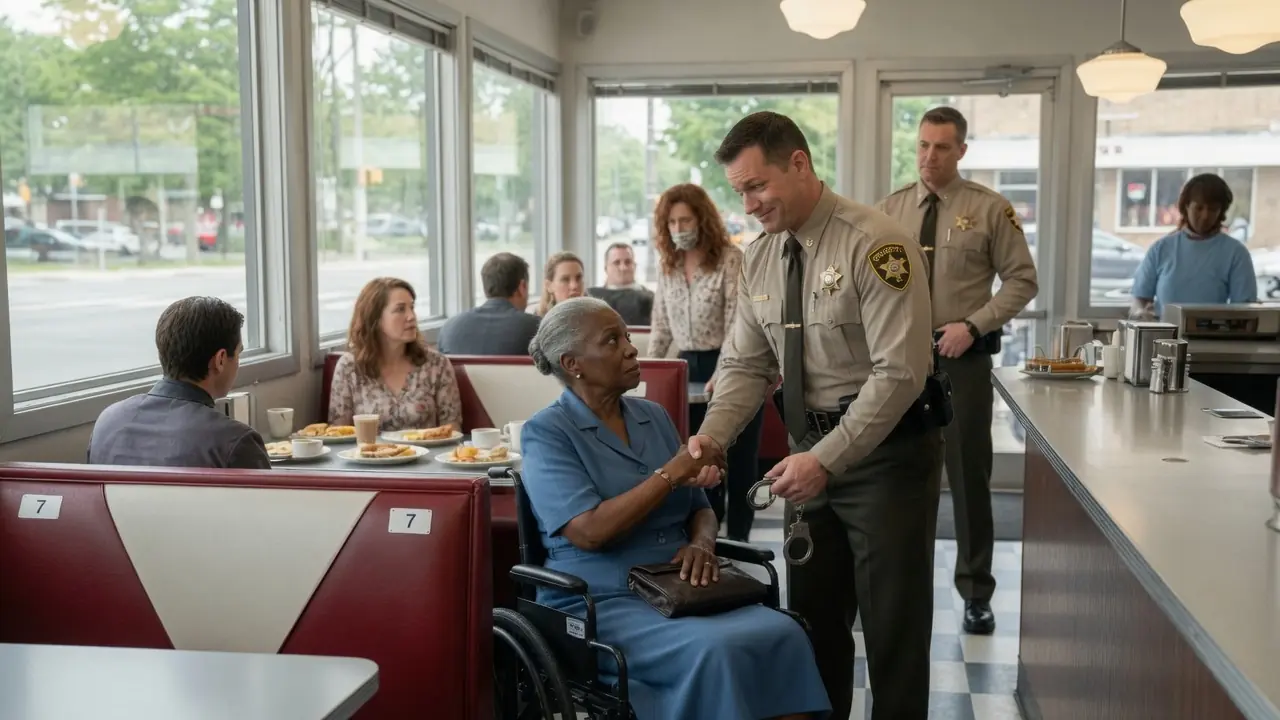
The deputy’s hand closed around Ruth Carter’s wrist just as she reached for her purse.
“Stand up.”
The words carried across the diner with enough force to silence the clatter of forks and coffee cups.
Ruth looked down at her wheelchair.
Then back at Deputy Aaron Crowley.
“I can’t.”
Aaron leaned closer.
His polished badge reflected in the window beside her booth.
“Don’t play games with me.”
“I’m not.”
“You expect everyone to believe you came back into this town by accident?”
“I came for a doctor’s appointment.”
“And stopped here afterward?”
“I wanted breakfast.”
Aaron’s fingers tightened.
Ruth felt the pressure against the bones in her wrist, but she refused to show pain.
Ruby’s Diner had been crowded only moments earlier. Contractors drank coffee at the counter. An elderly couple shared pancakes near the front window. Two nurses from the county clinic sat in a corner booth.
Now every customer watched without appearing to watch.
Deputy Caleb Norton stood near the entrance, blocking the easiest path to the door. His hand rested on his belt.
“This is police business,” he announced. “Stay seated.”
Ruby Dalton, the owner, remained behind the counter gripping a dish towel.
“Deputy Crowley,” she said carefully, “Mrs. Carter hasn’t caused any trouble.”
Aaron turned his head.
“Did I ask for your opinion?”
Ruby lowered her eyes.
Ruth did not.
At sixty-seven, she had lived long enough to understand how men like Aaron used silence.
They did not need everyone to agree.
Only to remain afraid.
Aaron looked back at her.
“My father warned people about you.”
Ruth’s stomach tightened.
Sheriff Henry Crowley had been dead for nearly six years, but his influence still lived inside the county courthouse, the sheriff’s office, and men who spoke his name as though it were another form of law.
“Your father warned people about anyone who knew the truth,” Ruth said.
Aaron smiled.
“There it is.”
He leaned down until his face was level with hers.
“The bitter old woman routine.”
“I told the truth twenty-seven years ago.”
“You accused a respected sheriff of covering up a crime.”
“He did.”
Aaron’s smile disappeared.
Across the diner, someone quietly lifted a phone.
Caleb noticed.
“Put that away.”
The phone lowered.
Aaron removed handcuffs from his belt.
“You’re under arrest for disorderly conduct.”
Ruth looked around the room.
“I ordered eggs, drank coffee, and paid my bill.”
“You became hostile during a lawful inquiry.”
“You sat down without permission and grabbed me.”
Aaron pulled her wrist toward him.
The chair shifted.
One wheel struck the table leg.
A coffee cup fell and shattered.
“There,” Aaron said. “Property damage.”
“You caused that.”
“Now you’re resisting.”
He reached for her other arm.
The front door opened.
Two men entered wearing Army service uniforms.
They were both tall and broad-shouldered, with the controlled posture of men who had spent years being trained not to waste movement.
One carried a phone already recording.
The other looked first at Aaron’s grip, then at Caleb near the door, then at Ruth’s wheelchair.
His expression did not change.
“Release our mother.”
Every face in the diner turned toward them.
Aaron looked over his shoulder.
“Your mother?”
The first soldier stepped closer.
His name was Captain Nathan Carter.
His brother, Chief Warrant Officer Micah Carter, remained near the entrance recording the room.
Aaron looked Ruth up and down.
“She doesn’t look old enough to have two sons your age.”
Nathan’s voice remained level.
“She raised us.”
“That isn’t what I asked.”
“It is the answer that matters.”
Micah spoke toward his phone.
“Time is 10:42 a.m. County Deputy Aaron Crowley is restraining a wheelchair user inside Ruby’s Diner. No charges were stated before physical contact. Deputy Caleb Norton is positioned near the main exit.”
Caleb shifted.
“Turn off the recording.”
“No.”
“This is an active arrest.”
“Then identify the offense.”
Aaron released Ruth’s wrist only to stand.
“Disorderly conduct. Resisting an officer. Possible interference in an old county investigation.”
Nathan moved beside Ruth’s chair.
“What old investigation?”
“None of your concern.”
Ruth looked up at her sons.
For an instant, she no longer saw decorated soldiers.
She saw two frightened boys sitting on the floor of a church office twenty-seven years earlier.
Nathan had been five.
Micah had been four.
They had held each other’s hands because no one had yet found words to explain why their parents were dead.
Ruth had found those words.
Then she had chosen not to speak all of them.
Not yet.
Aaron noticed the exchange.
“You boys should leave before this becomes serious.”
Nathan examined the red marks on Ruth’s wrist.
“It became serious when you put your hands on her.”
Aaron rested one hand near his holster.
Nathan’s eyes moved to it.
“Keep your hand away from your weapon.”
The diner seemed to shrink.
Aaron’s face darkened.
“You don’t give orders here.”
“No,” Nathan said. “But I know escalation when I see it.”
Micah continued recording.
“Deputy Crowley has moved his right hand toward his firearm during a verbal dispute involving an unarmed elderly woman.”
Caleb lowered his own hand from his belt.
Aaron looked around.
More phones had appeared.
Ruby was recording from behind the counter.
The elderly man near the window had raised his device with trembling hands.
The power inside the room shifted not because Nathan and Micah were stronger, but because the scene was no longer controlled by the deputies’ version of events.
Aaron let his hand fall.
“You think cameras change the law?”
“No,” Ruth said.
Her voice was quiet.
“They make it harder for you to invent one.”
Aaron stared at her.
Then he stepped backward.
“This is not over.”
Ruth met his eyes.
“I know.”
The deputies left without making an arrest.
No apology.
No explanation.
Only the heavy silence of men who had discovered too late that their actions would not disappear.
Micah locked the diner door after them.
Nathan crouched beside Ruth.
“Are you hurt?”
“Only angry.”
He examined her wrist.
“You should see a doctor.”
“I just came from one.”
“Then you’re going back.”
Ruby hurried from behind the counter.
“Ruth, I’m sorry.”
“You didn’t touch me.”
“I didn’t stop him.”
Ruth looked around the diner.
Neither had anyone else.
But shame had already begun replacing fear on several faces.
“We will talk later,” she said.
Outside, Aaron and Caleb remained inside their patrol car.
Watching.
Micah noticed.
“They’re not leaving.”
Ruth closed her eyes briefly.
“No.”
“Why do they care that you’re here?”
Nathan asked.
Ruth looked at both men.
The question had been waiting for most of their lives.
“Because Aaron’s father helped murder your parents.”
They drove to Ruth’s house without speaking.
It was a modest brick home on the edge of town, with a ramp Nathan had built during his last leave and a pecan tree planted by Ruth’s late husband.
Inside, she prepared coffee because some truths required the comfort of familiar rituals.
Nathan and Micah sat across from her at the kitchen table.
They had learned as children that when Ruth Carter folded both hands around a cup and did not drink, she was gathering courage.
“Your biological parents were David and Lorraine Wells,” she began.
Nathan’s jaw tightened.
She had told them the names before.
Nothing more.
“David worked maintenance for the county. Lorraine cleaned offices at night and handled payroll records for a small shipping company near the rail yard.”
Micah leaned forward.
“What did they discover?”
“Land theft.”
Ruth looked toward the kitchen window.
“Black families had properties seized for unpaid taxes that were not actually unpaid. Records were altered. Judges approved emergency sales. Buyers connected to Sheriff Henry Crowley purchased the properties for almost nothing.”
Nathan’s expression hardened.
“What were the buildings used for?”
“At first, stolen goods.”
Ruth hesitated.
“Later, military equipment.”
Micah’s eyes sharpened.
“What kind?”
“Communications units. Night-vision devices. Body armor. Anything small enough to disappear from supply chains and valuable enough to resell.”
“David found it?”
“He found inventory inside a county warehouse that should not have existed. Lorraine found the payment records.”
“They reported it to the sheriff,” Nathan said.
Ruth nodded.
“They trusted Henry Crowley.”
“And he killed them.”
“The official report said their car left Highway Nine during a storm.”
“There was no storm that night,” Micah said.
Ruth looked at him.
He had checked.
Years ago, perhaps.
“There were also no skid marks,” she said. “Your father’s seat belt had been cut. Your mother was alive when the first deputy reached the vehicle.”
Nathan went still.
“How do you know that?”
“My husband Samuel worked at the county storage yard. David had already told him what they found.”
Ruth’s voice weakened.
“Samuel reached the crash before the ambulance. Lorraine was conscious. She told him Henry Crowley arranged it.”
The clock on the wall ticked.
Neither son spoke.
“I filed a complaint with the state,” Ruth continued. “The investigator met with me twice, then the file disappeared. Henry visited this house after midnight.”
“What did he say?” Nathan asked.
“That accidents happen to people who ask the wrong questions.”
Micah stood and walked toward the window.
“You kept us here after that?”
“No.”
Ruth shook her head.
“I took you to my sister in Maryland for three years. When Henry believed I had stopped fighting, I returned.”
“You adopted us.”
“Samuel and I did.”
Nathan’s voice carried pain more than accusation.
“You knew everything and never told us.”
“I knew enough to get you killed.”
“We had a right to know.”
“You were children.”
“We became adults.”
“And then soldiers.”
Ruth met his eyes.
“You think that made me less afraid?”
Nathan looked away.
Micah remained near the curtains.
A patrol car moved slowly past the house.
He checked his watch.
“Second pass in fifteen minutes.”
Ruth wheeled toward the old hutch.
Inside a worn family Bible was a small brass key.
She placed it on the table.
“Samuel kept records.”
Nathan stared at it.
“Where?”
“Riverside Storage. Unit forty-seven.”
“What kind of records?”
“Names. Property deeds. Vehicle plates. Shipping dates. Photographs.”
“Why didn’t you use them before?”
“Because Samuel died before we could complete the case, and the state investigator who promised to help suddenly resigned.”
Micah picked up the key.
“Does Crowley know?”
“He knows something survived.”
Nathan looked toward the street.
“That diner wasn’t random.”
“No.”
Ruth folded her hands.
“It was a warning.”
They went to the storage facility that evening with civil-rights attorney Denise Parker.
Ruth had known Denise for years through church and community legal work. She was direct, cautious, and visibly unhappy that Nathan and Micah had considered going alone.
“We photograph everything before removing it,” she said. “We preserve dates, locations, and chain of custody.”
Nathan unlocked unit forty-seven.
The metal door rattled upward.
Inside were filing cabinets, banker’s boxes, and plastic tubs labeled in Samuel’s handwriting.
He had documented twenty years of corruption.
Property transfers signed by Judge Raymond Kessler.
Warehouse permits approved by Henry Crowley.
Insurance payments.
Photographs of county vehicles unloading military crates after midnight.
Micah found a notebook containing names and amounts.
Nathan found a photograph of David Wells standing beside a uniformed Army investigator.
The investigator was Brigadier General Thomas Avery, then a young major assigned to Army Criminal Investigation Command.
Micah studied the image.
“Our father was helping the Army.”
Denise took the photograph.
“That means this is federal.”
Ruth looked at the shelves.
“It always was.”
Headlights appeared outside.
Denise killed the flashlight.
Two vehicles entered the facility.
A patrol car.
A dark sedan.
Nathan lowered the storage door until only a narrow gap remained.
Aaron Crowley stepped out with Caleb Norton and two men in civilian clothes.
“We know you’re in there,” Aaron called.
Denise whispered, “Nobody touches a weapon.”
Nathan glanced at her.
“I wasn’t planning to.”
“You were thinking about it.”
“I think about many things.”
Micah quietly photographed the men and streamed the images to an encrypted cloud folder.
Aaron walked closer.
“We have authority to search property connected to stolen county records.”
Denise spoke through the door.
“Do you have a warrant?”
A pause.
“We have probable cause.”
“That is not a warrant.”
“Open the unit.”
“No.”
Aaron’s voice hardened.
“You are interfering with an investigation.”
Denise smiled without humor.
“Deputy, you are standing outside a privately rented storage unit demanding access without judicial authorization while two military officers document you. Choose your next step carefully.”
The men remained for several minutes.
Then withdrew.
They were not ready to force entry in front of a lawyer and cameras.
But the message was clear.
Time had shortened.
Denise contacted federal authorities that night.
Before they could respond, Aaron moved first.
The next morning, local news reported that Ruth Carter had assaulted a deputy during a welfare check at Ruby’s Diner.
The diner’s security system had supposedly malfunctioned.
Aaron appeared on camera with his wrist wrapped, claiming Nathan had attacked him.
Caleb confirmed the story.
Charges were filed against Ruth for disorderly conduct and against Nathan and Micah for obstruction and assault on law enforcement.
Judge Raymond Kessler signed the warrants.
“They control the sheriff’s office and the courthouse,” Denise said.
They sat inside her office watching the report.
“They do not control every witness,” Micah replied.
“Witnesses become frightened.”
“Then we find someone who isn’t.”
Ruby initially denied having footage.
She said the cameras stopped recording before Aaron entered.
The nurses from the corner booth refused to answer calls.
The elderly couple insisted they had seen nothing clearly.
Fear moved faster than courage.
Then seventeen-year-old dishwasher Luis Moreno sent Micah a message.
I copied the video before they erased it.
Luis met them behind a community center rather than the diner.
He carried a flash drive wrapped inside a sandwich bag.
“My grandmother knew Mrs. Carter,” he said.
Ruth looked at him.
“Teresa Moreno?”
Luis nodded.
“You paid for her heart medicine when I was ten.”
“I paid one month.”
“She lived three more years.”
His voice broke.
“Aaron came to the diner after closing. He made Ruby delete the system. I had already downloaded the footage because I thought something was wrong.”
Denise accepted the drive.
“Do you understand what this could mean for you?”
“Yes.”
“You may have to testify.”
“I will.”
The video showed everything.
Ruth sitting peacefully.
Aaron approaching her.
The unlawful physical contact.
Caleb blocking the exit.
Nathan and Micah entering without aggression.
Aaron moving toward his firearm.
No assault.
No disorderly conduct.
Only misconduct followed by a false report.
Federal investigators arrived that afternoon.
One of them was retired General Thomas Avery, now a special advisor to the Department of Defense Inspector General.
He recognized David Wells immediately from the photograph.
“I thought this case was destroyed,” he said.
“It almost was,” Ruth replied.
Avery looked at Nathan and Micah.
“Your father provided the first information about stolen Army communications equipment passing through this county.”
“Why wasn’t he protected?” Nathan asked.
Avery’s face tightened.
“Because someone inside the investigation leaked his identity.”
“Henry Crowley.”
“We never proved it.”
Micah placed Samuel’s notebook on the table.
“You may be able to now.”
The federal team began building a case.
The storage records connected Henry Crowley, Judge Kessler, and several business owners to decades of fraudulent seizures and military theft.
But physical evidence from the active warehouse network had already been moved.
Avery needed the current operation caught in progress.
They allowed a rumor to spread.
Micah made a deliberately public phone call inside Ruby’s Diner suggesting that Samuel had hidden a second ledger inside the abandoned Beaumont Textile Warehouse.
Luis ensured Aaron’s associates overheard it.
That night, surveillance teams watched vehicles converge on the warehouse.
Aaron arrived with Caleb.
Judge Kessler followed.
Several contractors opened crates containing stolen military equipment.
Others poured fuel over file boxes.
Every movement was recorded by federal cameras.
Inside a surveillance van, Ruth identified men who had worked with Henry Crowley decades earlier.
“That one is Charles Polk,” she said. “He handled payments.”
Avery nodded toward an agent.
“Confirmed.”
“And the man in the gray coat is William Garrett. He altered maintenance logs.”
The operation continued until Judge Kessler ordered the records burned.
Then federal agents moved.
There was no dramatic battle.
No soldiers fighting officers through dark corridors.
Only the efficient collapse of a conspiracy that had depended on secrecy.
Agents entered from three sides.
State police blocked the rail yard.
Aaron attempted to leave through the rear loading area and discovered Nathan standing beside two federal investigators.
Nathan did not touch him.
He did not need to.
Aaron looked toward the men surrounding the building.
“You think this changes what happened to your parents?”
“No,” Nathan said.
“It changes what happens to everyone after them.”
Aaron was arrested.
Caleb surrendered minutes later and began cooperating before sunrise.
Judge Kessler was stopped near his car carrying a briefcase filled with cash and property records.
The warehouse contained stolen military equipment, forged deeds, sealed court files, and personal property taken from families whose land had been seized.
The case widened beyond anything Ruth had imagined.
Fourteen people were indicted.
Former Sheriff Henry Crowley was charged posthumously through a formal finding naming him as the organizer of the network, though death had placed him beyond punishment.
Aaron faced civil-rights violations, witness intimidation, evidence destruction, conspiracy, and theft of federal property.
Judge Kessler was charged with racketeering and obstruction.
Caleb received a reduced sentence in exchange for testimony.
The charges against Ruth, Nathan, and Micah were dismissed.
At the first public hearing, Ruth entered the federal courthouse between her sons.
They wore civilian suits.
She wore the same blue dress from the diner.
Reporters called her brave.
She disliked the word.
For twenty-seven years, she had mostly felt afraid.
She simply continued anyway.
The prosecutor presented the original crash report.
Then the altered version.
Photographs showed the cut seat belt, the absence of skid marks, and a county vehicle near the scene before emergency responders arrived.
Samuel’s notes documented Lorraine’s final words.
The court formally recognized that David and Lorraine Wells had been murdered because they attempted to expose corruption.
Nathan closed his eyes.
Micah gripped the edge of the bench.
Ruth placed one hand over each of theirs.
She had held their hands when they were children.
Now they held hers.
During Aaron’s sentencing, the judge addressed him directly.
“You used public office as inherited property. You believed your father’s influence gave you authority over citizens, records, and truth.”
Aaron sat without expression.
“You targeted an elderly disabled woman because she survived long enough to challenge your family’s version of history.”
He received a lengthy federal sentence.
As marshals led him away, he passed Ruth.
She did not speak.
She had imagined this moment for years and discovered she wanted nothing from him.
Not an apology.
Not fear.
Not the satisfaction of a final sentence.
Justice was not Aaron looking defeated.
It was David and Lorraine’s names cleared.
It was stolen property returned.
It was her sons no longer carrying questions she had been too frightened to answer.
Recovered assets from the network were used to compensate families whose homes and businesses had been taken.
The Beaumont warehouse was transferred to a community trust.
Local leaders proposed naming the new facility after Ruth.
She refused.
“Name it after the people whose property was stolen.”
The final name became the Wells Community and Veterans Justice Center.
It housed legal services, a veterans’ clinic, archival records, and assistance for families facing wrongful property seizures.
Ruby donated the old booth from her diner to the center’s small café.
A plaque beside it read:
Truth sat here quietly before power tried to drag it away.
Luis received a scholarship funded by local businesses.
Ruby publicly admitted she had been frightened into deleting the footage.
“I failed Ruth when she needed me,” she said at the center’s opening. “A seventeen-year-old employee showed more courage than I did.”
Ruth took her hand.
“You told the truth eventually.”
“It should have been sooner.”
“Yes.”
Ruth did not soften the answer.
Forgiveness did not require pretending failure had not occurred.
Nathan and Micah returned to their military duties after the investigation.
They visited often.
On one quiet afternoon, the three of them sat in Ruth’s kitchen beneath the ticking clock.
Nathan looked at the brass key from the storage unit, now resting inside a small frame.
“Do you regret not telling us sooner?”
Ruth considered the question.
“Yes.”
Both men looked at her.
“I also believe keeping you ignorant kept you alive.”
“Both can be true,” Micah said.
Ruth nodded.
“I spent years telling myself protection justified silence.”
Nathan reached across the table.
“You protected us.”
“I also denied you part of yourselves.”
“You gave us another part.”
“What part?”
He smiled faintly.
“The part that knew what justice looked like before we knew why.”
Ruth looked down at their joined hands.
She had raised them to control anger, respect evidence, and defend people without becoming cruel.
At the diner, when Aaron reached toward his weapon, either son could have overpowered him.
They chose restraint.
That mattered more to her than any medal.
Years later, people in the county still told the story incorrectly.
Some said two soldiers burst into a diner and frightened corrupt deputies into surrendering.
That was not what happened.
Aaron left because witnesses began recording.
The case survived because Luis preserved the video.
The conspiracy fell because Samuel documented facts, Denise protected evidence, federal agents followed procedure, and frightened people eventually chose to speak.
Nathan and Micah had not rescued Ruth alone.
Long before they became soldiers, she rescued them.
She fed them.
Educated them.
Stayed beside their beds when nightmares came.
Taught them that strength without discipline became another form of danger.
The morning at Ruby’s Diner did not reverse those roles.
It completed them.
The boys Ruth once protected walked through the door as men ready to stand beside her.
Not in front of her.
Not instead of her.
Beside her.
That was the truth Aaron Crowley never understood.
He believed power meant forcing people to move.
Ruth believed power meant giving them somewhere safe to stand.
One left the diner with a badge and no honor.
The other remained in her wheelchair, surrounded by sons she had chosen and who had chosen her in return.
And for the first time in twenty-seven years, the town that had once looked away began looking directly at the truth.