The first swing landed on the fuel tank with a sound like a rifle shot. Deep black paint split beneath the steel head, gold leaf wrinkled inward, and the deputy laughed as though he had just won something. The old Black man standing outside the impound fence did not move.
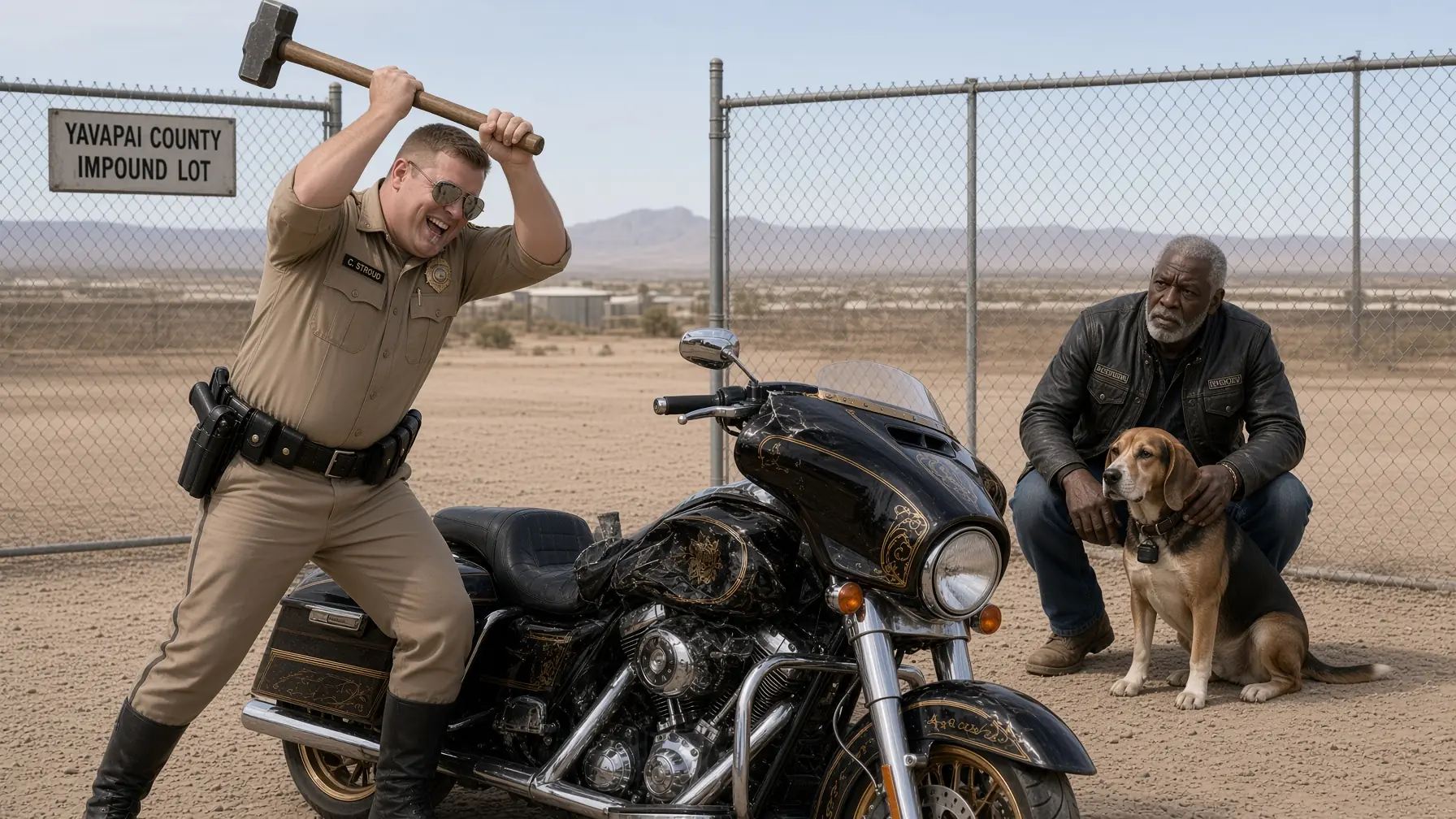
The second swing shattered the headlight. Glass scattered across the gravel, and Blue, the gray-muzzled hound sitting in the sidecar, began barking so hard that his whole body shook. Deputy Calvin Stroud looked toward the old man after every blow, waiting for anger, begging, or some sign that the humiliation was working.
He got none.
Marcus Ellery stood with one hand resting on Blue’s back and the other hanging loose by his side. At sixty-two, he still carried broad shoulders beneath a faded leather vest, but the years had softened the hard edges of his face and turned most of his beard silver. He looked less like a man preparing to fight than a man memorizing.
Stroud raised the sledgehammer again. “Still feel rich now?”
Marcus looked at him.
There were many answers available. He could have given Stroud his full name, his former title, or a list of people in Washington who would still answer when he called. He could have explained that the deputy had just destroyed a motorcycle worth more than the county impound lot, but instead Marcus said nothing.
Because men like Calvin Stroud talked most freely when they believed nobody important was listening.
The motorcycle had taken Marcus forty years to buy. It was not worth nine hundred thousand dollars as local gossip would later claim, but it was worth more than most new luxury cars and far more than Marcus ever imagined spending on himself. A Nevada builder named Benjamin Harrow had shaped the frame by hand, engraved the engine covers, laid the black-and-gold paint, and built the sidecar specifically for Blue.
Marcus had bought it after retirement. Not to show off, not to impress strangers at gas stations, and not because he needed one more symbol of success. He bought it because almost everything valuable in his adult life had belonged to a job, an institution, a public obligation, or someone else’s emergency.
This one thing belonged to him.
He had planned to ride north that morning toward Flagstaff, where twelve members of the Copper Saints Motorcycle Club were waiting at a roadside diner with coffee and birthday pie. Marcus had been part of the club for more than twenty years, though nobody there knew very much about his government career. They called him Judge because he could settle an argument without shouting and because he had a habit of listening until everyone else ran out of useful words.
The trouble began outside a gas station in Carden County, Arizona. Marcus had pulled in for fuel just before noon, and Blue sat upright in the sidecar wearing a padded harness and the small collar camera Marcus used mostly to record desert rides. The deputy cruiser parked beneath the shade canopy looked ordinary until Calvin Stroud climbed out.
Stroud was thirty-two, white, thick through the shoulders, and carried the restless confidence of someone who had spent years being obeyed without often being questioned. His partner, Ellis Wade, followed more slowly. Wade rarely started trouble, people later said, but he had developed the useful habit of standing close enough to make someone else’s trouble look official.
Stroud looked at the motorcycle first. Then he looked at Marcus.
“That yours?”
“It is.”
Stroud walked around it slowly. “Expensive.”
Marcus gave no answer.
Stroud pushed his sunglasses higher. “Real expensive for somebody riding alone through here.”
Marcus knew the sentence before the deputy finished it. He had heard versions in courtrooms, police departments, airport lounges, congressional offices, and towns where people believed prejudice became respectable if spoken softly enough.
“The registration and insurance are current,” Marcus said. “Documents are in the saddlebag.”
Wade’s hand shifted toward his belt. “Don’t reach.”
Marcus turned both palms outward. “I wasn’t.”
Stroud leaned toward the sidecar. Blue stretched his nose forward, curious rather than aggressive, but Stroud recoiled. “Control your dog.”
“He is restrained.”
“That harness legal?”
“Yes.”
“You got paperwork for that too?”
Marcus looked at the deputy’s nameplate. “If you need to inspect the harness, you can.”
Stroud stepped closer. “You got an answer for everything.”
“I answer questions.”
That was enough to irritate him.
Stroud tapped the tank with two fingers. “Custom build, custom parts, high-value equipment. We’ve had stolen bikes moving through this corridor.”
Marcus looked across the empty gas station lot. “Is there a stolen motorcycle matching this VIN?”
“I’m asking the questions.”
“You said stolen motorcycles were the reason for the stop. I’m asking whether mine matches one.”
Wade smirked.
Stroud did not. “Get off the bike.”
Marcus remained seated for another second. “Am I being detained?”
“You’re being investigated.”
“For what specific offense?”
Stroud leaned down until his face was close to Marcus’s. “For riding around on something you probably can’t explain.”
Marcus held his gaze. “I already explained it.”
Stroud’s eyes hardened. “Not to my satisfaction.”
A woman pumping gas at the next island looked over, then quickly away. Inside the store, the cashier had stopped stocking cigarettes behind the counter. Nobody spoke.
Marcus stepped off.
He unclipped Blue’s harness and lowered the old dog carefully to the pavement. Blue pressed against his leg, sensing tension now, tail low. Marcus kept the leash loose.
“Where are you taking the motorcycle?”
“County impound.”
“On what basis?”
“Suspected stolen property.”
“Have you checked the VIN?”
“We will.”
“You can check it here.”
Stroud smiled. “I said impound.”
The Copper Saints were already appearing outside the diner across the highway. Tommy Reyes, the club president, had seen Stroud put his hands on the motorcycle and stepped toward the road with three others. Marcus raised one hand.
Stop.
Tommy froze.
Nobody in the club liked it, but when Marcus Ellery told them to hold, they held.
Stroud climbed onto the motorcycle without asking Marcus how to operate the custom ignition system. He started it, revved too high, and lurched across the road toward the county impound yard. Marcus watched him bounce through the gate and nearly drop the motorcycle turning beside a work truck.
Wade laughed. “Guess he doesn’t like old men telling him how to do his job.”
Marcus said nothing.
Then Stroud climbed down, walked to the work truck, and pulled a sledgehammer from the bed.
That changed the scene.
Marcus stepped toward the gate. Wade blocked him with one arm.
“Stay back.”
“What is he doing?”
“County inspection.”
Marcus looked at him. “With a sledgehammer?”
Wade’s grin widened.
Behind the fence, Stroud raised the tool.
Blue began barking.
Marcus crouched.
He ran one hand across the dog’s neck as though trying to calm him. With his thumb, hidden beneath Blue’s collar, he pressed the small recording switch.
A vibration confirmed the camera was running.
Then Stroud swung.
The tank collapsed inward.
Marcus felt the impact somewhere below his sternum.
The second swing took the headlight.
The third smashed the instrument housing.
By the fourth, Stroud was laughing.
“You want custom parts?” he shouted. “Here’s your custom inspection.”
Wade leaned on the fence beside Marcus. “Maybe next time buy something that looks believable.”
Marcus turned his head slightly. “Believable to whom?”
Wade’s smile disappeared.
Stroud struck the front fender. Chrome folded.
Then he swung at the sidecar mount.
Blue lunged against the leash, barking wildly.
Marcus pulled him back.
The deputy looked over. “Control that mutt.”
Marcus’s voice changed for the first time. “Do not touch the dog.”
Stroud stared at him.
Something in Marcus’s face made him reconsider whatever joke had been forming.
Instead, he brought the hammer down on the luggage case.
Plastic and metal split.
When he was finished, the motorcycle leaned crooked on its stand, oil spreading beneath the engine, one mirror hanging by a wire. The machine Marcus had waited most of his life to own looked as though it had been thrown from a truck.
Stroud dropped the sledgehammer.
“File a complaint.”
Marcus looked through the fence.
Stroud smiled. “See how far it gets you.”
Marcus memorized the sentence.
Then he turned away.
Tommy Reyes met him at the roadside.
“Judge.”
Marcus continued walking.
“Judge, look at me.”
Marcus stopped.
Tommy’s face was red. “Say the word.”
“No.”
“They destroyed your bike.”
“I know.”
“We have twelve men right here.”
“That is exactly why the answer is no.”
Tommy looked toward the deputies. “They can’t do that.”
Marcus clipped Blue’s leash shorter. “Then we prove they did.”
He began walking.
“Where are you going?”
“Home.”
“Your house is two miles.”
“I know.”
Tommy stared. “I’ll drive you.”
Marcus shook his head.
He needed the walk.
Not because he was calm.
Because he was not.
He had spent most of his adult life learning that anger and action should never be allowed to become the same thing.
So he walked beneath the Arizona sun with Blue beside him and the Copper Saints following slowly at a distance, none close enough to make it feel like pity.
At home, Marcus gave Blue water first.
Then he made coffee.
The house was small, single-story, and quiet. A photograph of his wife, Lena, stood on the kitchen windowsill beside a desert flower she had pressed into a book more than twenty years earlier.
Lena had died from pancreatic cancer five years before.
She had been the only person who could tell when Marcus was angry by the way he washed dishes.
He rinsed the coffee mug too long.
Then looked toward the photograph.
“I know.”
Blue lowered himself beneath the table.
Marcus removed the camera from the dog’s collar and placed it beside the mug.
The phone rang before he watched the footage.
Tommy.
Marcus answered. “What?”
“Stroud’s done this before.”
Marcus sat down.
Tommy continued. “Not the hammer part. The impound part.”
“How many?”
“I don’t know yet.”
“Find out.”
“There was a guy from Tucson last year. Black rider. They said VIN alteration and kept his father’s Harley. Another guy from the reservation lost a bike after Wade stopped him near the county line.”
“Names?”
“I’m working on it.”
Marcus looked at the collar camera.
Tommy lowered his voice. “People say Sheriff Stroud protects Calvin.”
“Related?”
“Cousins.”
Marcus closed his eyes briefly.
There it was.
Not proof.
A pattern worth examining.
Tommy asked, “Judge, what are we doing?”
Marcus opened his eyes.
“We aren’t doing anything.”
“What?”
“You collect public information from riders who volunteer to talk.”
“Names, dates, receipts, impound paperwork, medical records if they already have them.”
“No threats.”
“No social media.”
“No club rides to the sheriff’s office.”
“Nothing that can become intimidation.”
Tommy went silent.
Then: “You’ve done this before.”
Marcus looked toward Lena’s photograph.
“Yes.”
“What exactly did you do before retiring?”
Marcus almost smiled.
“Government work.”
“Marcus.”
“Get the names.”
He ended the call.
Then he watched the video.
Four minutes and forty-eight seconds.
The angle from Blue’s collar was low, but excellent.
Stroud’s face.
Wade’s face.
Badge numbers.
The motorcycle.
The hammer.
Audio clear enough to hear every word.
Real expensive for somebody like you.
Maybe next time buy something believable.
File a complaint. See how far it gets you.
Marcus watched once.
No more.
He copied the original file to a secure drive without editing it.
Then he made a phone call.
Not to an old subordinate.
Not to a politician.
Not to anyone who owed him a favor.
That distinction mattered.
Marcus Ellery had spent four decades in federal law enforcement and public integrity work. He had served as a prosecutor, later as a senior Justice Department official, and for the final eight years of his career as director of a major federal investigative agency.
He had retired with influence.
Influence was exactly what he needed to keep away from the case.
So he called a former ethics counsel, not an investigator.
Her name was Caroline Voss.
“Marcus?”
“Caroline.”
“You sound terrible.”
“I’m angry.”
“That is usually when you sound calmest.”
He told her what happened.
She listened without interruption.
When he finished, she said: “You understand you cannot direct this.”
“I know.”
“You are the victim.”
“I know.”
“And if the allegations extend beyond your motorcycle, anyone who ever worked for you needs a clean chain of command.”
“I know.”
“Then what are you asking from me?”
Marcus looked at the video file.
“The correct door.”
Caroline answered immediately. “U.S. Attorney’s Office public corruption intake and the FBI field office’s civil-rights squad, with written disclosure of your former position and personal involvement.”
“Independent supervisors.”
“Yes.”
“No private calls to agents you used to command.”
“Yes.”
“Preserve the original video.”
“Already done.”
“Do not collect evidence beyond what people voluntarily give you.”
“I told Tommy the same.”
Caroline sighed. “You’re still annoying.”
“Thank you.”
“I’ll send you the formal reporting contacts.”
Marcus looked toward Blue.
“Caroline.”
“Yes?”
“If this is bigger—”
“Then let them prove it.”
That was the answer he needed.
Federal investigators did not arrive with black SUVs the next morning.
Real cases rarely moved that way.
First came a report.
Then preservation letters.
Then interviews.
A civil-rights prosecutor reviewed the footage.
An FBI supervisory special agent who had never worked directly under Marcus was assigned to coordinate preliminary inquiry.
An inspector from the state attorney general’s office joined because county property seizures and auctions were also involved.
Marcus gave a statement.
He handed over the original collar-camera device.
Then he stopped participating except as a witness.
That was harder than he expected.
For decades, he had known what investigators were doing because he was one of them.
Now he waited.
Tommy gathered riders.
Some refused to talk.
Marcus understood.
One man said: “I complained before.”
Another: “They charged me after I complained.”
A third asked: “How do I know you people won’t disappear too?”
Marcus told him the truth.
“You don’t.”
The man stared.
Marcus continued. “But you decide whether keeping the story private has worked better.”
Three days later, the man called back.
His name was Isaiah Grant.
His father had died two years earlier.
Isaiah inherited the Harley they had rebuilt together.
Deputy Stroud stopped him after the funeral for a plate-light issue.
The report later claimed possible VIN tampering.
Isaiah produced the title.
The motorcycle was still impounded.
Four weeks later, the county claimed storage and administrative costs exceeded what Isaiah could immediately pay.
The bike went to auction.
The buyer was a shell company registered to the address of Sheriff Raymond Stroud’s brother-in-law.
That was not yet proof of a criminal conspiracy.
It was enough for investigators to keep looking.
Then came Thomas Begay.
Diné mechanic.
His custom motorcycle had been seized for suspected stolen parts.
He produced receipts for nearly every component.
The county auctioned the bike before his administrative appeal was resolved.
Same buyer network.
Then Rosa Mendoza told investigators about her twenty-two-year-old son.
He was stopped outside a convenience store.
Deputies said the registration looked altered.
He questioned them.
Wade slammed him against a cruiser.
No body-camera footage existed.
Complaint denied.
Records showed the same pattern repeatedly.
Black riders.
Latino riders.
Native riders.
Occasionally poor white riders without lawyers.
High-value motorcycles.
Questionable seizures.
Rapid administrative fees.
Auctions.
Related buyers.
Not every seizure was improper.
That mattered.
Investigators found several legitimate impounds too.
Stolen motorcycles existed.
Altered VINs existed.
Some riders actually broke the law.
But the suspicious cases clustered around specific deputies and specific auction buyers.
That was different.
Federal subpoenas followed.
Bank records.
County auction records.
Impound logs.
Phone records.
Body-camera audit data.
Messages between Calvin Stroud and a towing contractor.
Emails between Sheriff Raymond Stroud’s office and auction administrators.
The pattern became stronger.
Then Ellis Wade asked for a lawyer.
That changed everything.
Marcus learned almost none of this in real time.
He learned only that the investigation remained active.
His motorcycle stayed inside a secure evidence facility.
His insurance company asked questions he could not yet answer.
The Copper Saints wanted updates.
He had none.
Tommy complained.
Marcus told him: “Good investigations are boring from outside.”
“I hate boring.”
“That is why you repair motorcycles instead of investigating public corruption.”
Tommy looked offended. “Motorcycles are complicated.”
“So are subpoenas.”
“Mine are louder.”
Marcus almost smiled.
Six weeks after the sledgehammer incident, Sheriff Raymond Stroud announced publicly that his department had done nothing wrong.
He called Marcus an “influential outsider.”
He said federal investigators were harassing a small county because a retired Washington official had been inconvenienced.
That word reached Marcus.
Inconvenienced.
He looked at the empty spot in his garage.
Then at Blue sleeping near the door.
He almost gave an interview.
Caroline Voss called before he could decide.
“Don’t.”
“How did you know?”
“You spent forty years teaching agents not to fight cases in newspapers.”
“I hate when people remember my own advice.”
“Good.”
Marcus said nothing.
Caroline continued. “Let the sheriff talk.”
“Why?”
“Because investigators are preserving that too.”
Marcus smiled faintly.
Then waited.
Three months after the incident, federal agents executed search warrants.
Not arrest warrants yet.
Search warrants.
County impound office.
Sheriff’s department administrative wing.
A towing company.
Two residences.
An auction business.
The raids happened early enough to prevent document destruction but not as a dramatic military assault.
Computers were imaged.
Files boxed.
Vehicles photographed.
Evidence logged.
The local news filmed agents carrying records from the impound office.
Carden County finally understood something serious was happening.
Calvin Stroud still reported to duty afterward, though on restricted administrative assignment.
That infuriated the Copper Saints.
Marcus told them: “A search warrant is not a conviction.”
Tommy said: “He smashed your bike.”
“Yes.”
“We all saw it.”
“Yes.”
“Then what are we waiting for?”
“For the law to prove everything else.”
Tommy shook his head.
“You are the least satisfying man I know.”
“Good.”
The break came from financial records.
The auction company had paid consulting fees to a business partly controlled by Sheriff Stroud’s brother-in-law.
The towing company routed referral payments through another entity.
Texts suggested Calvin Stroud received cash on certain high-value seizures.
Investigators also found messages in which deputies joked about “donor bikes” and discussed which riders were least likely to hire lawyers.
One message from Wade read:
Tourists complain. Locals disappear. Pick locals.
Another from Calvin:
No paperwork headache if they think nobody listens.
Then investigators found the messages concerning Marcus.
Calvin sent Wade a photograph of the destroyed motorcycle.
Old man learned the county tax today.
Wade replied:
Bet he never comes back.
Marcus was shown the exchange months later during trial preparation.
He stared at the words for a long time.
Then handed the page back.
He did not need to say anything.
The indictments came five months after the motorcycle was destroyed.
Calvin Stroud.
Ellis Wade.
Sheriff Raymond Stroud.
Two auction-company operators.
The owner of the contracted towing service.
Charges included conspiracy, civil-rights violations, extortion, wire fraud, falsification of records, and obstruction.
Not everyone faced the same charges.
Not every allegation was accepted by prosecutors.
Some cases remained administrative or civil.
That mattered too.
The first person to call Marcus was Tommy.
“They got them.”
“They indicted them.”
“Same thing.”
“No.”
Tommy groaned. “You cannot let anyone enjoy anything.”
“Enjoy pie.”
“Judge.”
“An indictment is an accusation.”
There was silence.
Then Tommy asked: “Can we at least ride through town?”
Marcus thought.
“After court.”
Tommy cursed affectionately and hung up.
Ellis Wade cooperated first.
His testimony was ugly.
He admitted Calvin often selected riders based partly on race, age, appearance, and perceived ability to fight the seizure.
He admitted standing by while reports were rewritten.
He admitted signing paperwork he knew was incomplete.
The prosecutor asked why.
Wade said: “Because Calvin was protected.”
“By whom?”
“Sheriff Stroud.”
“And why didn’t you report it?”
Wade looked toward the jury.
“Because eventually not reporting becomes easier than admitting how long you already knew.”
Marcus sat in the back row.
That sentence he remembered.
Cowardice rarely arrived all at once.
It accumulated.
One quiet decision at a time.
Calvin Stroud went to trial.
The defense argued that Marcus received special treatment because of his former status.
They were partly right.
His complaint was taken seriously quickly.
Marcus admitted that on the stand.
The defense attorney asked: “Would federal investigators have opened this case as aggressively if you had been an unknown motorcyclist?”
Marcus paused.
“I hope so.”
“That wasn’t my question.”
“No.”
“Then answer.”
Marcus looked at the jury.
“I cannot promise they would have.”
The courtroom became still.
The attorney leaned forward.
“So your influence mattered.”
“Yes.”
“Your former title mattered.”
“It opened a door faster.”
The attorney seemed pleased.
Marcus continued before he could stop him.
“That is one reason we are here.”
The attorney frowned.
Marcus said: “Because the riders before me had evidence too.”
“Some had titles.”
“Some had witnesses.”
“Some filed complaints.”
“They should not have needed a former federal director to become believable.”
The prosecutor did not need to rescue him.
The defense had accidentally reached the heart of the case.
The collar-camera video was played on the fourth day.
Marcus did not watch the screen.
He watched the jury.
The first hammer strike.
Stroud laughing.
The second.
Wade saying the motorcycle might be worth more than Marcus’s house.
The third.
Calvin telling him to file a complaint and see how far it got.
The prosecutor paused the video.
Then displayed photographs of motorcycles from other riders.
Isaiah’s Harley.
Thomas Begay’s custom Indian.
Rosa Mendoza’s son’s bike.
Different machines.
Same impound lot.
Same auction network.
Same paperwork signatures.
The case was never about one expensive motorcycle.
That was finally clear.
Calvin Stroud was convicted on several major counts and acquitted on two lesser ones.
The mixed verdict pleased Marcus more than a perfect sweep would have.
It meant the jury was evaluating charges.
Not writing revenge.
Sheriff Raymond Stroud later pleaded guilty to obstruction and conspiracy-related offenses.
Ellis Wade received a reduced sentence for cooperation but was permanently removed from law enforcement.
The auction operator forfeited assets tied to illegal sales.
Victims received restitution where records allowed ownership and value to be proved.
Not everyone got a motorcycle back.
Some had been resold too many times.
Some had been dismantled.
Some could not be located.
Justice did not reverse time.
It rarely did.
Carden County hired an outside administrator to rebuild the impound system.
Seizure paperwork required independent review.
Vehicle auctions could no longer be conducted through connected contractors.
Owners received clearer appeal procedures.
Body-camera failures triggered automatic technical review.
Citizen complaints involving seizure officers went outside the normal chain of command.
The county hated the cost.
Marcus considered that useful.
Abuse becomes less attractive when institutions finally have to pay the true price of allowing it.
His motorcycle returned after the trial.
Technically.
What remained of it.
The insurer classified it as a total loss.
Marcus stood in the garage looking at the bent tank, broken headlight, damaged front assembly, and scraped gold leaf.
Tommy stood beside him.
“You going to rebuild?”
Marcus ran one hand along the tank.
“No.”
Tommy looked surprised.
“You loved this bike.”
“I did.”
“Then why not?”
Marcus looked toward Blue, who was lying near the sidecar.
“Because some things can be repaired and still remain the place where something happened.”
Tommy understood.
“New one?”
Marcus shrugged.
“Maybe.”
The call from Benjamin Harrow came two weeks later.
The builder did not bother with greetings.
“I saw my motorcycle on television.”
Marcus smiled. “I bought it.”
“You bought the right to ride it.”
“I built it.”
“That sounds legally questionable.”
“I’m old.”
Marcus laughed.
Benjamin continued. “I’m making another one.”
“No.”
“Yes.”
“Insurance is paying.”
“Insurance can pay for parts.”
“I’m building the bike.”
“Ben.”
“Marcus.”
Neither spoke.
Then Benjamin said quietly: “My younger brother lost a motorcycle to a county seizure in Nevada in 1984.”
Marcus stopped.
“He never got it back.”
“Couldn’t afford a lawyer.”
“He stopped riding afterward.”
Benjamin exhaled.
“When I saw your footage, I thought about him.”
Marcus lowered his eyes.
“So don’t turn this into charity.”
“It’s not.”
“It’s an old mechanic settling something late.”
That language Marcus understood.
“Fine.”
Benjamin grunted. “Good.”
Then hung up before Marcus could change his mind.
The new motorcycle arrived the following spring.
Not identical.
Benjamin refused.
“Copies are for machines without history.”
The new bike was darker.
Less gold.
More restrained.
A wide touring frame.
Custom suspension.
Sidecar lowered for Blue’s aging joints.
Inside the sidecar, Benjamin had stitched a small phrase into the leather where only Marcus would see it.
NO ONE RIDES ALONE.
Marcus stared at it.
Tommy pretended to inspect the tires.
That was his way of giving Marcus privacy.
Blue climbed into the sidecar slowly.
Circled once.
Sat.
Marcus clipped the harness.
Then attached the same little collar camera.
Benjamin noticed.
“Still recording?”
Marcus smiled.
“Blue has a better evidence record than some departments.”
The old mechanic laughed.
A year after the original stop, the Copper Saints rode through Carden County.
Not hundreds.
Not an intimidation convoy.
Seventeen riders.
They stopped at the same gas station.
Marcus parked near the pump where Calvin Stroud had first approached him.
A new deputy cruiser pulled in.
Young officer stepped out.
Black woman.
Maybe thirty.
She nodded toward the motorcycles.
“Morning.”
Tommy whispered: “Here we go.”
The deputy pointed toward Blue.
“That harness is impressive.”
Marcus looked at her.
“Custom.”
“Dog likes riding?”
“More than I do.”
She smiled.
Then walked inside for coffee.
Nothing happened.
Tommy stared after her.
“That’s it?”
Marcus began fueling the motorcycle.
“That’s the goal.”
People told the story badly afterward.
They said a racist deputy destroyed the wrong Black man’s motorcycle.
Marcus hated that phrase.
There was no correct person whose property could be destroyed for entertainment.
They said Calvin Stroud should have recognized the retired federal director.
Marcus disagreed.
The deputy should have recognized a citizen.
They said Blue’s hidden camera brought down a sheriff.
It helped.
So did impound records.
Bank statements.
Subpoenas.
Other victims.
Witnesses.
Financial analysts.
Prosecutors.
A cooperating deputy.
Jurors.
The camera opened a door.
Evidence built the house.
Marcus spoke only once publicly about the case.
A journalism school invited him to discuss public corruption and citizen documentation.
He stood behind a lectern wearing no biker vest.
No former-director pin.
Just a dark jacket and open-collar shirt.
A student asked: “Sir, why didn’t you tell Deputy Stroud who you were?”
Marcus considered.
“At first, pride.”
The room shifted.
He continued. “I wanted to see what he would do if he believed I had no status.”
“Then?”
“Then I realized something.”
“What?”
“I already knew.”
Marcus looked across the audience.
“People had filed complaints before me.”
“The records existed.”
“The lesson did not require me to be abused.”
He paused.
“If I could repeat the day, I would still document.”
“But I would not romanticize standing there while someone destroys property.”
“Endurance is not always courage.”
“Sometimes the brave thing is stepping away and preserving evidence safely.”
The students wrote that down.
Good.
Marcus had spent enough of his life watching stories turn suffering into a requirement for justice.
Another student asked: “Do you forgive Calvin Stroud?”
Marcus shook his head.
“That is private.”
“Do you hate him?”
“No.”
“Why not?”
Marcus thought about the hammer.
The motorcycle.
The laughter.
Then Isaiah’s father’s Harley.
Thomas Begay.
Rosa Mendoza.
Dozens of complaint files.
“Hate would make the story too much about him.”
The student waited.
Marcus continued. “He mattered because a system protected him.”
“The useful question is not whether one cruel man regrets being caught.”
“It is whether the next cruel man has fewer places to hide.”
Blue died two years later.
Fifteen years and eleven months old.
Marcus buried him beneath a mesquite tree behind the house.
The collar camera sat on the kitchen table for months afterward.
He could not bring himself to throw it away.
Eventually, he placed it inside a small wooden box with Lena’s photograph and Blue’s old tag.
Not because it had once recorded a crime.
Because most of its storage card contained something else.
Desert roads.
Blue’s ears flapping in the wind.
Motorcycles behind them.
Sunsets.
Gas stations.
Tommy laughing.
Ordinary miles.
Marcus liked those recordings more.
Evidence had mattered for one afternoon.
Life had happened everywhere else.
At sixty-seven, Marcus finally stopped riding long-distance.
His knees complained.
His back became less forgiving.
The new motorcycle remained in the garage for weekend rides, and younger members of the Copper Saints began stopping by to ask advice they claimed not to need.
One afternoon Leon, now club vice president, asked him about Calvin Stroud.
“Judge, when he hit your bike the first time, what were you thinking?”
Marcus sat on the porch.
“Honestly?”
“Yeah.”
“I wanted to hit him with the same hammer.”
Leon laughed.
Marcus did not.
The laughter stopped.
Marcus continued. “People like clean stories.”
“Calm old man.”
“Bad deputy.”
“Perfect evidence.”
“Perfect justice.”
“That isn’t how it felt.”
“What did it feel like?”
“Humiliation.”
“Rage.”
“Fear for Blue.”
“And a strong desire to do something stupid.”
Leon nodded.
Marcus looked toward the desert.
“The important part wasn’t that I felt none of that.”
“It was that none of it got to choose my next move.”
That became the version the Copper Saints eventually told younger riders.
Not the version about a secret powerful man.
The version about procedure.
If stopped, keep hands visible.
Ask why.
Do not physically escalate.
Record where lawful.
Preserve documents.
Get names.
Get medical care if needed.
Write down what happened while memory is fresh.
Find a lawyer.
Report through channels that create records.
Do not assume a lost complaint means the story is useless.
Patterns are made from individual stories somebody refused to throw away.
Marcus liked that version.
It was less exciting.
Therefore more useful.
Years later, people driving through Carden County could still see the old impound lot.
Different management.
New cameras.
Digital intake system.
Independent audit notices posted publicly.
Nothing dramatic.
Most reform looked unimpressive from a highway.
Marcus considered that another good sign.
The county had once been a place where certain riders lowered their eyes when patrol cars passed.
Now people still disliked tickets.
Still complained about deputies.
Still argued about policing.
But complaints produced tracking numbers.
Auction data was public.
Supervisors could not erase the existence of a seized motorcycle with one signature.
Imperfect.
Better.
Marcus rode through one last time on his seventieth birthday.
Tommy rode beside him.
Leon behind.
Eleven others followed.
Blue was long gone.
The sidecar remained empty.
Marcus had considered removing it.
Never did.
At the gas station, he stopped beneath the same canopy.
The cashier inside was new.
The road had been resurfaced.
Nothing looked exactly as memory remembered.
Tommy removed his helmet.
“You ever think about the first bike?”
Marcus looked toward the county road.
“Sometimes.”
“Still miss it?”
“Yes.”
“Worth it?”
Marcus turned.
“No.”
Tommy looked surprised.
Marcus continued. “Justice was worth pursuing.”
“Losing the bike was not necessary for justice to matter.”
He looked toward the empty sidecar.
“People make a mistake when they say suffering is worth it because something good comes afterward.”
“The good thing doesn’t make the harm good.”
Tommy nodded slowly.
“That sounds like something Lena would say.”
Marcus smiled.
“It is.”
They finished fueling.
Marcus put on his helmet.
Before starting the engine, he looked once toward the old impound yard.
No anger rose.
That surprised him.
Only memory.
Calvin Stroud had once stood behind that fence with a sledgehammer, believing the most important fact in the world was that Marcus Ellery looked powerless.
He had been wrong about Marcus.
But that was never the lesson.
The lesson was that Marcus should not have needed to be powerful at all.
Isaiah Grant should not have needed a federal director.
Thomas Begay should not have needed one.
Rosa Mendoza’s son should not have needed one.
The right to own property, travel a public road, ask questions, challenge a seizure, and receive honest procedure did not depend on whether anyone in Washington recognized your name.
Marcus started the motorcycle.
The engine settled into a deep, steady rhythm.
Tommy pulled beside him.
“Ready, Judge?”
Marcus looked down the highway.
Wide desert.
Clean sky.
Open road.
“Let’s go.”
They rode north.
No confrontation.
No convoy waiting ahead.
No dramatic reckoning.
Just motorcycles moving across Arizona beneath afternoon light.
The sidecar empty.
The road open.
And somewhere behind them, in a county where complaints had once disappeared, a records system kept every new one.
Marcus thought that was a better monument than any statue.
Men like Calvin Stroud had believed power meant deciding whose story mattered.
Marcus had spent most of his life learning the opposite.
Power was temporary.
Titles ended.
Badges changed hands.
Motorcycles became metal again.
What lasted was the record.
The witness.
The person willing to say what happened.
And the system willing, finally, to listen before the wrong victim turned out to be someone important.
Because there had never been a wrong victim.
There had only been people the system had decided were easier to ignore.
That was the part Marcus Ellery never let anyone forget.