Maya Williams stepped out of the black Bentley, closed the driver’s door, and pressed the remote until every lock clicked at once. Deputy Travis Mercer was already coming toward her, his right hand resting near the baton on his duty belt and irritation tightening his face. “Open the car and hand me the key,” he ordered. Maya slipped the remote into her coat pocket and kept both hands visible. “My license, registration, and insurance are valid. I do not consent to a search. If you believe you have legal grounds to enter the vehicle, tell me what they are.” Mercer stared at her as though the refusal itself had answered some question in his mind. Behind him, younger Deputy Noah Bennett glanced down at the computer in the second patrol unit and called out that the registration had cleared, the Bentley belonged to Maya, and the insurance matched. Mercer heard him. Then he drew the baton anyway.
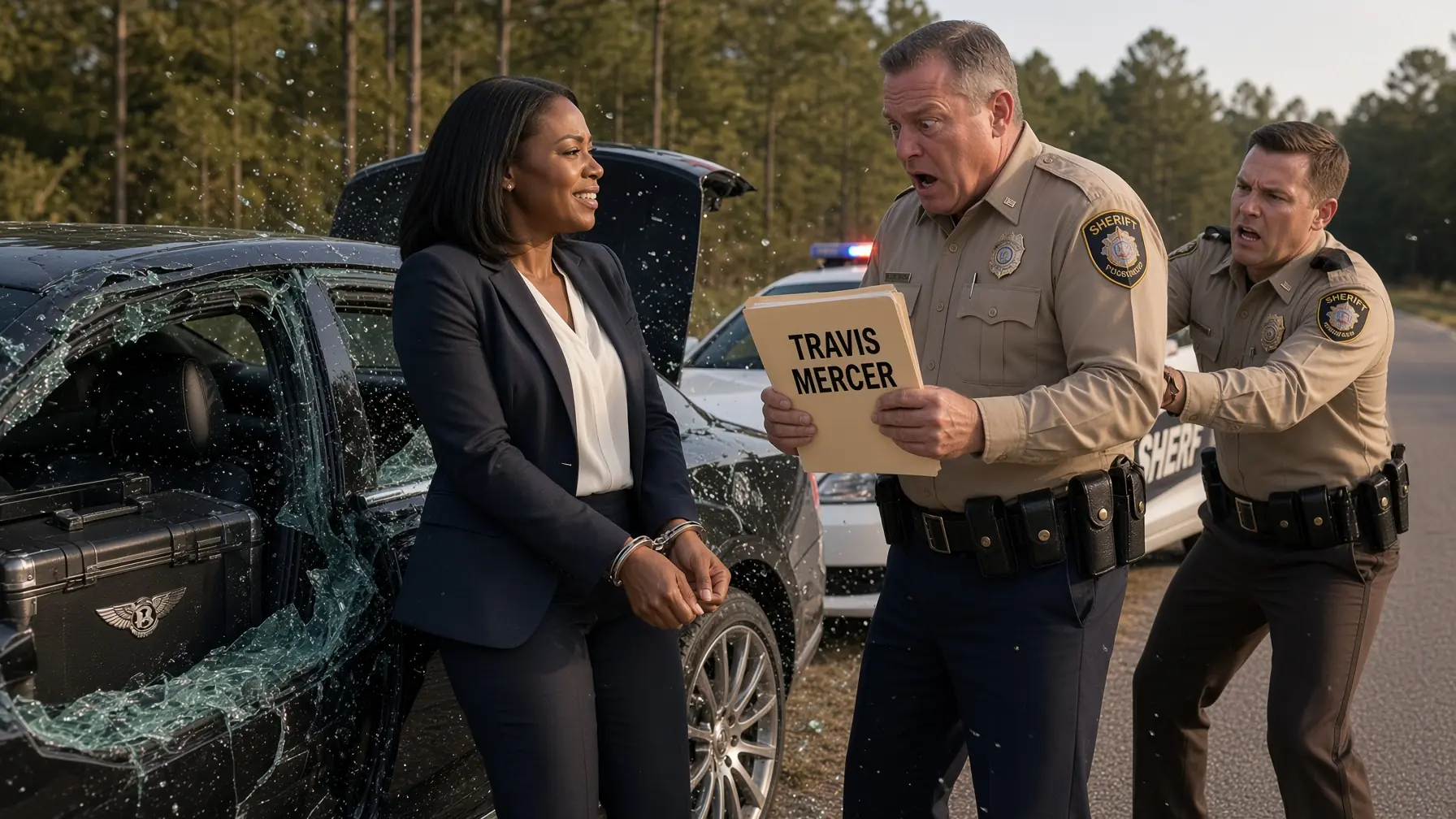
The first strike landed against the driver’s window with an explosion of tempered glass. Maya flinched but did not move toward the car. Mercer struck again, breaking the rear passenger window, then another, until shattered safety glass covered the cream leather seats and glittered along the shoulder. “That,” Maya said, her voice controlled despite the pulse beating visibly in her neck, “needs to be in your report.” Mercer spun toward her. “Shut your mouth.” Noah took two steps forward. “Mercer, her registration was confirmed before you broke the first window.” The senior deputy barely looked at him. “I heard you.” “Then what are we searching for?” Noah asked. Mercer leaned through the broken frame and began opening compartments. “Suspicious behavior.” Maya watched him remove the same registration document Noah had already verified electronically. “Refusing consent is not suspicious behavior,” she said. Mercer straightened. “You seem very confident for somebody in the middle of a police investigation.” Maya answered, “I’m confident about what happened.”
Twenty-seven minutes earlier, none of them had expected the afternoon to become important. Maya had been driving north through Carver County, North Carolina, on a quiet two-lane road that ran between soybean fields and pine woods. She was forty-three, Black, recently widowed, and dressed in dark trousers and a charcoal jacket she had worn to a county administrative meeting that morning. On the passenger seat sat a thermos, her phone, and a folder of ordinary transition paperwork. In the locked trunk was something less ordinary: a sealed black case bearing numbered tamper tape and a control label. It contained documents prepared for the next administration of the Carver County Sheriff’s Office—complaints, evidence audits, unresolved internal reviews, and summaries of cases that county officials believed required independent attention before a new command structure took over.
Maya was authorized to possess the case. That was not the secret she was trying to hide. The more important fact was that at twelve midnight, less than nine hours away, a county commission appointment would become effective. Carver County’s sheriff had resigned unexpectedly after a serious illness, and under the vacancy process the commissioners had appointed Maya to serve the remainder of the term. She had spent seventeen years in law enforcement before moving into state-level public integrity work, and she had been chosen largely because she had no professional roots inside Carver County. The appointment had been approved and signed but deliberately scheduled for public announcement the following morning. Until midnight, however, Maya was not Sheriff Williams. She had no command authority over the men who now stood beside her car, and she had no intention of pretending otherwise.
Mercer had pulled her over after following the Bentley for nearly two miles. He initially said her left rear turn signal appeared delayed during a lane change. Maya did not remember failing to signal, but she did not argue. She provided her license, registration, and proof of insurance. The registration database initially returned a manual-verification notice because the vehicle had recently been transferred from a corporate lease into her personal name. Dispatch resolved the discrepancy within minutes. That should have ended the stop with either a warning or whatever citation Mercer believed the signal justified. Instead, Mercer stared at the Bentley, then at Maya, and asked where she had gotten the car.
“I bought it,” she answered.
“With what?”
Maya looked at him.
“That isn’t related to the turn signal.”
Mercer smiled without warmth. “Just making conversation.”
“Then I’m declining the conversation.”
Something changed after that. The traffic issue became secondary. Mercer asked where she was going, what she did for work, why she was traveling through Carver County on a Sunday, whether anything illegal was inside the car, and eventually whether he could “take a quick look.” Maya answered the questions connected to the stop and declined the rest. When Mercer ordered her out, she complied. When he requested consent to search, she said no. When he demanded the key, she locked the Bentley instead. Noah Bennett arrived as backup during the argument and quickly verified the registration. He expected that confirmation to lower the temperature. It did the opposite.
Mercer was fifty-one and had spent twenty-four years wearing a badge. He was not incompetent in the way bad stories make bad officers incompetent. He knew procedure. He had arrested violent offenders, pulled children from wrecked cars, and once received a departmental commendation after finding an elderly dementia patient during a winter storm. He also possessed an increasingly dangerous weakness: he experienced resistance to his authority as evidence that more authority was needed. Most drivers surrendered to his tone long before a legal line became important. Maya did not. Every time she asked what justified the next demand, Mercer heard challenge rather than caution. By the time Noah confirmed the Bentley was hers, the stop was no longer about a questionable turn signal. It had become a contest Mercer believed he could not afford to lose in front of a younger deputy.
Noah understood that before he understood what to do about it. At twenty-nine, he had been with the sheriff’s office four years, long enough to know which senior deputies welcomed questions and which remembered them. Mercer belonged firmly to the second category. Noah objected when the first window broke, again when Mercer began searching the passenger compartment, and again when Mercer characterized Maya’s refusal as obstruction. But he did not physically stop him, call a supervisor immediately, or take control of the scene. He told himself he was preserving order between two increasingly stubborn people. Years later he would describe that explanation more accurately: he had been afraid of becoming the next problem.
Mercer found nothing in the cabin. Sunglasses. Receipts. Hand sanitizer. A phone charger. A folded county map. Nothing illegal, nothing dangerous, nothing remotely capable of retroactively justifying the shattered glass around him. Maya stood on the shoulder with her hands visible and watched his confidence turn into something more desperate. “Open the trunk,” he said. “No,” she answered. “You keep refusing everything.” Maya shook her head. “I gave you my identification. I gave you the registration. I gave you the insurance. I stepped out when ordered. What I did not give you was consent to search.” Noah said quietly, “She’s right about that.” Mercer turned on him. “Bennett, if you want to run this stop, say so.” Noah held his gaze. “I want us to have a reason for what we’re doing.”
That was when Noah noticed the dash camera.
It was smaller than most consumer units, mounted close to the rearview mirror with a green status light glowing beside the lens. He pointed. Mercer followed his hand and stared at it. “How long has that been running?” Maya looked toward the camera. “Before you approached the car.” The answer drained some of the color from Mercer’s face. The device had potentially captured her locking the Bentley, his demand for the key, Noah’s registration confirmation, the window strikes, the search, and every argument about consent. Mercer reached through the broken driver’s window and pulled the unit from its mount. Maya immediately said, “If you are seizing that, document when you took it and preserve the chain of custody.” Mercer snapped that he knew how evidence worked. Maya answered, “Then you know why the record matters.”
Instead of logging it immediately, Mercer set the camera on his patrol car. Then he returned to Maya. “Give me the key.” She refused. Mercer ordered her to turn around. “Am I under arrest?” Maya asked. “You are being detained while I complete the investigation.” “For what specific offense?” Mercer did not answer. He told her to turn around again. Maya did so without resistance, placing her hands behind her back while Noah watched. Mercer cuffed her, removed the Bentley remote from her pocket, and walked toward the trunk. Noah followed him. “Think about this first.” Mercer pressed the button. “I am.” Noah shook his head. “No. You’re trying to justify what already happened.”
The trunk lifted.
The black metal case sat alone in the center.
Both men stopped.
Official evidence tape crossed the latches. Numbered seals remained intact. A white label read: CARVER COUNTY SHERIFF TRANSITION — RESTRICTED INTERNAL REVIEW MATERIAL. Mercer leaned closer. Maya, still handcuffed beside the patrol car, said, “The control number is on the seal. Verify it before anyone touches the case.” Noah agreed. “That’s exactly what we should do.” Mercer looked back at Maya. “Where did you get it?” “Verify the number.” “Who gave it to you?” “Verify the number.” Mercer’s anger returned. He reached toward the seal.
“Do not break that,” Maya said.
He paused.
“Why?”
“Because you do not know what you are opening.”
“Then tell me.”
“No.”
Mercer tore the seal.
The case contained organized folders, personnel summaries, sealed envelopes, audit records, and an encrypted drive. Mercer opened the first file. Internal complaints. The second referenced evidence discrepancies. He scanned several lines and suddenly became still. Noah noticed. “What?” Mercer closed the folder. “Nothing.” But Maya had already seen his face. Mercer opened another page. His own name appeared near the top: Deputy Travis Mercer. Beneath it were references to a prior evidence discrepancy, a complaint regarding an undocumented search, and a supervisory review that had ended without formal finding. Another name appeared repeatedly in the approval column: Captain Raymond Dugan.
Now Mercer had something he had not possessed ten minutes earlier.
A personal reason to fear the contents of Maya’s trunk.
He closed the case and announced that Maya was being detained on suspicion of unlawful possession of restricted county material. Noah stared at him. “You don’t know it’s unlawful.” Mercer pointed toward the files. “Her name isn’t on these papers.” “You haven’t checked the custody record.” Mercer told him they would verify everything at the station. Maya said nothing. She had already offered the simplest verification several times. The numbered seal could have ended the question in minutes. Mercer had preferred an answer he could control.
A car slowed farther down the shoulder. An older woman pulled safely off the roadway and raised her phone. Mercer told her to keep moving. She replied that she was off the road and not interfering. Her name was Evelyn Brooks, a retired emergency-room nurse returning home from dinner with her sister. She had not witnessed the beginning of the stop, and she would later be careful never to claim that she had. What she did see was a Black woman standing handcuffed away from a Bentley with nearly every window broken, a senior deputy near an open trunk, and a younger deputy whose posture looked deeply uncomfortable. Evelyn began recording.
Mercer ordered the Bentley impounded. Then he carried the dash camera into his patrol car and shut the door. From outside, Noah saw him working with his mobile computer. He did not see every action, but when Mercer emerged several minutes later he said the camera’s files were corrupted. Noah stared at the device. “It was recording when you took it.” Mercer answered, “Recording doesn’t mean anything saved.” Noah asked whether he had already inspected the storage. Mercer’s eyes narrowed. “You have a problem with that?” Noah looked at the shattered Bentley and then at Maya. “I have a problem with not knowing what happened to evidence after you took possession of it.”
The drive to the Carver County Sheriff’s Office took twenty-eight minutes. Maya sat in the rear of Noah’s patrol car while Mercer transported the sealed case, now no longer sealed, in his own vehicle. Before Noah closed her door, she asked, “Who has the camera?” “Mercer.” “Was it logged before he handled it?” Noah hesitated. “Not yet.” Maya nodded once. “Remember that.” She did not ask him to take her side. She did not tell him who she would become at midnight. She asked him to remember an observable fact.
The sheriff’s office on Sunday evening looked nothing like the center of a coming scandal. Fluorescent lights hummed above the booking desk. Someone had abandoned a paper cup beside a printer. A deputy ate half a reheated chicken sandwich while writing a report. A local weather forecast played silently on a wall-mounted television. Maya was processed as Maya Williams, occupation listed only as county transition work. Nobody recognized her. The black case went to evidence intake. The dash camera followed. Mercer told the property deputy its media had been corrupted in the field. Noah immediately added that the device appeared operational when seized.
“Put down that it appeared active,” Mercer said. “Storage unreadable.”
The property deputy typed both statements.
Then Captain Raymond Dugan arrived.
Dugan was sixty-one, close to retirement, and had spent more than three decades inside Carver County law enforcement. He wore civilian slacks and an open-collar shirt because Mercer’s phone call had pulled him away from dinner. His annoyance disappeared the moment he read the label on the black case. He opened one of the folders Mercer had already disturbed, scanned a page, and asked, “Who else saw this?” Mercer nodded toward Noah. Dugan looked through the glass at Maya sitting calmly in an interview room and said something that would become important later. “Find out who she is before anybody outside this building does.”
Dugan interviewed Maya personally. She gave him the same answer Mercer had received: verify the control number. Dugan asked why his deputy’s name appeared in the documents. Maya said he should ask whoever prepared them. He accused her of making the situation unnecessarily difficult by refusing simple explanations. Maya answered that a numbered government seal and custody record existed precisely so important material did not depend on informal explanations beside a highway. Dugan studied her for several seconds. “You know a lot about procedure.” Maya said, “Procedure is usually most important when somebody wants to skip it.”
When Dugan left the room, he brought Mercer into his office.
He asked whether registration had cleared before or after the windows were broken.
Mercer did not answer.
Dugan understood.
Instead of stopping there, however, he began helping Mercer turn an ugly sequence into cleaner language. The original stop became an “administrative ownership irregularity.” Maya’s refusal to consent became “repeated noncompliance.” The window destruction became “vehicle entry during an unresolved investigation.” Discovery of the transition files appeared after those steps, giving the report a sense of progression that the actual timeline did not support. When Mercer asked what to write about the dash camera, Dugan looked at him and said, “According to intake, the media was unreadable.”
On paper, disorder began becoming procedure.
Noah saw it happening.
He also saw something small the others overlooked. When the dash camera first connected to the evidence workstation, the hardware registered normally. That did not prove what footage existed, but it contradicted a simple claim that the entire unit had arrived dead. Noah entered a routine maintenance notation with the serial number and intake timestamp. He accused nobody. Later, when the camera’s status changed from active electronic evidence to damaged equipment after supervisory access, he recorded the earlier system state. When an inventory line connected to the transition case disappeared from the normal screen, Noah recorded that it had previously existed.
He still had not done enough.
He knew that.
But he was beginning.
Dugan’s actions went further. During what he later described as a supervisory review, he handled the camera and the transition package outside the cleanest evidence procedures. The memory card that had appeared physically intact was later recorded as damaged. The original numbered seal disappeared. Several transition pages were no longer present when the case was inventoried again. Packaging changed. Electronic classifications changed. None of those things, by itself, would eventually prove who had done what. But computers remembered accesses even when people rewrote descriptions, and Noah’s timestamped notes created points investigators could compare against system-generated audit trails.
Across town, Evelyn Brooks was doing something even simpler.
She wrote things down.
The retired nurse sat at her kitchen table with the video open on her phone and a yellow legal pad beside it. She recorded the approximate time she stopped, where she parked, how many patrol vehicles she saw, what parts of the Bentley were already broken, where Maya stood, what she personally heard Mercer say, and what she did not know. Evelyn had spent thirty-five years watching memories change after car crashes, emergencies, and frightened midnight conversations. She understood that recollection became less reliable each time a person retold a story. So she created a record before anyone told her what the story was supposed to mean.
Then she called the sheriff’s office.
Dugan answered.