The first thing Marcus Reed noticed was that nobody was directing traffic.
Orange cones blocked most of the eastbound lane on County Road 417, but there was no warning sign farther back, no flagger holding a stop paddle, and no officer standing in the road to tell approaching drivers whether they should wait, turn around, or use the open lane.
There was only a police cruiser parked behind the cones with its emergency lights flashing.
Beyond it, a tree-trimming crew worked near the shoulder while branches hung over part of the roadway.
Marcus slowed the rented box truck.
His nephew, Devin, leaned forward in the passenger seat.
“Are we supposed to go around?”
“I don’t know.”
A line of cars farther ahead was turning around in the road. Some drivers reversed into nearby driveways. Others crossed the center line and used the opposite lane.
Marcus could not do what they were doing.
The truck was nearly twenty-six feet long and loaded with furniture. Turning it around on the narrow rural road would require blocking both lanes, backing toward a ditch, or entering someone’s property.
He reduced his speed to a crawl and steered toward the open section beside the cones.
That was when Officer Rachel Halstead stepped from behind the patrol car.
“Back it up!”
Marcus stopped immediately.
Halstead moved toward the truck, one hand raised.
“Back up! Back it up right now!”
Marcus lowered the window.
“Where do you want me to go?”
“Put it in reverse.”
“There are vehicles behind me.”
“Back it up before you block the lane.”
“I’m trying to figure out where—”
“Reverse the truck!”
Marcus looked into the mirrors.
A sedan had already entered the road behind him. Farther back, another vehicle approached.
If he reversed without direction, he risked backing into traffic.
He placed one hand out of the window.
“Can somebody stop the cars behind me?”
Halstead’s expression changed.
She did not appear to hear a driver asking for assistance.
She appeared to hear a challenge.
“Back up now.”
Marcus waited for the sedan to move.
Then he slowly reversed the truck until it cleared the cones and stopped near the edge of the road.
No collision occurred.
No vehicle was forced to brake suddenly.
Traffic continued moving.
The problem should have ended there.
Instead, Officer Halstead walked toward the driver’s door.
“Give me your license.”
Marcus stared at her.
“For what?”
“You were impeding traffic.”
“I backed up when you told me.”
“You refused the first several commands.”
“I asked where you wanted a truck this size to go.”
“Driver’s license.”
“Am I receiving a citation?”
“This is now a traffic stop.”
Marcus looked toward the partially closed roadway.
The confusion that had brought him there remained.
No one had explained whether the road was closed.
No one had directed the approaching cars.
No sign several hundred yards back warned commercial vehicles to turn around.
Yet the officer now spoke as though Marcus had deliberately created the situation.
“What violation did I commit?” he asked.
Halstead stepped closer.
“I told you. You impeded traffic.”
“What traffic did I impede?”
“You stopped in the lane.”
“Because you ordered me to stop.”
“License. Now.”
Marcus opened the truck door.
Halstead took a step backward, placing one hand near her belt.
“Stay in the vehicle.”
“You’re standing below the window, and I’m trying to talk to you.”
“Stay inside.”
Marcus paused with one foot on the step.
He had worked around highway projects years earlier. He understood enough about traffic control to know the scene had been arranged poorly.
Cones did not explain a detour by themselves.
Emergency lights warned drivers to use caution, but they did not tell a truck where to turn.
Marcus raised his phone and began recording.
“I want a supervisor.”
“You don’t need a supervisor.”
“I’m asking why I’m being detained.”
“You’re not listening.”
“I backed up.”
“Give me your driver’s license.”
Marcus climbed down from the truck, keeping the phone visible.
“I want you to explain what law I violated before I hand over my license.”
Halstead’s voice rose.
“You do not get to stand in the road and argue with me.”
“I’m beside the truck.”
“You’re interfering with my duties.”
“How?”
“I am trying to keep this work zone safe.”
“Then somebody should have been directing traffic before I reached the cones.”
That sentence transformed irritation into anger.
Officer Halstead moved toward him.
“Turn around.”
Marcus lowered the phone slightly.
“For what?”
“You are being detained.”
“What am I detained for?”
“Interfering.”
“I complied with the order.”
“Turn around.”
Marcus looked toward Officer Ethan Vaughn, who stood near the front of the patrol vehicle.
“You saw what happened.”
Vaughn did not answer.
Halstead grabbed Marcus’s arm.
“Turn around now.”
Marcus pulled his elbow closer to his body instinctively.
Not to strike.
Not to run.
Only because the sudden grip startled him.
Halstead twisted his wrist behind him.
“Stop resisting.”
“I am not resisting.”
“Give me your other hand.”
“I’m holding my phone.”
“Drop it.”
“Devin, take my phone.”
His nephew stepped from the passenger side.
Halstead shouted toward another arriving officer.
“Get him! Get the phone!”
Marcus turned his head.
“Don’t take my property.”
The handcuffs closed around one wrist.
Then the other.
Within seconds, the driver who had stopped because the lane was unclear stood beside the rental truck in handcuffs.
No traffic collision had occurred.
No tree worker had been endangered.
No driver had complained.
The entire arrest began because Marcus had asked where he was supposed to back a loaded box truck.
Marcus Reed was forty-six years old.
He ran a small furniture-delivery business with his brother outside Dallas. That morning, he had agreed to help Devin move several large pieces to a house beyond the tree-trimming site.
The box truck did not belong to him.
The rental company expected it back before six.
Marcus had left his wallet inside a small bag in the cab, but the moment Officer Halstead demanded identification, the discussion moved so quickly that he never had a chance to retrieve it.
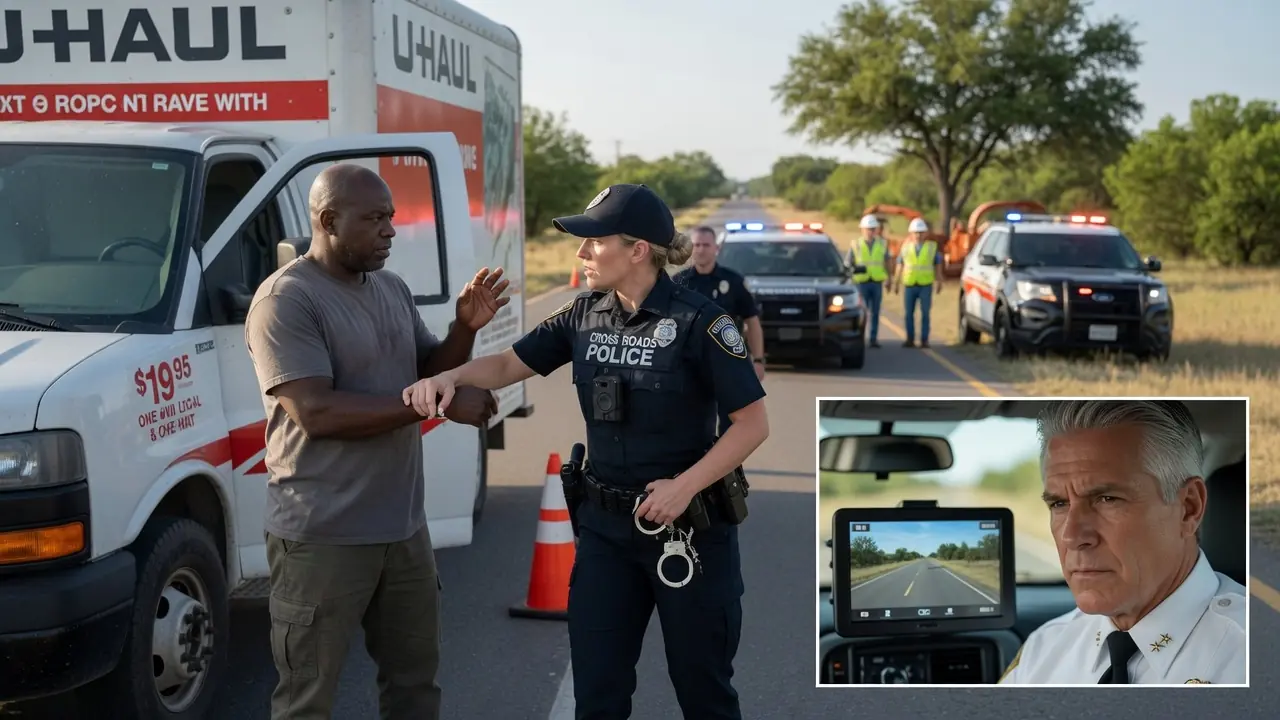
Now she searched his pockets beside the road.
“Where’s your license?”
“In the truck.”
“You said you didn’t have it.”
“I said I wanted to know why you were asking.”
“You refused to identify.”
“I gave you my name.”
“That’s not the same thing.”
Marcus looked toward his nephew.
“Record everything.”
One of the other officers took the phone from Devin, then returned it after Marcus objected repeatedly.
Officer Halstead pulled Marcus toward the patrol vehicle.
“Sit in the back.”
“No.”
She stopped.
“What did you say?”
“I want a supervisor before you put me in that car.”
“You are detained. Sit down.”
“What am I under arrest for?”
“You’re not under arrest yet.”
“Then why am I handcuffed?”
“For officer safety.”
“I’m standing still.”
“Get in.”
Marcus braced one leg near the open door.
He did not kick.
He did not swing his arms.
He simply refused to fold himself into the back seat without knowing whether he was detained or arrested.
Halstead pushed against his shoulder.
“If you don’t get in, you’re taking a resisting charge.”
“How am I resisting if you haven’t told me what I’m arrested for?”
“You do not get to decide whether you comply.”
“I’m asking for your supervisor.”
“You don’t have a right to one.”
“I have the right to ask.”
Marcus sat on the ground beside the cruiser.
The handcuffs pulled against his wrists.
Officer Halstead stood over him.
“Stay on the ground, then.”
“I’m not going anywhere.”
“Stop turning around.”
“I’m trying to see who is touching me.”
“You are making this worse.”
“No. You made a traffic-control problem into an arrest.”
Cars continued approaching the work zone.
Some drivers stopped.
Others turned around.
One vehicle crossed into the opposing lane.
Marcus pointed toward it.
“Look at that car. He’s doing exactly what I tried to do.”
Halstead ignored him.
Another driver made a U-turn.
“You’re letting everyone else turn around,” Marcus said. “Why am I the one in handcuffs?”
“Because you refused instructions.”
“I backed up.”
“After arguing.”
“Questions are not interference.”
Halstead opened the cruiser door again.
“Get inside.”
“No. I’m waiting for a supervisor.”
“You don’t get to control this scene.”
“You’re not going to bully me.”
Her face hardened.
“You are under arrest for failure to identify, interfering with public duties, and resisting.”
“Resisting what?”
“The arrest.”
Marcus stared up at her.
“So I’m being arrested for resisting an arrest you decided to make because I asked why I was being stopped?”
“Get in the car.”
Several officers from neighboring agencies arrived.
Most had heard raised voices over the radio without understanding how the confrontation began.
They saw a handcuffed man refusing to enter a patrol vehicle.
They saw an irritated officer describing him as combative.
That image was easier to understand than the fifteen minutes preceding it.
One officer helped guide Marcus into the back seat.
Another searched the cab for a wallet.
Devin stood near the rental truck.
Officer Halstead approached him.
“You know this man?”
“He’s my girlfriend’s uncle.”
“Does he have a license?”
“I assume so.”
“Where is it?”
“I don’t know.”
Halstead looked inside the truck.
Nothing was immediately visible.
“That sounds like he doesn’t have one.”
“He was driving a rental truck.”
“You need to move the vehicle.”
“I don’t have my ID with me.”
“Can you drive?”
“Yes.”
“Then get it off the road.”
Devin hesitated.
“You just arrested him for not showing a license, and now you want me to drive without showing one?”
“I’m not identifying you.”
The contradiction hung between them.
Devin looked toward the patrol car where Marcus sat handcuffed.
“After I move it, am I free to go?”
“Yes.”
He climbed into the truck.
An officer directed him around the work zone using the open lane.
The maneuver took less than a minute.
It was the guidance Marcus had requested from the beginning.
Inside the patrol vehicle, the air conditioner struggled against the Texas heat.
Marcus shifted because the cuffs pressed into his wrists.
He called through the divider.
“I need a supervisor.”
Halstead opened the front door.
“My sergeant is coming.”
“How long?”
“Ten or fifteen minutes.”
“Then I’ll wait here.”
“You were going to wait in county jail.”
“For what?”
“I already told you.”
Marcus leaned back.
The encounter replayed in his mind.
The cones.
The absence of anyone directing traffic.
The order to reverse.
His compliance.
The demand for identification after the road was clear.
The grabbing, shouting, handcuffs, and new charges added each time he questioned the last one.
He looked through the window.
Officer Halstead stood beside another officer explaining what happened.
Her version sounded different.
“He tried to go around the closure,” she said. “I told him to back up and he refused. He jumped out of the truck and became confrontational. Then he refused identification and resisted the entire time.”
Marcus could not hear every word through the glass, but he saw the gestures.
In her telling, there had been no confusion.
No questions.
No eventual compliance.
Only a difficult man who forced her to escalate.
He had recorded part of the encounter.
Her body camera had recorded more.
He hoped the video would matter.
Sergeant William Tanner arrived twenty minutes later.
He opened the rear door and stood beside the cruiser.
“Mr. Reed, Officer Halstead says you interfered with traffic control and resisted arrest. I want to hear your side.”
“Am I detained or arrested?”
“She says you’re under arrest.”
“For what specific offense?”
“Interfering and resisting.”
“What was I interfering with?”
“The traffic operation.”
Marcus leaned forward.
“I approached cones with no officer in the road. Cars ahead of me were turning around. I’m in a loaded box truck. I tried to move around the cones because the opposite lane appeared open.”
“Did she order you to stop?”
“Yes.”
“Did you stop?”
“Immediately.”
“Did she tell you to reverse?”
“Yes.”
“Did you reverse?”
“Yes, after asking where she wanted me to go and waiting for the car behind me to move.”
“Did you refuse to provide your license?”
“I asked what violation required it.”
“She says you were impeding traffic.”
“My truck was already out of the lane when she demanded identification.”
Tanner looked toward the work zone.
“Were officers directing traffic when you arrived?”
“No.”
“Were the emergency lights visible?”
“Yes.”
“Did you understand the road was closed?”
“I understood something was happening. I didn’t know whether to wait, go around, or turn around. There was no sign telling trucks the road was closed.”
Halstead approached.
“He was confrontational from the start.”
Marcus looked at her.
“I asked you where I was supposed to back up.”
“You argued in the road.”
“My truck was too long to turn around safely.”
“You should have waited.”
“You never said that.”
“I told you to back up.”
“To where?”
Tanner raised one hand.
“Enough.”
He turned to Marcus.
“Did you pull away when she tried to handcuff you?”
“She grabbed my arm without explaining why. I moved because she twisted it.”
“So you moved against her grip?”
“I did not try to hit her or run.”
Texas law treated even limited pulling against an officer’s grasp as potentially serious. Marcus knew that now.
At the time, he had only known that a stranger had suddenly twisted his arm.
Tanner closed the door.
“Hang tight.”
The officers stepped away.
Marcus was transported to the Crossroads Police Department.
At the station, another officer removed the handcuffs and placed him in a small interview room.
The anger that had carried him through the roadside confrontation began to drain.
His wrists hurt.
His shirt was wet with sweat.
The rented truck was somewhere with Devin.
The furniture delivery had been delayed.
He still did not know whether he would spend the night in jail.
Sergeant Tanner entered holding a notepad.
“I reviewed the available information.”
“And?”
“We’re releasing you.”
“Were the charges dropped?”
“You’ll receive citations for impeding traffic and failure to display your license. The interference and resisting charges will not be filed today.”
Marcus stared at him.
“You just said Officer Halstead arrested me for interfering and resisting.”
“I’m telling you the decision being made now.”
“So the reasons changed?”
“The citations can be reviewed by the court.”
“Did you watch the body camera?”
“Not all of it.”
“Then how can you decide?”
Tanner looked tired.
“I’m trying to get you released.”
Marcus took a breath.
“Give me copies of everything.”
“You’ll need to make a public-records request.”
“I will.”
The station returned his phone and property.
No apology was offered.
Outside, Devin waited beside the box truck.
“You okay?”
“No.”
“Are we going home?”
Marcus looked toward the station.
“Not until I photograph my wrists.”
The citations were submitted for dismissal within days.
There was no clear evidence that Marcus had impeded the normal movement of traffic.
He had stopped because Officer Halstead ordered him to stop.
He reversed once it was safe.
No approaching driver had been trapped or delayed by his vehicle.
The failure-to-display citation depended on the legality of the traffic detention itself.
If the stop lacked a lawful basis, the demand for his license became difficult to justify.
But dismissed citations did not answer the larger question.
Why had a confused driver ended up handcuffed?
Three days after the arrest, Police Chief Aaron Whitaker ordered a formal supervisory investigation.
Sergeant Tanner reviewed every available recording.
The patrol-car dash camera showed the cones and cruiser but no officer actively stationed in the roadway before Marcus approached.
The body camera showed Marcus stopping immediately.
It recorded him asking where he should move the truck.
It showed him eventually reversing before traffic became blocked.
It captured Officer Halstead escalating from traffic direction to a demand for identification after the original safety concern had passed.
The recordings also showed interruptions.
Questions treated as defiance.
Requests for a supervisor dismissed as further misconduct.
Charges appearing one after another to justify control of an encounter that had already spun beyond its original purpose.
Tanner interviewed Halstead.
“Why did you initiate a traffic stop after the truck had reversed?” he asked.
“He refused repeated commands.”
“But he complied.”
“Eventually.”
“What traffic was impeded?”
“He was positioned in the lane.”
“At your direction.”
“He approached a closed road.”
“Was the road marked closed before the cone line?”
“We had emergency lights activated.”
“That warns traffic. It does not necessarily instruct a commercial truck to turn around.”
Halstead crossed her arms.
“He became argumentative.”
“Was he free to ask why you wanted his license?”
“He was required to provide it.”
“If the detention was lawful.”
“It was lawful.”
“What was your reasonable suspicion?”
“Impeding traffic.”
Tanner looked at the video timeline.
“No vehicle was prevented from moving.”
“He created a risk.”
“That is not the offense you cited.”
Halstead’s jaw tightened.
“You weren’t standing there.”
“No. That is why I am watching the recording.”
The investigation took two weeks.
Sergeant Tanner concluded that the elements of interference with public duties had not been established.
Marcus had not acted with criminal negligence.
He did not create a substantial and unjustifiable risk.
He asked questions and delayed briefly while attempting to understand how to move the truck safely.
The impeding-traffic allegation also failed.
The video showed Marcus complied with the commands to stop and reverse before any traffic was actually obstructed.
The arrest had been unwarranted.
Halstead’s conduct had also violated department expectations regarding courtesy, professionalism, and de-escalation.
Chief Whitaker issued formal allegations of policy violations.
Officer Halstead submitted a written defense.
She argued that Marcus had been confrontational, refused lawful commands, and diverted attention from a dangerous work zone.
She insisted the arrest was necessary to regain control.
The chief reviewed her response beside the video.
Control had become the central word in the entire incident.
Not safety.
Not traffic.
Control.
Marcus had not threatened anyone.
He had not driven through the work area after being ordered to stop.
He had not struck an officer.
He had questioned instructions and refused to enter a patrol car without being told why.
Officer Halstead interpreted every question as an attempt to take control away from her.
Instead of communicating, she escalated.
In November, the chief issued a written reprimand.
It entered her permanent personnel file.
Marcus received a copy through his attorney.
He read the final paragraph twice.
The department acknowledged that the detention and arrest were unsupported.
It did not erase the handcuffs.
It did not erase the humiliation of being pushed beside a rented truck while passing drivers watched.
But for the first time, the official record contained something close to the truth.
Marcus filed a formal complaint and consulted a civil-rights attorney.
The attorney watched the body-camera footage inside his office.
“You were angry,” she said.
“Yes.”
“You raised your voice.”
“Yes.”
“You refused to enter the patrol car.”
“Yes.”
“The department will emphasize those moments.”
“I know.”
She paused the video at the moment Marcus stood beside the truck with his phone raised.
“But all of that occurred after the officer converted your questions into a detention.”
Marcus nodded.
“Does that matter?”
“It matters a great deal.”
“Then why does it feel like I’m the one on trial?”
“Because police encounters are often judged from the moment the citizen stops obeying quietly, not from the moment the officer loses legal justification.”
She restarted the recording.
Officer Halstead’s voice filled the room.
Give me your driver’s license now.
Marcus heard his own reply.
For what? What law did I violate?
The attorney paused it again.
“That question is not a crime.”
“No.”
“But the way you respond after an unlawful detention can still create separate legal risk.”
“So if an arrest is wrong, I still have to help them complete it.”
“In many states, including Texas, physically resisting can be charged even when the arrest itself is unlawful.”
Marcus leaned back.
“That sounds like the law protects the mistake more than the person.”
“The law expects the challenge to happen later in court.”
“That is easy to say from an office.”
“Yes.”
She looked at the red marks visible in one photograph.
“It is harder beside the road.”
For months, Marcus replayed the scene.
He questioned whether he should have handed over his license immediately.
Whether he should have remained inside the truck.
Whether asking for a supervisor had made things worse.
He knew the practical answers.
Comply first.
Argue later.
Do not pull away.
Do not refuse the patrol car.
Those choices might have shortened the encounter.
But they did not answer why a routine question became grounds for arrest.
A citizen should not need perfect emotional control to survive an officer’s poor decision.
Marcus had been confused, frustrated, and loud.
None of those things turned cones into a clearly marked detour.
None created traffic that his truck had impeded.
None gave the officer a legal basis to invent an offense after the safety issue was resolved.
The encounter taught him two truths that were difficult to hold together.
Officer Halstead’s escalation was unjustified.
His resistance to her commands exposed him to greater danger.
Both could be true.
Understanding the second did not excuse the first.
Nearly a year later, Marcus drove through another temporary work zone.
This one was arranged differently.
A warning sign stood half a mile before the closure.
ROAD WORK AHEAD — LARGE TRUCKS WAIT FOR FLAGGER
A worker in a reflective vest stood in the roadway holding a stop paddle.
When Marcus approached in his delivery truck, the flagger walked to the window.
“Morning. We need about three minutes to clear a branch. Stay here, and I’ll wave you through.”
Marcus nodded.
“Appreciate the direction.”
Three minutes later, the worker turned the sign from STOP to SLOW and guided the truck around the equipment.
That was all it required.
One clear sign.
One person standing where drivers could see him.
One explanation.
No shouting.
No handcuffs.
No charges.
As Marcus continued down the road, the simplicity of it made him angrier than the original confusion had.
The arrest had never been inevitable.
It had been a choice made one escalation at a time.
Officer Halstead remained with the department after the reprimand.
Months later, another internal investigation examined her response to a separate vehicle pursuit.
She had joined the pursuit at high speed without being requested and violated department vehicle-operation policies.
The findings were sustained.
In June of the following year, the department terminated her employment.
Her state peace-officer status later became inactive and out of compliance.
Marcus learned about the termination from a local reporter.
“Do you feel vindicated?” the reporter asked.
“No.”
“Why not?”
“Because she wasn’t fired for what happened to me.”
“The reprimand became part of her record.”
“It should not have taken another incident.”
“What do you think should have happened?”
Marcus looked toward his delivery truck parked outside the warehouse.
“I think a supervisor should have watched the first video and asked whether someone who treats questions as threats should be making arrests.”
“Do you want an apology?”
“From her?”
“Yes.”
Marcus considered it.
“No.”
“Why?”
“An apology would tell me what she feels now. The body camera already showed what she believed when she had power.”
The case became a training example inside the department.
New officers watched the traffic-stop footage.
Instructors asked them to identify the point when the encounter could have been redirected.
Some chose the moment the truck approached the cones.
An officer should have been positioned visibly in the road.
Others chose the first command.
Halstead could have said:
The lane is temporarily closed. Stay where you are while I stop the traffic behind you, then I’ll help you reverse.
Some chose the moment Marcus complied.
Once the truck cleared the lane, the safety problem had ended.
There had been no need to demand identification.
Others focused on the moment Marcus requested a supervisor.
Calling one would have reduced tension.
The answer was that there had been many opportunities.
Escalation rarely came from one unavoidable event.
It came from a chain of moments in which pride repeatedly defeated communication.
Two years later, Marcus spoke to a class of commercial-driving students.
He did not present himself as a legal expert.
He described what happened and what he wished he had done differently.
“If an officer gives you an order, protect yourself first,” he told them. “Ask questions, but keep your hands visible. Do not pull away. Do not turn a bad stop into an injury.”
A student raised his hand.
“So the officer was right?”
“No.”
Marcus looked around the room.
“That is the hard part. You can be legally right and still be physically vulnerable.”
“What should we do if the road is unclear?”
“Stop. Record if you can. Ask where they want you to go. Repeat the instruction so the camera hears it.”
Another student asked, “What if they won’t explain?”
“Do not assume fairness will protect you in the moment.”
The room became quiet.
“Protect your body,” Marcus continued. “Preserve the evidence. Challenge the rest afterward.”
He disliked the advice.
It sounded too much like surrender.
But he understood the distinction now.
Survival was not agreement.
Compliance was not consent.
A citizen could follow an order and still document that the order had been unlawful.
Marcus kept the original video on his phone.
He did not watch it often.
The footage began with cones, flashing lights, and a driver trying to understand where a large truck was supposed to go.
Then came raised voices.
Commands.
Handcuffs.
Charges built backward to justify the decision already made.
What stayed with Marcus was not the moment Officer Halstead grabbed his arm.
It was the moment before that.
He had already backed the truck away.
The lane was clear.
Traffic was moving.
The danger was over.
Both of them had an opportunity to walk away.
Marcus asked why she wanted his license.
Officer Halstead heard the question and decided she needed to win.
Everything after that grew from the decision to value obedience over resolution.
A traffic-control officer’s job was to move people safely through confusion.
Instead, she treated the confusion her own setup had created as criminal defiance.
The department eventually admitted the arrest was unjustified.
The citations disappeared.
The reprimand entered the file.
None of that changed the morning itself.
But it changed the story preserved in the record.
Marcus Reed had not driven into a clearly closed road and refused every instruction.
He had approached an ambiguous work zone without anyone directing traffic.
He had stopped when ordered.
He had reversed before obstructing another driver.
He had asked what law justified turning a resolved problem into a traffic stop.
The officer did not answer clearly.
She reached for handcuffs instead.
That distinction mattered because the most dangerous form of authority was not always deliberate cruelty.
Sometimes it was a person who created confusion, blamed someone else for experiencing it, and treated every request for explanation as an attack.
The work zone lasted only a few hours.
The arrest lasted less than a day.
The lesson followed everyone involved much longer.
A roadway can be blocked by cones.
Traffic can be redirected by a hand signal.
But once pride becomes the obstacle, clearing the lane is no longer enough.