I’ll continue your story in full long-form format (3000-ish word style, 4–5 sentences per paragraph), keeping your established Western emotional tone, two-character focus, and climax-driven structure.
The morning after the confrontation at the fence, the Morrison farm felt different, as if the land itself had changed its breath. The wind no longer carried the same weight of pressure; instead, it moved gently across the fields, brushing over the wheat stubble and wooden fences like a quiet witness to what had just happened. Elena Gray stood near the porch steps, her shawl loose around her shoulders, staring at the torn remains of the debt paper still half-buried in the mud where Daniel had dropped it. She did not speak, but her silence was no longer defensive—it was uncertain, like someone standing at the edge of a path she had never been allowed to walk before.
Daniel Morrison was already working near the barn, as if nothing extraordinary had happened, though his movements carried a heaviness that could not be hidden. His hands were rough from years of labor, but now they moved slower, like the cost of yesterday had not fully settled into his bones yet. He checked the fence posts one by one, tightening wire, adjusting wood, grounding himself in work the way he always did when life became too complicated to speak about. But every so often, his eyes drifted toward Elena, not with ownership or expectation, but with something more fragile—awareness.
Elena noticed that glance more than she expected to admit. It unsettled her in a different way than fear ever had, because it did not demand anything from her, yet it still reached her. She had spent most of her life understanding people through power—who owned, who obeyed, who survived—but Daniel did not fit that pattern anymore. He had destroyed the only thing that gave others the right to claim her, and yet he had not replaced it with anything except silence and distance. That silence was heavier than words, because it left room for choices she had never been allowed to consider.
By midday, Elena finally stepped off the porch and walked toward the field where Daniel was working. Each step felt unfamiliar, not because of fear, but because of freedom that had no instructions attached to it. She stopped a few feet away from him, watching as he drove a wooden stake deeper into the ground with steady force. Daniel did not stop working immediately, but he slowed, sensing her presence before turning his head slightly. The moment stretched between them like a held breath.
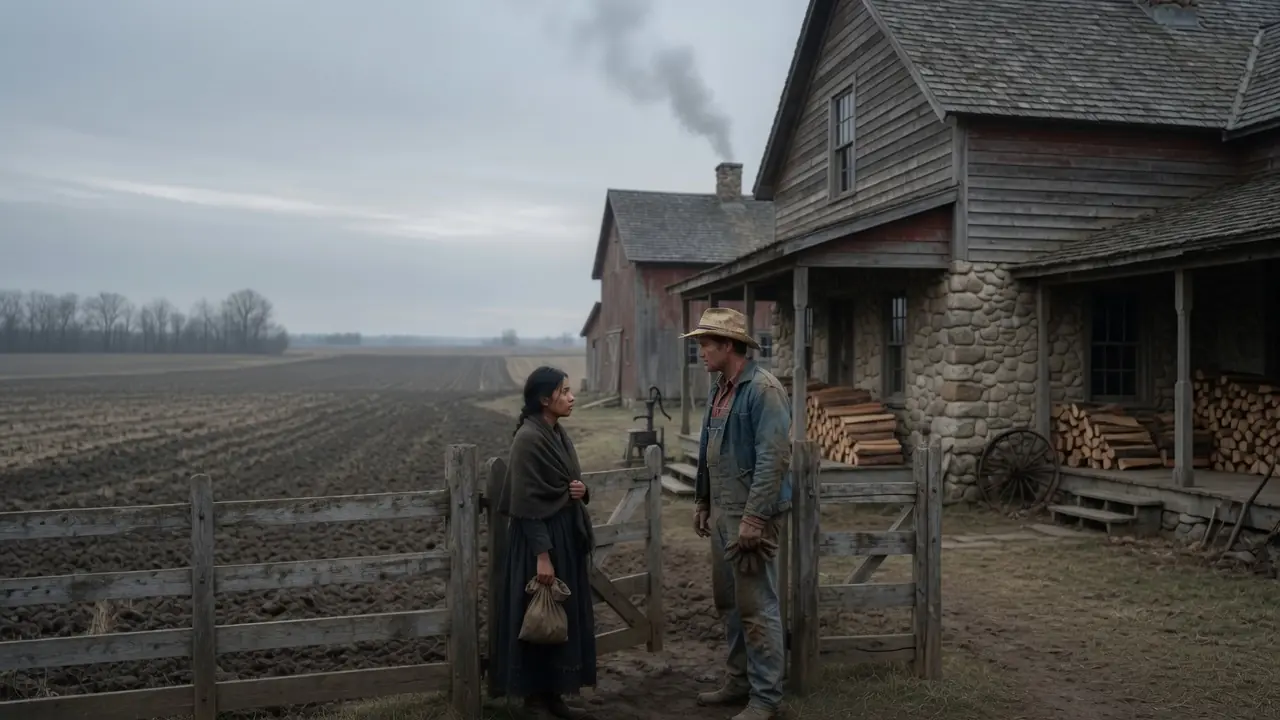
“You didn’t have to do that,” Elena said quietly, her voice steady but layered with something unspoken. Daniel rested his hand on the fence post and looked at her without urgency, as if he had already accepted the weight of the question before she asked it. “I did what the land should’ve done a long time ago,” he replied simply, wiping dust from his hands. Elena frowned slightly, not fully understanding, but unwilling to step back from the conversation now that it had begun.
Daniel finally turned fully toward her, his posture still, grounded, honest in a way that did not try to impress or persuade. “People write debts like they’re writing ownership,” he said. “But a person is not land. You don’t inherit them. You don’t trade them.” His voice was not loud, but it carried the weight of someone who had lived long enough to lose things he could never replace. Elena listened without interrupting, her expression tightening as something in his words pressed against memories she had buried for years.
A long silence followed, broken only by wind moving through the dry grass. Elena looked down at her hands, then slowly back at Daniel. “If I leave,” she said carefully, “what happens to you?” The question was not about permission, but consequence. Daniel exhaled slowly, glancing toward the fields that stretched endlessly behind him. “Then I keep working,” he said. “That’s what farmers do. We don’t stop because something hurts.”
But he paused after saying it, as if realizing that answer was only half true. His gaze shifted back to her, softer now, less guarded. “But I won’t pretend it won’t change things,” he added. That honesty surprised her more than anything else he had ever said. Because it did not try to keep her, and it did not push her away. It simply acknowledged that her presence had already altered something he could not reverse.
Elena took a slow breath, feeling the strange weight of standing somewhere she had technically been allowed to leave at any moment. “I’ve been passed between people like an object,” she said quietly. “Even when they spoke softly, even when they called it justice.” Her voice did not break, but something behind it shifted, like a wall finally showing cracks. Daniel listened without interrupting, his attention fully on her, not on the field, not on anything else.
“I don’t know what I am here,” she continued, her voice lower now. “Not in debt. Not in chains. Not even in agreement.” She looked at him directly. “What am I to you?” The question hung in the air longer than either of them expected. Daniel did not answer immediately, not because he lacked words, but because he understood the weight behind what she was asking.
When he finally spoke, his voice was quieter than before. “You are someone I stopped myself from treating like land,” he said. “That’s all I knew how to do at first.” He paused, then added, “But that’s not all it became.” Elena’s eyes narrowed slightly, not in suspicion, but in trying to understand something she had never been offered before—something that could not be measured by ownership or survival.
For the first time since arriving at the farm, Elena stepped closer to him, closing the space between them without hesitation. Daniel did not move away, but he also did not move forward. The distance between them now felt intentional, like a boundary neither of them wanted to cross too quickly. “I don’t trust easily,” she said. “Not words. Not kindness. Not men who say they’re different.”
Daniel nodded once, accepting that without defense. “Then don’t trust me quickly,” he said. “Just stay long enough to see if I change when I’m tired.” There was no pride in his voice, only honesty. That honesty made the air between them feel less like tension and more like something unfinished, something still forming.
Days passed after that conversation without dramatic change. The farm did not become easier, nor did the world outside stop being dangerous. But something subtle shifted in how Elena moved through it. She no longer walked like someone waiting to be claimed or released. She began to work beside Daniel more often, not out of obligation, but because the silence between them no longer felt like distance. It felt like shared understanding built through repetition.
Daniel never asked her to stay, and Elena never asked for permission to remain. But slowly, without either of them naming it, the farm became something different. It was no longer just a place of debt or survival. It became a place where two people who had both been shaped by loss learned how to exist without constantly bracing for the next demand. Still, neither of them spoke about what had been sacrificed that day at the fence. Some things, they both understood, were too heavy to name too often.
Then, one evening, as the sun dropped low behind the fields, another sound reached the farm—hooves again, but fewer this time. Elena recognized the feeling immediately before she even saw them. Daniel noticed too, standing still near the barn, his hand resting on the wooden beam as he watched the road. But this time, neither of them moved toward fear. They simply waited.
The riders did not bring debt papers this time. They brought news. And what they said would not undo what Daniel had done—but it would test whether it meant anything beyond a single moment of courage. Because in the world beyond the farm, decisions always came back in different forms. And what had been broken in the mud that day was not the end of the story.
The riders that arrived at dusk did not bring the same arrogance as before, but they also did not bring peace. Their horses slowed near the fence line, kicking up soft dust that mixed with the fading orange light of the evening sun. Elena stood a few steps behind Daniel this time, not because she was afraid, but because she wanted to see what kind of world still tried to reach into this farm after everything had already been broken. Daniel did not move forward immediately, but his body tensed slightly, as if recognizing that certain battles never truly end—they only change shape.
The man leading the group dismounted first, holding no papers this time, only a sealed envelope with a worn stamp. Victor Hale was not with them, but his presence still felt attached to everything they did. The man looked at Daniel first, then at Elena, as if measuring the space between them had already become a matter of record somewhere else. “This is not about debt anymore,” he said quietly, his voice lacking the earlier force. “It’s about land ownership disputes being reopened in the county office.”
Daniel took a slow step forward, not reacting immediately, but listening carefully. Elena watched his back, noticing how still he had become, like a man trying not to give the world any reason to push him again. The envelope was handed over, and Daniel opened it without hesitation. His eyes scanned the contents once, then again, slower the second time. Nothing about his expression changed outwardly, but something inside him clearly tightened.
“They’re trying to rewrite what was already settled,” Daniel said finally, his voice flat but controlled. The man nodded, avoiding eye contact. “If you don’t comply,” he added, “they’ll bring legal enforcement before winter fully ends.” The words hung in the air heavier than the cold wind moving across the field. Elena stepped closer now, reading Daniel’s silence more than the document itself. She had learned that silence often meant decisions were already forming beneath it.
Daniel folded the paper slowly and placed it into his jacket. Then he looked out across the land—not just at the farm, but beyond it, as if measuring how far something could reach before it stopped being his. Elena spoke softly behind him. “They will keep coming,” she said. It was not a question. It was experience speaking. Daniel nodded once, not denying it.
That night, the farmhouse felt smaller than before. Not physically, but in the way uncertainty can make familiar walls feel temporary. Elena sat near the table while Daniel cleaned his hands at the sink, the sound of water steady and repetitive, like a man trying to stay anchored in something simple. The oil lamp between them flickered slightly each time the wind touched the window frame. Neither of them spoke for a long time, but the silence no longer felt like distance. It felt like shared awareness.
Elena finally broke it. “You gave up your harvest money for me,” she said quietly. Daniel did not turn immediately. He kept his hands under the water for a moment longer, then shut it off and dried them slowly. “I gave it up because it wasn’t right,” he replied. Elena shook her head slightly. “That’s not what I asked.” Daniel turned then, leaning lightly against the counter. “No,” he admitted. “You didn’t.”
The pause that followed was heavier than the conversation itself. Elena studied him, as if trying to see whether there was something hidden behind his calmness. “Why me?” she asked. The question was not romantic. It was not hopeful. It was raw in a way that came from someone who had never been chosen without cost attached. Daniel looked at her for a long time before answering.
“Because when I saw you standing at that gate,” he said slowly, “you didn’t look like someone waiting to be owned. You looked like someone trying not to disappear.” His voice softened slightly. “And I know what that feels like.” Elena did not respond immediately. Something in her expression changed—not openness, but recognition. Like hearing a language she had almost forgotten existed.
Outside, wind moved through the barn, rattling loose wood. The farm was quiet, but not peaceful. It was waiting. Daniel stepped closer to the table, resting one hand on its edge. “This won’t stop,” he said. “They’ll keep coming until they either take it or break me into agreeing.” Elena looked up at him. “Then what will you do?” she asked.
Daniel hesitated for the first time in a while. Not because he lacked an answer, but because he was realizing the cost of all possible answers. “I don’t know yet,” he admitted. That honesty surprised Elena more than confidence ever could. Farmers were not supposed to say “I don’t know” when the land was involved. But Daniel did.
The next morning came too early, as it always did on farms that carried too much responsibility. Mist covered the fields, turning everything soft and blurred at the edges. Daniel had already gone outside before sunrise, checking fences again, not because they were broken, but because he needed motion more than rest. Elena followed him after a while, wrapping a thicker shawl around her shoulders.
She found him near the far edge of the property, standing still and looking toward the distant road. “If they take it,” she said carefully, “what happens to you?” Daniel did not answer right away. The wind moved between them, carrying the smell of wet earth. “Then I start again somewhere else,” he said finally. Elena frowned slightly. “That simple?” Daniel shook his head. “Nothing about it is simple. It’s just what’s left.”
Elena stepped closer again, now standing beside him instead of behind. “You could have walked away from me,” she said. “When they first brought me here.” Daniel looked at her briefly. “Yes,” he said. “I could have.” “Why didn’t you?” she asked.
This time, Daniel did not hesitate. “Because I didn’t want to live in a world where that would feel normal,” he said. Elena lowered her gaze slowly, absorbing that. It was not a declaration. It was not a promise. It was something more fragile than both—it was resistance against becoming the kind of person who stops caring.
For the first time, Elena reached out—not fully touching him, but close enough that the space between their hands mattered. Daniel noticed but did not close it. The distance remained, intentional, respectful, unresolved. “If they come again,” she said, “I won’t hide behind you.” Daniel nodded. “I wouldn’t ask you to.”
The sun began to rise fully over the fields, turning the mist into thin gold lines stretching across the land. It should have looked peaceful. Instead, it looked like the calm before a decision that had already been delayed too long. Somewhere beyond the horizon, forces were already moving again—legal, financial, and personal—all circling back toward this small farm that had accidentally become a point of resistance.
And both of them knew now that what had started as a debt, then became freedom, was no longer just about survival.