I drove my old rusted pickup into the Ror farmyard just as the Texas sun was dropping behind the river cottonwoods. The air was thick, hot, and dusty, with insects screaming from the grass and cattle shifting behind the fence near the old red barn. A flatbed trailer rattled behind my truck, empty for now, but ready to haul away whatever my boss told me to take. I had a folder on the passenger seat with Dale Ror’s signature on three different pages and a number circled in red: fifteen thousand dollars.
I did not like collecting farm debts. I had grown up around people who counted rain clouds like bank deposits and prayed over broken tractors because a bad week could become a bad year. But debt was debt, and my boss did not pay me to feel sorry for people. Dale Ror had borrowed money against the hay baler, the feed trailer, and part of the fall cattle sale, then vanished behind excuses until three months had passed. By the time I turned off the engine, I already felt the weight of the job sitting heavy in my chest.
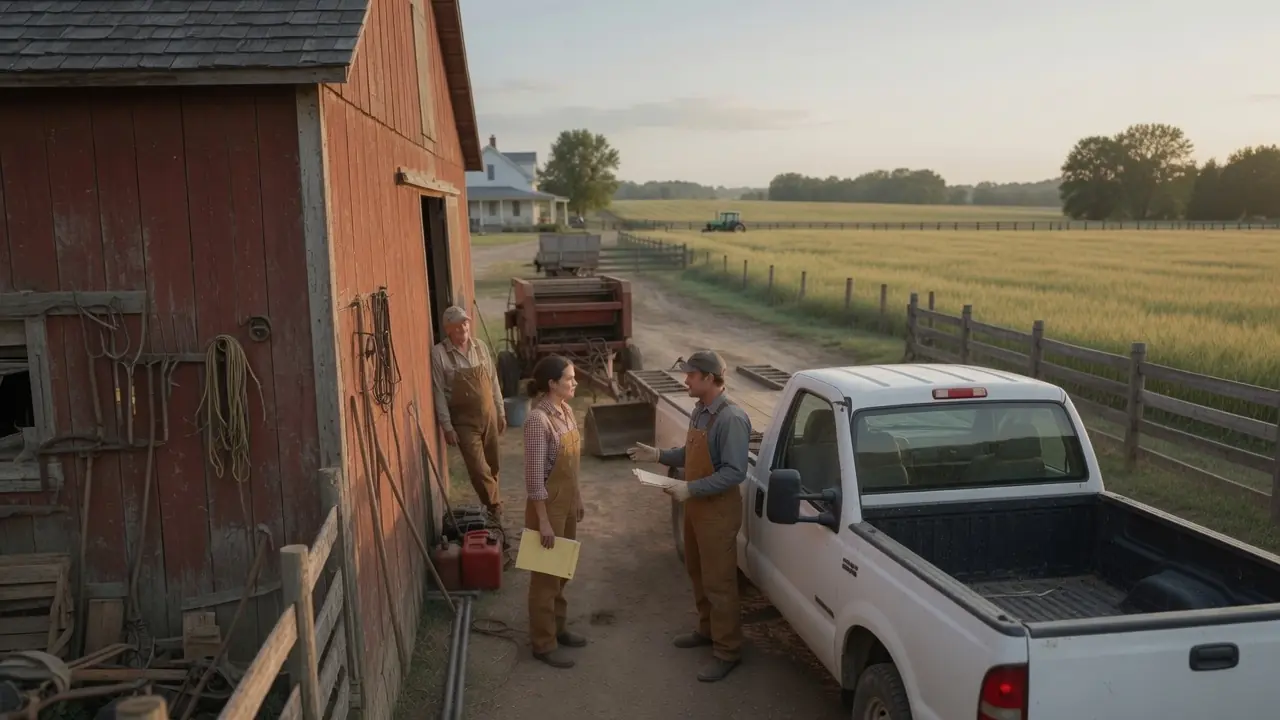
The farm looked like it was trying not to collapse in front of me. The farmhouse leaned a little toward the river wind, the porch boards were sun-bleached, and the barn door hung on one tired hinge. Fuel cans stood near the wall, tools were stacked neatly beside a broken gate, and a rust-red hay baler sat in the yard like a patient old animal waiting for another season. Everything was worn, but nothing was careless, and that told me someone here still cared.
I had just opened my truck door when the screen door slapped against the farmhouse frame. A woman stepped out into the yard and stopped at the edge of the porch, one hand gripping a yellow paper and the other resting against her hip. She was about thirty-two, sun-browned from fieldwork, strong in the shoulders, tired in the eyes, with long brown hair tied back in a messy ponytail. Her old flannel shirt was damp from heat, her faded jeans were covered in dust, and her bare feet were muddy like she had been working too long to remember shoes.
“You’re the man they sent for the debt, aren’t you?” she called.
I picked up the folder and shut my truck door. “Clay Mercer,” I said. “I’m here about Dale Ror’s loan.” She walked down the steps and crossed the yard until only a few feet of dust stood between us. She did not look frightened at first, but I saw how tightly she held the paper.
“My husband isn’t here,” she said. “He went to Houston looking for work. Two weeks gone, no real calls, no money sent back.” Her voice was low and rough from heat and long days outside. She stared right at me like she had practiced not looking away.
“That doesn’t change what he signed,” I said. “Fifteen thousand past due. My boss wants payment or equipment.” I opened the folder and pulled out the first contract, though I knew she had probably seen it before. “If I leave without money, I’m supposed to take the baler.”
Tessa Ror looked past me at the baler, and for the first time her face cracked. It lasted less than a second, but I saw it. That machine was not just equipment to her. It was hay, feed, cattle, bank time, winter survival, and the difference between a farm that could limp forward and one that stopped breathing before the month was over.
Most people begged or blamed when I showed up with a folder. They blamed the weather, the banks, the price of fuel, their family, their bad luck, their bad health, and sometimes God himself. Tessa did not throw any of that at me. She stood barefoot in a dusty yard and told me the truth like she had already spent all the lies she could afford.
“I have another way to pay,” she said. I looked back at her. “What way?” She stepped closer, close enough that I could smell soap, sweat, hay dust, and the long day clinging to her skin. Her jaw tightened, and her voice dropped. “You stay here tonight. I give you something money can’t buy. Tomorrow you leave, and the debt disappears.”
The wind moved through the dry grass, and the whole yard felt suddenly too quiet. I stared at her, not because I was tempted, but because I understood exactly how far desperation had pushed her to say it. Her eyes were steady, but her hand was twisted so hard into the hem of her shirt that her knuckles had gone pale. This was not seduction. This was a woman standing at the edge of losing everything and trying to throw herself in front of the fall.
“No,” I said.
She blinked once. “You didn’t even think about it.” “I don’t need to.” I put the contract back inside the folder and closed it. “I don’t take payment that costs a woman her dignity.”
Her face changed then, first with shame, then anger, then something worse than both. “You think I don’t know what I just said?” she asked. “You think I woke up this morning wanting to bargain like that in my own yard?” Her voice trembled, but she did not step back. “I have cattle to feed, a note at the bank, a husband who left me with his mess, and a farm that’s been in his family for thirty years.”
“I believe you,” I said. “But I’m still not taking that offer.” She looked down at the yellow paper in her hand. “Then take the baler and get it over with.” Her voice went flat, like someone closing a door from the inside. “At least that kind of ruin is honest.”
I looked at the field beyond the barn. The hay was standing high and ready, dry enough to cut if the weather held. A buyer could turn that hay into money if the work moved fast. The kind of money Dale should have been chasing instead of hiding in Houston or wherever men like him went when responsibility stopped feeling convenient.
“What’s on the yellow paper?” I asked.
Tessa looked up slowly. “A plan.” “Show me.” She hesitated like she expected me to laugh, then handed it over. The paper was folded twice and soft at the edges, covered in pencil numbers, dates, names, fuel estimates, sale prices, and payment marks.
It was not pretty, but it was real. She had written the north field first, the hay buyer in Rusk, the old grain drill to auction, the spare feed trailer to sell, the south lot cattle to move before the fence failed, and my first payment circled hard enough to nearly cut the page. Every dollar had a place to go before it had even arrived. Dale had signed the debt, but Tessa had done the math.
“You wrote this?” I asked. “Nobody else was going to.” I read the first payment again. It would not clear the whole fifteen thousand, not even close, but it was better than an empty trailer and a dead farm. “Thirty days,” she said. “Give me thirty days. You help me get the hay cut, delivered, and paid. You get paid first from the sale.”
I almost laughed because the plan asked me to do more work for the same people who had not paid me for the last debt. But Tessa was not asking for mercy. She was asking for structure. She was offering control where Dale had offered stories.
Before I could answer, the barn door creaked open. Dale Ror stepped out like a man arriving late to his own consequences. He was nearly sixty, with a belly over his belt, sun-reddened cheeks, and a smile too easy for a yard this tense. He looked at Tessa, then at me, then at the folder in my hand.
“Clay,” he called. “No need for all this.” I did not answer. He walked closer, wiping his hands on jeans that were too clean for farm work. “Tessa gets fired up. You know how women are when bills come around.”
Tessa’s jaw clenched. I looked at Dale and felt my patience drop another inch. “You told me you’d pay after the calf sale.” “Market came in low.” “You told me the bank transfer was sent.” “Clerical mistake.” “You told me you’d bring cash last Friday.” He spread his hands. “Got tied up.”
Tessa stared at the dirt for one second, then looked right back at me. “Thirty days,” she said again. “Written terms. Payment schedule. No side deals through him.” Dale’s smile slipped. “Now hold on.”
“No,” she said, turning to him. “You held on long enough.” The yard went still except for the insects and a loose sheet of tin tapping against the barn. Dale looked at her as if he did not recognize the woman standing there, or maybe as if he recognized her too late.
I took a blank contract sheet from my glove box and wrote the terms on the hood of my truck. Tessa stood beside me, reading every line before I finished it. Dale paced near the barn, muttering about how it was his farm, his equipment, his name on the land. Tessa did not look at him.
When she signed, her hand did not shake. I pushed the paper toward Dale, then pulled it back before he reached for the pen. “No,” I said. “She signs. You don’t.”
Dale’s face turned hard. “It’s my farm.” Tessa looked at him with a tired calm that cut deeper than shouting. “Then start acting like it.” He said nothing after that.
I left that evening without the baler I had come to take. The flatbed rattled empty behind me, and Tessa’s signed plan sat on the passenger seat beside my folder. I kept glancing at it on the drive back, wondering whether I had just made a smart business decision or stepped into the hardest month of my life. By the time the sun disappeared, I still did not know.
At six the next morning, Tessa was waiting by the north field with a grease gun, a coffee thermos, and mud already on her jeans. I came in my service truck this time, not the flatbed. She noticed immediately. “No trailer today,” she said.
“Don’t make me regret it,” I answered. “I won’t.” There was no smile in her voice, but there was more strength than the evening before.
The first problem showed itself before the baler ever moved. An irrigation line had split near the lower strip, spraying water sideways into the lane and soaking ground we needed dry. Tessa shut the pump, crouched in the mud, and pointed at the clamp. “Bad clamp,” she said.
“Old pipe too,” I answered. “Clamp is what we can afford.” That was how the first week worked. Not what was perfect. What could hold.
We patched pipes, replaced worn bearings, tightened belts, moved cattle, and cut hay under a sky that gave us no mercy. Tessa did not act helpless, and she did not pretend to know what she did not know. She handed me tools before I asked for them, argued when she thought I was wrong, and checked moisture in the windrows like every bale carried her future inside it. I had known stubborn people before, but Tessa’s stubbornness was different.
It was not pride for show. It was survival with a notebook. She counted fuel, calls, hours, and weather windows, then adjusted when the day punched holes through her plan. By the third morning, I stopped thinking of her as Dale’s wife and started thinking of her as the only reason Dale still had a farm to neglect.
Dale appeared now and then, always at the wrong time. He came out with coffee when we were already two hours into work and said things like, “Looks like my place still knows how to run.” He watched Tessa climb off the tractor with dust on her face and said she was making herself look rough. He told me not to get too comfortable, as if I was the threat in a yard full of his unpaid bills.
Tessa ignored most of it until the first hay load was ready. We had stacked the trailer tight, checked the straps twice, and tucked the delivery paperwork into a sleeve. Dale walked over wearing sunglasses and that same easy smile. “Guess you two have been getting along fine,” he said.
“We’ve been working,” I replied. He looked at Tessa. “That what we’re calling it now?” The words were quiet, but the poison in them was not.
Tessa’s face went cold. “The first load is ready because Clay showed up,” she said. “I showed up and you didn’t.” Dale’s smile died. He looked at the trailer, then at me, then back at his wife. “Just remember who owns this place.”
Tessa stepped closer to him. “I remember who almost lost it.” Dale had no answer for that. I climbed into the truck, and Tessa got in beside me with the papers on her lap.
The delivery should have been simple. We were halfway down the county road when Tessa checked the folder and went still. “The buyer agreement isn’t here,” she said. “It was in the blue folder on the kitchen table.”
“Dale?” I asked. “Dale asked where we were delivering this morning.” She pulled out her phone and called the buyer in Rusk. Her voice stayed steady, but her knuckles were white.
When she hung up, she stared through the windshield. “He sent a new routing number last night. His account.” I tightened my grip on the wheel. Dale had waited until Tessa turned work into money, then tried to move the money before it reached the farm. He did not need to touch the hay to steal the harvest.
We delivered anyway. At Larkin’s warehouse, Tessa stood in front of the gray-bearded buyer and refused to unload until he confirmed the original sale terms. He looked uncomfortable, saying Dale had claimed to handle finances. Tessa laid her copy of the invoice on his clipboard.
“Dale didn’t cut the field,” she said. “Dale didn’t bale it. Dale didn’t call you when moisture ran high. I did.” Larkin looked at the trailer, checked the load, then nodded. “Hay looks good. Payment releases tomorrow morning, unless there’s a dispute.”
“Hold it until I confirm with the bank,” Tessa said. “No new routing. No changes without my signature.” Larkin agreed, and we unloaded under a sun that felt hotter than judgment. Tessa did not smile when we left.
At the bank, Dale was already there. That told me everything. He stood near the front desk, speaking warmly to a woman behind the counter like a man who had never missed a payment in his life.
Tessa walked in with the folder against her chest. “I need to freeze any payment changes on Ror Farm sales unless they carry my signature,” she said. Dale turned, surprise flashing into anger, then into that charming smile. “Tessa, you didn’t need to come all the way in.”
“Yes, I did.” “And you brought him.” Dale looked at me like I was something dirty on his porch. I stood near the door. “I’m here about my payment.”
Dale laughed. “Your payment. Sure.” Then he leaned toward Tessa and lowered his voice, but not enough. “You think people aren’t talking? You think they don’t notice him at the farm every day?”
Tessa went still. I felt heat rise in my neck, but she turned her head just enough to stop me from speaking. Then Dale said, “You should have just kept him sweet until we got through this.”
The bank lobby shrank around us. Tessa’s face did not break, but something in her eyes did. I looked straight at Dale. “I don’t take payment through someone’s wife.”
For once, Dale had nothing clever ready. The bank manager came out, and Tessa laid every paper on his desk: the original buyer agreement, Dale’s attempted routing change, her signed payment plan, my equipment contract, the auction list, and the delivery receipt. She spoke clearly, without drama, without shame. The manager listened.
By the time we left, the operating account required her signature for every farm sale deposit. The first hay payment would go through as planned, with my payment documented first. Dale walked out behind us, red-faced and furious. Tessa got into my truck instead of his.
The first payment hit my account the next morning at 9:14. I was under my own tractor changing a hydraulic hose when my phone buzzed on the concrete floor. I wiped my hand on a rag and stared at the number for a long second. It was not everything, but it was real.
I called Tessa. “You see it?” she asked before I could speak. “I see it.” “Good,” she said. Behind her, I heard engines, voices, and metal clanging. “Where are you?” I asked.
“Auction yard,” she said. “Selling the old grain drill and feed trailer.” I sat up too fast and hit my shoulder on the tractor frame. “You went without me?” “You had your own work.” “Tessa, that drill has a cracked hitch. Don’t let them talk you down like it’s falling apart.”
She went quiet, then said, “Then get over here and look mean beside it.” I did. By the time I arrived, she was standing with a clipboard under one arm, tired but ready to fight.
The drill sold lower than she wanted but higher than Dale expected. The feed trailer sold clean. Dale showed up halfway through, hands in his pockets, watching every bid like the money still belonged to him before it even existed.
When it was over, he walked to Tessa. “That’ll help us breathe.” Tessa held the receipt against her clipboard. “It’ll help the farm breathe.” Dale’s eyes cut to me. “Always Clay now.”
“No,” Tessa said. “Always the work. You just stopped recognizing it.” Dale looked around, saw people watching, and walked away before his anger could turn into embarrassment. Tessa did not follow.
The final hay delivery came two days later and nearly broke all of us. The baler slipped timing again, the truck ran hot on the county road, and one stack had to be reloaded because I did not like how it leaned. Tessa argued with me for five minutes, then climbed up and helped restack it anyway. At Larkin’s warehouse, the load passed inspection, and the final receipt was signed.
That month’s money did not save the farm forever. It paid down the feed bill, put my debt into a real payment schedule, and gave Tessa control over farm income before Dale could reroute it into excuses. It kept the place alive, and sometimes alive is the first miracle before anything gets better. Dale could still call it his farm, but he could no longer sell tomorrow without Tessa seeing the paper.
He moved out the following week. Not far, just to his brother’s place outside Canton, but far enough that the yard started breathing differently. He packed two bags, fishing rods, and what was left of his pride. Before he left, he told Tessa she would beg him to come back when the farm got too heavy.
She stood on the porch, arms crossed. “No,” she said. “I’ll call a mechanic.” Dale slammed his truck door and drove off in a cloud of dust.
I stayed away after that, not because I wanted to, but because I did not want the town writing a dirty story over clean work. When Tessa called about a loose belt, I gave her the part number. When she asked about fair custom-cutting rates, I gave her the county average. When she texted, You don’t have to vanish, I stared at the message for ten minutes before answering.
I’m not vanishing. I’m keeping it clean.
Her reply came a minute later. I know.
Three weeks later, I drove back onto the Ror farm on a clear morning with no flatbed behind me. Just my service truck, a replacement part on the seat, two coffees in the cup holders, and a printed work order clipped to a board. The yard looked the same in some ways: old barn, dusty lane, cattle near the fence, baler waiting with one panel open. But it did not feel desperate anymore.
Tessa met me at the gate in rolled-up sleeves and dusty boots, her brown hair tied back the same way it had been the first evening. She looked tired, but not trapped. I handed her the coffee and held up the work order. “Official job,” I said.
She read the rate and lifted one eyebrow. “You brought paperwork.” “Always.” “And coffee?” “Not on the invoice.”
For the first time since I had met her, Tessa smiled like it cost her nothing. “Still need that baler running by Friday,” she said. I picked up my toolbox and walked beside her through the gate. “Then let’s earn it the right way.”
By noon, the belt was changed, the baler was tested, and the next field was ready. Tessa stood beside the machine with grease on her hand and sun on her face, looking across the farm like it was no longer something she was begging the world not to take. It was work. It was debt. It was trouble.
But it was hers to fight for now.
And that made all the difference.