The prison woke before dawn.
Execution days always began early, but this morning carried a silence heavier than routine. Guards spoke in low voices. Steel doors closed more gently than usual. Even the fluorescent lights seemed reluctant to stay on, flickering above the concrete corridor as if the building itself were unsettled by what would happen before sunrise.
At the far end of death row, Ethan Ward sat on the edge of his narrow bed.
He wore an orange jumpsuit and white prison shoes. His hands rested between his knees, fingers trembling despite the calm expression on his face.
In less than three hours, the State of Missouri intended to execute him for the murder of another police officer.
Ethan had once worn a badge himself.
For twelve years, he had served as a K-9 handler with the Ashford Police Department. Newspapers had called him a hero after he helped rescue two missing children from an abandoned quarry. He had received commendations for tracking armed fugitives and uncovering weapons hidden in places human officers had already searched.
Now his name appeared on a laminated card outside a death-row cell.
WARD, ETHAN MICHAEL.
Convicted murderer.
Execution scheduled for 6:00 a.m.
Two guards watched him through the bars.
“I’ve never seen one this calm,” Officer Bennett whispered.
His partner, Marcus Reed, kept his eyes on Ethan.
“Maybe he’s accepted it.”
Ethan heard them.
He had not accepted anything.
He had simply run out of ways to protest.
For eleven years, he had repeated the same statement to attorneys, judges, journalists, prison officials, and anyone else willing to listen.
“I did not kill Daniel Cross.”
Daniel had been a fellow police officer, a friend, and the man who had stood beside Ethan at his father’s funeral.
The state said Ethan shot him inside an abandoned warehouse during a raid.
Ethan said there had been someone else in the building.
The state said no other person had left physical evidence.
Ethan said his K-9 partner had seen the attacker.
The prosecution had laughed at that argument in court.
A dog could not testify.
A dog could not be cross-examined.
A dog could not explain why Ethan’s service pistol had fired the bullet that killed Daniel Cross.
The jury convicted Ethan in less than four hours.
Years of appeals followed.
Every one failed.
Now the only witness Ethan had trusted was on his way to the prison.
Ranger.
The German Shepherd had been Ethan’s partner for almost nine years. They had worked together, eaten together, and slept under the same roof. Ranger had saved Ethan’s life during a warehouse arrest years before the murder.
But on the night Daniel Cross died, officers found Ranger barking wildly beside the body.
Prosecutors told the jury the dog had turned against his own handler.
Ethan had always insisted they misunderstood.
Ranger had not been accusing him.
He had been trying to warn them.
A steel door buzzed open.
Warden Samuel Mercer entered the corridor carrying a clipboard. Behind him walked the prison chaplain, a psychologist, and two members of the execution team.
Mercer had supervised nineteen executions. He knew how condemned prisoners behaved during their final hours.
Some prayed.
Some shouted.
Some became so frightened they could no longer stand.
Ethan Ward had asked for only one thing.
Not a special meal.
Not a final telephone call.
Not a meeting with the press.
He had asked to see Ranger.
The warden stopped in front of the cell.
“Mr. Ward.”
Ethan raised his head.
“Your visit has been approved. The dog arrived at the outer gate ten minutes ago.”
For the first time that morning, something changed in Ethan’s eyes.
“Thank you.”
“The visit will take place in the preparation room. You will remain restrained. Ranger will stay on a leash with his current handler.”
“I understand.”
“You will have fifteen minutes.”
Ethan nodded.
Mercer studied him.
“Is there anything else you want before the procedure?”
“No.”
“Nothing?”
Ethan looked toward the small window at the end of the corridor. The glass was still dark.
“Just let me see him.”
The warden signaled to the guards.
The cell opened.
Ethan stood and placed his hands through the slot as instructed. Officer Reed secured the cuffs around his wrists. A chain was fastened at his waist, followed by shackles around his ankles.
The same man who had once carried a badge and sidearm now moved in steps short enough to keep him from running.
As they began walking, Bennett asked quietly, “Why the dog?”
Ethan stopped.
The chains made a soft metallic sound.
“Because he was there.”
“At the warehouse?”
“Yes.”
Bennett hesitated.
“People say he barked at you.”
Ethan looked at him.
“He was barking past me.”
The guard said nothing more.
Outside the prison walls, a black state vehicle passed beneath the final security gate.
In the rear compartment sat an aging German Shepherd with gray around his muzzle.
Ranger was thirteen years old now.
His hips had weakened. His left rear leg remained stiff from an injury suffered during his final year of service. He no longer chased suspects or searched buildings. He lived on a small property outside Columbia with his current caretaker, Officer Cole Ramirez.
But when Cole opened the transport crate, Ranger stepped out with the disciplined posture of a working dog.
“You remember this smell?” Cole whispered.
The prison air carried disinfectant, concrete, metal, fear, and hundreds of human scents layered across one another.
Ranger lifted his nose.
His ears moved forward.
Then his body became still.
Cole felt the leash tighten.
“Easy.”
Ranger looked toward the main building.
He had found something familiar.
Long before Ethan Ward became inmate number 87421, he had been one of the most respected officers in Ashford.
He joined the department at twenty-seven after serving four years in the Army. He was quiet, disciplined, and far more comfortable with animals than with department politics.
When the K-9 unit offered him a position, the dog assigned to him was not the animal anyone expected to succeed.
Ranger had been rescued from an abusive backyard breeder.
At eighteen months old, he was underweight and terrified of sudden movement. He flinched when men raised their hands. He refused to enter dark rooms. During his first evaluation, he hid behind a training barrier and would not respond to commands.
The department planned to remove him from the program.
Ethan asked for thirty days.
He began arriving at the training center before sunrise.
He sat near Ranger’s kennel without trying to touch him. He spoke softly. He placed food close enough for the dog to smell but far enough that Ranger had to choose to approach.
For three days, the dog refused.
On the fourth morning, Ranger stepped forward.
On the seventh, he allowed Ethan to touch his neck.
By the end of the month, Ranger followed him without a leash.
“You didn’t train that dog,” Daniel Cross once said. “You convinced him the world wasn’t going to hurt him.”
Ethan had looked down at Ranger.
“Maybe that’s the same thing.”
Within a year, Ethan and Ranger became the strongest team in the unit.
Ranger located a missing six-year-old boy who had wandered into a flooded woodland.
He tracked a robbery suspect for more than four miles through rain.
During a drug search, he found twenty kilograms of narcotics concealed inside a false wall after two other dogs failed to alert.
Their connection extended beyond work.
Ranger lived with Ethan.
When Ethan woke from nightmares related to his military service, the dog pressed his head beneath Ethan’s hand until his breathing slowed.
When Ranger injured his hip during a rooftop pursuit, Ethan slept on the floor beside him for three nights.
They understood one another through small movements.
A shift of Ethan’s shoulders.
A change in Ranger’s ears.
A single glance before entering a dangerous room.
Then came the warehouse.
The official operation began at 11:40 p.m. on October 18.
An anonymous informant claimed stolen police weapons were being stored in an abandoned textile warehouse near the river. Ethan, Ranger, Daniel Cross, and a small tactical team were dispatched.
The raid had been organized unusually quickly.
There was no complete briefing.
No photographs of the interior.
No explanation of who had supplied the information.
Lieutenant Malcolm Marsh, head of the department’s Special Investigations Unit, assured them the source was reliable.
Ethan remembered feeling uneasy before they entered.
Ranger felt it too.
The dog stopped at the loading-bay door and growled.
“What is it?” Daniel asked.
“I don’t know.”
“Want to pull back?”
Ethan should have said yes.
Instead, Lieutenant Marsh’s voice came through the radio.
“Proceed. Suspects may be moving the weapons.”
Ethan and Ranger entered first.
The warehouse smelled of rust, standing water, motor oil, and old fabric. Rain struck the metal roof. Their flashlights cut narrow paths between stacks of broken machinery.
Daniel moved along the opposite wall.
The rest of the team remained near the entrance.
Ranger suddenly pulled left.
Ethan followed him toward a corridor formed by wooden crates.
The dog stopped again.
His ears flattened.
A low growl vibrated in his chest.
Ethan raised his weapon.
“Police. Show yourself.”
Something moved above him.
A figure dropped from a metal platform.
The impact drove Ethan to the floor. His flashlight spun away, throwing broken circles of light across the ceiling.
Ranger lunged.
A second man emerged from behind the crates and struck the dog with a steel bar.
Ranger crashed into a pile of pipes but immediately tried to rise.
Ethan fought to reach his weapon.
Someone grabbed his collar from behind.
A blade entered his left shoulder.
The pain was immediate and blinding.
A voice spoke near his ear.
“Stay down, or the dog dies.”
Ethan later told investigators he heard those words.
The prosecution claimed they were invented.
What happened next existed only in fragments.
Daniel shouting.
A gunshot.
Another gunshot.
Ranger barking.
A body hitting the concrete.
Ethan’s fingers closing around his service pistol, although he could not remember drawing it.
Then officers rushed into the corridor.
They found Daniel Cross dead from a gunshot wound to the chest.
They found Ethan kneeling beside him.
Daniel’s blood covered Ethan’s hands.
Ethan’s service weapon lay nearby.
A firearms examiner later concluded that the fatal bullet had been fired from Ethan’s pistol.
No knife was recovered.
The puncture wound in Ethan’s shoulder was described in the emergency report as “a superficial laceration caused during the struggle.”
Ranger barked violently while officers restrained Ethan.
He lunged toward Lieutenant Marsh and Officer Owen Hale, one of the first men to enter after the shooting.
The department report said the dog was confused and aggressive.
Ethan said Ranger was identifying the attackers.
No one listened.
The case moved quickly.
The department was facing public criticism over missing weapons and corruption allegations. A decorated K-9 officer accused of murdering his colleague became a story that drew attention away from everything else.
Lieutenant Marsh testified that Ethan had seemed emotionally unstable before the raid.
Officer Hale said he entered the warehouse and saw Ethan holding the gun beside Daniel’s body.
The medical examiner confirmed the bullet matched Ethan’s weapon.
The prosecution used images of Ranger barking during the arrest.
“If even his own dog recognized the danger,” the prosecutor told the jury, “why should we ignore it?”
Ethan’s defense attorney never obtained the complete K-9 training records.
He never asked why Ranger had barked at Marsh and Hale.
He never investigated the anonymous source behind the raid.
He never challenged the shallow examination of Ethan’s shoulder wound.
The jury found Ethan guilty.
The first sentence was life imprisonment.
After a retrial on the penalty phase, the state imposed death.
Ranger was transferred to another handler.
Within two years, he retired.
Ethan never saw him again.
Until now.
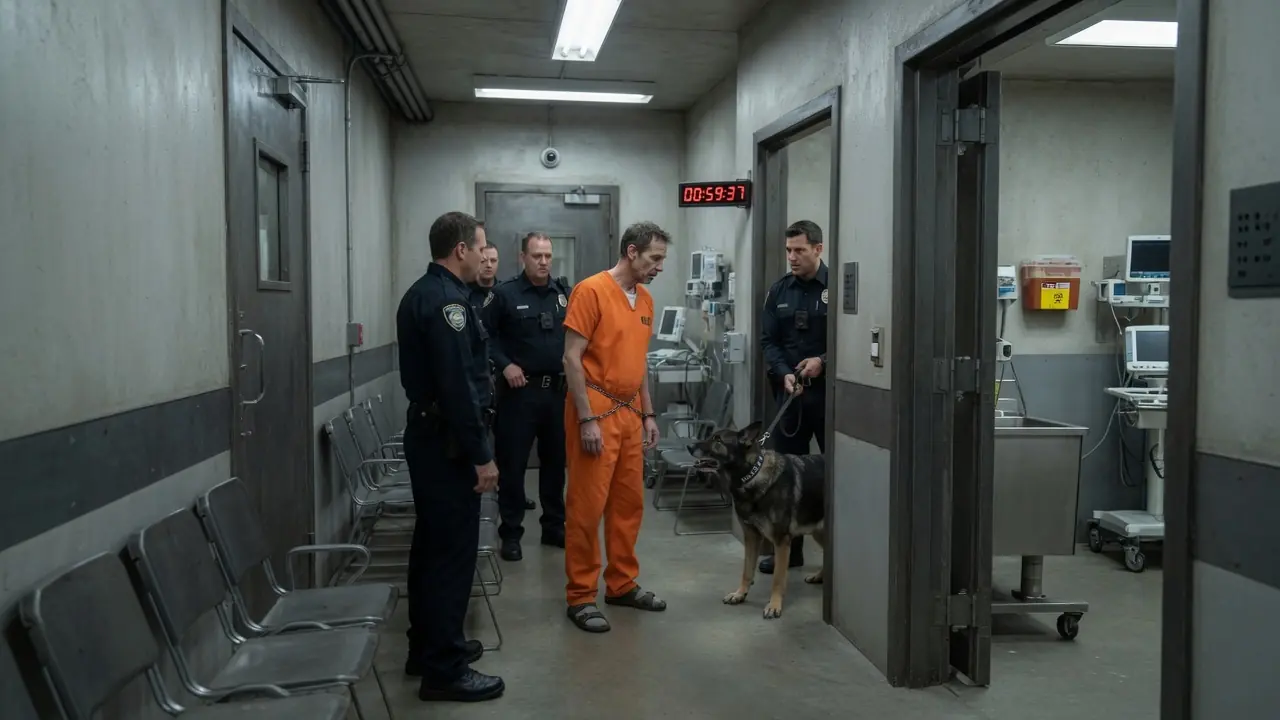
The preparation room inside the execution wing contained a bolted table, four chairs, and a reinforced observation window.
Ethan stood near the center with his wrists restrained in front of him.
Warden Mercer remained by the wall.
The chaplain and psychologist stood near the window. Four guards formed a loose semicircle around the room.
Another man waited near the door.
His name was Owen Hale.
He was sixty years old and worked as a senior investigator for the Department of Corrections. Before joining the prison system, he had spent eighteen years with the Ashford Police Department.
He had been present at the warehouse.
Hale had requested permission to witness the execution, claiming Daniel Cross’s former colleagues deserved representation.
When Ethan saw him, a wave of nausea moved through his stomach.
Hale had testified against him.
He had sat in court and described Ethan as cold, detached, and unremorseful.
Now he stood ten feet away, wearing a dark suit and a corrections identification badge.
Their eyes met.
Hale gave no sign of recognition beyond a slight tightening of his jaw.
The outer door opened.
Cole Ramirez entered with Ranger.
For a moment, no one moved.
Ethan forgot the guards.
He forgot the execution team waiting nearby.
He forgot the clock above the door.
All he saw was the dog.
Ranger looked older than Ethan had imagined.
Gray covered much of his face. His body had become leaner, and one rear leg moved stiffly.
But his eyes were the same.
Alert.
Intelligent.
Searching.
Ethan’s breath caught.
“Ranger.”
The dog’s ears rose.
Ethan lowered himself as far as the chains allowed.
“It’s me, boy.”
Everyone expected Ranger to run toward him.
He did not.
The dog took one step into the room, lifted his nose, and inhaled.
Then his entire body stiffened.
A growl rose from deep in his chest.
Cole tightened the leash.
“Easy.”
One of the guards whispered, “He remembers.”
Ethan’s face tightened with pain.
“Ranger, please.”
The dog looked directly at him.
For a second, Ethan believed the prosecution had been right.
Perhaps Ranger had always seen him as the killer.
Perhaps Ethan had built his final hope around a memory that meant nothing.
Then Ranger moved.
He walked past Ethan.
Straight toward Owen Hale.
The growl became louder.
Hale stepped back.
“What is this?”
Ranger lowered his body and pulled against the leash.
Cole needed both hands to hold him.
“Ranger, heel.”
The dog ignored the command.
His eyes never left Hale.
Hale’s face lost some of its color.
“Get that animal away from me.”
Cole studied Ranger’s posture.
“This isn’t random aggression.”
“I don’t care what it is.”
Hale moved toward the door.
Ranger barked sharply.
Once.
Twice.
The sound echoed through the room.
Ethan felt something open in his memory.
A voice in darkness.
Stay down, or the dog dies.
He stared at Hale.
The investigator reached for the door handle.
Warden Mercer stopped him.
“No one leaves.”
Hale turned.
“I came here as an observer. I’m not part of your execution procedure.”
“You were at the original crime scene,” Mercer said.
“That was eleven years ago.”
Ranger barked again.
Cole crouched beside the dog.
“Has he ever met you since then?” he asked Hale.
“No.”
“Were you in the warehouse?”
“I arrived with backup.”
Ethan’s breathing became unsteady.
“That voice.”
Everyone looked at him.
Hale’s eyes narrowed.
Ethan stepped forward, chains dragging lightly over the floor.
“You spoke to me before Daniel was shot.”
“That’s impossible.”
“You told me to stay down.”
Hale shook his head.
“You’ve been inventing stories for eleven years.”
“Say it again.”
“What?”
“Tell me to stay down.”
Hale looked toward the warden.
“This is absurd.”
Ethan’s voice rose.
“Say the words.”
Ranger pulled harder against the leash.
Cole placed one hand against the dog’s chest.
Hale’s composure began to crack.
“I don’t have to participate in this.”
The prison psychologist, Dr. Lena Foster, stepped forward.
“Mr. Hale, why did you personally request to attend this execution?”
“Daniel Cross was my colleague.”
“You left the Ashford Police Department two months after Mr. Ward’s conviction.”
“I changed careers.”
“You also contacted this office three times last week to confirm whether Ranger would be brought inside.”
Hale stared at her.
Dr. Foster continued.
“The warden informed me of those calls because they seemed unusual.”
Ethan looked toward Mercer.
The warden nodded slightly.
Hale’s hand moved near the inside of his jacket.
Ranger erupted.
The dog lunged with a force no one expected from an animal his age.
Cole lost half a step before regaining control.
Two guards moved between Hale and the door.
“Hands where we can see them,” Mercer ordered.
Hale raised both hands slowly.
“This has gone far enough.”
Then Ethan noticed something.
A dark leather cord around Hale’s right wrist.
A small metal clasp hung from it.
The sight pulled another fragment from his memory.
A hand gripping his collar.
A leather band brushing his cheek.
A metal clasp shaped like a narrow cross.
Ethan stared.
“You were the one behind me.”
Hale’s expression changed.
Only slightly.
But it was enough.
“You wore that bracelet.”
Hale looked down at his wrist.
The room became silent.
Ethan continued.
“It struck my face when you stabbed me.”
“That proves nothing.”
Ranger’s growl deepened.
Cole looked at the bracelet.
“May I ask where you got that?”
“It belonged to my brother.”
“What does that have to do with the dog?” Mercer asked.
Cole answered without taking his eyes from Ranger.
“Police dogs do not identify guilt. But they remember associations—voices, objects, movement, and odor. Ranger’s reaction may be connected to something he experienced during the warehouse incident.”
Hale laughed, but the sound was unsteady.
“You’re delaying an execution because an old dog dislikes a bracelet?”
“No,” Mercer said. “I’m delaying nothing yet.”
He looked toward Ethan.
“But we are eleven minutes from beginning the final procedure, and a witness to the original case is attempting to leave while the inmate recalls details that were never presented at trial.”
Hale’s face hardened.
“The courts rejected his claims.”
“The courts did not have this interaction.”
Hale turned toward the guards.
“I’m an investigator with this department. Move.”
Neither guard obeyed.
Ranger suddenly changed direction.
Instead of pulling toward Hale, he turned back to Ethan.
He moved around him, sniffing rapidly.
Then he pressed his nose against Ethan’s left shoulder.
Ethan winced.
Ranger barked once and sat.
Cole stared at the dog.
“What does that mean?” Dr. Foster asked.
“That is one of his old trained indication behaviors.”
“For what?”
“Human blood.”
Ethan looked at his shoulder.
The scar remained beneath the jumpsuit, a narrow depression just below the collarbone.
Cole asked permission to examine it.
Warden Mercer signaled to a medical officer.
The jumpsuit was loosened at the shoulder.
The prison doctor leaned close.
“This isn’t a superficial cut.”
Ethan’s skin showed a deep, irregular puncture scar.
The doctor traced the healed tissue without touching it.
“The original wound likely entered at least two inches. Possibly more.”
Mercer looked at Hale.
“The trial record described it as a scratch.”
“I didn’t write the medical report.”
“No,” Ethan said. “But your brother-in-law did.”
Hale froze.
Another memory had returned.
Dr. Peter Vaughn, the emergency physician who treated Ethan, had been married to Hale’s sister.
That relationship had never been disclosed to the defense.
Dr. Foster looked toward the warden.
“We need to contact the governor’s office.”
Hale stepped backward.
“You have no legal basis to stop the sentence.”
Mercer took the radio from his belt.
“I have authority to request an emergency stay when credible new evidence emerges.”
“This is not evidence.”
Ethan looked at the bracelet again.
“Then take it off.”
Hale did not move.
“Let them test it.”
“For what?”
“My blood.”
Hale’s mouth opened, but no answer came.
The bracelet was eleven years old. Any biological material should have disappeared long ago.
Yet Hale protected it instinctively.
That reaction frightened him more than the dog.
Warden Mercer pressed his radio.
“Contact the attorney general’s duty office. Request immediate emergency review. Suspend execution preparations until further notice.”
The room changed instantly.
Radios activated.
The execution-team members outside were ordered to stand down.
Ethan did not feel relief.
Not yet.
He had lived through too many denied appeals to believe a single order could save him.
Hale moved suddenly.
His right hand went inside his jacket.
Ranger lunged.
The old German Shepherd struck Hale’s forearm before he could draw the weapon concealed beneath his coat.
A handgun fell onto the concrete.
The guards tackled Hale against the wall.
The weapon skidded beneath the table.
Cole pulled Ranger back.
“Secure him!”
Handcuffs snapped around Hale’s wrists.
Mercer stared at the gun.
Corrections investigators were prohibited from carrying weapons inside the execution wing.
Hale had passed through multiple security checkpoints.
Someone had helped him bring it in.
“Why are you armed?” Mercer demanded.
Hale struggled once, then stopped.
His face had become gray.
“I wanted to be safe.”
“From a chained prisoner?”
Hale looked at Ethan.
Ranger stood between them, chest heaving.
Ethan finally understood.
Hale had not come to witness justice.
He had come to make certain Ethan never left the room alive.
If the execution had been delayed for any reason, Hale had prepared another solution.
Mercer ordered every camera in the room preserved.
He directed guards to separate Hale from all other staff and contact state police rather than prison investigators.
Within minutes, the attorney general’s office placed an emergency hold on the execution.
The governor issued a temporary stay twenty-three minutes later.
At 5:51 a.m., nine minutes before Ethan Ward was scheduled to die, the execution was canceled.
Ethan was moved to the prison infirmary under independent guard.
Ranger remained with Cole outside the room.
Owen Hale was transported to a state-police facility.
At first, he refused to speak.
Then investigators searched his home.
Inside a locked steel box in the basement, they found copies of the original warehouse operational plan, photographs of confiscated weapons that had never been entered into evidence, and a handwritten ledger documenting payments made to several Ashford officers.
The warehouse raid had never been a legitimate operation.
Lieutenant Malcolm Marsh and a group of officers had been selling seized weapons to criminal organizations. Daniel Cross discovered the scheme after noticing missing evidence from the department property room.
He threatened to report them.
Marsh arranged the warehouse meeting to intimidate him.
Ethan and Ranger were sent there under false information so they could be blamed if anything went wrong.
Daniel arrived early and confronted Marsh.
During the argument, Marsh shot him.
Hale attacked Ethan from behind and stabbed him. Another officer took Ethan’s service weapon and fired a second round into a wall, creating gunshot residue and supporting the story that Ethan had fired during a struggle.
The fatal bullet had not actually come from Ethan’s pistol.
The original firearms examiner had altered the report.
A modern review of preserved evidence revealed microscopic markings inconsistent with Ethan’s weapon.
The bullet had been fired from a second pistol registered to Lieutenant Marsh.
That pistol had disappeared after the investigation.
State police found it buried inside an oil drum on land once owned by Hale’s father.
Hale confessed after investigators showed him the ballistic results.
He admitted stabbing Ethan.
He admitted threatening to kill Ranger.
He admitted helping plant Ethan’s weapon beside Daniel’s body.
Most importantly, he admitted that Ranger had barked at him and Marsh when officers entered the warehouse.
“The dog knew,” Hale said during the interrogation.
“He kept trying to get to us. We told everyone he had become aggressive because Ward killed Cross.”
Malcolm Marsh was arrested at his home in Florida.
He denied everything until investigators confronted him with Hale’s confession, the financial ledger, and the recovered murder weapon.
Two other former officers were charged with conspiracy, evidence tampering, and obstruction of justice.
The emergency stay became permanent.
Ethan’s conviction was vacated four months later.
The hearing took place in the same courthouse where he had been sentenced to death.
Ethan entered wearing a plain gray suit provided by his attorneys.
Ranger sat beside Cole in the front row.
The dog was not presented as forensic proof.
He did not need to be.
He had only done what he had been trained to do.
He noticed what humans ignored.
He reacted to danger.
He guided them back toward evidence they had refused to examine.
The judge reviewed the altered ballistics report, Hale’s confession, the undisclosed relationship involving the emergency physician, and the concealed records from the warehouse operation.
Then she looked at Ethan.
“Mr. Ward, the state failed you at every stage of this case.”
Ethan sat without moving.
“Investigators ignored evidence of your injuries. Officers concealed their own involvement. Expert testimony was falsified. Your defense was denied information essential to a fair trial.”
The judge’s voice became quieter.
“No court can return the eleven years taken from you. It can only acknowledge that those years should never have been taken.”
She signed the order.
“The conviction is vacated. All charges against Ethan Michael Ward are dismissed with prejudice.”
For several seconds, Ethan did not react.
His attorney touched his shoulder.
“You’re free.”
The word felt too small.
Free.
Ethan looked toward Ranger.
The dog’s ears rose.
Cole unclipped the leash.
Ranger walked slowly across the courtroom.
This time, he did not growl.
He did not search the room.
He went directly to Ethan.
Ethan dropped to his knees.
Ranger pressed his head against Ethan’s chest.
The years between them seemed to disappear.
“You waited for me,” Ethan whispered.
The dog released a low, tired whine.
Ethan wrapped both arms around him and buried his face in the gray fur around his neck.
Reporters filled the courthouse steps, but Ethan made only a brief statement.
“My name is Ethan Ward. For eleven years, people called me a murderer because the men responsible controlled the evidence.”
He looked down at Ranger.
“The only witness who never changed his story could not speak in a courtroom.”
Cameras clicked.
“Ranger did not prove my innocence by himself. He reminded people where they had refused to look. Once they looked, the truth was still there.”
A reporter called out, “What will you do now?”
Ethan thought about the apartment he no longer owned, the career that could not be restored, and the friends who had stopped writing after his conviction.
Then he placed one hand on Ranger’s head.
“I’m going somewhere quiet with my dog.”
The state offered Ethan temporary housing, counseling, and compensation.
He accepted a small farmhouse outside Columbia.
There were six acres of grass, an old barn, and a porch that faced west.
Ranger moved slowly during their first walk around the property.
Ethan matched his pace.
Neither of them needed to hurry anymore.
At night, Ranger slept beside Ethan’s bed, just as he had years before.
Sometimes Ethan woke suddenly, convinced he could hear steel doors closing.
Ranger would lift his head and press his nose against Ethan’s hand.
The old signal.
You are here.
You are safe.
Months later, Ethan visited Daniel Cross’s grave.
Daniel’s widow, Rebecca, met him there.
For years, she had believed Ethan killed her husband. She had attended the sentencing and asked the court to impose the death penalty.
Now she stood beneath a gray October sky holding a folded letter.
“I don’t know how to apologize for wanting you dead,” she said.
Ethan looked at Daniel’s name carved into the stone.
“You believed what they showed you.”
“I should have questioned it.”
“So should a lot of people.”
Rebecca knelt and placed the letter near the grave.
“Daniel trusted you.”
“I trusted him too.”
Ranger walked to the headstone and sat.
Rebecca began crying.
Ethan remained beside her until she was ready to leave.
He did not offer easy forgiveness.
Some wounds could not be healed by one conversation.
But he did not carry hatred away from the cemetery either.
He had spent eleven years surrounded by walls built from other people’s lies.
He refused to build another prison inside himself.
Owen Hale later pleaded guilty and received a lengthy sentence in federal prison.
Malcolm Marsh was convicted of murder, conspiracy, weapons trafficking, and obstruction of justice.
The altered firearms examiner lost his license and was imprisoned for falsifying evidence.
The Ashford Police Department reopened dozens of cases connected to Marsh’s unit.
Several convictions were overturned.
The state created new procedures requiring independent review when police officers were accused of crimes involving colleagues from their own departments.
Those reforms could not restore Ethan’s lost years.
They could not return Daniel Cross to his family.
But they made it harder for the same silence to destroy another life.
Ranger lived for another fourteen months.
His final winter was gentle.
He spent most afternoons sleeping on the farmhouse porch while Ethan repaired fences or walked the property.
One evening, as the sun lowered over the field, Ranger struggled to stand.
Ethan carried him inside.
He placed a blanket beside the fireplace and lay down next to him.
Ranger rested his head on Ethan’s arm.
Ethan remembered the frightened young dog from the training kennel.
The first cautious step.
The first time Ranger allowed himself to be touched.
The night he saved Ethan from an attacker.
The morning he walked into an execution wing and refused to ignore danger.
“You saved me twice,” Ethan whispered.
Ranger’s eyes remained on him.
“No. More than twice.”
Ethan stayed on the floor throughout the night.
Shortly before dawn, Ranger’s breathing became softer.
Ethan placed one hand against his chest.
“Where you go, I go,” he said.
Ranger released one final breath.
Then he was still.
Ethan buried him beneath an oak tree overlooking the western field.
The department offered Ranger a formal police memorial.
Ethan declined the ceremony but accepted a small service marker.
It read:
RANGER
POLICE K-9
LOYAL PARTNER
HE NEVER STOPPED SEARCHING
Years later, visitors sometimes asked Ethan whether Ranger truly understood that he was innocent.
Ethan always answered carefully.
“Dogs don’t understand courtrooms. They don’t understand convictions or death sentences.”
Then he would look toward the oak tree.
“But Ranger understood fear. He understood danger. And he knew the difference between the man who loved him and the men who wanted him silent.”
The state had nearly executed Ethan because people trusted a clean report more than a wounded man.
They trusted altered evidence more than unanswered questions.
They transformed Ranger’s desperate warning into proof of guilt because that explanation was convenient.
In the end, the dog did not perform a miracle.
He simply remained loyal to what he had witnessed.
His memory led investigators to the scar.
The scar led them to the medical report.
The report exposed the hidden relationship.
Hale’s fear exposed the weapon.
And the weapon opened a conspiracy buried for more than a decade.
Ethan’s final request had been meant as a farewell.
He thought he was asking for fifteen minutes with the only family he had left.
Instead, Ranger entered the prison carrying the one thing no court, corrupt officer, or passing year had managed to erase.
The truth.
And because an old dog refused to forget, a condemned man walked out through the front gate alive.