For nine years, the tanker came before sunrise.
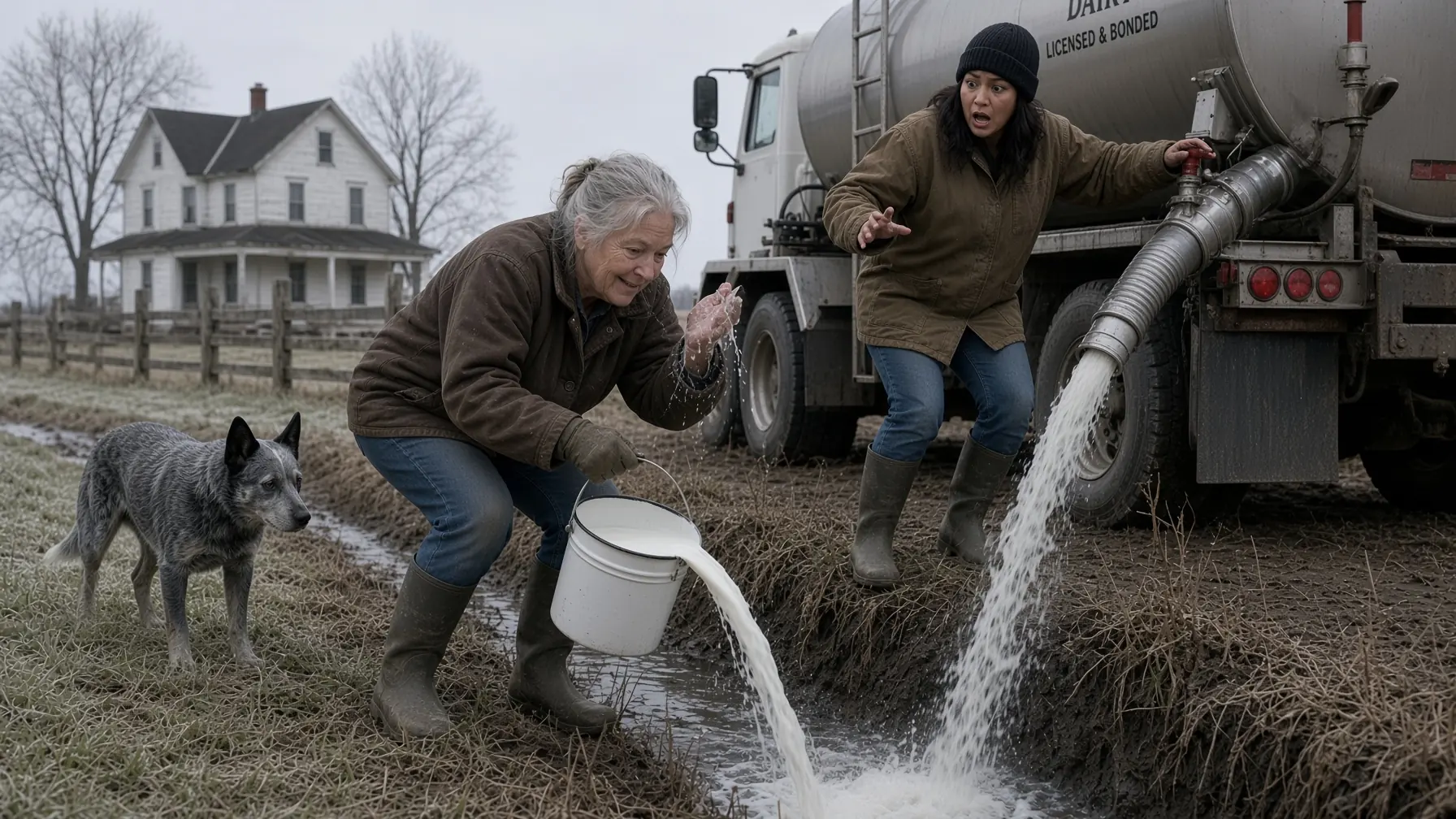
It rolled down the service lane above Lorna Keller’s property with its lights low, backed toward the northern fence, opened a valve, and emptied whatever Brightland Dairy did not want into the shallow drainage ditch beside her land. Sometimes it was thin and gray. Sometimes it was cream-heavy. Sometimes it had already turned sour inside the tank. Whatever the reason, by the time the sun came up, another pale stream would be lying against Lorna’s fence, soaking into her soil and carrying its smell toward the farmhouse.
Brightland called it rejected milk.
Lorna called it what it had become.
Garbage.
She was sixty-eight years old, widowed, and living in a farmhouse that had belonged to her family longer than the dairy complex on the hill had existed.
The ditch stretched for nearly two hundred feet.
Once it had been nothing more than a shallow runoff channel dug by some dead farmer to carry spring rain away from the county road. Now the grass around it had vanished. The soil along the fence had gone pale and crusted. In summer the flies came so thick that Lorna stopped opening the windows on the north side of the house.
Her son Glenn had stopped bringing his daughter.
That hurt more than the smell.
The last time they visited in July, the little girl made it twenty minutes on the porch before crying because flies kept landing on her sandwich. Glenn packed the cooler back into his car, buckled his daughter into the rear seat, and stood with one hand on the driver’s door.
“Ma, I can’t keep bringing her here.”
Lorna had looked at the dead strip along the fence.
“I know.”
“You need to sell.”
“No.”
“They’ve offered before.”
“Not enough.”
“It’s more than the place is worth like this.”
Lorna turned toward him.
“Like what?”
Glenn hesitated.
That was enough.
“Go home,” she said.
“Ma—”
“Kiss the girl for me.”
Glenn rubbed his forehead.
“You’re sixty-eight. You’re alone up here. The well tastes wrong. You haul drinking water from the springhouse. You’ve got a dog older than some cars. What exactly are you holding on to?”
Lorna looked toward the farmhouse.
Then beyond it to the low stone building built into the hill.
“You wouldn't understand.”
“That’s what you always say.”
“No.”
She shook her head.
“I usually say you don’t listen.”
He left angry.
Lorna watched his car until it disappeared.
Then Bram came and sat beside her.
Bram was an old blue heeler with a gray muzzle and stiff back legs. Lorna’s husband Hank had found him as a puppy in a cardboard box outside the feed store and brought him home inside his coat.
After Hank died, Bram transferred his loyalty to Lorna without discussion.
He slept by her bedroom door.
Followed her to the chicken coop.
Walked the fence every morning.
And hated the dairy ditch with an intensity Lorna found almost human.
He never drank near it.
Never stepped into the dead grass.
If the wind blew the smell toward the house, Bram would lift his head and growl at the hill.
“I know,” Lorna always told him.
“I know.”
For the first several years, she fought.
Called the county.
Called Brightland.
Sent letters.
A man with a clipboard came once.
He stood beside the ditch holding a handkerchief over his nose and told her they were “reviewing disposal practices.”
Nothing changed.
Brightland Dairy was the biggest employer in the township.
Two thousand cows.
Hundreds of workers.
Truck contracts.
Feed contracts.
Equipment leases.
Tax money.
A poor county could become very patient with a company that paid half its bills.
Lorna eventually stopped calling.
Not because she accepted it.
Because she got tired of hearing polite words laid over the same smell.
She moved her tomatoes to the south side of the house.
Kept north windows shut.
Stopped using the well for drinking after one summer when the water developed a sour edge she could taste beneath the iron.
After that she pulled water from the springhouse.
Two jugs at a time.
Up the hill on a garden cart.
Every winter she considered leaving.
Every winter she stayed.
The house still had Hank’s workbench.
The springhouse still had her grandmother’s copper kettle hanging from a green hook.
And some things, once you had buried enough people, became more than property.
They became proof that your life had happened somewhere.
Lorna refused to sell that proof cheaply.
The first real change came during a cold snap in January.
Ten below at night.
Barely above zero during the day.
Fence wire sang in the wind.
Snow squeaked beneath boots.
Lorna woke before sunrise and went outside to break ice from the chicken water.
Bram followed.
The tanker had already come.
Fresh tire marks showed in the snow.
A new load lay frozen in the ditch, pale beneath a thin crust.
Usually Bram avoided it.
That morning he walked directly toward it.
“Bram.”
The old dog ignored her.
He stopped near the fence and began scratching.
“Leave it.”
He scratched harder.
Then looked back.
Lorna sighed and walked down.
The smell stopped her.
Not because it was worse.
Because it wasn’t.
For nine years, the ditch had smelled of spoiled milk, acid, rot, mud, and summer decay.
This was different.
Cold had slowed everything.
The upper layer had frozen before the milk could turn foul.
Beneath the crust, something had thickened.
Lorna crouched.
She scraped away ice with one glove.
A soft white curd appeared beneath.
She removed the glove.
Touched it.
Cold.
Smooth.
Then she lifted her fingers toward her face.
Bram watched.
Lorna smelled it.
And something inside her opened.
Bright lactic tang.
Cream.
Grass.
A clean sourness.
Not spoilage.
Transformation.
For several seconds she knelt in the snow without moving.
Then whispered:
“No.”
Bram tilted his head.
Lorna scooped another little handful.
Smelled again.
Her eyes filled.
She had not smelled milk like that in years.
Not since before the old Valley Cooperative Creamery closed.
Before forty family dairies disappeared one by one.
Before Brightland expanded across the valley.
Before Lorna put away the long curd knife and stopped walking into warm rooms full of steam before daylight.
Nobody on the hill knew this.
Glenn barely remembered.
The county certainly did not.
But for thirty-one years, Lorna Keller had made cheese.
Not hobby cheese.
Not kitchen cheese.
Thousands of wheels.
Cheddar.
Washed rind.
Fresh farmer cheese.
Small experimental batches that went to fairs and restaurants.
She had run the make room at Valley Cooperative for most of her adult life.
She could judge curd by the squeak against her teeth.
Could tell when milk had come from cows pushed too hard.
Could smell silage trouble before a lab test confirmed it.
Could walk into a room, inhale once, and know whether the starter culture was running too fast.
When Brightland began undercutting the smaller farms, the cooperative lost milk.
Then lost contracts.
Then closed.
Lorna’s last day there, she took one final wheel home and ate it slowly through the winter.
When it was gone, she never made another.
There seemed no reason.
Until now.
She looked uphill.
“They don't know.”
Bram’s ears lifted.
Lorna laughed once.
A small, unbelieving sound.
“They don't even know what they're throwing away.”
She stood.
Then walked toward the springhouse.
That afternoon she cleaned Oma’s copper kettle.
Her grandmother had made cheese in the springhouse before Lorna was born.
The building sat partly inside the hillside, thick stone walls holding the cold all year. A narrow spring ran through a stone trough beneath the shelves.
Fifty-two degrees.
Winter.
Summer.
Always.
Oma used to call it the family’s only real inheritance.
“Money can go,” she had said. “Land can be sold. But good water feeds whoever comes after you.”
Lorna had been twelve when Oma first let her stir a vat alone.
She had not thought of that in years.
Now she washed the kettle.
Scrubbed the slate.
Found an old thermometer.
Then stopped.
She could not use milk from the ditch.
Not safely.
Not after it touched contaminated ground.
Lorna knew that much better than anyone.
She needed milk before it hit the soil.
The next morning, she waited near the fence with a clean enamel pail.
When the tanker arrived, a young woman climbed out.
She wore a canvas coat several sizes too large and looked no older than thirty.
The woman opened the valve.
A clean white stream arced toward the ditch.
Lorna stepped forward.
“Stop.”
The worker jumped.
“What are you doing?”
“My name is Lorna Keller.”
“I know who you are.”
“Then you know this is my fence.”
The worker looked toward the road.
“I just do the disposal.”
“I know.”
“You can’t come onto dairy property.”
“I’m not.”
Lorna remained on her side.
“What’s your name?”
The woman hesitated.
“Marisol Reyes.”
“People call you Marisol?”
“Sol.”
“All right, Sol.”
Lorna pointed toward the milk.
“Is that spoiled?”
Sol looked at it.
“Some loads are.”
“This one?”
Silence.
Lorna waited.
Sol lowered her voice.
“No.”
“Then why dump it?”
“I don't make the rules.”
“I didn't ask who made them.”
Sol’s jaw tightened.
“Over quota.”
Lorna stared.
“What?”
“The processing contract only takes so much.”
“How much are you throwing away?”
“Depends.”
“How much today?”
“Maybe two hundred gallons.”
“Good milk?”
Sol looked at the stream.
“Yes.”
Something cold moved through Lorna that had nothing to do with January.
“How often?”
Sol laughed without humor.
“You don't want to know.”