Adrian Wycliffe had heard many fine women laugh in polished parlors, but none of their voices stayed with him after the lamps burned low. They smiled behind lace fans, spoke softly about land, bloodlines, and family alliances, then watched his silver spurs as if they could already hear wedding bells ringing from his ranch. He was thirty-four, heir to one of the largest cattle spreads in northern Wyoming, and every ambitious family from Cheyenne to Denver believed he needed a wife. Adrian believed he needed something else, though he had not known how to name it until his mother lay dying beside a low fire and told him what to seek.
“Find a woman worthy of the life you carry,” she whispered, her thin hand folded inside his. “Not one chasing your ranch, your cattle, or your name. Find the woman who still stands steady when life turns cruel.” Those words followed him long after the funeral, following him across cattle towns, church suppers, railroad dinners, and spring dances where every introduction felt arranged before he entered the room. By the second autumn after her death, people had started calling him proud, but Adrian knew pride had nothing to do with it.
He was tired of rooms where every smile had a price. He was tired of fathers discussing daughters like contracts, tired of mothers measuring him as if he were a saddle fit for purchase. Wealth had made him visible to every hungry eye, but it had also made honesty hard to find. So when rain trapped him inside a dusty general store in a rough northern valley, he paid little attention to the gossip until he heard two old women speak of a farm girl named Clara Whitcombe.
“She still takes stew to Widow Barnes every Sunday,” one woman said while measuring beans into a sack. “After what that family did to her father, I’d have let the old woman starve.” The other shook her head and answered, “Clara ain’t built that way. Best woman in three counties, and life never gave her much but work.” Adrian stood near the stove, gloved hands warming above the iron top, and felt his mother’s voice rise again inside him.
That evening, the innkeeper told him more. Clara lived alone near the edge of the timber, where the valley narrowed before the old cattle trail climbed into the hills. Her father had died owing money, her brothers had gone west chasing silver, and every winter since had pressed harder on her little homestead. “She’s stubborn,” the innkeeper said, wiping a glass that was already clean. “Works harder than most cowboys I know, and never asks anybody to pity her.”
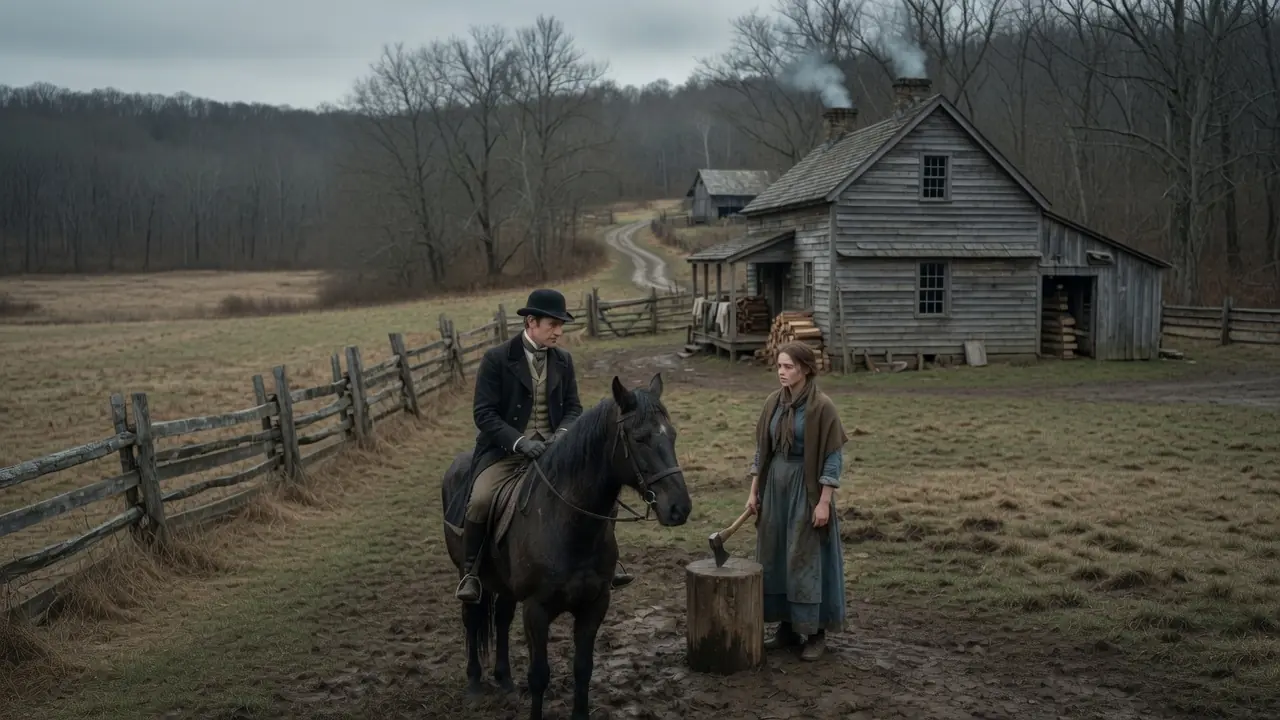
At sunrise, Adrian saddled his dark stallion and rode north. The road grew rough beyond town, becoming a muddy track between pine woods and pastureland, with snow still clinging in patches where the sun never reached. Low clouds dragged across the hills, and the wind carried that hard metallic smell that came before more weather. By afternoon, he saw the place the innkeeper had described: a small farmhouse, a leaning fence, a weathered barn, and a woman splitting firewood alone beside a chopping block.
Clara Whitcombe did not stop working when she saw him. She swung the axe once more, clean and hard, splitting the log so neatly Adrian had to admire the strength in her narrow shoulders. Her sleeves were rolled above her wrists despite the cold, and a brown shawl was tied close over her faded blue work dress. She looked poor, tired, and guarded, but there was nothing weak in the way she turned and faced him across the muddy yard.
Adrian removed his hat out of respect. “Miss Whitcombe?” he called. She looked at his black Stetson, fine coat, polished boots, and silver spurs without changing expression. “If you came looking for gratitude, cowboy, you took the wrong road.” The words were sharp enough to surprise him, but there was no vanity in them, only caution earned the hard way.
Before Adrian could answer, shouting broke through the trees behind him. A rider came hard down the trail, horse lathered and stumbling, hat nearly blown from his head. “Clara!” the man yelled. “They’re coming back from the lower creek. Three wagons, hired riders, and county papers.” Clara’s face changed for one brief second, fear flashing across it before she buried it under control.
The rider introduced himself as Eli Marsh, a mill worker from the neighboring settlement. He had known Clara since childhood and had ridden ahead to warn her that Vernon Halley’s men were coming again. Halley was a railroad investor with money behind half the valley’s trouble, a man who bought land cheap when families were tired, frightened, or legally cornered. Adrian knew the name, and that knowledge tightened his jaw.
Clara leaned the axe against the chopping block and looked toward the distant creek. “They said they’d return before winter,” she said. Adrian stepped down from his horse. “What do they want?” She glanced at him, still unsure whether to trust the stranger in expensive clothes. “The farm,” she answered. “And they’re willing to call theft business if the paperwork looks proper.”
She invited both men inside before the weather turned worse. The farmhouse was plain but orderly, with a small stove, folded blankets, a worn table, and a stack of old letters tied with string near the window. Nothing there spoke of money, but every object seemed cared for as if Clara had decided that poverty did not excuse disorder. Adrian noticed a cracked cup mended with wire on a shelf and thought it looked more honorable than half the silver service in his own dining room.
As rain began striking the roof, Eli explained the pressure on the valley. Halley’s men had been buying small ranches and homesteads, using old debts and false claims to make families believe they had no choice. Clara’s father had refused to sell before he died, and after his death, the debt against the land seemed to grow every time a new paper appeared. “My father owed money,” Clara admitted. “But not what they claim.”
Adrian listened closely, remembering cases he had heard whispered about in Cheyenne clubs. Railroad men often hid greed beneath legal language, knowing most farmers could not afford lawyers or time. False debt, altered ledgers, survey markers placed before sale, county officers paid to look away, all of it had the same smell. And when Clara looked toward the window, Adrian saw that smell had already reached her gate.
Three wagons rolled through the rain and stopped near the fence. Mounted men in dark coats sat behind them, while two county officers stepped down awkwardly, avoiding Clara’s eyes before they even reached the porch. Vernon Halley came last, tall, sharp-faced, and dressed in a black coat too fine for the mud. When he saw Adrian standing near the stove, the polite smile on his face tightened.
“Well,” Halley said, removing his gloves. “I did not expect to find the Wycliffe heir hidden in the woods.” Adrian stepped closer to Clara’s side. “And I did not expect to find you threatening a woman over farmland.” Halley’s smile returned, smooth as oiled leather. “It is business, Mr. Wycliffe. Nothing more.”
Clara opened the door wider but did not invite him in. Halley entered anyway, bringing the smell of wet wool, horse sweat, and arrogance with him. One officer unfolded a document and read that unpaid debts tied to Clara’s father gave the railroad company claim to portions of the property. If payment was not made within seven days, the land would be seized before the first heavy snowfall.
“That number is false,” Clara said at once. The officer swallowed and looked down at the paper. “It is what the records show.” Eli stepped forward angrily, but Adrian raised a hand to stop him. Anger would only help Halley pretend he had order on his side.
Halley’s eyes moved over Clara, then Adrian. “If Miss Whitcombe has receipts proving otherwise, she may produce them.” Clara went still. The pause was small, but everyone in the room felt it. Halley smiled because he had learned exactly what he needed: the proof existed, but Clara did not know where it was.
After the men left, the farmhouse felt colder. Clara stood near the doorway, watching their wagons disappear through the rain. “You know him,” she said without turning around. Adrian nodded. “I know men like him. They never come this far unless the land is worth more than the debt.” Eli looked between them. “Worth what?”
Adrian did not answer then, but later, while helping Clara secure the barn, he saw survey stakes driven near the lower creek. They carried railroad marks, but public maps placed the planned route miles away. Someone had surveyed Clara’s land in secret, and men did not risk secret surveys over ordinary pasture. Clara noticed his expression and said softly, “My father believed there was silver under this valley.”
The next day, Adrian and Eli rode to the creek and found disturbed earth beneath the pines. Shovel marks, boot prints, lantern oil, and signs of a hidden camp showed that Halley’s men had already been searching. From a ridge, they saw two wagons concealed among the trees and heard men talking below. One voice said, “If the old farmer’s receipts exist, find them before Halley returns.”
That evening, Clara led Adrian upstairs to search the attic. Her father had once told her that if trouble ever came, the truth would still be inside the house. They opened trunks, moved old quilts, checked loose floorboards, and examined drawers filled with faded letters. For hours, dust stung their eyes and lamplight shook against the rafters.
Clara finally sank beside an old chest, frustration breaking through her careful calm. “Maybe they’re gone,” she whispered. “Maybe Halley already found them.” Adrian knelt near a narrow table by the window, noticing one leg sat crooked against the floor. When he shifted it, a small rusted brass key dropped onto the boards.
Clara stared at it. “I’ve seen that before.” She took the lantern and hurried to an old wardrobe covered with quilts. Behind it, half-hidden in the wallboards, was a narrow locked door almost invisible in the attic gloom. Her hand trembled only once as she slid the key into the lock and turned it.
Inside the small space sat a wooden box wrapped in cloth. Clara lifted it with both hands, and hope, real and unguarded, crossed her face for the first time since Adrian had met her. But before she could open it, a crash shook the house below. Eli shouted from the front room, “Get away from the windows!”
Heavy boots thundered across the porch. Another blow struck the front door, splintering wood beneath the latch. Vernon Halley’s voice carried up the stairs, calm no longer. “Hand over the papers, Miss Whitcombe, or my men will tear this farmhouse apart board by board.”
Adrian took the lantern and motioned Clara toward the back loft stairs. She clutched the wooden box to her chest and followed, moving quickly through the hidden passage behind stacked grain sacks. They slipped out through the rear of the house into cold mud and reached the barn as Halley’s men forced their way inside the front room. Eli joined them moments later, breathless, rifle in hand, though his eyes showed he knew one rifle could not stop all of them.
In the barn, Clara placed the wooden box on a work table. Inside were receipts, loan records, signed payment notes, and county documents tied carefully with ribbon. Beneath them lay a thin leather journal in her father’s hand. Adrian stood beside her as she opened the final pages and read the truth.
Halley and several investors had discovered silver deposits beneath the valley years earlier. Instead of buying the land honestly, they had created false debt claims, pressured county officers, and forced families out before anyone understood what lay beneath their farms. Clara’s father had uncovered the scheme and hidden the proof before he died. “That’s why they want this land,” Eli said, voice low with fury.
The barn doors opened before Clara could answer. Halley stepped inside with two hired riders behind him, his polished calm gone from his face. “You have made this far more difficult than necessary,” he said. His gaze dropped to the box, and for the first time, Adrian saw naked greed behind the man’s eyes.
Adrian moved in front of Clara. “These papers will reach the governor by morning.” Halley laughed, but it sounded strained. “You think powerful men fall because of old receipts?” Clara stepped beside Adrian, no longer hiding behind him. “No,” she said. “But lies do.”
Outside, horse hooves sounded in the yard. Not two or three, but many. Lanterns appeared through the barn door, carried by farmers, mill workers, ranch families, and men from town who had finally grown tired of fear. Eli had sent word before sunset, and the valley had come.
The county officers stood among them, their faces grim now that witnesses filled the yard. One officer stepped forward and looked directly at Halley. “We’ve heard enough.” Halley turned, searching for the old obedience in their faces, but the crowd had taken it from him. By sunrise, Halley’s wagons were searched, his false records were found, and his hired men were disarmed without a shot being fired.
News traveled fast across Wyoming. The scandal reached Cheyenne, then the capital, and the railroad project through the valley was halted. Families forced from their land began filing claims, and Clara’s father’s name was cleared in county records. The farmhouse that had nearly been stolen became the place where the valley’s truth had been saved.
Winter came hard after that, but it no longer felt like a threat standing alone at Clara’s gate. Neighbors helped repair the fence, mend the barn door, and stack firewood along the porch. Adrian stayed longer than he had planned, first to make sure Halley’s allies did not return, then because leaving felt stranger than staying. Clara never asked him to stay, which was one reason he did.
They worked side by side through the cold weeks. Adrian split wood, rode fence, helped rebuild the corral, and learned that Clara could mend harness, bargain for supplies, and silence foolish men with one look. Clara learned that Adrian’s wealth had not made him soft, only lonely. He listened more than he spoke, and when he did speak, he never made her feel small.
One evening, snow fell lightly outside the farmhouse, and Clara stood beside the stove warming her hands. “You could go back to your ranch,” she said. Adrian looked through the window at the white yard, then at the woman who had stood firm when men with papers and guns came for her home. “I could,” he said. “But I don’t think my road leads away from here anymore.”
She studied him carefully, still too wise to trust pretty words too quickly. “I am not one of your ballroom women.” Adrian smiled faintly. “That is the first thing I admired about you.” Clara’s mouth softened, not quite a smile but close enough to change the room. “And I am not leaving this farm.”
“I would never ask you to,” he said. “A man who asks a woman to surrender the thing she fought for does not deserve to stand beside her.” She looked away then, but he saw her eyes shine in the firelight.
By spring, the valley held a gathering beneath an open sky. It was not a grand society wedding with crystal chandeliers or imported flowers. It was a frontier wedding with horses tied along the fence, children running through pasture grass, neighbors carrying pies, and church bells ringing across the hills. Clara wore a simple white dress sewn by the women in town, and Adrian wore his black Stetson, polished boots, and his mother’s old silver pin fastened inside his coat.
As Clara walked toward him, Adrian finally understood what his mother had known. A worthy woman was not measured by title, manners, softness, or wealth. She was measured by courage when life turned cruel, kindness when bitterness would have been easier, and the strength to stand in front of a storm without pretending she was not afraid. Clara Whitcombe had all of that, and more.
The valley that day looked alive in a way Adrian had never seen from the porch of any mansion. Cattle moved in the distance, smoke rose from farm chimneys, and the creek shimmered under the new sun. When Clara placed her hand in his, her grip was steady. It was the same steadiness he had seen when she held the axe, the box of evidence, and the truth of her father’s name.
Adrian had ridden out to find a worthy woman. He found a frontier farm girl fighting alone against powerful men, false debts, and a railroad scheme built on theft. In standing beside her, he found not only the wife his mother had wished for him, but the kind of life his wealth had never been able to buy. And when the church bells rang across the Wyoming valley, he knew his search had ended exactly where his heart was meant to begin.