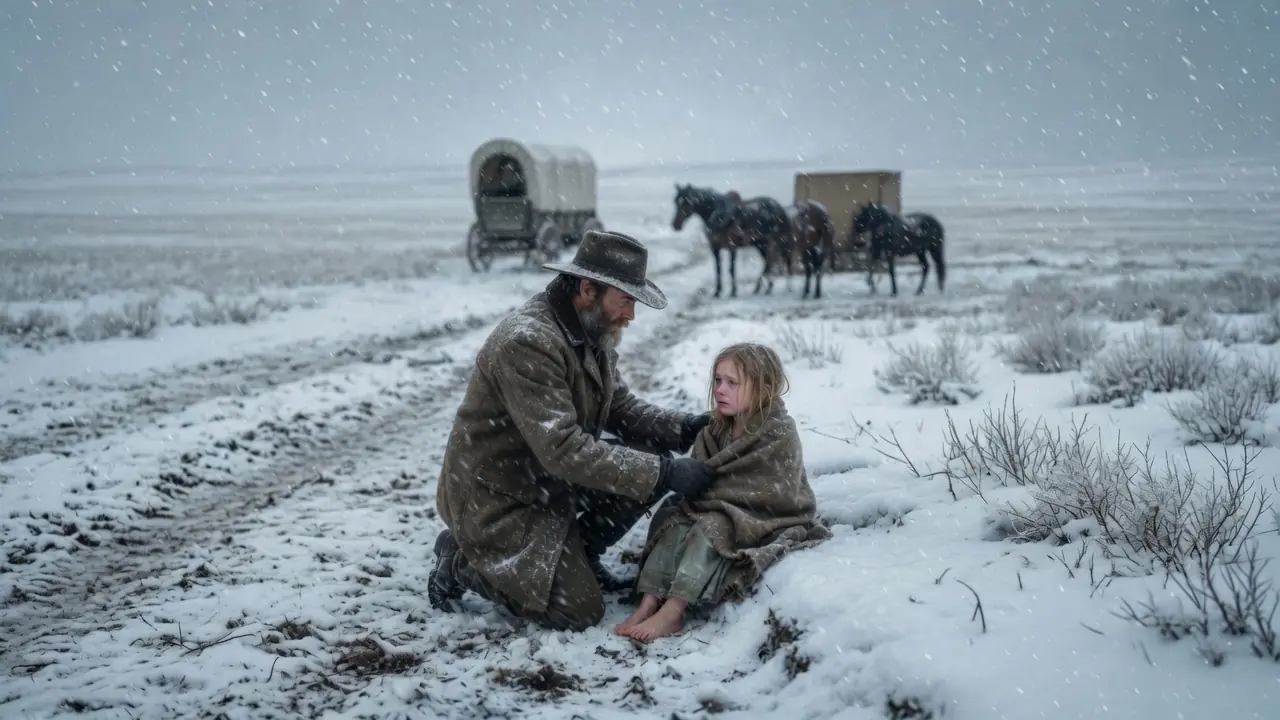
The snow had been falling since before sunrise, soft at first, then thick enough to hide the wagon tracks beneath a white blanket. Five-year-old Eliza May Parker sat in the snow beside the Santa Fe Trail with her knees pulled close and a rough wool blanket slipping from her shoulders. Her little gray-green dress was damp at the hem, her blonde hair stuck to her cheeks, and her bare feet curled under her as if she could make them disappear from the cold. Behind her, the last covered wagon had faded into the pale distance, leaving only wheel marks, hoofprints, and the terrible quiet of people who were not coming back.
Mrs. Harlo had told her to wait by the cottonwood tree. “Just sit there a minute, Eliza,” she had said, tying a ribbon around one of the wagon crates without looking the little girl in the eyes. Eliza had obeyed because good children obeyed, and because after her parents passed from fever months earlier, obedience was the only way she knew to keep a roof near her head. But the wagons had begun moving, one after another, and when Eliza stood up and called after them, the wind swallowed her voice. By the time she understood that “wait” meant “stay behind,” the wagon train was already too far away for her small legs to chase.
At first, she had not cried. She had stood under the tree with both hands holding the blanket, staring after the trail as if staring hard enough could make someone turn around. Then the cold found her feet, the sky grew heavier, and the wide empty prairie became bigger than any room she had ever known. She whispered her mother’s name once, then her father’s, but the snow answered with silence. Finally, she sat down because standing felt too hard, and the tears came in small broken breaths.
By afternoon, her voice had gone hoarse from calling. She had a heel of bread in her pocket, but the bread was stiff and dry, and she only nibbled it because she was afraid there would be nothing after it was gone. The cottonwood branches creaked above her, and every sound made her think of wolves, strangers, or the wagons returning. “I stayed,” she whispered to no one. “I did what she told me.”
Miles away, Jack Thornton was riding home through weather most men would have waited out. He was not most men. At forty-three, Jack owned the Triple T Ranch, three thousand head of cattle, two valleys of grazing land, and enough influence in the territory that bankers smiled before they spoke to him. Yet he rode alone more often than men expected, with a black horse named Amos beneath him and a heavy brown coat dusted white from the storm.
Jack had grown up with nothing but hunger, hard ground, and other people’s mercy. A ranch hand named Silas Boone had taken him in when Jack was just a boy sleeping behind a freight shed, and everything Jack had become had started with that one act of kindness. He had never forgotten the sound of a voice asking, “You need supper, son?” when the whole world had stopped looking at him. That was why, when Amos slowed near the cottonwood tree and lifted his head, Jack trusted the horse before he trusted the trail.
At first, Jack thought the shape in the snow was a bundle dropped from a wagon. Then it moved. He reined Amos in sharply, swung down from the saddle, and felt his chest tighten when he saw the little girl sitting there, wrapped in a blanket too thin for the weather. Her eyes were red from crying, but when she saw him, she stiffened and tried to sit straighter, as if even a child could understand the risk of looking helpless in a hard country. Jack crouched several feet away, keeping his hands visible.
Jack’s jaw tightened, but he kept his anger out of his face. “How old are you?” he asked. Eliza wiped her nose with the back of her hand and answered in a small, shaking voice. “Five. Almost six when the summer comes.” Jack looked down the trail where the wagon train had vanished, and something inside him went still and cold.
“Do you know my name?” she asked suddenly, as if names mattered before anything else. Jack softened. “Not yet.” The little girl swallowed hard. “I’m Eliza May Parker. My mama said I should always say all of it, so folks know I belong to somebody.” Jack felt those words hit him harder than the wind.
He removed his gloves and carefully adjusted the blanket around her shoulders. “Well, Eliza May Parker,” he said, “I’m Jack Thornton.” Her lower lip trembled. “Are you going to leave me too?” Jack looked her straight in the eyes, the way Silas Boone had once looked at him. “No, ma’am. I reckon the leaving ends right here.”
Eliza searched his face with the serious distrust of a child who had already learned too much. “Mrs. Harlo said I was too much trouble.” Jack’s eyes flicked once toward the trail, and for a moment his expression hardened. “Then Mrs. Harlo never knew what trouble was.” He opened his saddlebag and pulled out a clean cloth, a pair of thick socks, and a wrapped biscuit from Mrs. Chen’s kitchen.
Eliza did not reach for the biscuit until he nodded. She took it with both hands and ate like she was afraid the food might be taken back if she waited too long. Jack turned away slightly while she ate, giving her the dignity of not being watched too closely. When she finished, she looked embarrassed by the crumbs on her chin. Jack smiled and said, “Best biscuits in the territory. Hard to eat one without wearing part of it.”
That made Eliza’s mouth twitch, not quite a smile, but close. Jack warmed the socks inside his coat before sliding them over her small feet with careful hands. “I’ve got a ranch twenty miles west,” he told her. “Big house, good cook, warm fire, and a porch where the wind tells stories all evening.” Eliza stared at him. “Would I have to sleep in the barn?” Jack shook his head. “Not unless you’re secretly a very small horse.”
This time, she did smile, though tears still clung to her lashes. Jack lifted her onto Amos and climbed up behind her, wrapping his coat around both of them. She was light as a bundle of laundry, and that made him angrier than he wanted to be. A child that small should have been carrying dolls, not fear. As Amos started toward the Triple T Ranch, Eliza kept one tiny hand twisted in Jack’s sleeve.
The ride took hours because of the snow. Eliza dozed against Jack’s chest, waking now and then to ask if the ranch was still coming. Each time, Jack answered the same way. “Still coming, little miss.” After the fourth time, she whispered, “You promise?” Jack tightened the coat around her and said, “I promise on my horse, my hat, and every cow that ever gave me trouble.”
At dusk, the Triple T Ranch appeared through the snow like a lantern-lit promise. The main house stood large and strong, built of honey-colored timber with a wide porch and smoke rising from two chimneys. Barns and bunkhouses sat beyond it, and lanterns moved as ranch hands finished the evening work. Eliza lifted her head, eyes widening as if she had never imagined any place could hold that much light.
Mrs. Lien Chen came out before Jack reached the porch. She was the ranch cook, housekeeper, and the only person on earth who could scold Jack Thornton without consequences. “You stubborn man,” she called, pulling her shawl tight. “Riding in weather like this when soup is on the stove.” Then she saw the child in his arms, and all scolding left her face.
“Found her by the trail,” Jack said simply. “Wagon train left her.” Mrs. Chen’s eyes flashed with sorrow and fury, but her hands were gentle when she reached for Eliza. “Then the wagon train is full of fools,” she said. “Come here, baby. Let’s get you warm.”
Eliza looked back at Jack before letting Mrs. Chen take her. “You’re not going away?” she asked. Jack removed his hat and stepped onto the porch. “No. I’m just bringing in your bundle and telling the men to ready a fire.” Eliza nodded, but she kept watching him until he came through the door behind her.
That night, Mrs. Chen wrapped Eliza in clean flannel, combed her hair, and sat her near the hearth with a bowl of chicken stew. Eliza held the spoon awkwardly, eating slowly at first, then faster when she realized no one was counting the bites. Jack sat across the room, pretending to read a cattle ledger while watching her over the top of the page. Every time Mrs. Chen offered more bread, Eliza looked at Jack, as if asking permission to need something.
“You don’t have to ask to eat in this house,” Jack told her. Eliza looked down at the bowl. “Mrs. Harlo said asking too much made folks tired of you.” Mrs. Chen made a sound under her breath that might have been a prayer or a curse. Jack closed the ledger and said, “In this house, hungry people eat, tired people rest, and little girls ask all the questions they want.”
Eliza absorbed that like it was a lesson too strange to trust. “What if I ask too many?” she said. Jack leaned back in his chair. “Then I’ll answer too many.” She thought about that. “How many cows do you have?” Jack smiled. “Enough that counting them makes my head hurt.”
Over the next week, Eliza tested the edges of kindness. She saved half her bread under her pillow until Mrs. Chen found it and cried in the pantry where Eliza could not see. She folded every blanket after using it and apologized whenever a floorboard creaked under her feet. When Jack gave her a little carved horse from his desk, she asked who she should give it back to at bedtime. Jack knelt in front of her and said, “When something is yours, Eliza, it does not have to leave with the sun.”
The ranch hands softened around her one by one. Old Caleb made her a little stool so she could reach the wash basin. Thomas, the youngest hand, let her brush Amos with a brush nearly bigger than her arm. Mrs. Chen sewed her two dresses from good cloth, one blue and one brown, and Eliza stared at them as if they were gowns fit for a queen. Still, every evening, when wagons creaked on the distant road, Eliza went still.
Jack noticed. He noticed everything about fear because he had lived with it long enough to recognize its footsteps. One evening, he found her on the porch, staring toward the east. “Thinking about the Harlo wagon?” he asked. Eliza nodded. “If they come back, do I have to go?”
Jack sat beside her, leaving enough space so she could choose whether to move closer. “Not unless you want to.” Eliza turned sharply. “But Mrs. Harlo took me after Mama and Papa.” Jack’s voice stayed steady. “Taking a child in and loving a child are not always the same thing.”
Eliza’s eyes filled again. “Maybe I was bad.” Jack shook his head before she finished. “No.” She looked startled by the firmness in his voice. Jack softened it. “Grown folks sometimes do wrong things and make children carry the blame. That does not make the child bad.”
A month passed, and the snow began melting from the fence rails. Eliza grew stronger, though she was still small for her age. She learned that Amos liked apples, that Mrs. Chen’s pie crust was better when no one spoke during the first bite, and that Jack Thornton drank coffee so strong it looked like it could stand up in the cup. She also learned that the Triple T Ranch was not only big, but important.
Men rode for hours to ask Jack’s opinion on cattle prices. Bankers visited with polished boots and careful smiles. The sheriff greeted him with respect, and merchants in town straightened when he entered their shops. Eliza watched all of it from beside Jack’s leg, trying to understand why a man who owned so much would stop for a child left with nothing.
One afternoon, Jack took her into town to buy new boots. The storekeeper, Mr. Pritchard, smiled when Jack entered, then looked down at Eliza with curiosity. “Who’s this little thing?” he asked. Eliza stepped behind Jack’s coat.
Jack’s expression changed just enough for the room to cool. “This is Miss Eliza May Parker,” he said. “She is under my protection.” Mr. Pritchard’s smile became nervous. “Of course, Mr. Thornton. Fine boots for the young lady, then?” Jack nodded. “The finest that fit.”
Eliza stood on a little wooden box while Mr. Pritchard measured her feet. She kept looking at the boots lined on the shelves, afraid to like any pair too much. Jack noticed her staring at brown leather boots with tiny stitched flowers along the sides. “Those the ones?” he asked.
“They look expensive,” Eliza whispered. Jack crouched beside her. “That wasn’t my question.” She touched the boots with one finger. “They look like they could walk far and not be afraid.” Jack’s throat tightened. “Then those are the ones.”
Trouble arrived two weeks later with a wagon wheel and a familiar voice. The Harlo wagon rolled into town at noon, muddy, worn, and carrying Mrs. Harlo’s sharp face beneath a bonnet. Mr. Harlo stepped down beside her, thin-lipped and restless, asking at the general store whether anyone had seen a little girl named Eliza. By sunset, the whole town knew they had “come back for the child.”
Jack heard before Eliza did. He was in the stable when Sheriff Donnelly rode up and told him the Harlos were asking questions. Jack’s hand stilled on Amos’s saddle. “They leave her barefoot in snow and return when she’s fed?” he said.
The sheriff sighed. “Word got around that you took her in.” Jack’s eyes narrowed. “Word got around, or money got around?” The sheriff did not answer. He did not need to.
Mrs. Harlo arrived at the Triple T Ranch the next morning wearing grief like a borrowed shawl. She stepped onto the porch with Mr. Harlo behind her and pressed a hand to her chest when Eliza appeared in the doorway. “There you are, child,” she cried. “We’ve been worried sick.”
Eliza froze. Her new brown boots stood planted on the porch boards, but her face went white. Jack stepped out beside her, not touching her, just standing close enough for her to know she was not alone. “Morning,” he said, his voice flat.
Mrs. Harlo looked from Eliza to the house, then to the barns and corrals beyond. Her eyes lingered on the ranch hands, the horses, the carved porch, the proof of money. “Mr. Thornton,” she said sweetly, “there has been a terrible misunderstanding. We thought Eliza had climbed into another wagon.”
Eliza whispered, “You told me to wait by the tree.” Mrs. Harlo’s smile trembled. “Children get confused, dear.”
Jack looked down at Eliza. “Do you feel confused?” Eliza clutched the side of her dress, then shook her head. Jack turned back to Mrs. Harlo. “There’s your answer.”
Mr. Harlo stepped forward. “Now see here, Thornton. We took that girl in after her parents died. She’s tied to us by obligation.” Jack’s eyes hardened. “Obligation did not keep her feet warm.”
Mrs. Harlo’s voice sharpened. “You have no legal right to keep her.” Jack nodded once. “Not yet.” Her eyes flickered. He saw the moment she realized he had already thought beyond the porch.
That afternoon, Jack rode into town with Eliza seated before him on Amos. Mrs. Chen followed in the wagon, along with Caleb and the sheriff. The Harlos arrived too, trying to look offended instead of afraid. Judge Willard, a tired man with kind eyes and a white mustache, opened the small courthouse and listened while the whole story unfolded.
Mrs. Harlo cried at the right moments. Mr. Harlo spoke of duty, hardship, and misunderstanding. Jack said little, but every word was clean and steady. Then Judge Willard asked Eliza if she wanted to speak.
The courtroom went very quiet. Eliza sat beside Jack, her small boots not reaching the floor. She looked at Mrs. Harlo, then at Mr. Harlo, then at Jack. “I waited,” she said. “I waited until the snow hurt.”
Mrs. Harlo covered her mouth, but Eliza continued. “Mr. Jack found me. He gave me socks and soup, and he answers my questions. I don’t want to go where people tell me to wait and don’t come back.” Her voice broke on the last word, and Jack closed his hand gently around the edge of the bench to keep from reaching for her in front of the judge.
Judge Willard removed his spectacles and rubbed his eyes. When he spoke, his voice carried the weight of every person in the room. “A child is not a sack of flour to be dropped and reclaimed when convenient.” Mrs. Harlo gasped, but the judge did not look at her. “Temporary custody will remain with Mr. Thornton until formal adoption papers are reviewed.”
Eliza did not understand every word. She only understood that Jack stood, placed his hat against his chest, and said, “Thank you, Judge.” Then he looked down at her, and for the first time since the wagon train left, Eliza breathed like the air belonged to her.
The adoption took three months. Jack submitted letters from the sheriff, the doctor, Mrs. Chen, the schoolteacher, and half the town. Some people whispered that a single cowboy had no business raising a little girl, but the whispers grew quieter when those people saw Eliza laughing on the ranch porch, learning letters at the kitchen table, and riding Butterscotch around the corral with Jack walking beside her. Love, when steady enough, has a way of embarrassing doubt.
On the day Judge Willard signed the final papers, Eliza wore her blue dress and brown flower-stitched boots. Jack wore his best black coat and looked more nervous than he had facing cattle storms, bank meetings, or winter crossings. When the judge asked if he understood the full responsibility of adopting Eliza May Parker, Jack’s voice came thick but firm. “Yes, sir. I understand she is not charity. She is family.”
Eliza looked up at him. “Forever family?” she whispered. Jack knelt right there in the courthouse, not caring who watched. “Forever, if you’ll have me.” Eliza threw her arms around his neck and held on with all the strength her small body had.
After that day, she became Eliza May Thornton, though Jack told her she could keep Parker in her heart wherever she needed it. “Names are not cages,” he said. “They are doors.” Eliza liked that and spent a whole week practicing her new name on paper. Sometimes she wrote Eliza Parker Thornton, sometimes Eliza May Thornton, and once, in crooked letters, she wrote Jack’s Girl.
Years moved gently after that, though not without storms. Eliza learned to read, to ride, to count cattle, to bake biscuits badly, and to argue with Jack about whether little girls should climb fences. Jack lost every argument that involved her eyes filling with determination, though Mrs. Chen claimed he surrendered too fast. The ranch became louder with Eliza in it, full of questions, songs, small boots in hallways, and laughter Jack had not known he was missing.
One winter evening, when Eliza was nearly eight, she asked the question that had been waiting inside her since the day in the snow. She and Jack sat on the porch wrapped in blankets, watching lanterns glow in the barn. “Papa Jack,” she said, because that was what she had started calling him, “why did you really keep me?”
Jack looked toward the dark trail beyond the ranch gate. “Because someone should have kept me once,” he said. Eliza leaned against him. “Did nobody?” Jack smiled sadly. “One man did. That was enough to change my life.”
Eliza thought about that for a long moment. “Then you changed mine.” Jack’s voice softened. “No, little miss. You changed mine too.” She looked up at him, serious and small beneath the blanket. “Then we both got found.”
Many years later, people would know Eliza Thornton as one of the finest ranch women in the territory. She would build a school near the Triple T, fund a home for children with nowhere to go, and ride the same trails where she had once been abandoned. Whenever someone asked why she cared so much for children left behind by the world, she would tell them about snow, a cottonwood tree, and a cowboy who stopped.
She would say that she had once believed family meant the people who were supposed to come back. Then Jack Thornton taught her that family also meant the person who arrived when everyone else had gone. He did not save her because she was useful, wealthy, easy, or expected. He saved her because she was a child in the snow, and that was reason enough.
And every winter, when the first snow fell over the Triple T Ranch, Eliza would stand on the porch beside the man who became her father and remember the question she had asked him with frozen feet and a broken heart. Are you going to leave me too? Jack’s answer had become the foundation of her whole life.
No, ma’am. The leaving ends right here.