The emergency meeting began three days after the video reached two million views.
Every chair inside the Redwood Crest community hall was occupied. Residents stood along the walls, crowded near the windows, and whispered beneath the bright ceiling lights while two local reporters waited outside the locked entrance.
At the front of the room sat Nolan and Bethany Pierce.
They had arrived early and chosen seats beside the homeowners association president. Nolan carried a thick folder containing screenshots of threatening messages they had received since the incident.
Bethany wore sunglasses even though the meeting began after sunset.
Across the aisle sat Adrian Cole.
He wore a dark blue sweater and kept both hands folded in his lap. No attorney sat beside him, and he had brought no printed statement.
His phone rested on the table in front of him.
The same phone he had used to record everything.
HOA president Gloria Bennett struck the wooden gavel once.
“We are here to discuss the confrontation that occurred Sunday afternoon on Alderwood Lane and the public attention now affecting this community.”
Nolan leaned toward the microphone.
“A confrontation is not what happened.”
Adrian looked at him but said nothing.
Nolan continued.
“My wife and I asked an unfamiliar man a reasonable question after hearing about recent thefts. We never intended for the situation to become hostile.”
“You called the police,” someone said from the back.
“Because he became aggressive.”
Several residents began murmuring.
Gloria raised one hand.
“Please allow everyone to speak.”
Bethany removed her sunglasses.
Her eyes were swollen from lack of sleep.
“Our names and faces are everywhere. People have contacted my employer. Strangers have threatened us. We’re afraid to leave our house.”
Adrian finally spoke.
“Threatening you is wrong.”
The room became quieter.
Bethany looked surprised.
Adrian continued.
“No one should threaten your family. But strangers behaving badly afterward does not change what you did before the video was posted.”
“We made a mistake,” Nolan said.
“No.”
Adrian’s voice remained controlled.
“You keep calling it a mistake as though you turned onto the wrong street.”
Nolan’s jaw tightened.
Adrian touched the phone on the table.
“You followed me for three blocks after I asked you to stop. You demanded my address. Then you told emergency dispatch that I was a suspicious, aggressive man walking through a neighborhood where I had lived for nine years.”
“We didn’t know you lived there.”
“I told you.”
“You refused to identify the house.”
“Because two strangers were following me.”
Gloria leaned toward Adrian.
“Could this have ended more quickly if you had simply shown them where you lived?”
A few people nodded.
Adrian looked around the room.
There it was again.
The question disguised as compromise.
The assumption that peace had been available if only he had surrendered enough personal information to satisfy people who had already decided his presence required explanation.
Instead of answering immediately, Adrian unlocked his phone.
“I’d like to play something.”
Nolan shifted.
“We’ve all seen the edited video.”
“This isn’t the video.”
Adrian connected the phone to the community hall’s speakers.
A dispatcher’s voice filled the room.
“Emergency services. What is the location of your emergency?”
Then Nolan’s recorded voice answered.
“Yes, there’s a suspicious man walking around Redwood Crest. We’ve tried asking what he’s doing, but he’s becoming aggressive.”
The room went still.
The dispatcher asked whether the man had a weapon.
“No,” Nolan replied. “But he has a backpack, and he’s filming us.”
“Has he threatened you?”
There was a pause.
“Not exactly.”
The recording continued.
In the background, Adrian could be heard speaking loudly and clearly.
“I live here. I’m unarmed. I’m walking my dog. These people are following me, and I’ve asked them to leave me alone.”
Then Bethany’s voice entered the call.
“Listen to him. He’s getting confrontational.”
Adrian stopped the recording.
No one spoke for several seconds.
Gloria looked toward the Pierces.
“You said he refused to explain himself.”
Nolan’s face reddened.
“He never gave us proof.”
Adrian turned toward the HOA president.
“That is what this meeting is actually about.”
He stood.
“They believed a person walking on a public sidewalk had to prove he belonged because they did not recognize him.”
He looked toward Nolan and Bethany.
“When I answered, they rejected the answer. When I asked them to stop following me, they called that aggression. When I recorded them for my safety, they used the recording as another reason to describe me as dangerous.”
Bethany’s voice shook.
“We were looking out for our neighbors.”
Adrian looked around the crowded room.
“I was one of your neighbors.”
The meeting had begun with the aftermath.
The incident itself had started seventy-three hours earlier, when Adrian was thinking about leftover lasagna.
It was Sunday afternoon.
He had spent most of the morning in his garage building a storage cabinet from walnut boards. The project should have taken one weekend, but Adrian had changed the door design twice and rebuilt one corner after discovering the frame was a sixteenth of an inch out of square.
Precision mattered to him.
During the week, Adrian worked as a senior software engineer for a cybersecurity company. His job involved finding vulnerabilities hidden inside systems that appeared secure.
A reused password.
An incorrectly configured server.
A line of code that behaved normally until someone asked it the wrong question.
On weekends, he preferred problems made from wood and metal.
They were more honest.
A crooked shelf did not pretend to be straight.
At one in the afternoon, Adrian left the garage and called for his dog.
Baxter, a five-year-old golden retriever, came running from the kitchen with a tennis ball in his mouth.
“You cannot bring that to the park.”
Baxter wagged his tail.
“The other dogs steal it.”
The dog continued wagging.
Adrian removed the ball and placed it on the counter.
Ten minutes later, they walked toward the neighborhood dog park.
Adrian had followed the same route hundreds of times.
He passed the gray house where Mrs. Ellison grew tomatoes beside her mailbox. He crossed near a storm drain that flooded after heavy rain and walked beneath a maple tree he had helped plant during a neighborhood project seven years earlier.
Redwood Crest had been his home since he was twenty-eight.
He purchased the beige two-story house on Alderwood Lane after receiving his first large performance bonus.
Friends expected him to buy a luxury car.
Adrian bought a house with a cracked deck, an unfinished basement, and a garage large enough for tools he could not yet afford.
The purchase meant more than property.
He grew up in a small Cleveland apartment with his mother, Renee. She cleaned a hospital at night and slept during the hours when other parents attended school events.
When childcare failed, Adrian sat in a basement corridor near the hospital vending machines while she worked.
He completed homework beneath harsh fluorescent lights and learned not to complain when he became tired.
He also learned how easily people ignored workers they considered unimportant.
Visitors left cups beside overflowing trash bins instead of handing them to Renee.
Doctors stepped around her cleaning cart without meeting her eyes.
One evening, a woman spilled coffee and snapped her fingers for Renee to clean it while continuing a telephone conversation.
Adrian was twelve.
He stood from his chair.
His mother stopped him with one look.
Later, while they waited for the bus home, he asked why she allowed people to treat her that way.
“I don’t allow it,” she said.
“You didn’t say anything.”
Renee looked toward the empty road.
“Some people decide who you are before you speak. You cannot spend every day fighting for a place inside their imagination.”
“What do you do instead?”
“Know who you are before they decide.”
Adrian carried those words through college and into rooms where he was often the only person who looked like him.
He worked quietly.
Built expertise.
Bought the house.
Paid the mortgage.
Repaired the deck with his own hands.
For nine years, Redwood Crest felt peaceful.
Then Nolan and Bethany Pierce moved into the neighborhood.
They arrived eleven weeks before the incident.
Their house stood near the entrance to the subdivision, nearly half a mile from Adrian’s property. They introduced themselves at an HOA meeting, volunteered for the neighborhood safety committee, and began posting frequently on the residents’ message board.
Nolan reported unfamiliar vehicles.
Bethany photographed delivery workers who remained parked after dropping off packages.
When several parcels were stolen from Pine Ridge Court, the Pierces proposed a volunteer neighborhood patrol.
The thefts had been captured on a doorbell camera.
The suspect was a thin teenager wearing a red sweatshirt.
Adrian never saw the HOA discussion in which Nolan referred to “people who didn’t fit the area.”
He missed that meeting because his mother was visiting.
Several longtime residents heard the comment.
None asked Nolan to explain it.
By Sunday afternoon, vague suspicion had become permission.
Adrian left the dog park at 1:41.
Baxter walked beside him while Adrian listened to a podcast through one earbud. The dog stopped at nearly every hedge, examining scents with the seriousness of an investigator.
A dark blue sedan approached from behind.
It slowed.
Adrian moved closer to the edge of the sidewalk, assuming the driver wanted to turn into a driveway.
The vehicle continued at walking speed.
Adrian glanced back.
Nolan was driving.
Bethany sat beside him.
Neither waved.
The sedan passed, stopped twenty yards ahead, and pulled to the curb.
Both doors opened.
Adrian removed his earbud.
Bethany stepped onto the sidewalk.
“Excuse me.”
Adrian stopped.
“Can we help you with something?”
“No, thank you.”
He continued walking.
Behind him, two car doors closed.
Footsteps followed.
“Do you live around here?” Nolan asked.
Adrian looked back.
“I’m going home.”
“Where is home?”
Adrian turned forward again.
“Near here.”
Bethany gave a small laugh.
“We’re just asking.”
“And I answered.”
The footsteps continued.
Adrian shortened Baxter’s leash.
“We’ve had break-ins,” Nolan said.
“I heard about the packages.”
“Then you understand why we’re concerned.”
Adrian stopped.
The Pierces stopped too.
“Did you see me take a package?”
“No.”
“Enter someone’s property?”
“No.”
“Try a door?”
Bethany folded her arms.
“We didn’t say you committed a crime.”
“Then what are you concerned about?”
Neither answered directly.
Bethany looked at the small backpack Adrian wore.
“What do you have in there?”
“Dog treats and water.”
“Can you show us?”
Adrian stared at her.
“No.”
The word changed the interaction.
Until that moment, the Pierces had spoken with artificial politeness. They framed their demands as neighborly questions and expected cooperation to protect the appearance of reasonableness.
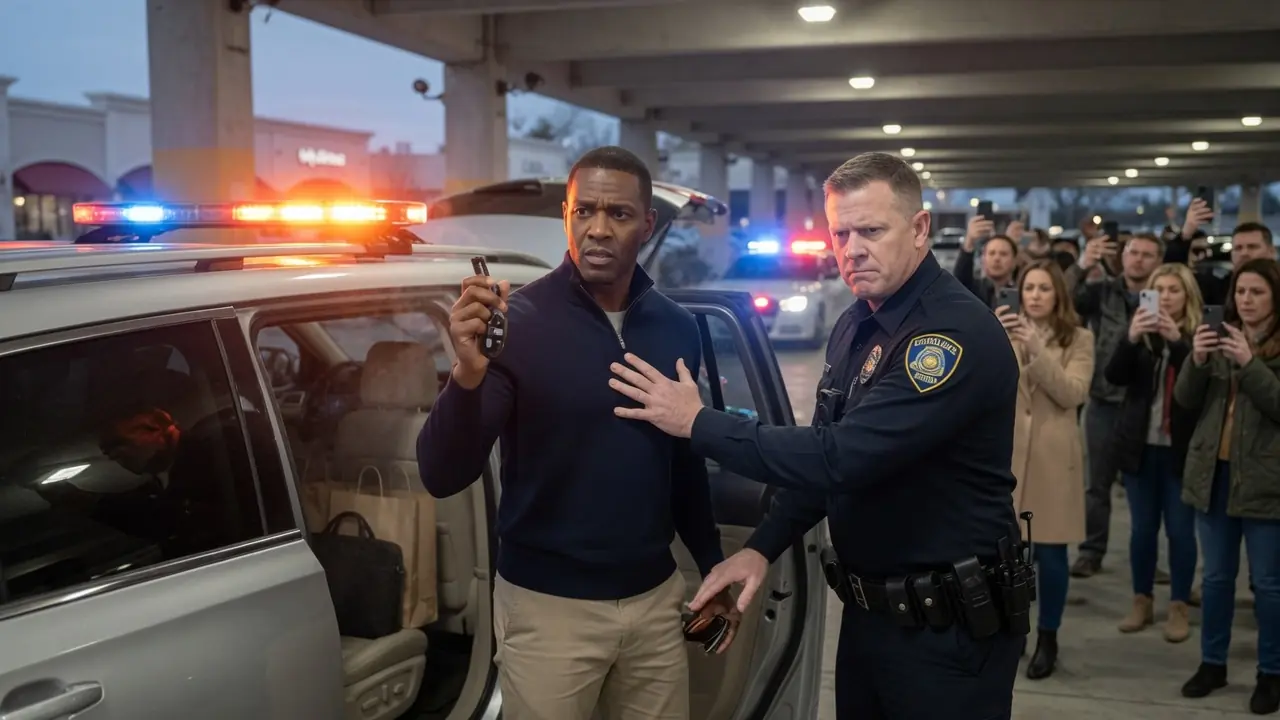
His refusal stripped that away.
Nolan stepped closer.
“We don’t recognize you.”
“You moved here three months ago.”
“That doesn’t answer the question.”
“I have lived on this street for nine years.”
Nolan and Bethany exchanged a glance.
It was quick.
Dismissive.
Adrian recognized the conclusion moving between them.
They did not believe him.
“If you live here,” Bethany said, “which house is yours?”
“I’m not giving two strangers my address.”
“We are not strangers. We’re residents.”
“You’re strangers to me.”
Nolan’s voice became firmer.
“There’s no reason to become hostile.”
Adrian looked at him.
“I am walking my dog.”
“You’re refusing a simple request.”
“You are not entitled to make it.”
Baxter sensed the change in Adrian’s body and moved closer to his leg.
Adrian continued walking.
The Pierces followed again.
He reached the next intersection and turned onto Alderwood Lane.
His house was now less than three blocks away.
“Stop following me,” he said without turning.
“We’re walking on a public sidewalk,” Bethany replied.
“So am I.”
“We want to make sure you leave the neighborhood.”
Adrian stopped so suddenly that Nolan almost walked into him.
“I live here.”
“Then prove it.”
“No.”
Bethany removed her phone.
“Maybe we should call someone.”
Adrian took out his own phone first.
He opened the camera.
The recording began with the pavement before he raised it to chest height.
“It is 1:47 p.m.,” he said. “I’m walking home from the Redwood Crest dog park. These two people have been following me, and I have asked them to stop.”
Bethany’s face tightened.
“Do not record us.”
“We’re in public.”
“You don’t have our permission.”
“I don’t need it.”
Nolan folded his arms.
“You’re making yourself look suspicious.”
Adrian kept his voice level.
“I am recording because you refuse to leave me alone.”
“We’re only trying to find out what you’re doing here.”
“I said I’m going home.”
“You could be lying.”
“So could you.”
Nolan took a step toward the camera.
Adrian stepped backward.
“Do not come closer.”
Bethany pointed at him.
“See? Now he’s threatening us.”
Adrian looked into his phone.
“I have not threatened either person. I have asked them to stop following me.”
Nolan pulled out his phone.
“If you won’t cooperate, we’re calling the police.”
Adrian felt cold despite the mild afternoon.
He understood that the call would reach officers before his explanation did.
The Pierces would control the first description.
They could shape the encounter with a few words.
Aggressive.
Suspicious.
Refusing to identify himself.
Carrying a bag.
Adrian placed both feet firmly on the sidewalk.
“Call them.”
Bethany blinked.
“What?”
“Call the police. I’ll wait right here with the video running.”
Nolan dialed.
Adrian heard the dispatcher answer.
“There’s a suspicious man walking around the neighborhood,” Nolan said.
Adrian raised his voice.
“I am a resident. I’m walking my dog. They have followed me for three blocks.”
Nolan turned away from him.
“He’s being aggressive and filming us.”
“Because you are following me.”
Bethany moved closer to Nolan’s phone.
“He won’t tell us where he’s going.”
Adrian faced his own camera.
“I told them I was going home. I refused to give strangers my home address.”
The dispatcher asked whether anyone had a weapon.
Nolan looked toward the backpack.
“I don’t know.”
Adrian immediately spoke.
“I am unarmed. My backpack contains dog treats and a water bottle.”
Bethany shook her head dramatically.
“He’s getting confrontational.”
Adrian stopped speaking.
Years of experience had taught him that calmness did not guarantee safety.
Still, he understood that every movement could be interpreted through the story the Pierces had already told.
He positioned himself beneath a streetlight.
He shortened Baxter’s leash.
He kept his hands visible.
Four minutes later, the patrol car appeared.
Officer Dana Ruiz exited first.
Her partner, Officer Miles Grant, remained near the passenger side while scanning the sidewalk and surrounding homes.
Ruiz looked at Adrian.
Then the Pierces.
Then Baxter.
“Who made the call?”
“I did,” Nolan said.
Ruiz turned toward him.
“What happened?”
Nolan pointed at Adrian.
“We noticed him wandering through the neighborhood. When we tried asking what he was doing, he became hostile.”
Adrian kept the camera raised.
“They followed me after I told them I live here.”
Bethany spoke over him.
“He refused to identify himself.”
“I am not required to identify myself to them.”
Ruiz raised one hand.
“Everyone stop.”
She turned toward Adrian.
“Sir, do you have identification?”
The request should have been ordinary.
It did not feel ordinary.
Adrian’s wallet was in his back pocket. The officers had been called because someone already described him as dangerous.
Reaching suddenly could transform tension into catastrophe.
“My wallet is in my back-right pocket,” Adrian said. “I’m going to reach for it slowly.”
Ruiz nodded.
“That’s fine.”
Adrian moved carefully and removed his license.
Ruiz read it.
Her eyes paused at the address.
She looked toward the beige house visible two properties away.
“You live at 1814 Alderwood Lane?”
“Yes.”
“How long?”
“Nine years.”
Officer Grant looked toward the Pierces.
“You said he was wandering.”
“We didn’t know where he lived,” Bethany replied.
Adrian looked at her.
“I told you.”
“You didn’t prove it.”
Ruiz handed back the license.
“He was not required to prove it to you.”
Nolan’s expression tightened.
“He was recording us.”
“After you followed him?”
“We were concerned.”
Ruiz asked the question that should have been asked during the emergency call.
“What behavior did you observe that suggested a crime?”
Nolan looked toward Bethany.
“He had a backpack.”
Ruiz waited.
“And?”
“He didn’t want to answer us.”
“That is not a crime.”
Bethany’s voice rose.
“You don’t understand. People like him could be anywhere before somebody notices.”
The words left her mouth.
Her face changed immediately.
Officer Grant stared at her.
“People like him?”
“That isn’t what I meant.”
Adrian kept recording.
The officers separated the parties.
Ruiz confirmed no crime had occurred and provided Adrian with an incident number. She warned the Pierces that continuing to follow or confront him could become harassment.
No arrests were made.
The police left.
The Pierces walked back toward their car.
Adrian completed the final distance home with Baxter beside him.
When he unlocked the front door, the dog entered first and went directly to his water bowl.
Adrian remained in the doorway.
The house looked unchanged.
His tools rested in the garage.
A coffee cup sat beside his unfinished cabinet.
The leftover lasagna waited inside the refrigerator.
Yet the safety he associated with the house felt thinner.
He locked the door.
Then he transferred the recording from his phone to his computer.
Adrian watched every second.
His voice sounded steady.
The Pierces sounded confident.
Their certainty disturbed him more than the insults.
They genuinely believed they possessed the authority to decide whether he belonged on the street.
Adrian considered keeping the video private.
Then he imagined what the police report might have said without it.
Concerned residents approached unidentified man.
Subject became argumentative.
Officers verified residence.
Matter resolved.
The language would flatten the pursuit, the demands, and the power of the emergency call into a harmless misunderstanding.
Adrian sent the original footage to his attorney and saved two additional copies.
Then he posted a shorter version publicly.
He did not identify the Pierces’ address.
He did not ask viewers to contact them.
His caption contained only three sentences.
I was followed while walking home in the neighborhood where I have lived for nine years. The people following me called police and described me as aggressive after I refused to give them my home address. I am posting the recording so the facts cannot be rewritten.
The video spread faster than Adrian expected.
By midnight, it had forty thousand views.
By Monday afternoon, it had passed half a million.
By Tuesday, it had reached millions.
News stations contacted him.
Civil-rights organizations requested interviews.
Thousands of people shared similar experiences.
A physician described being questioned outside her own condominium.
A professor wrote that neighbors called security while he carried furniture into the home he had just purchased.
A delivery driver explained how often residents photographed him after he completed his route.
The praise made Adrian uncomfortable.
Many commenters called him heroic for remaining calm.
He understood the intention.
Still, the words placed another burden on him.
As though extraordinary restraint had been the price of deserving safety.
Other comments blamed him.
Why not show them your address?
Why make everything about race?
Why record instead of simply cooperating?
Adrian closed the computer.
The first neighbor to knock on his door was Evelyn Brooks, a retired librarian who had lived across the street for fifteen years.
She carried banana bread wrapped in foil.
“I saw the video,” she said.
Adrian remained in the doorway.
Evelyn noticed his hesitation.
“I’m not here to ask you to forgive the neighborhood.”
“You didn’t follow me.”
“No.”
She looked down.
“But I attended a safety meeting last week.”
Adrian’s expression changed.
“What safety meeting?”
“The Pierces raised concerns about unfamiliar people near the park. Nolan proposed photographing anyone residents didn’t recognize.”
“Did anyone mention me?”
“Not by name.”
“What did he say?”
“That the neighborhood was changing and we needed to protect its character.”
Adrian looked toward the Pierces’ house.
“And nobody asked what that meant?”
“No.”
The answer was quiet.
Evelyn held the bread closer to her chest.
“I thought he was being overdramatic. I didn’t think silence would matter.”
“It told him everyone agreed.”
“Yes.”
Adrian stepped aside and allowed her inside.
That conversation led to the emergency HOA meeting.
Now, three days later, Adrian stood in the community hall while residents confronted the words they had allowed to remain vague.
Nolan closed his folder.
“We have apologized.”
“No,” Adrian said. “You said you were sorry the incident became public.”
Bethany’s eyes filled.
“What do you want from us?”
“I want you to stop describing your consequences as though they were the original harm.”
The room remained silent.
Adrian continued.
“You are afraid because strangers know where you work. I understand that fear. On Sunday, I was afraid because you sent armed officers toward me after describing me as a threat.”
Nolan looked away.
“I never said you had a weapon.”
“You said you didn’t know when the dispatcher asked.”
“Because I didn’t.”
“You could see both my hands.”
Gloria Bennett looked toward Officer Ruiz, who stood near the rear wall at Adrian’s request.
“Officer, could the call have become dangerous?”
Ruiz answered carefully.
“Any call involving an allegedly aggressive person carries risk. Officers make decisions based partly on information received before arrival.”
“What prevented escalation?”
“Mr. Cole’s communication helped.”
Adrian looked at her.
“My innocence helped.”
Ruiz nodded.
“Yes.”
“Would the situation have been different if I had been angry?”
“Possibly.”
“Was I allowed to be angry?”
The question remained in the room.
Ruiz answered honestly.
“Yes. You were.”
The HOA eventually adopted new policies.
Residents could report observed criminal behavior, but unofficial patrols were prohibited. Photographing people solely because they were unfamiliar would be treated as harassment under community rules.
Neighborhood alerts had to describe actions rather than race, clothing, or perceived belonging unless those details were relevant to an actual reported crime.
The policies passed overwhelmingly.
Adrian did not celebrate.
Rules could limit conduct.
They could not control the first thought inside someone’s mind when a stranger appeared.
The Pierces issued a written apology one week later.
The first version said they regretted that Adrian had felt targeted.
He returned it through the HOA attorney.
His response contained one sentence.
I did not feel targeted; you followed and targeted me.
The second apology was more direct.
It acknowledged that they pursued him, rejected his truthful explanation, demanded private information, and called police without witnessing illegal conduct.
Adrian accepted the statement for the public record.
He did not accept an invitation to meet privately.
Forgiveness was not an appointment the Pierces could schedule after losing control of the story.
The police department reviewed the dispatch call and body-camera footage.
Officer Ruiz had handled the encounter without force, but she remained troubled by one part of her response.
She visited Adrian several weeks later.
“I asked for your ID before asking them what crime they observed,” she said.
“You followed the structure of the call.”
“That may be the problem.”
Adrian waited.
Ruiz explained that officers were now being reminded to separate suspicious behavior from mere presence before demanding identification.
“Will that change every encounter?” Adrian asked.
“No.”
“Then why do it?”
“Because no policy changes everything. That doesn’t mean we leave the bad one alone.”
Adrian nodded.
“That sounds like software.”
Ruiz smiled faintly.
“I’ll pretend I understand that.”
Months passed.
The video moved out of the news cycle.
Redwood Crest returned to ordinary disputes about fences, parking, and lawn maintenance.
The Pierces sold their house before the end of the year.
Some residents called their departure a victory.
Adrian did not.
He had never wanted their home.
He had wanted to reach his own without being followed.
Gradually, his afternoon walks became ordinary again.
At first, Adrian carried the phone in his hand every time he left the house.
Later, it remained in his pocket.
He still noticed cars slowing behind him.
He noticed footsteps.
He noticed when someone looked for too long.
The incident did not teach him that he did not belong in Redwood Crest.
It taught him that legal ownership and social acceptance were different things.
His name was on the mortgage.
His taxes maintained the road.
He knew the neighbors, the drainage problems, and every shortcut to the dog park.
None of that prevented two newcomers from believing their uncertainty outweighed his word.
One year after the incident, Renee visited.
She stood in Adrian’s living room examining the walnut cabinet he had finally completed.
Her fingers traced the lower door.
“This hinge is uneven.”
“It’s a sixteenth of an inch.”
“You used to lose sleep over less.”
“I decided to leave it.”
“Why?”
Adrian looked through the front window toward Alderwood Lane.
“Because the cabinet still works.”
Renee studied him.
“You still like living here?”
“Yes.”
The answer came after a pause.
His mother heard it.
“You can leave someday if you choose.”
“I know.”
“But don’t leave because strangers told you the house wasn’t yours.”
“I won’t.”
That evening, Adrian took Baxter for a walk.
They passed the former Pierce house, now occupied by a family with two children and an elderly beagle.
The new homeowner was repairing a sprinkler near the sidewalk.
He looked up.
“Evening, Adrian.”
“Evening.”
Nothing more happened.
No one demanded an address.
No vehicle slowed.
No police arrived.
Adrian returned home carrying an empty water bottle and a bag of dog treats.
It was the kind of walk nobody recorded.
That was what made it valuable.
People who watched the viral video often focused on the moment the officer read Adrian’s license.
The address proved he lived two houses away.
The revelation destroyed the Pierces’ narrative in seconds.
But Adrian never considered that the most important moment.
The license did not transform him from a suspicious man into an innocent homeowner.
It merely forced other people to recognize facts he had already stated.
The real turning point occurred earlier.
It happened when Adrian said, “I live here,” and the Pierces decided his word could not be trusted.
Everything after that followed naturally from the first judgment.
The pursuit.
The demand for proof.
The accusation of aggression.
The emergency call.
The police response.
The crowded meeting where residents finally had to listen to the recording without the protection of polite explanations.
Adrian Cole was not saved by the address printed on his driver’s license.
He had the right to walk peacefully even if he lived across town.
He had the right to refuse strangers his personal information.
He had the right to become angry when followed.
The disturbing part of the story was never that the man they suspected turned out to own a house nearby.
It was that they believed ownership would have been the only acceptable reason for him to be there.
A year later, the video remained online.
Adrian rarely watched it.
He did not need to.
He remembered every word.
But he also remembered what happened after the camera stopped.
A neighbor admitted that silence had encouraged suspicion.
An officer questioned a procedure she once considered automatic.
A community heard the emergency call and lost the ability to call it a misunderstanding.
And one quiet Sunday afternoon eventually became quiet again.
Adrian unlocked the beige house on Alderwood Lane.
Baxter ran inside.
The cabinet door remained slightly uneven.
The mortgage still carried Adrian’s name.
But none of those things explained why he belonged.
He belonged because no public sidewalk required another person’s permission.
That had been true before the video.
Before the license.
Before the police arrived.
The only thing that changed was that the rest of the neighborhood was finally forced to hear it.