The first police car arrived without sirens.
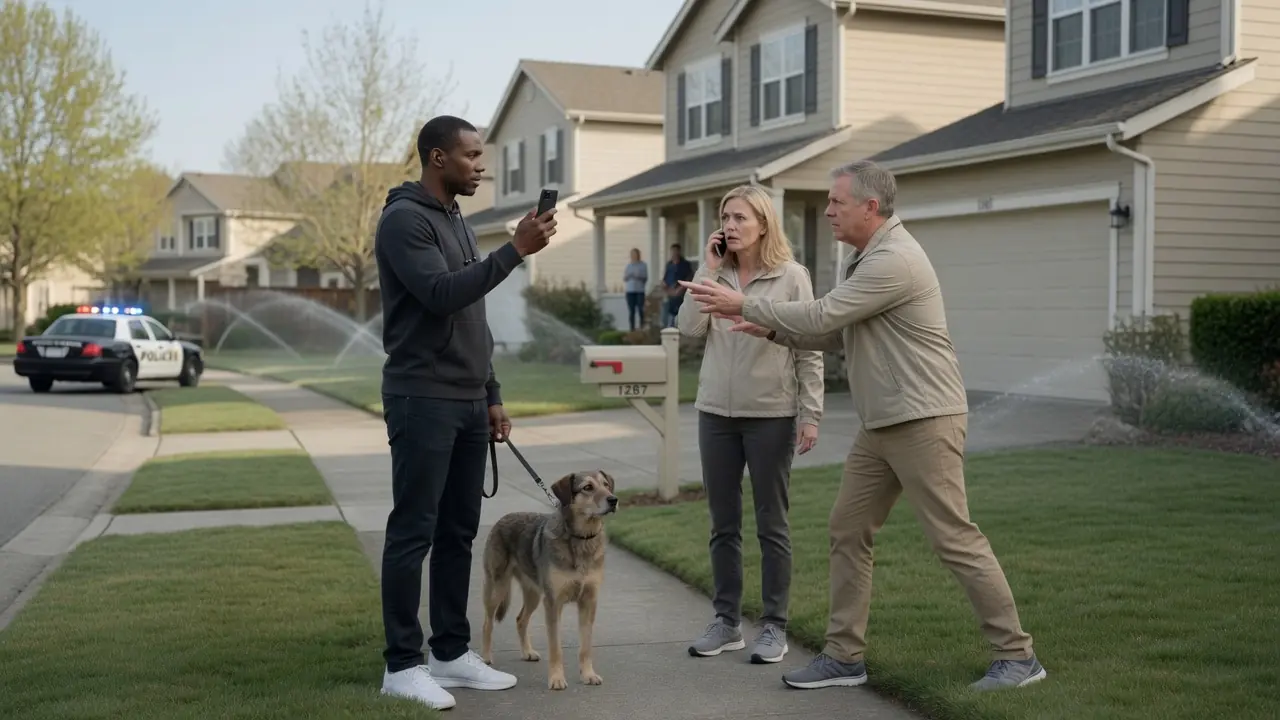
Its tires rolled slowly around the bend of Alderwood Lane, passing identical mailboxes, trimmed hedges, and lawns still wet from afternoon sprinklers. The patrol vehicle stopped twenty feet from Marcus Holloway, who stood on the public sidewalk with a dog leash in one hand and his phone raised in the other.
Marcus did not move.
He had already told the dispatcher’s caller that he was unarmed.
He had said it loudly enough for the phone recording to capture.
He had also explained that he was walking home, that he lived on the street, and that the couple standing behind him had followed him for nearly three blocks after he asked them to stop.
None of that made his heartbeat slow.
Two officers stepped from the patrol car.
Marcus kept the camera running.
The first officer was a woman in her late thirties named Elena Ruiz. She looked from Marcus to the couple standing near a stone driveway, then down at the golden retriever sitting patiently beside his leg.
The second officer, Connor Hale, remained closer to the patrol car.
“Sir,” Ruiz said, “we received a report of a disturbance.”
Marcus nodded toward the couple.
“They followed me from the dog park. I asked them three times to leave me alone.”
The woman behind him spoke immediately.
“That is not what happened.”
Her name was Denise Harper.
She and her husband, Paul, had moved into Redwood Crest less than three months earlier. They stood together in matching light jackets, both flushed with the confidence of people who believed the police had arrived to confirm their version of events.
“He was wandering around the neighborhood,” Denise continued. “When we asked what he was doing, he became confrontational.”
Marcus turned the phone slightly so the officers and the couple remained visible.
“I said I was walking home.”
Paul stepped forward.
“We didn’t recognize him.”
“You don’t have to recognize me,” Marcus replied.
Ruiz raised one hand.
“Everyone stop talking for a moment.”
The street became quiet except for the ticking of a lawn sprinkler and the faint jingle of the dog’s collar.
Ruiz looked at Marcus.
“Do you have identification?”
He felt a familiar calculation begin.
His wallet was in his back pocket.
Reaching for it should have been a simple act.
In a tense encounter built upon a false claim that he was dangerous, it did not feel simple.
Marcus kept his right hand visible.
“My identification is in my back-right pocket,” he said. “I’m going to reach for it slowly.”
Ruiz nodded.
“That’s fine.”
Marcus lowered his recording hand slightly and removed the wallet with two fingers. He opened it and handed her his driver’s license.
Officer Hale moved closer while Ruiz read the information.
Her eyes went first to the name.
Then the photograph.
Then the address.
She looked over Marcus’s shoulder toward the beige two-story house three properties away.
“You live at 1814 Alderwood Lane?”
“Yes.”
Ruiz studied the license again.
“How long?”
“Nine years.”
The silence that followed felt heavier than the police car.
Denise folded her arms.
“Well, how were we supposed to know that?”
Marcus looked toward her.
“I told you.”
“You could have been lying.”
“So could you.”
Paul’s face tightened.
“You were filming us.”
“After you began following me.”
“Because we were concerned.”
Marcus pointed his phone toward the street.
“Concern would have been asking once and accepting the answer. You followed me after I told you to stop.”
Denise looked at Officer Ruiz.
“He was acting aggressive.”
Ruiz glanced toward Marcus.
He stood on the sidewalk wearing running shoes, a gray sweatshirt, and a small backpack containing dog treats and a bottle of water. His retriever remained seated beside him.
There were no broken windows.
No damaged property.
No tools that could be mistaken for burglary equipment.
No crime scene.
Only a man attempting to reach his own house while two strangers demanded proof that he belonged there.
“What exactly did he do that you considered aggressive?” Ruiz asked.
Denise hesitated.
“He raised his voice.”
“After you followed him?”
“We were protecting the neighborhood.”
Marcus let out a slow breath.
Officer Hale looked toward the Harpers.
“Did he enter your property?”
Paul pointed toward the edge of the driveway.
“He came close.”
“That was not the question.”
“No.”
“Did he threaten either of you?”
Denise answered.
“Not directly.”
“Did he attempt to enter a home or vehicle?”
“No.”
“Did you witness him committing any crime?”
Paul looked irritated.
“We had recent break-ins.”
Ruiz glanced toward Hale.
He opened a small notebook.
“When?”
“I don’t know. We heard about them.”
“From whom?”
“The neighborhood message board.”
Marcus knew the posts they meant.
Two weeks earlier, someone had taken packages from a porch on Pine Ridge Court. A teenager had also entered several unlocked vehicles looking for cash.
Security-camera footage showed a thin young man in a red hooded sweatshirt.
Marcus was thirty-seven, broad-shouldered, and wearing gray.
The only similarity was that both were Black.
Ruiz handed Marcus his license.
“You’re free to go.”
Denise stepped closer.
“That’s it?”
Ruiz turned toward her.
“What else were you expecting?”
“You’re not even going to ask why he refused to tell us where he lived?”
Marcus stared at her.
“Because you had no right to ask.”
Denise’s voice rose.
“We live here.”
“So do I.”
“You people don’t understand what it’s like when strangers start appearing—”
She stopped.
The words had left her mouth before she understood how they sounded.
Even Paul looked at her.
Officer Hale lowered his notebook.
“You people?” he repeated.
Denise’s face went pale.
“That is not what I meant.”
Marcus said nothing.
He did not need to.
The camera had recorded everything.
Ruiz looked toward the couple.
“You called emergency services to report a suspicious man. The man was walking his dog on a public sidewalk two houses from his own home.”
“We were being cautious,” Paul said.
“Caution does not require following someone.”
“He could have explained himself.”
“He did.”
Ruiz’s tone hardened.
“And he was not required to prove his residence to either of you.”
Denise shook her head.
“This is being turned around on us.”
Marcus almost laughed.
That was the first sentence she had spoken that felt entirely honest.
She believed the arrival of police should have fixed the power imbalance in her favor. She had expected Marcus to be questioned, searched, perhaps detained.
Instead, the officer had read the address on his license.
Now Denise felt accused by the facts she had created.
Ruiz asked Hale to speak with the couple separately.
Then she approached Marcus.
“Are you all right?”
It was the first time anyone had asked.
Marcus looked toward his house.
The curtains in his living room were open. His unfinished bookshelf stood visible through the front window, clamps still attached to one side.
“I’m fine.”
Ruiz studied him.
“You don’t sound fine.”
“I’m trying to get home without this becoming something worse.”
“Do you want to file a complaint?”
Marcus looked at his phone.
The timer showed fourteen minutes and thirty-seven seconds.
“I want an incident number.”
“You’ll have one.”
“I also want it documented that they followed me after I told them to stop.”
Ruiz nodded.
“I’ll include it.”
His dog rose and pressed against his leg.
Marcus rested one hand on the retriever’s head.
The dog’s name was Winston.
Winston cared nothing about property values, neighborhood demographics, or who had lived on Alderwood Lane longest. He knew only that his walk had lasted too long and his owner’s body had become tense.
Marcus looked toward Denise and Paul.
“They called because I didn’t answer their questions.”
Ruiz did not disagree.
“They called because they thought you were suspicious.”
“No.”
Marcus met her eyes.
“They decided I was suspicious before asking anything.”
That distinction stayed with her.
Twenty-three minutes earlier, Marcus had been thinking about leftover pasta.
It was an ordinary Sunday afternoon in late April. The sky was pale blue, the air cool enough for a sweatshirt, and sprinklers clicked across Redwood Crest’s carefully maintained lawns.
Marcus had taken Winston to the community dog park after spending most of the morning rebuilding a cabinet in his garage.
Weekend projects were how he relaxed.
He wrote cybersecurity software during the week. His job required hours of concentration on invisible weaknesses—misconfigured servers, stolen credentials, small errors capable of exposing entire systems.
On weekends, Marcus preferred materials he could touch.
Wood.
Screws.
Paint.
Electrical wiring.
He liked problems that stayed solved after he repaired them.
At 1:42, he left the dog park and began walking home.
Earbuds played softly beneath his hood. Winston trotted beside him, stopping twice to investigate shrubs that had apparently developed important information since the previous afternoon.
A dark blue sedan approached from behind.
It slowed.
Marcus moved closer to the curb, assuming the driver needed space.
The vehicle continued creeping beside him.
Then it stopped.
A door opened.
Marcus looked back.
A man and woman stepped onto the sidewalk. Both appeared to be in their mid-forties. The man wore khaki trousers and a navy windbreaker. The woman wore a white athletic jacket and dark sunglasses.
They stared at him.
Not a passing glance.
A sustained inspection.
Marcus removed one earbud.
The woman called out first.
“Excuse me.”
He waited.
“Can we help you?”
The question sounded polite.
Its meaning did not.
“No, thanks.”
Marcus continued walking.
Footsteps followed.
“Do you live around here?” the man asked.
Marcus looked over his shoulder.
“I’m heading home.”
“Where is that?”
“Home.”
The woman laughed softly.
“We’re only asking.”
“And I answered.”
The couple exchanged a glance.
Marcus had seen that look before.
It was the look people used when the answer provided did not grant them the authority they expected.
The man moved closer.
“We’ve had incidents in the neighborhood.”
“What kind of incidents?”
“Break-ins.”
“I heard about the stolen packages.”
“So you understand why people are alert.”
Marcus continued walking.
“I understand that you should contact police if you witness a crime.”
“We’re trying to determine what you’re doing.”
“I’m walking my dog.”
The woman pointed toward his backpack.
“What’s in the bag?”
Marcus stopped.
Winston looked up.
“Why?”
“People have tools.”
“So?”
The woman removed her sunglasses.
“We don’t recognize you.”
“You don’t need to.”
Her expression changed.
Marcus understood then that the conversation would not end through reason.
They did not want information.
They wanted compliance.
He resumed walking.
The couple followed.
“Sir,” the woman called, louder now. “We asked you a question.”
Marcus did not turn.
The man quickened his pace.
“Don’t be rude.”
Marcus stopped again.
“I live on this street. I am going home. Please stop following me.”
The man folded his arms.
“If you live here, telling us which house shouldn’t be difficult.”
“I don’t owe you my address.”
“We’re neighbors.”
“I’ve never seen you before.”
The answer struck both of them.
For one second, their positions reversed.
They were the unknown people.
They were the ones recently arrived.
They were following a resident through a neighborhood he knew better than they did.
The woman’s voice became sharper.
“Are you threatening us?”
“No.”
“You’re acting hostile.”
“I’ve asked you to leave me alone.”
Marcus took out his phone.
He did not raise it dramatically.
He opened the camera, began recording, and held it at chest height.
The image shook slightly.
He narrated for the record.
“It is 1:47 p.m. I’m on Alderwood Lane, walking home from the dog park. These two people have followed me for approximately two blocks after I asked them to stop.”
The woman stepped toward the camera.
“You don’t have permission to record us.”
“We’re on a public sidewalk.”
“Turn that off.”
“Stop following me.”
“We’re asking a simple question,” the man said.
“And I gave you a simple answer.”
The woman placed one hand on her hip.
“If you continue recording, we’ll call the police.”
Marcus kept the camera steady.
“Go ahead.”
She appeared surprised.
He continued.
“I live right here. I am unarmed. I’m walking my dog. Call them.”
The man removed his phone.
That was when fear entered Marcus’s body.
Not panic.
Something colder.
A calculation built from too many news reports, too many videos, and too much knowledge of how quickly a false description could become an officer’s first impression.
The police would not arrive knowing Marcus.
They would arrive knowing the caller’s language.
Suspicious.
Aggressive.
Unknown male.
Possible burglary activity.
Marcus had spent his career studying how information framed decisions. The first report often shaped everything that followed.
So he kept recording.
The man called emergency services.
“Yes,” Paul said. “There is a suspicious man walking around our neighborhood.”
Marcus spoke loudly enough for the dispatcher to hear through the phone.
“I am a homeowner. I’m walking my dog. They are following me.”
Paul turned away.
“He’s becoming confrontational.”
“I have asked you three times to leave me alone.”
Denise moved closer to Paul’s phone.
“He’s filming us and refusing to say where he’s going.”
Marcus addressed his own camera.
“They are reporting that I’m aggressive because I will not give strangers my home address.”
Denise scoffed.
“See? He’s trying to make this into something.”
“It became something when you called the police.”
Paul listened to the dispatcher.
“We’ll stay where we are.”
Marcus stopped walking.
Continuing toward his house would reveal exactly where he lived to people who had already followed him.
Leaving could be described as fleeing.
Standing still seemed safest.
He positioned himself near a streetlight, visible from several homes, and placed both hands where an approaching officer could see them.
Winston sat beside him.
Four minutes later, the patrol car arrived.
By 2:10, the officers had completed their initial interviews.
Officer Ruiz gave Marcus the incident number.
The Harpers were warned not to follow or approach him again. Because the dispatcher recording did not include an invented crime or claim of a weapon, police did not immediately charge them with filing a false report.
But the incident was documented.
Marcus walked the final distance home.
He did not look back.
Once inside, he locked the door.
Then he stood in the living room without moving.
Winston waited near his food bowl.
The leftover pasta sat inside the refrigerator.
The cabinet project remained unfinished in the garage.
Everything looked exactly as it had before the walk.
Yet the house no longer felt as quiet as it had that morning.
Marcus had purchased it nine years earlier.
He grew up in a one-bedroom apartment outside Cleveland with his mother, Yvonne. She worked nights cleaning a hospital and spent afternoons sleeping behind a thin bedroom door while Marcus tried to complete homework without making noise.
When childcare failed, Yvonne brought him to work.
He sat near the vending machines in a lower hospital corridor, solving math problems while she emptied trash containers and polished floors.
People often spoke past her.
Visitors handed her cups without asking whether she was busy.
Administrators entered elevators while she carried supplies and never held the doors.
Yvonne noticed everything.
She rarely complained.
“People will decide who you are before you open your mouth,” she once told Marcus. “Your job is not to spend your whole life begging them to change their minds.”
“What is my job?”
“To know who you are before they decide.”
Marcus carried that lesson into school, college, and his first technology job.
He became skilled at work most people did not understand.
At twenty-eight, he accepted a senior position with a cybersecurity company and received a salary that looked unreal beside the wages on his mother’s old paychecks.
His first major purchase was not a sports car.
It was a home.
Redwood Crest seemed peaceful.
The street curved around mature trees. Children rode bicycles in the afternoons. People waved while collecting mail. The neighborhood association argued about lawn signs and fence heights rather than anything truly dangerous.
Marcus chose the beige house on Alderwood Lane because it had a large garage.
He replaced the kitchen cabinets himself.
Built shelves in the office.
Repaired the deck.
Planted the maple tree near the front window.
For nine years, no one questioned why he was there.
Some neighbors became friends.
Others remained politely distant.
Marcus accepted both.
He did not need universal approval.
He believed ownership, routine, and time had made his presence ordinary.
Then two new residents followed him down the street and called the police because they could not imagine that the Black man they did not recognize might know the neighborhood better than they did.
Marcus transferred the video to his computer.
He watched it once.
The footage made his stomach tighten.
His voice sounded calmer than he remembered.
Denise and Paul sounded more certain.
When Marcus reached the moment Denise said, “You people don’t understand,” he stopped the recording.
He considered deleting it.
Posting would bring attention.
Attention would bring arguments.
Strangers would analyze his tone, movements, clothes, and decision not to provide an address.
Some would ask what happened before the camera began.
Others would insist the Harpers were simply protecting their property.
Marcus understood how quickly an event could become content detached from the person who endured it.
Then he remembered Denise telling dispatch he was aggressive.
He remembered the police car rounding the corner while Paul’s description existed as the only official narrative.
Marcus uploaded the video to a private cloud folder first.
He sent copies to his attorney, his sister, and his employer’s legal department.
Then he posted a shortened version publicly with a simple caption:
I was followed while walking home in the neighborhood where I have lived for nine years. I recorded because the people following me called police and described me as aggressive. The video speaks for itself.
He did not include the Harpers’ address.
He did not ask anyone to contact them.
He did not add music or dramatic captions.
By midnight, the video had been viewed more than forty thousand times.
By morning, it had passed half a million.
Messages flooded Marcus’s accounts.
Some came from people sharing similar experiences.
A doctor described being stopped outside his own apartment building.
A college professor said a neighbor reported her for entering a house she owned.
A delivery driver described customers watching him leave packages, then calling police because he remained in the area to organize his route.
Other messages were cruel.
People accused Marcus of seeking attention.
Some said he should have shown identification to the couple immediately.
One comment asked why an innocent person would refuse to say where he lived.
Marcus read too much.
Then he closed the laptop.
At eight, someone knocked on his door.
It was his neighbor, Helen Porter, a retired teacher who had lived across the street for seventeen years.
She carried a plate of blueberry muffins.
“I saw the video.”
Marcus opened the door but did not invite her inside immediately.
Helen noticed.
“I’m sorry.”
“You didn’t follow me.”
“No.”
She looked toward the Harpers’ house at the far end of the block.
“But I attended the neighborhood meeting when they complained about unfamiliar people near the dog park.”
Marcus’s expression changed.
“What meeting?”
“Last Thursday. Informal security discussion.”
“Was I mentioned?”
“Not by name.”
“What did they say?”
“That certain people seemed out of place.”
Marcus stared at her.
Helen lowered her eyes.
“I should have asked what they meant.”
“Did anyone?”
“No.”
The answer hurt differently.
The incident had not begun with footsteps behind him.
It began in rooms where vague suspicion passed as responsible conversation.
“Why are you telling me?”
“Because silence helped them believe everyone agreed.”
Marcus stepped aside.
Helen entered.
They sat in the living room while Winston placed his head in her lap and immediately accepted one piece of muffin despite Marcus’s objection.
Helen explained that Paul had proposed a neighborhood patrol.
Denise wanted residents to photograph anyone they did not recognize.
Several people expressed concern.
No one directly challenged the premise.
Marcus looked around the room.
“I have been here nine years.”
“I know.”
“Paul has been here eleven weeks.”
“I know that too.”
“Yet he decided who belonged.”
Helen nodded.
“And the rest of us allowed him to speak as though he had that authority.”
The homeowners association called an emergency meeting two days later.
Marcus initially refused to attend.
Then Officer Ruiz contacted him.
The department had reviewed the dispatch recording and body-camera footage. No criminal charge was filed, but the department issued a formal notice to the Harpers about misuse of emergency resources and potential harassment.
Ruiz also told Marcus that Paul claimed online threats had made the couple victims.
“He has received threats?” Marcus asked.
“Yes.”
“I never posted their address.”
“We know.”
“Have they apologized?”
“No.”
That answer convinced Marcus to attend the meeting.
The community center was full.
Residents stood along the walls because every chair had been taken. Local reporters waited outside, but the association president barred cameras from the room.
Marcus sat in the second row.
The Harpers arrived together.
Denise looked exhausted.
Paul carried a folder of printed messages they had received.
When the meeting began, he spoke first.
“Our family has been subjected to harassment because of a misunderstanding.”
Marcus felt the room shift.
A misunderstanding.
The same word organizations used when consequences became uncomfortable.
Paul continued.
“We never intended harm. We were trying to protect our new community after hearing reports of crime.”
Helen raised her hand.
“You followed a resident who asked you to stop.”
Paul looked toward her.
“We did not know he was a resident.”
Marcus stood.
“You keep saying that as though it explains everything.”
The room became silent.
Paul faced him.
“If you had simply told us—”
“I did.”
“You refused to say which house.”
“Because strangers were following me.”
Denise spoke from her seat.
“We were neighbors.”
“Not to me.”
Her eyes filled with anger.
“We asked a reasonable question.”
“No.”
Marcus’s voice remained controlled.
“You asked a question you believed I had to answer. When I refused, you escalated.”
Paul held up the folder.
“We have received death threats.”
“That is wrong.”
The response surprised him.
Marcus continued.
“No one should threaten you. It does not erase what you did.”
Denise stared at him.
“We’ve lost friends over this.”
Marcus looked around the room.
“I nearly lost the ability to reach for my wallet safely because of the description you gave police.”
No one spoke.
Officer Ruiz, standing near the rear wall, lowered her eyes.
Marcus faced the residents.
“This is not only about two people.”
Several neighbors shifted.
“You heard conversations about unfamiliar people. You watched suspicion become a neighborhood project. Some of you have known me for years, but when new residents implied people like me were threats, nobody asked them to be specific.”
Helen nodded slowly.
Marcus continued.
“I do not want a ceremony. I do not want a statement saying Redwood Crest welcomes everyone. I want you to understand what happened.”
He looked toward Paul and Denise.
“They treated discomfort as evidence. Then they used the police to force an answer they had no right to demand.”
The association adopted new policies that evening.
No unofficial patrols.
No photographing people solely because residents did not recognize them.
Emergency calls required descriptions of observed behavior, not assumptions about belonging.
The policies were useful.
Marcus knew rules alone could not repair instinct.
The Harpers issued a written apology the following week.
It said they regretted that Marcus “felt targeted.”
He returned it through the association’s attorney.
His response contained one sentence:
I did not feel targeted; you targeted me.
The apology was rewritten.
This time, it acknowledged that they followed him, ignored his requests, and called police without witnessing a crime.
Marcus accepted the statement publicly.
Privately, trust remained absent.
Months passed.
The video left the news cycle.
Reporters stopped calling.
Redwood Crest returned to lawn disputes, school pickups, and weekend barbecues.
But the neighborhood was not exactly the same.
Some residents began introducing themselves instead of observing from windows.
Others became defensive, claiming they were afraid to report genuine crime.
Marcus responded whenever asked.
“Report actions. Not existence.”
Paul and Denise eventually sold their house.
Their departure did not feel like victory.
Marcus had never wanted to drive them away.
He wanted to walk home without strangers believing they could turn his refusal to obey into an emergency.
Officer Ruiz visited him several weeks after the incident.
She was off duty and carried no official folder.
“I wanted to thank you for the video,” she said.
Marcus looked surprised.
“For making your department look bad?”
“For showing where the encounter could have gone wrong.”
“You handled it calmly.”
“I did.”
She hesitated.
“But I still asked for your identification first.”
Marcus waited.
Ruiz continued.
“You were the subject of the call. It felt procedural.”
“It also made me prove their suspicion wrong.”
“Yes.”
She looked toward the sidewalk.
“We changed part of our response training. Officers are now told to establish whether any crime was observed before requesting identification from someone who is simply present in a public place.”
“That came from this?”
“Partly.”
Marcus nodded.
“That matters.”
Ruiz looked toward him.
“Do you wish I had done something differently?”
“Yes.”
“What?”
“Asked them the questions you asked me.”
She absorbed the answer.
“Fair.”
Winston approached and inspected her shoes.
Ruiz knelt to scratch behind his ears.
“He was the calmest person there.”
“He knew he lived here.”
A year later, Marcus still walked Winston every afternoon.
He used the same route.
At first, he carried his phone in his hand the entire time.
Gradually, it returned to his pocket.
He continued noticing slow cars.
Footsteps behind him.
Curtains moving.
The incident did not make him afraid of the neighborhood.
It made him aware that belonging could exist legally, financially, and socially while still being denied inside another person’s imagination.
Marcus owned the house.
His name was on the mortgage.
His taxes helped maintain the street.
He knew which storm drain flooded, which dog escaped through a damaged fence, and which elderly resident needed help carrying salt during winter.
None of those facts protected him from suspicion when two strangers saw his skin before seeing the leash, the relaxed pace, or the house waiting ahead.
One afternoon, a boy riding a bicycle stopped beside him.
The child was perhaps ten and lived near Pine Ridge Court.
“My mom saw your video,” he said.
Marcus looked down.
“What did she say?”
“That people shouldn’t follow somebody just because they don’t know him.”
“That sounds right.”
The boy considered this.
“But what if someone really is stealing?”
“Then report what they’re doing.”
“What if you’re not sure?”
“Watch the action, not the person you imagined.”
The child frowned, trying to understand.
Marcus pointed toward a man across the street carrying a ladder.
“If you don’t recognize him, does that make him a burglar?”
“No.”
“What would?”
“If he broke a window.”
“Exactly.”
The boy nodded and rode away.
Marcus continued home.
The maple tree near his front window had grown taller. The unfinished cabinet from the day of the incident had long since become part of the living room.
One small flaw remained near the lower hinge.
Marcus could have repaired it.
He chose not to.
The uneven line reminded him that not every mark needed to be erased to prove the structure remained strong.
Yvonne visited that summer.
She stood on the porch and watched Winston patrol the yard.
“You still like it here?” she asked.
Marcus looked along Alderwood Lane.
Children played near the corner.
Helen watered flowers across the street.
A delivery driver placed a package on a porch without anyone photographing him.
“Yes.”
His mother studied his face.
“That took too long.”
“What did?”
“The answer.”
Marcus smiled.
“I like the house.”
“I didn’t ask about the house.”
He looked toward the street.
“I don’t know if I’ll stay forever.”
“That’s different from being chased out.”
“Yes.”
Yvonne nodded.
“Then decide on your time.”
That evening, Marcus walked Winston after dinner.
No one followed him.
No police came.
Nothing happened.
That was what he wanted.
Not an apology printed in the neighborhood newsletter.
Not millions of video views.
Not strangers praising his restraint as though calmness should have been required for his safety.
Only an uneventful walk home.
The video remained online.
Marcus sometimes regretted that the worst afternoon of his life had become the way millions of strangers knew his face.
But the footage preserved something important.
It showed how danger could begin without shouting.
A stare.
A question shaped like an accusation.
Footsteps that continued after someone asked to be left alone.
A phone call that transformed discomfort into an armed response.
People often focused on the moment Officer Ruiz read the address on Marcus’s license.
That was when the Harpers’ story collapsed.
But Marcus believed the more important moment occurred earlier.
It happened when he said, “I live here,” and they decided his word was not enough.
Everything that followed grew from that choice.
They believed they could question him.
Follow him.
Demand his address.
Describe him as aggressive.
Call people with weapons to resolve a discomfort they had created.
The license did not make Marcus innocent.
The mortgage did not make him worthy of respect.
Living in Redwood Crest for nine years did not grant him rights he lacked elsewhere.
He had the right to walk peacefully before anyone knew his name.
That was the truth people missed when they celebrated the final reveal.
The story was not remarkable because the suspicious stranger turned out to be a homeowner.
It was disturbing because he should never have needed to prove it.
Marcus Holloway did not become a different person when the officer read his address.
He remained what he had been from the beginning.
A software engineer.
A son.
A neighbor.
A man walking his dog toward a beige house with his name on the mortgage.
The only thing that changed was that everyone else finally lost the ability to pretend they had not been told.