They're still behind me. I've asked them three times to leave me alone. I'm just walking home. You don't live here. Tell us who you're visiting.
I don't owe you any explanation. This is a public sidewalk. I'm recording for my own safety. Call the police. Go ahead and call them.
I'll wait right here with this video running. Step on our property. I'm not on your property. I'm His name is Eddie Bostwick, 37 years old, homeowner, software engineer, and weekend DIY fanatic. On an ordinary walk back from the community dog park, he became something else in the eyes of two strangers.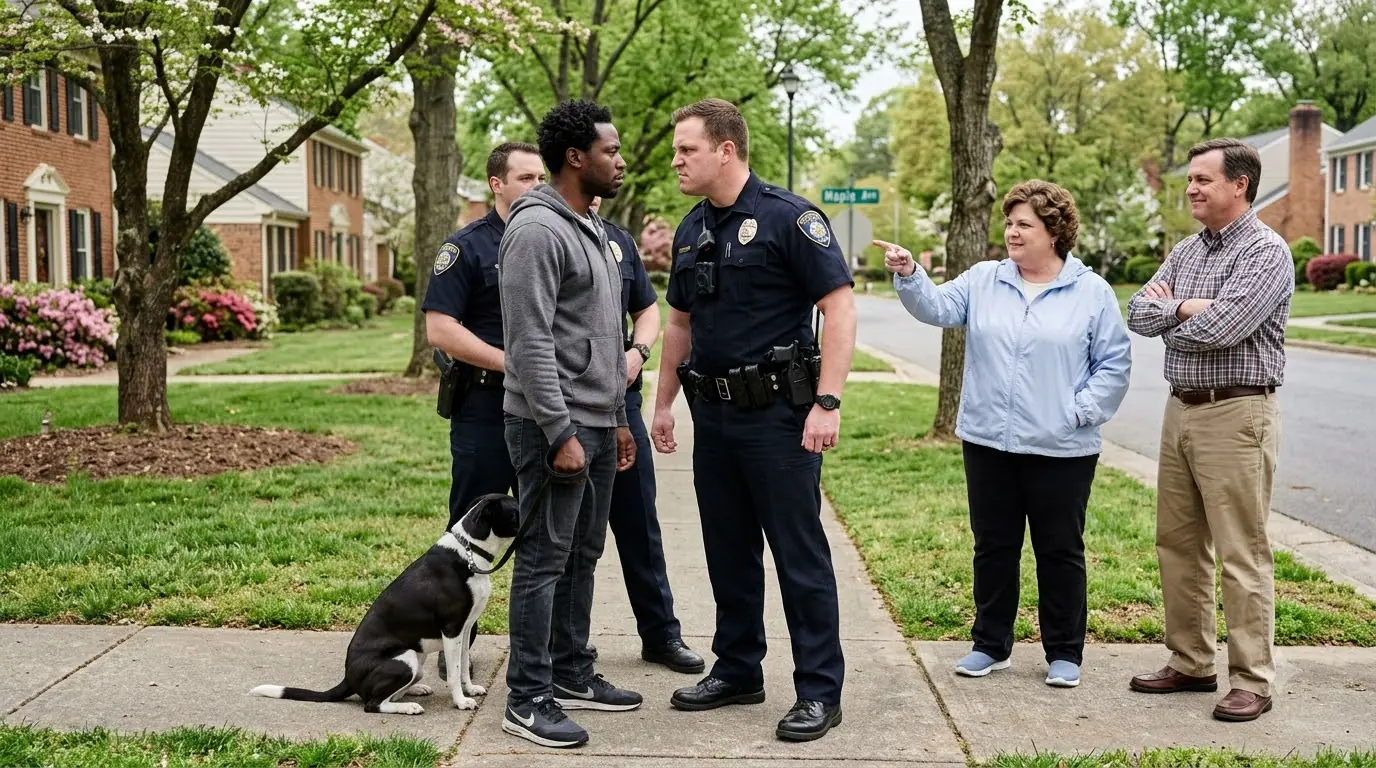
A suspect, a threat, a man whose very presence on the sidewalk was interpreted as a challenge. The couple trailing behind him didn't care that he lived here. Didn't care that he had been in this neighborhood for 9 years. Didn't care that the house he was walking toward had his name on the mortgage. They saw him.
They judged him, and they dialed the police. What happened next would expose a chain reaction of fear, entitlement, and a weaponized phone call that nearly spiraled into catastrophe. And the worst part, none of it should have happened. Before that afternoon confrontation, Eddie Bostwick was the kind of man people pointed to when they wanted an example of discipline. He wasn't loud.
That taught him everything. The value of precision, the dignity of work, the importance of owning your space. By 28, he'd climbed into a senior software engineering role at a cybersecurity firm. The salary shocked him at first. Six figures, bonuses, stock options, the kind of money that made people assume he came from it.
He didn't. His first big purchase wasn't a car. It wasn't a watch. It wasn't any of the cliches. It was a house. a beige two-story home on a quiet cul-de-sac and redwood crest, a predominantly suburb where joggers smiled mechanically, dogs wore sweaters, and the mailboxes all matched like they'd been printed from the same template.
Eddie loved it here. He chose this neighborhood intentionally for the peace, for the space, and for the quiet he never had growing up. For nine years, no one questioned his presence until one did. Then two. Then a phone call that would flip the power dynamic of his entire life.
Redwood Crest had a reputation. Safe, orderly, predictable. Uniqueness was tolerated as long as it stayed quiet. Difference was fine as long as it didn't disrupt the rhythm. But walking while being viewed as suspicious, that was enough to disturb the fragile symmetry.
People didn't say it out loud. Of course, they used polite substitutes. I just didn't recognize him. I was just looking out for my neighbors. I'm sure it was nothing.
But in Redwood Crest, suspicion didn't need evidence, just discomfort. And on that particular Sunday afternoon, under a pale spring sun with sprinklers clicking across pristine lawns, discomfort took the shape of a couple named Mark and Linda Howell. They had recently moved in. They didn't know Eddie and they didn't try to, but they knew one thing with absolute certainty. 1:42 p.m. He walked down Alderwood Lane, earbuds in, leash in hand, his dog trotting beside him.
He is relaxed, calm, thinking about the leftover pasta waiting in his fridge. Behind him, a car slows down, then creeps, then stops altogether. A door shuts. He turns slightly, enough to catch a glimpse. A couple, mid-40s, matching windbreakers.
The kind of synchronized suburban uniformity that makes people appear interchangeable. They stare, not a glance, a stare. Eddie doesn't engage, doesn't break stride. He's learned not to, but then he hears footsteps. Soft at first, then quicker.
They're following him. Not walking the same direction, not heading home. Following. And there's a tone in Linda's voice. high, thin, rehearsed with indignation when she calls out, "Excuse me, sir. Can we help you with something? " Help him.
As if he has stumbled into their world by mistake. Eddie takes out one earbud. No, I'm good. Just heading home. Where is that?
Her emphasis is surgical, subtle, but unmistakable. Just home, he replies. Unwilling to surrender more than that, Mark steps forward. We've had some incidents around here, break-ins. You understand?
Eddie nods once. I live on this street. The couple exchange a glance. A silent, dismissive judgment. As if proximity doesn't equal belonging.
As if owning a house isn't enough. As if a man stating I live here, is somehow suspicious in itself. And that's when Linda says it. We just want to make sure you're not wandering around where you shouldn't be. "Wandering where you shouldn't be. " Eddie feels the shift, a familiar one, where the burden of proof falls entirely on him.
So, he does the only thing he knows guarantees accuracy. He starts recording. The camera angle is shaky. A true handheld POV of a man trying to stay composed. "Look at this," Eddie narrates calmly.
These people are following me for walking in my own neighborhood. You don't have to record us, Linda snaps. Then stop following me. We're just asking what you're doing, Mark adds. I said, going home.
You don't need to get aggressive. Aggressive? The default accusation. The instant reframing of calm self-defense into hostility. Eddie keeps his tone level.
I'm literally walking my dog. Mark folds his arms. We don't recognize you. You don't need to, Eddie replies. That answer hits them hard because it strips them of the power they thought they had, the perceived authority to grant or deny someone's right to exist peacefully in a public space.
Linda's voice cracks with righteous confidence. If you don't stop recording us, we'll call the police. And Eddie says the line that will eventually echo across social media. Call them. I live right here.
I have nothing to hide. But they weren't calling for truth. They were calling for control. The moment Mark pulls out his phone, the energy shifts. A phone call in situations like this isn't neutral.
It's informational. It's not about safety. It's a threat. A weapon. A statement that says, "Your life can be escalated with one number, and I get to decide when. " Eddie records the call.
Every word. Hello. Yes, there's a suspicious man walking around the neighborhood. He's acting aggressive. He's filming us.
We don't know what he's doing. Suspicious. Aggressive. Unknown. Code words.
The kind that create danger out of thin air. Eddie stays still—too still. A stillness born from survival instinct. He knows how quickly things can go wrong when police arrive with the wrong narrative already implanted. He raises his voice, projecting for the camera, for potential viewers, for the record.
I'm a homeowner. I'm unarmed. I'm walking my dog. These people are following me and I've asked them to stop. Linda scoffs dramatically, loud enough for dispatch to hear.
He's getting confrontational. Confrontational. The script writes itself. Four minutes. That's all it takes.
A patrol car rolls onto Alderwood Lane. Lights off, windows down. Two officers step out. Eddie keeps recording. Sir, one officer says, "We received a call about a disturbance from them. " Eddie points, still filming.
They followed me. The officers take in the scene. A calm man holding a leash. An agitated couple gesturing wildly. No broken windows.
No signs of forced entry, no property damage, no crime, just presence. Linda jumps in first. He was acting hostile. We didn't know what he was doing here. I told you I live here, Eddie replies.
The officers pause. Do you have ID on you? Eddie hesitates, not out of defiance, but out of calculation. Reaching for anything in a tense, misinformed encounter can go wrong. It's in my back pocket, he says slowly.
I'm going to grab it now. I'm telling you before I move. The officer nods. Eddie retrieves his wallet and hands over his driver's license. The officer examines it, then looks up, then examines it again.
You live two houses down from here. Correct. Silence. A heavy, awkward silence that lands like a verdict. For a moment, no one breathes.
Eddie waits for the apology that never comes. The shift doesn't happen all at once. It begins with one officer turning to the couple. "You said he was wandering suspiciously. " "Yes," Linda insists. "We'd never seen him before. " The officer gestures toward Eddie.
"He's been a resident here for almost a decade. " Mark's face tightens. "Well, how are we supposed to know that? He was filming us. " "After you followed him," Eddie interjects. "Because we were concerned," Linda fires back. The officer's tone hardens.
Concern doesn't justify making a false report. Linda stutters. Her confidence crumbles. She searches for a justification that had never existed. You people don't understand. she blurts.
"You people. " Even the officers react to that one. The second officer steps in. Ma'am, do you understand that calling 911 without cause is a misuse of emergency services? She goes pale. Humiliation sets in.
The kind that comes when the authority she tried to weaponize flips direction. When the power she thought she controlled vanishes. When the narrative collapses in front of witnesses. By nightfall, Eddie uploads the video. Not for revenge, not for clout, for his safety, for transparency, for the record.
The footage spreads faster than he expects. Hundreds of thousands of views, then millions. Comments flood in. This could have gone so wrong. She tried to weaponize the police.
He handled that better than most could. Why is walking home considered suspicious? Journalists reach out. Civil rights groups issue statements. Neighbors who had never spoken to Eddie now knock on his door to apologize for a community they once believed was fair and unbiased.
Redwood Crest's homeowners association announces an emergency meeting. The police department releases a statement reminding citizens that false reports are prosecutable. Mark and Linda, they claim they're being attacked online. They never acknowledge what they did. Not once.
What does this incident really reveal? That proximity doesn't equal belonging. That ownership isn't enough to shield someone from suspicion. that in certain neighborhoods the first question isn't is he okay but why is he here? Why does a man need to justify walking down his own street? Why did a couple believe their discomfort outweighed his safety?
Why does the benefit of the doubt travel in one direction and never toward men like Eddie? And the biggest question, what would have happened if Eddie wasn't calculating? Wasn't calm? wasn't recording. How many stories don't get captured on video? How many escalations are never documented?
How many people disappear into the cracks of miscommunication? This wasn't about a walk. It wasn't about a neighborhood. It wasn't even about a phone call. It was about power.
Who feels entitled to use it? Who is harmed by it? And what happens when the truth is finally undeniable? Eddie still walks his dog every afternoon. Same street, same houses, same silence.
But now, every time he hears a car slow behind him, every time footsteps echo a little too closely. Every time someone glances at him for a second too long, he remembers that moment when a stranger's fear became a weapon. He remembers how quickly his existence became an incident. And he remembers this.
It didn't matter that he lived there. It mattered that they didn't think he did. So, the question hangs in the air unanswered. Unsettling. How many more people have to prove they belong in the places they already call home?