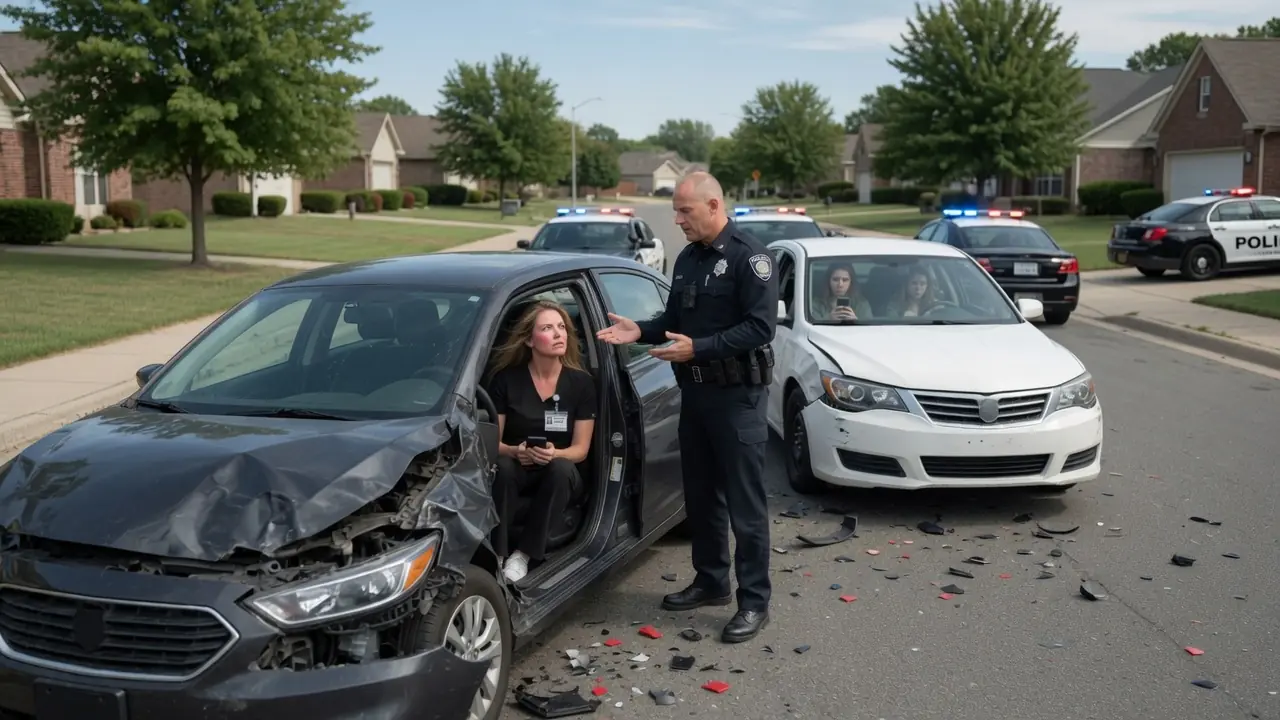
The silver sedan sat crooked across the edge of the highway, its rear bumper crushed inward and one front tire resting against the curb.
Twenty feet behind it, a blue compact car had stopped at an angle with its driver’s door bent so badly that it would no longer open.
Steam drifted from beneath the hood.
A young woman named Kayla Turner climbed out through the passenger side, shaking so hard she nearly dropped her phone.
“She kept brake-checking me,” Kayla said as the first patrol officer approached. “I tried to get away from her, but she kept moving in front of me.”
Officer Daniel McCready looked from Kayla to the silver Ford Taurus.
Its driver remained seated with the windows up and the doors locked.
“What happened before the impact?” he asked.
“She started at the intersection. She was going between lanes and cutting in front of us. Every time I changed lanes, she moved over too.”
Kayla pointed toward a man standing beside a pickup truck on the shoulder.
“That man saw everything. He stopped and gave me his number.”
The witness raised one hand.
“I saw the silver car brake hard for no reason,” he said. “The blue car tried to avoid her. She did it more than once.”
McCready glanced toward the Taurus again.
The driver stared straight ahead.
Another officer stood beside her window, tapping gently on the glass.
“Ma’am, can you lower the window?”
The woman did not move.
“Can you provide your license, registration, and insurance?”
Still nothing.
Then the window opened less than an inch.
“What do you want?”
“We need your information because you were involved in a crash.”
“I didn’t cause anything.”
“Can I see your driver’s license?”
“No.”
The officer paused.
“Ma’am, I need you to step out of the vehicle.”
The window went back up.
The door locks clicked.
Officer McCready approached the passenger side and leaned slightly toward the glass.
“Ma’am, are you injured?”
The woman looked at him with open irritation.
“No.”
“Then please step out so we can investigate the collision.”
“I said no.”
“What is your name?”
“You already know who I am.”
“I don’t.”
“I work at the county jail.”
McCready remained calm.
“That doesn’t change what we need from you.”
The driver pointed toward one of the officers.
“I know Sergeant Ludwig. Call him.”
“We can call a supervisor, but first you need to provide your license.”
“I know my rights.”
“You were operating a vehicle involved in a crash.”
“And I said I’m not giving you anything.”
Inside the Taurus, the woman folded her arms.
She appeared to believe that naming her workplace had ended the discussion.
It had only changed the nature of it.
Her name was Tara Winslow.
She was thirty-eight years old and worked as a licensed practical nurse in the medical unit at Stonebridge County Jail.
For nearly four years, Tara had entered the facility through an employee entrance, passed through security, and treated people brought in by officers from across the county.
She had seen frightened first-time offenders.
Drunk drivers.
People arrested after domestic disputes.
Men and women who screamed that the police had made a mistake.
Tara often told new employees the same thing.
“Everybody says they didn’t do anything.”
She understood the booking process.
She knew that arguing with officers did not make an arrest disappear.
She knew that cameras recorded almost everything.
She knew that once a lawful order was given, refusing it could create charges separate from the original investigation.
But on that humid Friday afternoon, sitting inside her damaged car, Tara behaved as though none of those rules applied to her.
Because she was not one of the inmates.
She was staff.
And somewhere along the way, she had begun to believe that working inside the system placed her above it.
The trouble had started ten minutes earlier.
Kayla Turner and her cousin Megan were returning from a shopping center.
Traffic was heavy but moving steadily.
Near the first intersection, Tara’s silver Taurus cut across two lanes without signaling.
Kayla braked to avoid hitting her.
At the next light, Tara stopped several feet beyond the line, then reversed unexpectedly when another driver honked.
Kayla moved into the right lane.
Tara moved in front of her.
Kayla changed lanes again.
Tara followed.
“I thought she was angry at somebody else,” Megan later explained. “Then we realized she was watching us in her mirror.”
Tara accelerated.
When Kayla tried to create distance, Tara slowed abruptly.
The first brake check nearly caused a collision.
Kayla turned onto another road, hoping Tara would continue straight.
Tara followed.
At the final intersection, Tara moved in front of Kayla’s car and slammed on the brakes.
Kayla swerved.
The right side of her car struck a curb before the front corner collided with Tara’s rear bumper.
The sound was loud enough for the 911 dispatcher to hear through Kayla’s open phone line.
After the impact, Tara drove another hundred feet before stopping.
Kayla remained on the phone with emergency services.
A witness pulled over.
Tara got out briefly and shouted that Kayla had been racing her.
Then she returned to the Taurus and locked herself inside.
That was how officers found her.
Officer McCready checked the Taurus’s registration.
The vehicle belonged to Tara.
Her license status required further review, and no active insurance record immediately appeared in the system.
Sergeant Ethan Ludwig arrived several minutes later.
Tara recognized him through the windshield.
She opened the door suddenly and stepped halfway out.
“Ethan, tell these people to get away from my car.”
Ludwig held up one hand.
“Tara, stay where you are.”
“I know you.”
“I know who you are.”
“Then tell them I work at the jail.”
“They already told me.”
Tara pointed toward Kayla.
“She caused this. She and that other girl were racing me.”
“Okay. We’ll investigate it.”
“They’re lying.”
“That’s why we’re speaking to everyone.”
Tara attempted to close the door.
An officer placed one hand against it.
“You cannot lock yourself inside while we’re investigating a crash.”
“Get your hand off my property.”
“We need your license.”
“I said no.”
“Tara,” Ludwig said, “give Officer McCready your license.”
“Why?”
“You were driving.”
“I know how this works.”
“Then you know why he needs it.”
Tara stepped fully from the car.
She moved close to the officer holding the door, forcing him to take a step backward.
“Back up.”
“Please stay beside your vehicle.”
“You back up.”
“We’re trying to complete an accident report.”
“You put your hands on me and you’re going to jail.”
The officer looked at Ludwig.
Tara noticed his body camera.
She raised one hand and struck it with the back of her fingers.
The device shifted on his vest.
“Do not touch the camera,” he said.
“I didn’t touch anything.”
“Yes, you did.”
“I’m not stupid.”
“Tara, step away from him,” Ludwig ordered.
“Tell him to get away from my car.”
“Step back.”
“I know my rights.”
Ludwig’s voice hardened.
“You also know better than to touch an officer’s equipment.”
Tara reached for the car door.
The officer blocked her.
“Step out and turn around.”
“No.”
“Tara, turn around.”
“I said no.”
“Put your hands behind your back.”
“What are you arresting me for?”
“Turn around.”
Tara pulled her arm away when McCready reached for it.
Another officer moved in from the passenger side.
Tara twisted, pushing against both of them.
“Get off me!”
“Stop resisting.”
“I’m not resisting!”
“You’re pulling away.”
“Let go of me!”
The officers tried to guide her toward the ground.
Tara braced one foot against the lower door frame and kicked backward.
Her shoe struck McCready near the shin.
Ludwig warned her.
“Tara, stop fighting or you may be tased.”
“You can’t tase me!”
“Stop resisting.”
“I work at the jail!”
The warning came again.
Then the electronic control device fired.
Tara’s body stiffened.
She fell onto the pavement with the officers controlling her descent.
For one brief moment, the entire roadside became quiet.
Then Kayla’s cousin spoke from several yards away.
“That’s what happens when you act crazy.”
Ludwig turned sharply.
“Do not interfere.”
The young woman fell silent.
Officers rolled Tara onto her side and secured both wrists.
“Give me your hands.”
“You already have them!”
“Stop pulling.”
“I’m not doing anything!”
The handcuffs locked.
Tara stared up at Ludwig.
“You know me.”
“I do.”
“You’re really going to do this?”
“You made the decision when you fought them.”
“I didn’t cause that accident.”
“We’re not talking about the accident right now.”
Getting Tara into the patrol car took nearly as long as handcuffing her.
She refused to bend at the waist.
She planted both feet against the door frame.
She claimed the officers were hurting her while simultaneously pushing herself backward.
“I need to go home to my children.”
“We will contact whoever needs to be contacted,” Ludwig said. “Put your feet inside.”
“I have to explain what happened.”
“You can explain after you sit down.”
“I know you personally.”
“That does not change the order.”
“I’m not getting into his car.”
“It is the available patrol car.”
“I don’t feel safe with him.”
“The camera will run the entire time.”
Tara looked toward the other vehicles.
“I want a different officer.”
“You don’t get to select your transport.”
She continued holding both feet outside.
Ludwig leaned closer.
“Tara, listen carefully. If you keep resisting, force may be used again.”
“You’re threatening me.”
“I am explaining what will happen if you refuse.”
“I didn’t do anything.”
“You are under arrest.”
“For what?”
“Resisting, battery on officers, and offenses connected to the collision.”
“I never hit anybody.”
“The cameras will show what happened.”
Tara finally allowed the officers to place her feet inside.
Before the door closed, she called Ludwig by name once more.
He stopped.
“You know what happens at booking,” he said quietly. “Make this easier on yourself.”
The door closed.
The roadside investigation continued without her.
Kayla and Megan provided written statements.
The independent witness described Tara repeatedly changing lanes and braking in front of the blue car.
His description matched what the 911 dispatcher heard before the impact.
Kayla uploaded photographs taken during the incident.
The images showed Tara’s Taurus moving across lane markings shortly before the crash.
Officers also located traffic-camera footage from a nearby business.
It did not capture the collision itself, but it showed Tara’s car cutting sharply in front of Kayla twice.
The physical evidence matched the witness accounts.
Damage on Tara’s rear bumper was consistent with Kayla striking her after a sudden stop.
The investigator concluded that Tara had caused the crash through reckless lane changes and brake-checking.
Then officers searched for proof of insurance.
The glove compartment contained no active policy card.
The electronic database showed no current coverage.
Tara shouted from the patrol vehicle.
“I told you I don’t have insurance. Stop searching my things.”
Ludwig stood near the open door.
“Do you need medical attention?”
“Yes.”
“What is the medical complaint?”
“I can’t breathe.”
“Are you having chest pain?”
“I don’t like being restrained.”
“That is not the same as being unable to breathe.”
“You offered an ambulance. I want one.”
“All right.”
Emergency medical personnel were called.
Tara’s breathing and vital signs were checked.
Because a Taser had been used and she complained of discomfort, officers transported her to a hospital for clearance.
The trip to the hospital did not calm her.
Neither did the examination.
After medical staff cleared Tara for transport, an officer approached with a wheelchair.
“I can walk,” she said.
“Then stand slowly.”
The moment the officer touched her arm to steady her, Tara jerked away.
“Don’t touch me.”
“You are still in custody.”
“I know how to walk.”
“Then walk with us.”
She moved three steps, stopped, and refused to continue.
At the patrol car, the argument began again.
“I’m not riding with him.”
“He is your transport officer.”
“I feel threatened.”
“He has not threatened you.”
“He was laughing at me.”
“He was not laughing.”
“I saw his face.”
“You’re going to sit in the car.”
“I want another vehicle.”
“That is not an option.”
Tara placed one foot inside but kept the other on the pavement.
“Stop pushing me.”
“No one is pushing you.”
“You have your hand on me.”
“Because you keep moving backward.”
“I need a tissue.”
“We’ll get one at the jail.”
“I’m not going there.”
The officer looked at her.
“You work there.”
“That’s why you can’t take me there.”
“That is exactly where you are being taken.”
Tara’s face changed.
Until then, she had spoken about the jail as though her employment protected her.
Now she seemed to understand what was about to happen.
She would not enter through the employee door.
She would not be wearing scrubs.
She would not hold keys or a medical chart.
Her coworkers would not see her as part of the staff.
She would arrive in handcuffs through the secured intake entrance.
“Tara,” the officer said, “sit down.”
She finally did.
Because of Tara’s erratic driving and behavior, an officer requested a chemical test.
He read the implied-consent warning slowly.
Tara interrupted several times.
“Are you saying I have to take a urine test?”
“I am requesting a urine sample as part of the impaired-driving investigation.”
“And if I refuse?”
“Your driving privilege may be suspended. Because of your prior history, refusal may also carry additional consequences.”
“I haven’t taken anything.”
“Then you may provide the sample.”
“No.”
“Is that a refusal?”
“I said I don’t understand.”
The officer read the warning again.
Tara refused.
The refusal was documented.
By then, the charges under consideration included reckless driving, driving under the influence with property damage, refusal to submit to testing, resisting without violence, resisting with violence, and battery on law-enforcement officers.
Charges were allegations, not convictions.
Tara would still have the right to an attorney and a court hearing.
But none of that changed where the patrol car was going that night.
The radio transmission reached Stonebridge County Jail shortly before midnight.
“Intake, be advised. We’re arriving with an extremely combative female prisoner. Additional staff may be required in the sally port.”
The dispatcher asked for the prisoner’s name.
The officer answered.
There was a pause.
“Did you say Tara Winslow?”
“Affirmative.”
“She works here.”
“We’re aware.”
Inside the jail, word traveled quickly.
The night supervisor instructed employees not to gather near intake.
No phones.
No photographs.
No commentary.
Tara’s employment did not entitle her to special treatment, but it also did not make public humiliation acceptable.
Two corrections officers waited in the secure vehicle bay.
Both knew her.
One had eaten lunch with her three days earlier.
The patrol car entered through the outer gate.
The metal door closed behind it.
Tara looked through the window at the familiar concrete walls.
She had driven into that bay dozens of times as an employee when helping transport inmates to the hospital.
She knew the sequence.
Outer door closed.
Inner door verified.
Vehicle secured.
Prisoner removed.
Search.
Medical screening.
Property inventory.
Fingerprints.
Photograph.
Cell assignment.
The patrol officer opened the rear door.
Tara refused to move.
“I want Lieutenant Hammond.”
“He’s not working tonight.”
“I want the jail administrator.”
“You can contact your attorney after booking.”
“I work here.”
One of the corrections officers stepped forward.
“Tara, place both feet on the floor.”
She stared at him.
“Marcus, you know me.”
“I do.”
“Tell them this is wrong.”
“I wasn’t at the crash.”
“They tased me.”
“You’ve been medically cleared.”
“I cannot be booked here.”
Marcus kept his voice professional.
“You will be processed according to policy.”
Tara looked around the sally port.
There was no sympathetic coworker rushing to release her.
No supervisor quietly opening a side door.
No professional title strong enough to stop the procedure.
For the first time that day, she became quiet.
She stepped out.
The nurse performing Tara’s intake examination had worked beside her for nearly two years.
Neither woman knew where to look.
The nurse followed the screening form.
“Do you have any current injuries?”
“My back hurts.”
“Any chest pain?”
“No.”
“Difficulty breathing?”
“Not now.”
“Any medications?”
Tara answered quietly.
The corrections officer inventoried her property.
Phone.
Keys.
Wallet.
Earrings.
Shoes.
The same process Tara had watched hundreds of inmates undergo.
When the fingerprint scanner illuminated, she hesitated.
“Place your right hand flat.”
Tara obeyed.
The camera was next.
She stood against the measurement wall.
Her makeup was streaked.
Her hair, carefully arranged that morning, hung loosely around her face.
“Look forward.”
The flash went off.
The photograph entered the same database she had accessed when reviewing patient files for incoming inmates.
Then she was issued jail clothing.
The employee she had once been disappeared behind a secured door.
By morning, Tara had been placed on administrative leave.
The jail opened its own employment review.
Her supervisors examined the available body-camera footage and arrest reports.
The investigation did not begin with the assumption that every charge was true.
It focused on whether Tara’s conduct violated workplace standards, professional requirements, and public-trust policies.
The footage was difficult to explain away.
Tara repeatedly invoked her employment while refusing ordinary accident procedures.
She threatened officers with arrest.
She struck or pushed at body cameras.
She fought efforts to remove her from the vehicle.
She kicked, pulled away, and refused transport commands.
Whatever had happened before the police arrived, her conduct afterward had been her own.
Several days later, Stonebridge County terminated her employment.
The notice cited conduct unbecoming, misuse of her position, failure to maintain professional standards, and loss of trust.
Tara appealed.
The appeal failed.
She had once believed saying “I work at the jail” would make officers step back.
Instead, the sentence became one of the strongest reasons the jail could no longer keep her.
Employees who worked around people deprived of their freedom were expected to understand restraint, procedure, and accountability.
Tara had tried to use proximity to the system as personal immunity.
The system rejected the claim.
Kayla’s car was declared a total loss.
Because Tara had no active insurance, Kayla’s own insurer initially covered much of the damage under an uninsured-motorist provision.
The process still cost Kayla money.
A deductible.
Missed work.
Medical appointments for neck pain.
Weeks without reliable transportation.
The crash itself lasted seconds.
Its consequences did not.
For a month, Kayla slowed whenever a silver sedan moved in front of her.
She stopped changing lanes near aggressive drivers.
She left greater distance than necessary at intersections.
When friends teased her for driving like an elderly woman, she did not laugh.
“You don’t know what the person in front of you is thinking,” she said.
The witness who had stopped at the crash scene later testified at a hearing.
He described Tara looking repeatedly in her mirror before braking.
The photographs and traffic footage supported his account.
Tara’s defense attorney argued that Kayla had been following too closely.
That question remained important.
A driver must maintain sufficient distance even when someone else behaves recklessly.
But the investigation concluded that Tara intentionally created the danger by repeatedly moving in front of Kayla and braking without a traffic-related reason.
Responsibility did not have to belong entirely to one person for Tara’s conduct to matter.
Months later, the most serious charges were resolved in court.
Some counts were reduced as part of an agreement.
Others remained.
Tara entered a plea that avoided a lengthy trial but required her to accept legal responsibility for resisting officers, reckless driving, and refusing the requested test.
She received probation, mandatory substance-abuse evaluation, anger-management counseling, community service, and a lengthy driving suspension.
The court also ordered restitution for uncovered losses connected to the crash.
The judge addressed her directly.
“You repeatedly told officers that you worked in a county jail.”
Tara stood beside her attorney.
“Yes, Your Honor.”
“Why?”
“I thought they would understand that I knew the process.”
The judge studied her.
“The video suggests you believed knowing the process meant you could refuse it.”
Tara said nothing.
“You encountered many people during your employment who claimed the rules should not apply to them.”
“Yes.”
“On that day, you became one of them.”
Tara lowered her eyes.
The judge continued.
“Your occupation did not make your conduct worse because jail employees are more valuable than other citizens. It made the conduct especially concerning because you understood what resistance, threats, and escalation could produce.”
Tara nodded.
For once, there was no argument.
A year after the crash, Kayla received a letter.
There was no return address she recognized.
Inside was a handwritten apology from Tara.
It did not ask for forgiveness.
It did not blame stress, medication, traffic, officers, or misunderstanding.
It said simply that Tara had watched the videos after months of refusing to view them.
She had seen herself moving across the lanes.
She had heard the crash through the 911 recording.
She had watched herself refuse her license, strike at a camera, and tell officers that her job made her different.
The most difficult part, she wrote, was watching Kayla stand beside the damaged car trying to explain what happened while Tara continued screaming over everyone.
I wanted control more than I wanted the truth, the letter said.
Kayla read the sentence twice.
She did not respond.
An apology could acknowledge damage.
It could not remove it.
Still, she placed the letter in a drawer rather than throwing it away.
Tara found work later at a private medical clinic.
She no longer carried keys to locked units or walked through rows of cells.
Her new employer knew about the conviction and placed strict conditions on her employment.
She attended counseling.
She stopped drinking.
She did not drive for more than a year.
When her license was eventually restored, she purchased an older compact car and installed front and rear dashboard cameras.
Not because she expected to prove other drivers wrong.
Because she no longer trusted her memory when anger took control.
Her counselor asked what she had learned from the recordings.
“That I believed I was calm,” Tara said.
“You weren’t.”
“No.”
“What did you believe the officers were doing?”
“Humiliating me.”
“And what were they asking for at the beginning?”
“My license and insurance.”
“Did you have insurance?”
“No.”
“Did you have a valid reason to refuse?”
Tara stared at the floor.
“No.”
“Then why did you?”
“Because the other driver was blaming me.”
“And?”
“I didn’t want to lose.”
The counselor waited.
Tara continued.
“I made every instruction feel like an insult. Once I did that, I couldn’t back down without admitting I was wrong.”
“That is how escalation works.”
Tara nodded.
She understood that now.
Too late to protect the job.
Too late to prevent the crash.
But not too late to recognize the pattern before it controlled the rest of her life.
The story spread online because of its obvious irony.
A jail employee arrested and booked into the same facility where she worked.
Viewers laughed at the reversal.
Some celebrated the Taser deployment.
Others mocked Tara’s appearance, her voice, and the moment she realized she was going to Stonebridge.
But to Sergeant Ludwig, the irony was never the important part.
He had watched too many encounters become entertainment after the danger passed.
A wrecked car was not entertainment.
A frightened driver was not entertainment.
An angry suspect falling onto pavement was not entertainment.
The useful lesson had begun much earlier.
At the first lane change.
The first deliberate brake check.
The first decision to turn another driver’s fear into a contest.
Tara had possessed multiple opportunities to stop.
She could have continued through the intersection.
She could have allowed Kayla to create distance.
She could have exchanged information after the crash.
She could have lowered the window.
She could have provided her license.
She could have stepped out.
She could have kept her hands away from the cameras.
She could have entered the patrol car without another fight.
Each choice narrowed the next one.
By the time the jail doors closed behind her, the final destination felt sudden.
It was not.
She had been driving toward it one decision at a time.
Kayla eventually replaced her car.
On the first day she drove the new one, her mother sat beside her.
A driver behind them began following too closely.
Kayla’s hands tightened around the steering wheel.
Her mother noticed.
“You okay?”
“Yeah.”
The car behind them moved closer.
For one moment, Kayla felt the old anger.
She imagined slowing down abruptly.
Making the other driver understand.
Then she remembered the silver Taurus.
The crushed door.
The screaming.
The roadside filled with flashing lights.
Kayla signaled, moved into the right lane, and let the vehicle pass.
Her mother looked over.
“You could have stayed where you were.”
“I know.”
“Why didn’t you?”
Kayla watched the impatient driver disappear ahead.
“Because being right isn’t worth turning a stranger into a collision.”
They continued home.
No police.
No ambulance.
No handcuffs.
No jail.
Just one driver refusing to let another person’s anger decide what happened next.
That was the quiet lesson hidden beneath all the shouting.
Defensive driving was not surrender.
Stepping away was not weakness.
And authority borrowed from a uniform, a workplace, or a personal connection could not protect someone from the consequences of losing control.
Tara Winslow had spent years watching people arrive at Stonebridge County Jail after insisting the rules did not apply to them.
Then, on one violent afternoon, she made the same mistake.
When the patrol car carried her through the employee entrance she would never use again, she finally saw the system from the other side of the locked door.