Disrespecting a stranger was always a gamble.
Cornering a quiet woman beside a dusty fuel pump in Ventura, California, was something else entirely.
Bradley Lawson did not understand that distinction when he pulled his spotless 2024 Audi A6 into the small roadside gas station just after three on a hot Thursday afternoon. He was too busy checking his Rolex, complaining into a wireless headset, and measuring every passing second against the conference call he was already late to join.
Bradley was forty-one years old and successful in all the ways that mattered to him. He wore tailored shirts, expensive shoes, and the kind of confidence that came from years of being surrounded by people who rarely told him no. He measured his life in quarterly margins, billable hours, and the horsepower beneath the polished hood of his car.
The gas station did not fit into that world.
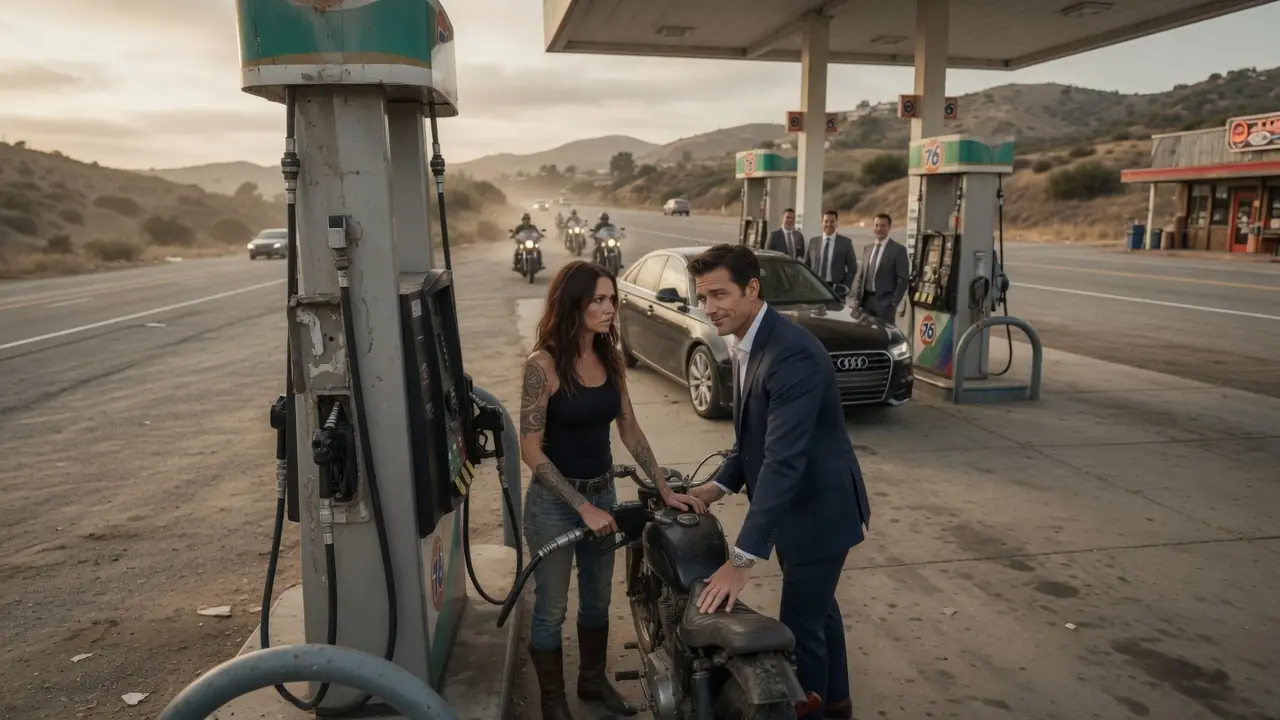
It sat near the edge of Ventura, where the city began giving way to dry hills, repair yards, and long roads leading toward the coast. Its faded canopy offered little protection from the afternoon sun. The pumps were old. A handwritten sign on the convenience-store window announced that the card reader at pump six was out of order.
Bradley stopped at pump six.
He did not notice the sign.
He stepped out of the Audi still speaking into his headset.
“No, I don’t care what legal says. Push the acquisition through before Friday.”
He inserted his card.
The machine did nothing.
Bradley tried again.
Still nothing.
He struck the keypad with the side of his hand.
“You have got to be kidding me.”
At the pump beside him stood a woman in her late forties.
Her name was Rebecca “Becca” Mercer.
She wore faded jeans, black riding boots, and a simple gray T-shirt beneath an open denim jacket. Her dark hair, streaked lightly with silver, had been tied into a low ponytail. A pair of sunglasses rested on top of her head.
She was filling an older pickup truck whose paint had faded from years of sun and use.
Nothing about her invited attention.
That was exactly how she preferred it.
Becca glanced toward the broken card reader.
“The machine’s down,” she said. “You have to pay inside.”
Bradley turned toward her.
He removed one earbud.
“What?”
“The reader doesn’t work.”
He looked at the handwritten sign, then back at her.
“And you waited until now to mention that?”
Becca paused.
“You didn’t ask.”
Bradley stared at her as though she had personally arranged the malfunction.
“Some of us have places to be.”
She returned her attention to the fuel pump.
“So do most people.”
The answer was calm.
It was not rude.
But Bradley heard disrespect because he was accustomed to deference.
He ended his call without saying goodbye and marched toward the store. The cashier explained the broken reader, processed his payment, and gave him a receipt.
When Bradley returned, Becca was still filling the pickup.
He shoved the nozzle into his Audi and glanced at the amount on her pump.
“You people always take forever.”
Becca looked toward him.
“You people?”
Bradley waved one hand toward her truck, her boots, and the faint outline of a motorcycle-club patch visible beneath her open jacket.
“Whatever this is.”
Becca slowly removed the nozzle from the pickup and returned it to the pump.
She did not respond.
That should have ended the exchange.
Bradley was not the kind of man who knew when to stop.
He noticed the small winged skull emblem embroidered near the edge of her shirt. It was old, faded, and partly hidden by the jacket.
He smirked.
“What, your boyfriend ride one of those loud toys?”
Becca screwed the cap onto the fuel tank.
“My husband rides.”
“Of course he does.”
She reached for the driver’s door.
Bradley stepped between her and the truck.
It was a small movement.
Casual enough that he might later claim it had been accidental.
But it blocked her path.
Becca looked at him.
“Move.”
Bradley smiled.
“Relax.”
“I said move.”
He leaned slightly closer.
“You know, women like you always act tough until somebody calls the bluff.”
The cashier inside the store noticed the confrontation and looked toward the telephone beneath the counter. An elderly man near the ice machine stopped loading bags into his trunk.
Becca remained perfectly still.
She had spent enough years around volatile men to know that anger often gave them exactly what they wanted.
A reaction.
A reason.
A story they could later rewrite.
So she gave Bradley nothing.
“Step away from my truck.”
He laughed.
“What are you going to do? Call your biker husband?”
Becca looked toward the highway.
“No.”
That answer amused him.
“Smart.”
She continued quietly.
“He already knows where I am.”
Bradley looked at the old pickup.
There was a small magnetic tracker mounted near the dashboard, connected to a riding-group safety application her husband insisted they both use during long trips.
Bradley did not notice it.
He reached toward the patch near her jacket.
“Let me see this ridiculous thing.”
Becca caught his wrist before his fingers touched the fabric.
She did not squeeze hard.
She did not twist.
She simply stopped him.
Bradley’s expression changed.
“Take your hand off me.”
“You first.”
For one second, neither moved.
Then Bradley jerked his arm free.
His face flushed.
“You think you can put your hands on me?”
“You tried to touch me.”
“I was looking at your jacket.”
“You were told to move.”
The cashier opened the store door.
“Sir, leave her alone.”
Bradley turned toward him.
“Mind your business.”
“It is my business. You’re on my property.”
Bradley looked around.
The old gas station.
The dusty lot.
The aging cashier.
The quiet woman beside the pickup.
He saw no one he considered important.
That made him bolder.
He pointed toward Becca.
“She assaulted me.”
The cashier looked at her.
Becca shook her head once.
“He tried to grab my vest.”
Bradley laughed.
“Your vest? You’re not even wearing one.”
Becca glanced toward the back seat of the pickup.
A folded black leather vest rested there.
She had removed it earlier because of the heat.
Bradley followed her eyes and saw the large red-and-white patch across the back.
This time he read it.
Hells Angels.
Ventura Charter.
He gave a dismissive laugh.
“You expect that to scare me?”
“No.”
Becca opened the truck door.
Bradley slammed it shut before she could climb inside.
The sound echoed beneath the fuel-station canopy.
The old man near the ice machine stepped backward.
The cashier reached for the phone.
Becca’s calm expression did not change, but something in her eyes did.
“Do not touch my truck again.”
Bradley moved closer.
“What happens if I do?”
Becca looked at the hand he had placed on the door.
“Someone will explain it better than I can.”
Bradley glanced around theatrically.
“I don’t see anyone.”
Becca’s phone vibrated in her pocket.
She took it out.
A message appeared from her husband.
YOU GOOD?
She typed one word.
NO.
Then she slipped the phone away.
Bradley shook his head.
“Pathetic.”
He reached for the truck door again.
This time Becca stepped back.
Not because she was afraid.
Because she had heard something in the distance.
The cashier heard it too.
A low mechanical rumble rolled across the highway.
Bradley continued talking.
“You people think leather jackets and tattoos make you important. I deal with men who own companies. Real power. Real money.”
The rumble grew louder.
Becca watched the road.
Bradley finally noticed her attention had moved away from him.
“What are you looking at?”
She did not answer.
The first motorcycles appeared around the bend.
Three at first.
Then eight.
Then more.
They rode in a staggered formation, steady and controlled. Sunlight flashed across chrome, black fuel tanks, and worn helmets.
The engines did not scream.
They did not need to.
There were too many of them.
Bradley stepped away from the truck as the motorcycles turned into the gas station.
One by one, they filled the spaces along the edge of the lot.
Twelve.
Eighteen.
Twenty-three.
The final motorcycle stopped directly behind Bradley’s Audi.
Every engine shut off within seconds.
The resulting silence felt heavier than the noise.
The riders removed their helmets.
Most were older than Bradley expected.
Some had gray beards.
Others wore reading glasses or carried old injuries in the way they stood. Their leather vests bore the same red-and-white markings as the one folded inside Becca’s truck.
No one shouted.
No one rushed toward Bradley.
They simply looked at Becca.
Then at the handprint Bradley had left in the dust on her truck door.
A tall man in his late fifties dismounted from the lead motorcycle.
His name was Jack Mercer.
He had broad shoulders, a short gray beard, and the quiet posture of someone who did not need to prove he could control a room. Across the front of his vest was a small patch that meant nothing to Bradley.
President.
Ventura Charter.
Jack walked directly to Becca.
He ignored Bradley.
“You hurt?”
“No.”
“He touch you?”
“He grabbed for the vest and blocked the truck.”
Jack looked at her wrist.
A faint red mark had appeared where Bradley had pulled away.
His jaw tightened.
“Anything else?”
“He slammed the door.”
Jack nodded once.
Only then did he turn toward Bradley.
Bradley straightened his shirt.
“Look, this is getting ridiculous.”
Jack said nothing.
Bradley gestured toward Becca.
“She started it.”
Still nothing.
“I was trying to use the pump. She got an attitude.”
Jack’s eyes remained fixed on him.
Bradley’s voice became less certain.
“She grabbed me.”
Jack finally spoke.
“You tried to touch her vest.”
“I was looking at it.”
“After she told you not to.”
Bradley glanced toward the other bikers.
They had spread across the lot.
Not surrounding him.
Not blocking him.
Just watching.
That somehow felt worse.
Bradley forced a laugh.
“Do you know who I am?”
Jack looked toward the Audi.
“No.”
“I’m a senior vice president at Lawson Strategic Holdings.”
Jack waited.
Bradley expected the name to matter.
It did not.
“I manage deals worth more than this entire gas station.”
Jack nodded toward Becca.
“And you still never learned what ‘move’ means.”
A few riders exchanged glances.
No one smiled.
Bradley looked toward his car.
“I’m leaving.”
Jack stepped aside.
“No one’s stopping you.”
Bradley took one step.
Then Becca spoke.
“You forgot something.”
He turned.
She pointed toward the cashier.
The elderly store owner still stood in the doorway. Bradley had shouted at him, ordered him to mind his business, and disrupted the station for nearly fifteen minutes.
Bradley looked irritated.
“What?”
Jack’s voice remained quiet.
“You apologize to my wife.”
Bradley looked from Jack to Becca.
Then toward the riders.
“I didn’t do anything.”
Jack nodded slowly.
“That answer tells me you’re not ready to leave yet.”
Bradley’s face tightened.
“Is that a threat?”
“No.”
Jack looked toward the security camera above the store entrance.
“That is evidence.”
The cashier followed his gaze.
“It recorded everything.”
Bradley looked up.
For the first time, real concern entered his face.
The camera pointed directly toward the pumps.
Jack continued.
“You blocked her vehicle. Tried to grab her clothing. Slammed her door. Refused to leave private property after the owner told you to.”
Bradley looked toward the cashier.
The old man held the phone in one hand.
“Police are already coming,” he said.
Bradley’s confidence cracked.
“You called the police?”
The cashier nodded.
“Before the motorcycles arrived.”
Bradley turned toward Jack.
“This is absurd.”
Jack folded his arms.
“You wanted real power.”
Bradley stared at him.
“Real power is having every reason to hurt someone and choosing the law instead.”
The words settled over the gas station.
One of the younger riders lowered his eyes.
Becca remained beside the truck, her expression steady.
Bradley looked around again.
Nobody had touched him.
Nobody had damaged his car.
Nobody had threatened violence.
They had simply removed every excuse he might have used later.
The police cruiser arrived six minutes after the first motorcycle.
Two officers stepped out.
The cashier showed them the security footage. Becca explained what happened. The elderly customer near the ice machine gave a statement.
Bradley interrupted repeatedly.
He mentioned his job.
His attorneys.
His company.
His reputation.
The officers asked him to stop talking.
When one officer told him he could be cited for harassment and detained for interfering with the investigation, Bradley finally became quiet.
He looked toward Becca.
She had not raised her voice once.
That seemed to trouble him more than anything else.
The officer asked whether she wanted to pursue charges.
Becca considered the question.
Jack did not speak for her.
The bikers did not move.
The decision belonged entirely to her.
“I want the incident documented,” she said. “And I want him formally trespassed from this property.”
The station owner nodded.
“Absolutely.”
The officer turned toward Bradley.
“You are being issued a trespass notice. You are not to return here. Any future contact with Mrs. Mercer may result in additional charges.”
Bradley looked humiliated.
“This is because of them.”
The officer glanced toward the motorcycles.
“No. This is because of you.”
Bradley signed the notice.
His hand shook slightly.
Before he reached the Audi, Becca called his name.
He turned slowly.
She stood beside Jack, though not behind him.
“You kept talking about power,” she said.
Bradley said nothing.
“Power isn’t the ability to frighten someone who is alone.”
She looked toward the riders.
“It’s what people choose to do when you’re no longer alone.”
Bradley opened his car door.
No one stopped him.
He drove away beneath the silent gaze of twenty-three riders and two police officers.
When the Audi disappeared onto the highway, the tension finally eased.
The cashier exhaled.
“I thought this was going to become ugly.”
Jack looked toward Becca.
“It almost did.”
She folded her arms.
“You brought half the charter.”
“You said no.”
“I meant I wasn’t okay. I didn’t mean invade a gas station.”
One of the older riders smiled.
“We were nearby.”
Becca looked at the motorcycles filling the lot.
“All twenty-three of you?”
The rider shrugged.
“Very nearby.”
A few men laughed.
The sound broke the remaining tension.
Jack opened the back door of the pickup and removed Becca’s leather vest. He held it while she slipped her arms through.
The patch settled across her back.
Jack adjusted one side near her shoulder.
“You sure you’re all right?”
She looked at him.
“I handled it.”
“I know.”
His answer carried no doubt.
That mattered.
He had not arrived because he believed she was helpless. He came because she had said something was wrong, and in their marriage, that was enough.
The cashier stepped outside with a tray of bottled water.
“On the house.”
Jack reached for his wallet.
The man shook his head.
“You just saved me from filling out a lot more insurance paperwork.”
Becca smiled.
“They didn’t save you.”
She looked toward the security camera.
“You did, when you called the police.”
The cashier gave a tired laugh.
“I nearly called too late.”
“But you called.”
The bikers stayed for another twenty minutes, buying drinks, snacks, and enough fuel to make the station owner forget the afternoon had begun badly.
They did not discuss Bradley after that.
Men like him often believed they remained the center of every room they entered.
He was already becoming irrelevant.
Several weeks later, the gas station owner installed a new card reader at pump six and replaced the old security camera with a better system. Near the register, he placed a small sign.
RESPECT COSTS NOTHING.
HARASSMENT COSTS MORE.
Bradley Lawson never returned.
His company’s legal department contacted Becca once, asking whether she planned to make the incident public. She told them she had no interest in publicity.
She wanted only the security footage preserved.
A month later, Jack and Becca stopped at the station during a Sunday ride. Dozens of motorcycles followed them.
The cashier greeted Becca by name.
Coffee was waiting near the register.
Jack leaned beside her while she filled the truck.
“You know,” he said, “you could have called sooner.”
She looked at him.
“You know I don’t like making a fuss.”
“You married the president of a motorcycle charter.”
“That was your first warning.”
Jack smiled.
Becca finished pumping fuel and replaced the nozzle.
Across the lot, older riders talked quietly about engines, road conditions, and where they planned to eat lunch. They looked nothing like the terrifying army Bradley had imagined.
They were husbands.
Fathers.
Mechanics.
Veterans.
Men who argued about tire pressure and carried antacids in their saddlebags.
But they shared one rule that required no explanation.
When one of their own said something was wrong, they showed up.
Becca looked across the motorcycles, then at Jack.
“You didn’t come because of the vest, did you?”
Jack shook his head.
“No.”
“Because I’m your wife?”
“Partly.”
“What was the other part?”
He looked toward the pump where Bradley had cornered her.
“Because nobody deserves to be treated that way when they’re alone.”
Becca studied his face.
Then she nodded.
That was the part Bradley Lawson had never understood.
The danger had never been that Becca’s husband was president of the Hells Angels.
The danger was believing a quiet person could be humiliated without consequence simply because nobody important appeared to be watching.
Bradley had judged the truck.
The clothes.
The worn boots.
The silent woman standing alone beneath a faded gas-station canopy.
He had mistaken restraint for weakness.
He had mistaken wealth for authority.
And he had mistaken being alone for having no one.
By the time the motorcycles arrived, it was already too late to undo those mistakes.
Not because anyone harmed him.
Because twenty-three silent witnesses forced him to see exactly what kind of man he had chosen to become when he believed there would be no consequences.
Sometimes the clearest punishment is not fear.
It is exposure.
And on a dusty afternoon in Ventura, surrounded by cameras, police officers, strangers, and the men who came when Becca sent one word, Bradley Lawson finally had nowhere left to hide from himself.