ticket. It's right here. Unlock it and hand it over. The code scans. I'm not giving you my phone.
What are you hiding in there? What you are about to see isn't a movie. It is the exact moment a badge turns a mundane commute into a constitutional crisis. Captured from two different angles. Crosstown Transit Station, Subterranean Level B, 7:42 p.m. The platform was a long stretch of gray concrete lit by harsh fluorescent tubes.
Julian Grant, a 19-year-old architectural draftsman, stood right behind the tactile yellow warning line waiting for the northbound train. He had just finished a 10-hour shift. He carried a rolled blueprint under his left arm, held a half-empty coffee cup in his left hand, and gripped his smartphone in his right. He wasn't looking for a fight. He just wanted to go home.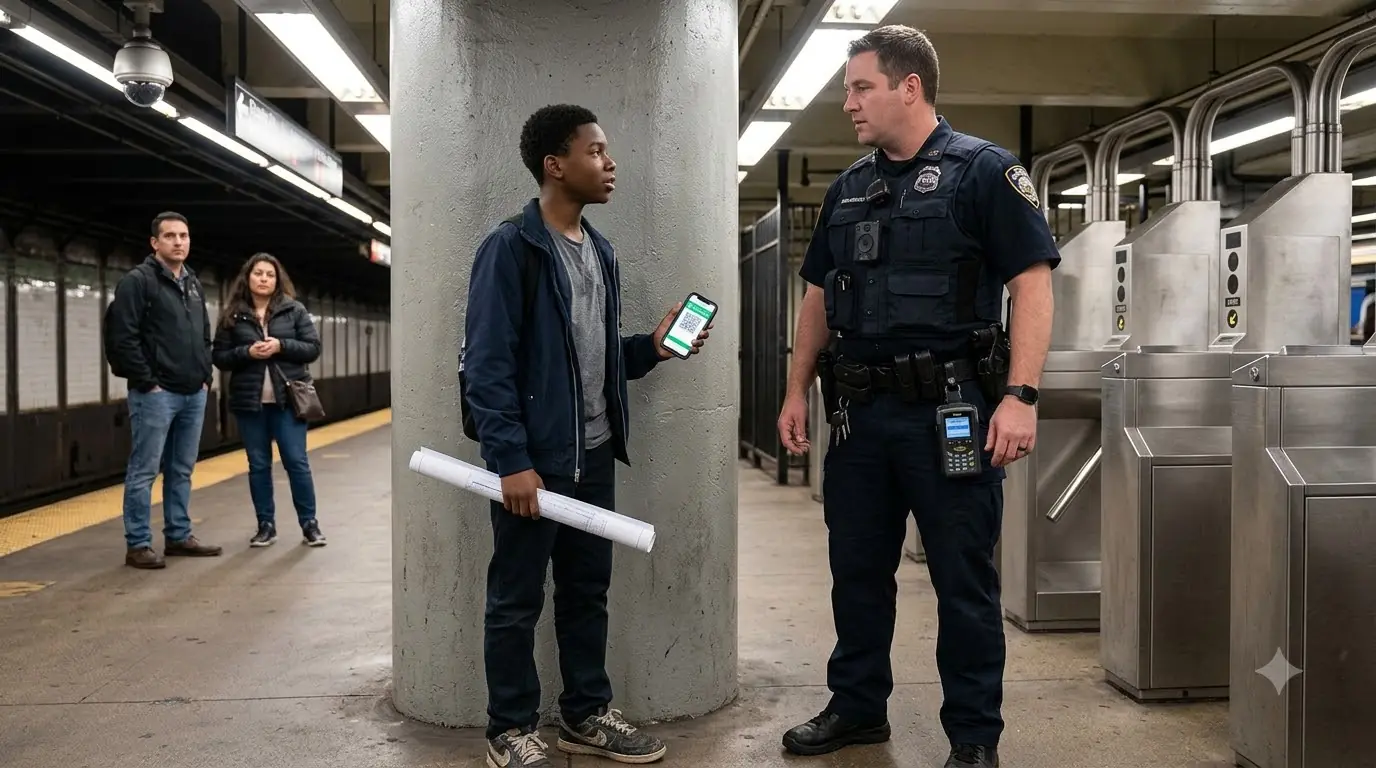
High above the platform, encased in tinted domes, the Transit Authority security cameras silently recorded the entire station. Every angle was covered. Transit Officer Thomas Murray walked down the platform conducting a random fare evasion sweep. He wore a standard-issue tactical vest, a body camera mounted dead center on his chest, and a digital ticketing scanner clipped to his utility belt. Murray stopped directly in front of Julian blocking his path.
"Ticket. " Murray demanded. Julian didn't argue. He shifted his coffee cup, tapped his smartphone screen to wake it up, opened the city transit application, and held the device out. The digital QR code was bright, perfectly centered, and legible. The digital scanner rested right there on Murray's belt.
Before the officer makes his first move, hit that subscribe button and drop a like if you're ready to see a corrupt system dismantle itself. And let me know in the comments, what city are you watching from? Murray didn't unclip his scanner. Instead, he held out his open palm. "Unlock it and give it here. " Murray ordered.
He stepped aggressively into Julian's personal space closing the distance to mere inches. "I said hand it over. " Murray raised his voice. "What are you hiding in there? Are you carrying a stolen device? " Before Julian could even process the sudden accusation, Murray lunged. The officer's right hand snapped forward attempting to violently snatch the smartphone directly out of Julian's grip.
If someone suddenly grabs at a thousand-dollar piece of property, the body reacts. Julian flinched. He quickly pulled his right arm back pressing the phone tight against his own chest to protect it from falling onto the concrete tracks. He didn't raise a fist. He didn't shove the officer.
He simply shielded his property. "Stop pulling away. " Murray shouted, his voice echoing loudly over the rumble of an approaching train. Murray grabbed Julian by the collar of his jacket with his left hand, stepped behind Julian's right knee, and executed a sweeping takedown. Julian was driven hard onto the concrete platform. The impact shattered the smartphone screen and sent the coffee cup flying across the floor.
Julian was instantly pinned under 220 pounds of tactical gear, his face pressed against the cold floor. As Murray wrenched Julian's arms behind his back and ratcheted the steel handcuffs painfully tight over his wrists, Julian gasped against the concrete. "I am not resisting. You tried to take my property. " Murray hauled him to his feet by the handcuff chain. "You're under arrest for suspicion of theft and resisting. " An hour later, Julian was sitting in a cinder block holding cell at the precinct.
Out in the bullpen, Officer Murray sat at his terminal and opened the digital incident reporting system. Murray typed, "Subject became visibly defensive when asked to verify fare. Subject attempted to conceal the electronic device acting in a manner consistent with possessing stolen property. When this officer attempted to secure the device for verification, the subject became physically hostile pulling away and engaging in a physical struggle necessitating a controlled takedown. " Murray clicked submit. He was absolutely confident that his written report, backed by the audio of him shouting "Stop pulling away" on his body camera, would easily secure a conviction.
Central City Municipal Court, Room 302, 9:00 a.m. Misdemeanor arraignments moved fast. Dozens of defendants sat in rows on heavy wooden benches waiting for their names to be called over the low hum of the crowded room. Julian Grant sat in the second row wearing the exact same clothes he had been arrested in the night before. His architectural blueprint was crushed flat inside a clear plastic police property bag resting on his lap. Beside him sat his attorney, David Sterling.
"State versus Julian Grant. " The bailiff called out. Sterling and Julian walked past the wooden divider and stood before the assistant district attorney's table. The ADA opened a manila folder, skimmed Officer Murray's incident report for the first time, and didn't look up. "Transit fare evasion, resisting a law enforcement officer, and suspicion of possession of stolen property. " The ADA recited rapidly. He pulled a pre-printed form from his stack.
"Your client has no prior criminal record. I'm offering a standard diversion. He pleads guilty to the fare evasion, a $50 fine. We drop the resisting and stolen property charges, 10 hours of community service, and he walks out of here today. " Julian looked at the table. A guilty plea would end the immediate threat of jail time.
"The defense rejects the plea offer. " Sterling said flatly. The ADA finally looked up annoyed by the disruption to his schedule. "Counsel, if we go to trial on a resisting charge, your client risks 30 days in county. Officer Murray's body camera has audio of a physical altercation. The sworn narrative states your client was hiding the device and acting consistently with a thief. " "The officer's narrative is factually false. " Sterling replied.
He didn't raise his voice. He reached into his leather briefcase, pulled out a single sheet of paper, and slid it across the prosecution table. It wasn't a witness statement. It was a digital system log subpoenaed directly from the Central City Transit Authority's servers. "This is the digital footprint of my client's smartphone from last night. " Sterling said.
"Look at the timestamps. " The ADA looked down at the highlighted rows of data. "At 7:39 p.m. and 14 seconds, my client accessed the transit application using his biometric face ID. " Sterling stated pointing to the first line. "At 7:39 p.m. and 20 seconds, the application pinged my client's personal checking account at Chase Bank and purchased a single ride digital ticket. " Sterling moved his finger down to the final highlighted row. "At 7:40 p.m. and 12 seconds, the Transit Authority's own turnstile scanner located at the south entrance of level B registered that exact digital ticket. The system verified it and opened the gate.
Officer Murray initiated his stop at 7:42 p.m. " The ADA stared at the paper. The data was an unalterable server log. Julian Grant had paid his fare using his own face and his own bank account logging the transaction into the city's servers three full minutes before Officer Murray approached him. The ADA slowly looked up from the server log to the printed police report in his folder. He read Murray's sentence.
"Subject attempted to conceal the electronic device acting in a manner consistent with possessing stolen property. " He didn't argue. He picked up his pen, drew a thick diagonal line across the front of Julian's file, and wrote nolle prosequi. "The state drops all charges. " The ADA said quietly closing the folder. "Your client is free to go, Mr. Sterling. " Sterling didn't smile. He carefully picked up the transit log and slid it back into his briefcase.
"Keep the file handy. " Sterling said turning away from the table. "We'll be needing Officer Murray's badge number for the federal filing. " 7two hours after the municipal charges were dropped, David Sterling filed a federal civil rights lawsuit in U. S. District Court. The complaint named Officer Thomas Murray and the Central City Transit Authority alleging illegal search and excessive force.
The city attorney's office immediately filed a motion to dismiss. Lead counsel, Sara Jenkins, built her defense entirely on Officer Murray's body camera audio. During the physical takedown on the platform, Murray had pressed chest-to-chest against Julian, obstructing the body camera lens. There was no visual record of the struggle on the police footage. In her filing, Jenkins cited the clear, loud audio of Officer Murray shouting, "Stop pulling away. " Followed by the sounds of scuffling footwear and heavy breathing.
She argued the audio proved Julian Grant had initiated a physical struggle, granting Murray qualified immunity. Judge Robert Thomas scheduled a discovery conference in his chambers. Jenkins sat on the left side of the heavy mahogany table. Sterling sat on the right. Judge Thomas sat at the head, reading Jenkins' motion.
"Counsel," Judge Thomas said, looking at Sterling, "plaintiff's municipal charges were dropped due to a fabricated justification for the stop. However, the officer's body camera audio clearly records your client engaging in a physical altercation. How do you overcome the audio evidence of resisting? " Sterling opened his laptop, turned the screen toward the judge, and pushed it to the center of the table. "Your Honor, the body camera audio is accurate," Sterling said, "but it is incomplete. " "We subpoenaed the raw, wide-angle security footage from the transit authority's platform cameras. " Sterling pressed play. The media player on the screen was split horizontally.
The top half showed the silent, high-definition transit security footage. The bottom half showed the black, obstructed screen of Officer Murray's body camera. On the top screen, Officer Murray approached Julian Grant. Julian held out his phone. The audio from Murray's body cam played clearly through the laptop speakers.
"Unlock it and give it here. I need to tap the screen. " Julian's voice responded, "The barcode is right there, man. It's scanning. I'm not handing you my unlocked phone. " The visual on the transit camera showed Julian standing perfectly still. Murray's audio track spiked in volume.
"I said hand it over. What are you hiding in there? " On the silent transit video, Murray suddenly lunged forward, grabbing for the phone. Julian instinctively pulled his hand back to his chest, taking a half step away from the officer to protect his property. He made no aggressive movement. "Stop pulling away," Murray shouted from the laptop speakers.
But the transit video showed Julian completely frozen. He wasn't pulling away. He wasn't struggling. He was backed against a concrete pillar, simply holding his phone against his chest. The video showed Murray stepping behind Julian's knee and slamming a stationary citizen into the concrete.
Julian's voice played from the body cam audio as he was pinned to the floor. "I am not resisting. You tried to take my property. " Sterling paused the video. The frame was frozen on Murray kneeling on Julian's back. The room was completely silent.
Judge Thomas looked from the frozen video to the printed motion to dismiss on his desk. Jenkins stared at the laptop screen. Judge Thomas picked up his pen and signed the bottom of Jenkins' motion. "The motion to dismiss is denied," Judge Thomas stated, sliding the document back across the desk. The visual evidence directly contradicts the officer's verbal commands on the audio track.
Proceed to discovery, counsel. " With Judge Thomas's ruling, the civil suit entered the discovery phase. David Sterling subpoenaed Officer Murray's disciplinary record and filed a formal request for production for the transit authority's internal documents. Item 12 requested all directives and standard operating procedures regarding mobile application fare verification. The city attorney, Sara Jenkins, delivered a hard drive containing 8,000 pages of disorganized, unindexed digital PDFs. The files consisted mostly of outdated employee handbooks and maintenance schedules from the magnetic stripe ticket era.
Sterling and his paralegal ran optical character recognition, OCR, software across the drive. The software flagged a routine department newsletter dated 14 months prior to the arrest. At the bottom of page three, a single bullet point reminded officers to review command staff Memorandum 41B regarding the new mobile ticketing rollout. Sterling ran a search for Memorandum 41B across the 8,000 pages. Zero results.
The document was not on the drive. In the attached privilege log, Jenkins had listed a generic block of withheld files under internal law enforcement tactical privilege. Sterling didn't call Jenkins. He drafted a motion to compel, attached the newsletter referencing the missing memo, and filed it directly with Judge Thomas. Judge Thomas didn't schedule a hearing.
He issued a one-page electronic order, giving the city attorney's office exactly two hours to deliver the unredacted document to Sterling's firm. At 11:15 a.m., a city courier arrived at Sterling's office with a sealed manila envelope. Inside was a single sheet of paper on official transit authority letterhead, signed by the chief of transit police. Sterling skipped to the second paragraph of Memorandum 41B. "Due to strict Fourth Amendment privacy protections regarding personal electronics, officers shall exclusively utilize issued digital scanners to verify mobile application fares.
Officers shall visually inspect the passenger screen. Under no circumstances shall an officer demand, seize, or take physical possession of a passenger's unlocked cellular device to verify a ticket. " Sterling placed the memo flat on his desk. Officer Murray had directly violated a written command from his own chief of police. Sterling picked up his phone and dialed Jenkins' direct line. "We have the memo," Sterling said when she answered.
"I'm noticing Officer Murray for a sworn deposition on Tuesday. " At 9:00 a.m., a certified videographer pressed record. A court reporter sat at the corner of the conference table. Officer Thomas Murray sat opposite David Sterling, wearing his Class A dress uniform. Sara Jenkins sat to his left. Sterling had three manila folders in front of him.
"State your name for the record," Sterling said. "Officer Thomas Edward Murray, Central City Transit Authority. " Sterling opened the first folder, turned his laptop toward Murray, and played the synchronized transit video. He paused the footage at the exact moment Murray drove Julian Grant into the concrete. "Officer Murray," Sterling said, "did Julian Grant step toward you at any point during this encounter? " Murray looked at the frozen frame. "No. " "Did he verbally threaten you? " "No. " "Did he raise his hands in a striking motion? " "No. " "When you lunged for his cellular device, he pulled it back against his own chest.
Is that correct? " "He pulled away from my lawful command," Murray answered. Sterling opened the second folder and slid a document across the table. "Exhibit B, your sworn incident report. Please read the highlighted sentence. " Murray picked up the paper. "Subject became physically hostile, pulling away and engaging in a physical struggle. " "Based on the video we just watched," Sterling said, "do you testify under oath that pulling a phone to one's own chest constitutes being physically hostile? " "Objection, form," Jenkins stated automatically.
"You may answer," Sterling said. "I perceived it as resistance in the moment," Murray replied. Sterling opened the third folder. He pulled out a single sheet of transit authority letterhead and slid it to Murray. "Exhibit C," Sterling said, "are you familiar with command staff memorandum 41B issued 14 months prior to this incident? " Murray looked at the header.
He looked to Jenkins. Jenkins kept her face completely neutral, but her posture stiffened. "I am familiar with it, yes," Murray said. "Please read the highlighted second paragraph aloud for the record. " Murray stared at the text. The room was silent except for the clicking of the court reporter's machine.
"Read it, officer," Sterling repeated. Murray cleared his throat. "Due to strict Fourth Amendment privacy protections regarding personal electronics, officers shall exclusively utilize issued digital scanners to verify mobile application fares. Officers shall visually inspect the passenger screen. Murray paused.
"Finish the paragraph," Sterling said. "Under no circumstances shall an officer demand, seize, or take physical possession of a passenger's unlocked cellular device to verify a ticket. " Sterling let the words hang in the air for three full seconds. Officer Murray, Sterling leaned forward. Did you demand physical possession of my client's unlocked device? Yes.
Did you use physical force to seize it causing the altercation? Objection, argumentative. Jenkins interrupted. Answer the question officer, Sterling said never breaking eye contact. Did you use force to seize the device violating a direct written order from your chief?
Murray stared at Sterling. He looked at the printed memo then back to the camera lens. On the advice of counsel, Murray said his jaw tight. I invoke my Fifth Amendment right against self-incrimination. Sterling closed his folder.
We're done here. At 4:00 p.m. City Attorney Sarah Jenkins sat in the top floor conference room of the Central City Transit Authority. Transit Police Commissioner Davis sat at the head of the table. The digital projector displayed the frozen frame of Officer Murray invoking his Fifth Amendment right. Turn it off, Davis said.
Jenkins pressed a button on the remote. The screen went black. If this goes to a federal jury, Jenkins said opening her file, Sterling will introduce Memorandum 41B. He will establish that Murray's actions were a conscious violation of your department's policy. Davis didn't look at the file.
What is our wider exposure? If Sterling proves a pattern of Fourth Amendment violations across the department, he will file a class action certification, Jenkins answered flatly. He will subpoena our dispatch logs. He will look for every passenger whose phone was handled by an officer during a fare sweep over the last two years. That is thousands of potential plaintiffs.
Davis stared at the blank projector screen. One aggressive officer had just handed a plaintiff's attorney the keys to the entire transit budget. Settle the Grant case, Davis ordered. Do not let them file for class certification. Keep our logs sealed.
At 9:00 a.m. the next morning, Jenkins walked into David Sterling's office. She didn't sit down. $2.5 million, the city admits no fault, Murray resigns quietly. Sterling remained seated behind his desk. Julian Grant sat next to him. The financial settlement is $3.2 million, Sterling said sliding a single sheet of paper across his desk.
But the money isn't the primary term. Jenkins looked down at the paper. My client is dropping the class action threat, Sterling continued. In exchange, the transit authority will alter its public infrastructure. Jenkins picked up the term sheet.
By the end of the month, Sterling said, the city will install permanent metal signage at every turnstile in the transit system. The text will state, "Passengers must display valid digital fare. Transit police are strictly prohibited from taking physical possession of personal electronic devices. " Jenkins stopped reading. Sterling was forcing the city to publicly advertise its officers' restrictions to every commuter, permanently destroying the intimidation tactic Murray had relied on. "If you refuse the signage," Sterling added, his voice completely neutral, "I file the class action motion at noon.
I will attach the video of Officer Murray pleading the Fifth to the public docket. " Jenkins placed the paper back on the desk. She looked at Julian, who had remained silent, then back at Sterling. "I will have the mayor's office sign the paperwork by 3:00," Jenkins said. She turned and walked out of the office. Central City Transit Police Precinct, locker room.
8:00 a.m. Thomas Murray stood in front of his open metal locker. He unclipped his duty belt. He placed his tactical vest, his digital fare scanner, and his Axon Body 3 camera on the wooden bench. He didn't pack his uniform. It was city property.
He put a spare phone charger and a combination lock into a small cardboard box. He walked down the linoleum hallway to the watch commander's office. He placed his silver shield and his precinct key card on the desk. He didn't speak. He turned around and walked out the back door into the civilian parking lot.
Because he resigned under the shadow of a federal civil rights settlement, his name was automatically submitted to the state's Brady list. He was permanently unemployable in law enforcement. 48 hours later, the Municipal Finance Department authorized a direct ACH wire transfer. The city's general liability fund was debited exactly $$3.2 million. The funds cleared the Federal Reserve window and landed in the IOLTA trust account of Sterling and Partners.
At midnight that same week, city maintenance crews arrived at all 74 subway stations across Central City. They carried heavy-duty drills, rivet guns, and stacks of brushed aluminum placards. Monday morning, 7:42 a.m. Julian Grant walked down the concrete stairs into the subterranean level B of the Crosstown Transit Station. He was holding a cup of coffee in his left hand and his smartphone in his right. The platform was loud with the rumble of the approaching northbound train.
Julian walked up to the automated turnstile. Mounted at eye level, riveted directly into the steel casing of the scanner unit, was a brand new 6-by-10-inch brushed aluminum sign. The black engraved letters reflected the harsh fluorescent light. "Passengers must display valid digital fare. Transit police are strictly prohibited from taking physical possession of personal electronic devices. " Julian didn't smile.
He didn't pause to admire it. He tapped his smartphone screen to wake it up, held the bright QR code two inches from the red laser reader, and waited for the electronic beep. The turnstile light flashed green. The metal gates parted. Julian walked through and caught his train.
Officer Murray bet his badge that a tired commuter wouldn't defend his Fourth Amendment rights. That bet cost the city $$3.2 million and permanently changed the rules for every passenger in the transit system. But think about this, if that platform camera hadn't caught the truth, who would the judge have believed?
Would you have handed over your unlocked phone to Officer Murray? Let me know in the comments. Subscribe for more real stories of corrupt egos hitting the brick wall of the law.