At 5:42 on a cold Tuesday morning, Officer Daniel Mercer decided the man jogging through Lakewood Heights did not belong there.
The neighborhood was still half asleep.
Sprinklers clicked across dark lawns. Porch lights glowed above stone walkways. A newspaper delivery van crawled along the opposite side of the street while the first pale line of sunrise appeared behind rows of expensive homes.
The jogger wore black running shoes, gray shorts, and a navy pullover damp with sweat. He was a tall Black man in his late forties, lean rather than muscular, with close-cropped hair graying at the temples.
He carried no bag.
He wore no hood.
He had done nothing more suspicious than slow down near a white colonial house and glance at the number beside its driveway.
Mercer watched him from his patrol SUV.
The officer had been parked beneath a maple tree finishing his coffee when dispatch mentioned a report of a “suspicious male” seen looking at houses.
The caller had provided no description beyond male, possibly Black, wearing dark clothes.
That was enough for Mercer.
He shifted into drive and rolled forward.
The jogger heard the engine before he saw the lights.
Mercer pulled to the curb beside him and lowered the passenger window.
“Stop right there.”
The man slowed, looked at the police vehicle, then removed one wireless earbud.
“Are you speaking to me?”
“You see anyone else running around here at this hour?”
The jogger glanced toward an elderly woman walking a golden retriever half a block away.
“Yes,” he said. “Actually.”
Mercer’s expression hardened.
“Come over here.”
The man did not approach the SUV.
He remained on the sidewalk, breathing evenly.
“Why?”
“Because I told you to.”
“That doesn’t explain why you stopped me.”
Mercer opened his door and stepped out.
At thirty-six, he had been with the Lakewood Police Department for eleven years. He was broad through the shoulders, with a shaved head and a habit of standing too close when he wanted people to feel smaller.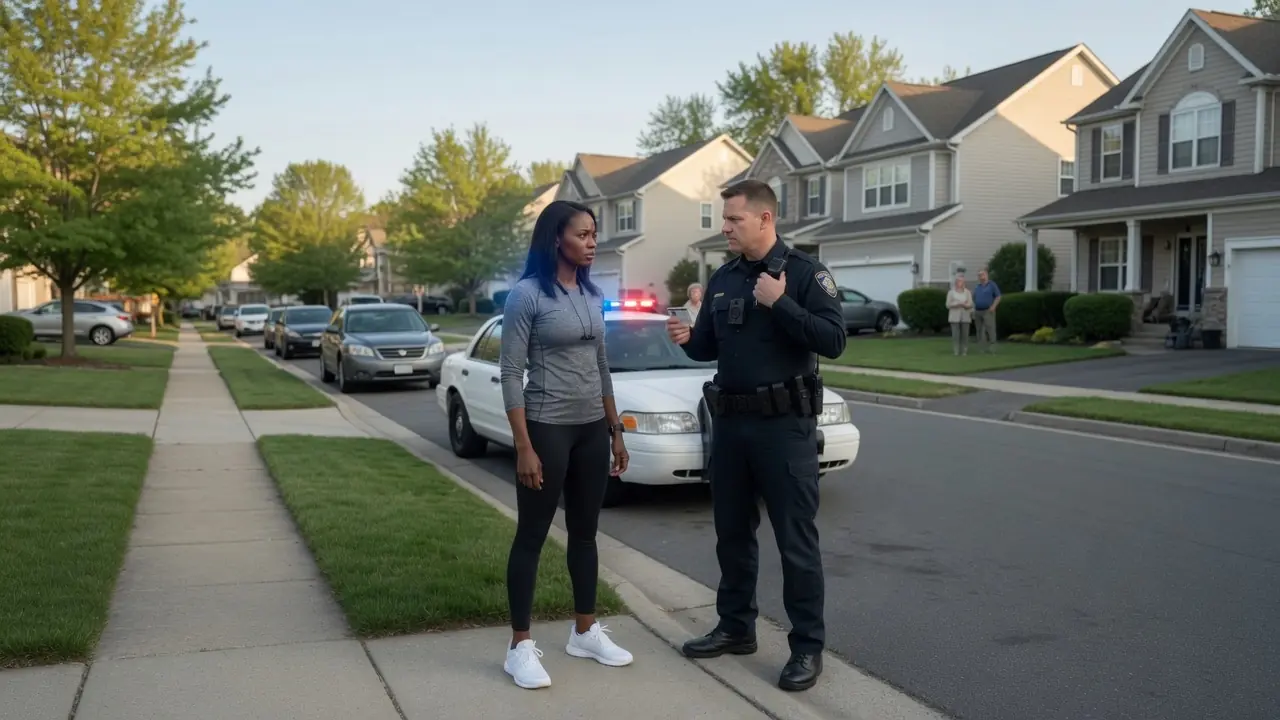
His body camera was mounted in the center of his chest.
The red recording light was off.
“Name,” Mercer said.
The jogger checked his watch.
“Am I being detained?”
“I asked for your name.”
“And I asked whether I’m being detained.”
Mercer stepped onto the sidewalk.
“Let’s not make this difficult.”
The jogger studied him for a moment.
“You’re the one making it difficult.”
The elderly woman with the dog slowed.
Mercer noticed her watching and raised his voice.
“We had a report of someone casing houses.”
The jogger looked along the quiet street.
“And you decided that person was me?”
“You match the description.”
“What description?”
Mercer hesitated.
“Male. Dark clothing.”
The jogger looked down at his navy pullover.
“So does half the morning running club.”
“You’re not with a running club.”
“You don’t know that.”
“I know you were staring at houses.”
“One house.”
“Why?”
The jogger put his earbud into his pocket.
“Because I was checking the address.”
“Whose address?”
“That is not your concern.”
“It becomes my concern when someone reports suspicious activity.”
The dog walker had stopped completely now.
Her golden retriever sat beside her, tail moving slowly across the pavement.
Mercer pointed toward the curb.
“Sit down.”
The jogger’s eyebrows lifted.
“No.”
Mercer’s right hand moved toward his belt.
“I’m not asking.”
The jogger’s gaze followed the movement.
His voice became quieter.
“That would be a mistake.”
Mercer laughed once.
“You threatening me?”
“No. I’m warning you against turning a conversation into something neither of us can undo.”
Mercer took another step forward.
“Put your hands on your head.”
The man’s face changed.
Not with fear.
With disappointment.
It was the look a teacher might give a student who had ignored every opportunity to correct an obvious error.
“Officer,” he said, “I am going to give you one chance to reconsider what you’re doing.”
“Hands on your head.”
The man complied slowly.
The woman with the dog lifted her phone.
Mercer pointed at her.
“Ma’am, keep moving.”
“I live here,” she said.
“Then go home.”
The jogger spoke without taking his eyes off Mercer.
“She has every right to record.”
Mercer turned back toward him.
“You an attorney?”
“No.”
“Then stop explaining the law to me.”
“You asked what I was.”
“I asked your name.”
“And I’m choosing not to provide it until you state the legal basis for detaining me.”
Mercer reached for the man’s wrist.
The jogger moved his hand away.
It was a small movement.
Mercer reacted as though he had been attacked.
He grabbed the man’s arm, twisted it behind his back, and pushed him toward the hood of the patrol vehicle.
“Stop resisting!”
“I am not resisting.”
“Stop resisting!”
“You are the only person using force.”
Mercer shoved him against the hood.
The jogger caught himself before his face struck the metal.
The dog barked.
The woman recording shouted, “He didn’t do anything!”
Mercer pulled one handcuff from his belt.
The jogger’s tone did not rise.
“Before you put that on me, check the inside pocket of my pullover.”
Mercer froze.
“Why?”
“My identification is there.”
“So now you want to cooperate?”
“No.”
The jogger turned his head as far as Mercer’s grip allowed.
“I want you to understand how serious your mistake is.”
Mercer smiled.
“You people always say that.”
The jogger went still.
The woman’s phone continued recording.
Mercer seemed to realize what he had said, but pride kept him from correcting it.
He reached into the pullover and removed a slim leather card holder.
Inside were three cards.
A driver’s license.
A federal identification credential.
And a Lakewood municipal access card.
Mercer looked at the name.
JONATHAN ELLIS CARTER.
He looked at the photograph.
Then at the official seal beneath it.
His grip loosened slightly.
The jogger felt the hesitation.
“Now,” Jonathan said, “do not explain.”
Mercer looked up.
Jonathan’s voice was calm.
“Just call your captain.”
For the first time since leaving his patrol vehicle, Daniel Mercer looked uncertain.
He read the federal identification again.
OFFICE OF INSPECTOR GENERAL
SPECIAL INVESTIGATIONS DIVISION
Below that was another line.
FORMER ASSISTANT UNITED STATES ATTORNEY
Mercer released Jonathan’s arm.
The handcuff remained open in his other hand.
“You should have identified yourself.”
Jonathan straightened his pullover.
“I asked whether I was being detained.”
“You could have prevented this.”
“No,” Jonathan said. “You could have prevented this.”
The woman with the dog came closer.
“Are you all right?”
Jonathan nodded.
“Please keep recording.”
Mercer’s face reddened.
“This was a lawful investigatory stop.”
Jonathan looked at the body camera on Mercer’s chest.
“Why isn’t your camera recording?”
Mercer glanced down.
“I forgot to activate it.”
“You forgot during a reported suspicious-person investigation?”
“It happens.”
Jonathan nodded toward the patrol SUV.
“Call your captain.”
“I can explain this.”
“Don’t.”
Jonathan’s gaze settled on him.
“Call Captain Raymond Shaw and tell him Jonathan Carter is waiting.”
Mercer stared.
The name had an immediate effect.
“You know Captain Shaw?”
“Yes.”
“How?”
“That is a question you should ask him.”
Mercer stepped away and reached for his radio.
He hesitated before pressing the button.
“Dispatch, contact Captain Shaw.”
A reply crackled through the speaker.
“Confirm. Captain Shaw?”
“Yes.”
“Reason?”
Mercer looked at Jonathan.
The morning light was strengthening now, revealing the first signs of panic beneath the officer’s anger.
“Tell him Jonathan Carter has requested him at Hawthorne and Lake.”
Silence followed.
Then dispatch responded in a different tone.
“Unit Twelve, remain at your location. Captain Shaw is en route.”
Mercer lowered the radio.
Jonathan checked his watch again.
“You’ve delayed me fifteen minutes.”
Mercer folded his arms.
“You’re free to go.”
“No.”
Mercer blinked.
“You just said you wanted to leave.”
“I wanted to continue my run before you assaulted me.”
“I did not assault you.”
Jonathan turned toward the woman.
“Did you record the officer twisting my arm?”
She nodded.
“Yes.”
“Did you record him ordering me to place my hands on my head?”
“Yes.”
“Did you record his statement about ‘you people’?”
Her expression tightened.
“Yes.”
Jonathan looked back at Mercer.
“I’m staying.”
More porch lights came on.
A man in a bathrobe stepped onto his front porch. Two teenagers watched through an upstairs window. A landscaping truck slowed as it passed.
Mercer shifted his weight.
“You’re trying to turn this into a spectacle.”
Jonathan replied, “I was jogging.”
Captain Raymond Shaw arrived nine minutes later in an unmarked black sedan.
He was fifty-eight, with a carefully trimmed silver mustache and the composed posture of a man accustomed to entering rooms where others stood when he appeared.
He stepped out wearing a white command shirt beneath a dark jacket.
His eyes went first to Jonathan.
Then to Mercer.
Then to the woman holding the phone.
“What happened?”
Mercer spoke immediately.
“Suspicious-person complaint. He refused identification and became uncooperative.”
Jonathan said nothing.
Shaw’s eyes moved to the inactive body camera.
“Why is your camera off?”
“Equipment issue.”
Jonathan finally spoke.
“It was not an equipment issue. He admitted he forgot to activate it.”
Mercer turned toward him.
“I said it may not have activated.”
“No,” the woman interrupted. “You said, ‘I forgot to activate it.’ I recorded that too.”
Shaw’s expression did not change, but the skin around his eyes tightened.
He looked at Jonathan.
“Mr. Carter, perhaps we could discuss this privately.”
Jonathan shook his head.
“There is nothing private about a detention conducted on a public sidewalk.”
“Then tell me what resolution you’re seeking.”
“I want you to ask Officer Mercer why he was parked here before the complaint came in.”
Mercer’s head snapped toward him.
Shaw frowned.
“What do you mean?”
Jonathan looked at the patrol SUV.
“His engine was off when I passed Oakridge Drive four minutes before he stopped me. Dispatch logs will show when the call was received.”
Mercer responded too quickly.
“I was conducting neighborhood patrol.”
“At 5:31 this morning, you were parked outside 118 Hawthorne Avenue.”
Shaw went still.
The house Jonathan had paused to examine stood directly across from them.
White siding.
Black shutters.
A dark green door.
Mercer looked at it, then back at Jonathan.
“I was parked under a tree half a block away.”
“You had a direct line of sight to that house.”
“So?”
Jonathan removed his phone from an armband.
He opened a photograph.
It showed a man leaving 118 Hawthorne Avenue the previous night carrying a large envelope.
The man was Captain Raymond Shaw.
Shaw looked at the screen.
His calm expression vanished for less than a second.
Jonathan saw it.
So did Mercer.
The woman’s camera captured both.
“What is this?” Shaw asked.
Jonathan locked the phone.
“The reason I was checking the address.”
Mercer stepped closer.
“Are you investigating us?”
Jonathan looked at him.
“I was.”
The word changed the air.
Shaw recovered first.
“Mr. Carter, whatever authority you believe you have, you cannot interfere with an active police investigation.”
Jonathan smiled faintly.
“There is no active investigation.”
“There was a suspicious-person call.”
“Made by whom?”
Shaw looked toward Mercer.
Mercer touched his radio.
“Dispatch provided no caller identity.”
Jonathan said, “There was no caller.”
Mercer’s face hardened.
“You accusing me of fabricating a call?”
“I’m stating that dispatch records will show you requested a suspicious-person incident number after you had already stopped me.”
Shaw’s eyes narrowed.
“You seem very certain.”
“I reviewed the system last night.”
That answer made Mercer look confused.
It frightened Shaw.
Jonathan continued.
“Lakewood Police has been under covert federal audit for eleven weeks.”
Mercer looked at his captain.
Shaw did not look back.
“The audit concerns missing evidence, altered body-camera records, false pedestrian stops, and the disappearance of confidential informant funds.”
The dog walker lowered her phone slightly.
The residents listening from nearby porches became silent.
Mercer shook his head.
“I don’t know anything about missing evidence.”
Jonathan watched him closely.
“I didn’t say you did.”
Shaw stepped between them.
“That’s enough.”
Jonathan’s gaze moved to the captain.
“No, Captain. It stopped being enough when Officer Mercer placed his hands on me.”
Shaw lowered his voice.
“You’re making a mistake conducting this conversation in front of civilians.”
Jonathan gestured toward the homes.
“These are the people your department serves. Why shouldn’t they hear it?”
“Because unproven allegations can damage public trust.”
“Public trust was already damaged. You were simply counting on no one proving it.”
Shaw glanced toward the woman’s phone.
“You need to stop recording.”
She looked at Jonathan.
Jonathan replied, “No, she doesn’t.”
Shaw’s composure cracked.
“Mr. Carter, do not instruct residents to interfere with police business.”
A second vehicle turned onto Hawthorne Avenue.
It was a dark federal sedan.
Two agents stepped out.
One was a white woman in her early forties wearing a gray suit and no visible badge. The other was a younger Latino man carrying a tablet.
Shaw’s face lost color.
The woman approached Jonathan.
“Are you injured?”
“My shoulder is sore.”
She turned to Mercer.
“Officer Daniel Mercer?”
“Yes.”
“I’m Special Agent Laura Kim. You are instructed not to access your department computer, body-camera portal, phone, or patrol vehicle.”
Mercer stared at her.
“Am I under arrest?”
“Not at this time.”
Shaw stepped forward.
“Agent Kim, there is clearly a misunderstanding.”
Laura removed a folded document from her jacket.
“This is a federal preservation order covering department communications, vehicle data, camera records, and evidence-room access.”
Shaw did not take it.
She held it out until he did.
The younger agent walked toward Mercer’s SUV.
Mercer blocked him.
“You need a warrant.”
The agent stopped.
Laura said, “The vehicle belongs to the city. Captain Shaw signed an interagency cooperation agreement six months ago giving federal auditors access.”
Mercer looked at Shaw.
“You signed that?”
Shaw did not answer.
Jonathan understood the expression on Mercer’s face.
This was not loyalty breaking.
It was a subordinate realizing the man above him had prepared to sacrifice him.
Mercer pointed toward Jonathan.
“This was a setup.”
Jonathan shook his head.
“I run this route three mornings a week.”
“You knew I’d stop you.”
“I suspected an officer might.”
“Because you wanted a racial incident on camera.”
“No.”
Jonathan’s voice hardened for the first time.
“I wanted to learn whether your department was still stopping Black residents without cause after reporting that the practice had ended.”
Mercer laughed bitterly.
“So you baited me.”
“I wore running clothes and used a sidewalk.”
The dog walker raised her phone again.
Jonathan continued.
“You supplied everything else.”
Laura instructed Mercer to place his radio and duty phone on the hood of the patrol vehicle.
He complied slowly.
Captain Shaw folded the preservation order.
“Jonathan, we should speak.”
Jonathan looked at him.
“You called me by my first name.”
Shaw realized the mistake.
Mercer heard it too.
“You two know each other,” he said.
Jonathan did not answer immediately.
Shaw said, “We met during a city review.”
Jonathan looked at him.
“That is not where we met.”
Mercer turned toward his captain.
Shaw’s voice became sharp.
“Officer, remain silent.”
Jonathan studied the older man.
“Tell him.”
Shaw did not.
“Tell him why you recognized my name before you arrived.”
Mercer looked between them.
Shaw’s jaw worked.
Jonathan spoke for him.
“Twenty-two years ago, Raymond Shaw was my partner.”
The woman with the dog whispered, “Partner?”
Mercer frowned.
“You were a cop?”
Jonathan nodded.
“Lakewood Police Department. Patrol Division.”
Shaw looked toward the watching residents.
“This is unnecessary.”
“It is the only part that makes the rest understandable.”
Jonathan turned slightly so the woman’s phone could hear him clearly.
“In 2004, Officer Raymond Shaw and I responded to a robbery call at a convenience store on River Street. The suspect was described as a white male wearing a red jacket.”
Shaw closed his eyes briefly.
Jonathan continued.
“Three blocks away, Shaw detained a seventeen-year-old Black student named Malcolm Price. Malcolm was wearing a green school sweater and carrying a trumpet case.”
Mercer’s expression shifted.
He had heard the name.
Everyone in the Lakewood department knew the Price case, though the official version had changed over the years.
Jonathan’s voice remained steady.
“Malcolm asked why he was being stopped. Shaw ordered him to the ground. When Malcolm moved the trumpet case away from the rain, Shaw shot him.”
The street was silent.
“Malcolm survived,” Jonathan said. “But the bullet damaged his spine. He never walked again.”
Shaw looked at the pavement.
“I believed the case contained a weapon.”
“You testified that Malcolm pointed it at you.”
“That was how I perceived it.”
“No,” Jonathan said. “That was how you described it after learning my body camera had malfunctioned.”
Mercer looked at Shaw.
“There weren’t body cameras in 2004.”
“Not department-issued,” Jonathan said. “I wore a privately purchased audio recorder because I was documenting misconduct inside the unit.”
Shaw’s head lifted.
“You said the tape was destroyed.”
“I said the original was damaged.”
The difference landed visibly.
Jonathan continued.
“The recording captured Shaw ordering me to repeat his version of events.”
Laura Kim watched the captain.
Shaw’s breathing changed.
Mercer asked, “What did you do?”
Jonathan looked at him.
“I refused.”
“And?”
“I was charged with insubordination, accused of mishandling evidence, and forced out of the department.”
Shaw spoke quietly.
“You resigned.”
“After your friends made it clear my family would not be safe if I stayed.”
“That is not true.”
“My wife’s car was followed for three weeks. A brick came through my son’s bedroom window. Internal Affairs told me none of it could be connected.”
Jonathan’s face remained controlled, but anger now lived beneath every word.
“Six months later, you were promoted.”
Shaw looked at Laura.
“This is ancient history.”
“No,” Laura said. “It’s motive.”
Mercer turned toward the captain.
“You knew he was investigating us.”
Shaw said nothing.
“You knew before you came here,” Mercer continued.
“Be quiet.”
Mercer stepped back.
The relationship between them changed in that moment.
For years, Shaw had protected Mercer from complaints, disciplinary reviews, and civil lawsuits. Mercer had mistaken protection for loyalty.
Now he saw it for what it was.
Control.
Jonathan watched the realization spread across his face.
“Officer Mercer,” he said, “why were you parked outside 118 Hawthorne Avenue?”
Mercer’s eyes moved toward the white house.
“I told you. Patrol.”
“Who lives there?”
“I don’t know.”
Jonathan took a folded sheet from his pocket.
“Thomas Weller.”
Mercer’s expression remained blank.
But his left hand curled.
Jonathan noticed.
“Mr. Weller was the department’s evidence supervisor until last month. He contacted the Inspector General’s Office after discovering narcotics were being removed from sealed packages and replaced with powdered sugar.”
Shaw interrupted.
“That allegation was investigated and found unsubstantiated.”
“You conducted the investigation.”
“As captain, that was my responsibility.”
“You closed it four hours after receiving it.”
“Because Weller had no proof.”
Jonathan pointed toward the house.
“He has proof now.”
Every eye turned toward 118 Hawthorne Avenue.
The curtains remained closed.
No lights were visible inside.
Laura looked at the younger federal agent.
“Check the residence.”
The agent moved toward the driveway.
Shaw stepped in front of him.
“You do not have authority to enter a private home without consent.”
Jonathan looked at the front door.
“I was supposed to meet Weller at 5:30.”
The younger agent paused.
“He didn’t answer?”
“No.”
“Did you call?”
“Three times.”
Laura turned toward Shaw.
“You were photographed leaving this house last night.”
Shaw’s face became unreadable.
“I met with a former employee regarding department business.”
“At eleven forty-seven?”
“He asked for confidentiality.”
Jonathan looked at Mercer.
“And you were assigned to watch the house this morning.”
Mercer shook his head.
“No.”
“Your vehicle GPS will tell us.”
Mercer looked at Shaw.
The captain still refused to meet his eyes.
Laura approached the front door and knocked loudly.
“Mr. Weller? Federal agents.”
No response.
She knocked again.
Jonathan noticed something near the side of the house.
A garden gate stood open.
He had seen it closed when he ran past earlier.
“Laura.”
She followed his gaze.
The younger agent drew his weapon.
They moved along the side path.
Mercer took a step after them.
Jonathan blocked him.
“You remain here.”
“You don’t give me orders.”
“No,” Jonathan said. “But Agent Kim just did.”
From behind the house came a shout.
“Call an ambulance!”
Laura disappeared through the open back door.
Jonathan ran toward the house.
Mercer followed despite the order.
Inside, the kitchen smelled of coffee and cleaning chemicals.
A mug lay broken near the sink.
Thomas Weller was on the floor beside the pantry.
He was sixty-three, heavyset, with thinning gray hair. His face was pale, and dried blood marked the corner of his mouth.
The younger agent checked for a pulse.
“He’s alive.”
Jonathan knelt beside him.
“Thomas?”
Weller’s eyelids fluttered.
“Jon…”
“I’m here.”
Weller struggled to breathe.
“They came back.”
“Who?”
His eyes moved past Jonathan.
Toward Mercer.
Mercer stopped in the doorway.
Weller began shaking.
“Him.”
Mercer’s face changed.
“I’ve never seen this man.”
Weller lifted one trembling finger.
“You… took the box.”
Mercer backed away.
“No.”
Laura entered behind him.
“Officer Mercer, step away from the door.”
“He’s confused.”
“Step away.”
Mercer raised both hands.
“I was outside the whole time.”
“Not last night,” Weller whispered.
Jonathan looked at him.
“Was Shaw here?”
Weller nodded faintly.
“And Mercer?”
Another nod.
Mercer turned toward the captain, who had just entered the kitchen.
“You said he was gone.”
Shaw’s eyes sharpened.
Everyone heard it.
Mercer realized what he had said.
Laura drew her weapon.
“Both of you, hands where I can see them.”
Shaw lifted his hands slowly.
Mercer did not.
He stared at the older man.
“You told me Weller had left town.”
Shaw’s voice remained controlled.
“Daniel, stop talking.”
“You said we were only taking files.”
“Stop.”
“You hit him.”
Shaw looked at Laura.
“He’s panicking.”
Mercer laughed once, the sound thin and disbelieving.
“You’re putting this on me.”
“No one is putting anything on anyone,” Laura said. “Place your hands on the counter.”
Mercer’s right hand moved toward his holster.
Jonathan saw it first.
“Daniel.”
Mercer looked at him.
Jonathan spoke quietly.
“Do not make another mistake because Captain Shaw needs you to.”
The words reached him.
His hand stopped.
Shaw’s face tightened.
Mercer slowly removed his gun and placed it on the floor.
Then he put both hands on the counter.
Laura cuffed him.
The younger agent secured Shaw.
Paramedics arrived within minutes.
Weller had been drugged and struck in the head, but doctors later said he would recover.
Inside a false panel beneath his pantry floor, federal agents found a locked metal case.
It contained copied evidence logs, photographs, bank statements, and twelve encrypted memory drives.
One drive held body-camera videos officers had marked as corrupted.
Another contained payroll records showing payments to nonexistent confidential informants.
The money had been diverted through a charity controlled by Captain Shaw’s brother-in-law.
But the most damaging file was a spreadsheet with 214 names.
Most belonged to Black and Latino residents stopped by Lakewood officers during the previous six years.
Beside each name were notes.
COMPLAINED — DISCREDIT
HAS RECORD — PRESSURE
NO CAMERA
SAFE STOP
NO LAWYER
Jonathan’s name appeared at the bottom.
CARTER — FEDERAL? CONFIRM IDENTITY
MERCER TO HANDLE
The stop had not been random after all.
Shaw had known Jonathan was investigating.
He had seen him running through the neighborhood twice before and suspected he was meeting Weller.
He ordered Mercer to watch the house and identify him without creating an official trail.
Mercer had invented the suspicious-person call.
What Shaw had not expected was Mercer’s temper.
He had wanted information.
Mercer created evidence.
By noon, both men were in federal custody.
Lakewood’s police chief called a press conference and described them as isolated individuals whose conduct did not represent the department.
That statement lasted four hours.
Then three more officers were arrested.
By the end of the week, seven had been suspended, two evidence technicians had agreed to cooperate, and the district attorney announced that hundreds of criminal cases would be reviewed.
The video recorded by the woman with the golden retriever appeared online before sunset.
It began with Mercer ordering Jonathan to put his hands on his head.
It captured the twisting of his arm.
The inactive body camera.
The phrase “you people.”
Then Jonathan’s quiet answer after Mercer found his identification.
Don’t explain. Just call your captain.
The clip spread across the country.
Some viewers celebrated the moment Mercer realized whom he had stopped.
Jonathan hated that interpretation.
In every interview request he declined, producers wanted the same story.
Racist officer stops powerful federal investigator and immediately regrets it.
But power was not the point.
Jonathan understood that Mercer’s behavior would have been equally wrong if the jogger had been a teacher, a mechanic, an unemployed father, or a teenager walking home.
The badge in Jonathan’s pocket did not make him deserving of dignity.
It merely forced Mercer to notice that dignity had consequences.
Three days after the arrests, Jonathan visited Malcolm Price.
Malcolm lived in a small brick home outside Baltimore with his wife and two daughters. At thirty-nine, he worked as a high school music teacher and used a lightweight wheelchair.
A trumpet rested on a stand near the living-room window.
Jonathan had not seen him in almost a year.
Malcolm watched the viral video on a tablet.
When it ended, he looked up.
“You still jog in weather like that?”
Jonathan smiled.
“My knees complain more than they used to.”
Malcolm placed the tablet aside.
“You got Shaw.”
“We got evidence.”
“That isn’t what I said.”
Jonathan looked toward the trumpet.
For twenty-two years, part of him had imagined this day.
Shaw arrested.
The truth exposed.
The report rewritten.
He had expected triumph.
Instead, he felt tired.
“Do you remember what you told me after the shooting?” Jonathan asked.
Malcolm nodded.
“I told you not to let him turn you into somebody angry.”
“I became angry anyway.”
“Angry isn’t the same as cruel.”
Jonathan sat opposite him.
“I should have protected you.”
“You testified.”
“Not soon enough.”
“You were twenty-seven with a wife and a baby.”
“I still knew the truth.”
Malcolm leaned back.
“You think courage means fear disappears before you act.”
Jonathan said nothing.
“It doesn’t,” Malcolm continued. “Sometimes courage means you act late. Sometimes badly. Sometimes after years of wishing you had acted sooner.”
He looked at the paused image of Mercer gripping Jonathan’s arm.
“But you act.”
Jonathan lowered his eyes.
Malcolm smiled slightly.
“Also, you really should have shown him the badge sooner.”
Jonathan laughed.
The sound surprised both of them.
Malcolm laughed too.
Then his expression became serious.
“What happens now?”
“Federal consent decree. Independent oversight. New evidence procedures. Body cameras that officers can’t deactivate manually.”
“And the people on that list?”
“Every stop will be reviewed.”
“That’s paperwork.”
“It’s a beginning.”
Malcolm nodded.
“Beginnings count.”
Captain Raymond Shaw was charged with conspiracy, evidence tampering, wire fraud, civil-rights violations, obstruction of justice, and attempted murder.
Officer Daniel Mercer faced charges related to Weller’s assault, false reporting, unlawful detention, and conspiracy.
At first, Mercer denied everything.
Then prosecutors showed him the spreadsheet.
MERCER TO HANDLE.
Shaw had documented him not as a partner, but as a tool.
Mercer agreed to cooperate.
His testimony exposed a system in which certain officers manufactured minor stops to identify vulnerable residents, pressure informants, and create opportunities to steal cash or drugs.
Complaints disappeared.
Camera footage was reclassified as corrupted.
Supervisors rewarded officers who remained loyal.
Mercer admitted he had stopped more than one hundred drivers and pedestrians without sufficient cause.
Some encounters ended with warnings.
Others ended with arrests.
One ended with a broken jaw.
Asked why he participated, Mercer gave several answers.
Because Shaw protected him.
Because everyone did it.
Because the people they stopped usually had no influence.
Because he believed control was the same thing as respect.
None of those answers excused him.
Jonathan attended the sentencing hearing eighteen months later.
Mercer stood before the judge wearing a dark suit instead of a uniform. Without the badge, gun, and radio, he looked smaller.
Before sentencing, he asked to speak.
He turned toward Jonathan.
“I knew who you were before I stopped you,” Mercer said.
Jonathan had already learned that from the evidence, but hearing it aloud felt different.
“Captain Shaw showed me your photograph two days earlier. He told me you might be threatening an informant.”
A murmur moved through the courtroom.
“I believed him because I wanted to believe him. It made what I was doing feel legitimate.”
Mercer swallowed.
“But when I saw you running, I didn’t think federal investigator. I saw a Black man in a rich neighborhood, and I knew the explanation people would accept.”
He looked down.
“I used that.”
Jonathan’s expression did not change.
Mercer continued.
“I don’t expect forgiveness.”
“Good,” Jonathan said quietly.
Mercer nodded.
The judge sentenced him to six years in federal prison.
Shaw received twenty-three.
The Lakewood Police Department underwent federal oversight.
New leadership fired officers who had falsified records and promoted several who had previously been punished for reporting misconduct.
Laura Kim warned Jonathan that reform would be slow.
“Policies are easy,” she said. “Culture is where people hide.”
Jonathan knew.
Six months after the stop, he returned to Hawthorne Avenue for another morning run.
The season had changed.
Spring trees arched over the sidewalks. Tulips bordered the white colonial house where Weller had nearly died.
Weller no longer lived there.
He had entered witness protection before Shaw’s trial.
The woman with the golden retriever was outside again.
Her name was Margaret Bell.
Jonathan had learned it only after her video became central evidence in the federal case.
She waved when she saw him.
“You’re late,” she called.
Jonathan checked his watch.
“By two minutes.”
“Slipping.”
Her dog trotted toward him, tail wagging.
Jonathan stopped to scratch behind its ears.
Margaret looked down the street.
“There’s a new officer patrolling.”
“Should I be worried?”
“She introduced herself to everyone on the block.”
“That sounds suspicious.”
Margaret smiled.
Then she became thoughtful.
“Can I ask you something?”
“Of course.”
“That morning, when Officer Mercer found your identification, were you afraid?”
Jonathan looked toward the spot where the patrol SUV had been parked.
“Yes.”
“You didn’t seem afraid.”
“I’ve had practice hiding it.”
“What did you think would happen?”
“I thought he might arrest me. I thought he might invent a reason. When his hand moved toward his weapon, I thought something worse might happen.”
Margaret looked troubled.
“Then how did you stay calm?”
Jonathan considered the question.
“I wasn’t calm.”
She waited.
“I was controlled,” he said. “There’s a difference.”
He put the earbud back into his right ear.
Margaret nodded toward the municipal building several blocks away.
“They named the new review office after Malcolm Price.”
Jonathan smiled.
Malcolm had protested the honor.
Then his students convinced him to accept.
“Have you seen it?” Margaret asked.
“Not yet.”
“You should.”
“I will.”
Jonathan started jogging again.
At the end of Hawthorne Avenue, he passed a young patrol officer speaking with a delivery driver. Her body camera light was on.
She stood at a respectful distance.
Her hands remained visible.
The driver was explaining something, and she was listening.
It was a small thing.
Not proof that the department had changed.
Not proof that history would not repeat itself.
But beginnings counted.
Jonathan continued toward the lake as the sun rose above the trees.
For years, Raymond Shaw had believed power meant controlling the story before anyone else could speak.
Daniel Mercer had believed a uniform allowed him to decide who belonged on a sidewalk.
Both men had been wrong.
The story had survived in damaged recordings, hidden files, frightened witnesses, and the memory of a teenager holding a trumpet case in the rain.
It had survived long enough to be heard.
Jonathan reached the path beside the water and increased his pace.
His shoulder still ached on cold mornings where Mercer had twisted it.
The pain was fading.
The lesson was not.
A person should never need a federal credential to be treated like a human being.
And an officer should never need to discover someone’s title before deciding whether their rights mattered.
That morning, Jonathan Carter had carried authority in his pocket.
But the right to run freely through his own city had never come from the badge.
It had always belonged to him.