Officer Ethan Mercer had been waiting outside the gates of Fort Redstone for almost forty minutes when he finally heard the motorcycle.
The sound began somewhere beyond the bend—a deep, uneven rumble belonging to an engine built long before computer controls, digital displays, or electronic fuel injection.
Ethan recognized it immediately.
He straightened beside his patrol car and removed his hat.
A black 1957 Harley-Davidson appeared between the pine trees.
Its rider sat upright despite his age, one gloved hand steady on the throttle. His gray beard moved in the morning wind, and the faded leather vest across his shoulders carried old Army patches that Ethan had once dismissed as suspicious.
Samuel Grayson slowed near the gate.
He looked toward Ethan but did not stop immediately.
For one uncomfortable second, Ethan wondered whether the old soldier intended to ride past him without speaking.
He would have deserved that.
Samuel eventually turned onto the gravel shoulder and shut off the engine.
Silence settled around them.
“You’re early,” Samuel said.
“I didn’t want to miss you.”
“You said that last year too.”
Ethan lowered his eyes.
Last year, those words had carried arrogance.
He had stopped Samuel on an empty highway, accused him of stealing the motorcycle, searched his saddlebags without permission, and questioned whether the military medal inside was real.
That morning, Ethan carried no citation book.
He held only a white envelope.
Samuel looked toward it.
“What’s that?”
“A photograph.”
Ethan removed an old black-and-white picture and handed it to him.
Two young soldiers stood outside a canvas field tent.
One was Samuel, barely twenty-five, lean and serious beneath a dirty helmet.
The other was Lieutenant Thomas Mercer.
Ethan’s grandfather.
On the back, written in Thomas’s faded handwriting, were seven words:
The man who returned when nobody ordered him.
Samuel read the sentence twice.
His hand tightened slightly around the photograph.
“Where did you find this?”
“My grandmother had it in a metal box.”
Samuel looked at the young version of himself.
“That was taken two weeks after the valley.”
“The place where you saved him?”
Samuel raised his eyes.
“I helped carry him out.”
“My grandfather said you went back alone.”
“There were men covering me.”
“He said everyone believed he was already dead.”
Samuel did not respond.
Ethan continued carefully.
“I spent most of my life hearing about the soldier who brought my grandfather home. I never knew his full name.”
“You knew it when you read my license.”
Ethan felt the shame return.
“Yes.”
“But you did not believe the man standing in front of you could be him.”
“No.”
Samuel handed the photograph back.
Ethan shook his head.
“It’s yours.”
“Your grandfather gave it to your family.”
“He wrote about you on the back.”
Samuel studied the picture once more before slipping it carefully inside his vest.
Beyond the gate, soldiers were gathering for the first anniversary of the Grayson Center for Recovery and Resilience.
The building had been named for Samuel despite his objections. It provided treatment, vocational training, and long-term support for wounded service members and veterans living with trauma.
Samuel had been invited to lead the ceremonial ride onto the base.
Just as he had been the year before.
But one year earlier, he had almost missed the dedication because Ethan Mercer decided an eighty-two-year-old man could not possibly own the motorcycle he was riding.
Samuel looked toward the fort.
“You’re returning to regular patrol?”
“Next month.”
“You nervous?”
“Yes.”
“That may be useful.”
Ethan glanced toward him.
“I used to think hesitation made an officer weak.”
“Hesitation can be dangerous.”
Samuel adjusted one glove.
“But certainty without facts is worse.”
The old motorcycle ticked softly as its engine cooled.
Ethan looked toward the photograph hidden inside Samuel’s vest.
“I want to tell you what happened that morning from my side.”
“I already know what happened.”
“You know what I did.”
Ethan paused.
“I don’t think you know why I did it.”
Samuel’s expression remained unreadable.
“Do you?”
The question landed harder than Ethan expected.
He looked toward the highway beyond the trees.
“I’m beginning to.”
One year earlier, the military convoy arrived like a storm moving across the horizon.
The first vehicle came over the rise at 9:07 in the morning.
A dark green Humvee led the formation, followed by two additional tactical vehicles, a troop carrier, and a black government SUV.
Ethan stood beside his patrol car holding Samuel’s registration.
His partner, Officer Luis Navarro, watched the convoy approach.
“What is this?” Ethan asked.
Luis did not answer.
The military vehicles slowed together.
Their hazard lights activated in sequence.
Then the lead Humvee turned onto the shoulder.
Ethan looked toward Samuel.
The old man remained beside the guardrail with both hands visible.
He showed no surprise.
No fear.
Only a tired patience that Ethan had mistaken for evasiveness during the previous ten minutes.
The black SUV stopped behind the patrol car.
Brigadier General Laura Bennett stepped out.
She was fifty-four, tall and composed, wearing a service uniform covered with ribbons Ethan could not identify.
A colonel exited behind her.
Several soldiers climbed from the other vehicles.
Some carried ceremonial flags.
One held a framed portrait protected by cloth.
General Bennett saw Samuel beside the guardrail.
Her expression changed immediately.
She walked across the shoulder and stopped before him.
Then she raised a formal salute.
“Command Sergeant Major Grayson.”
Samuel returned it.
“General.”
Ethan felt the registration paper become damp inside his hand.
General Bennett lowered her salute.
“Are you hurt?”
“No.”
“Was there an accident?”
“No.”
She looked toward the open motorcycle saddlebags.
The polished wooden box Ethan had removed rested on the seat.
“Why is your property open?”
Samuel glanced toward Ethan.
“The officer was verifying whether it belonged to me.”
General Bennett turned.
Her eyes moved over Ethan’s uniform, body camera, and nameplate.
“You believed the motorcycle was stolen?”
Ethan tried to keep his voice steady.
“The rider was stopped for a lane violation. During the investigation, questions arose regarding ownership.”
Luis looked away.
Samuel said nothing.
General Bennett studied the fresh blacktop beneath their feet.
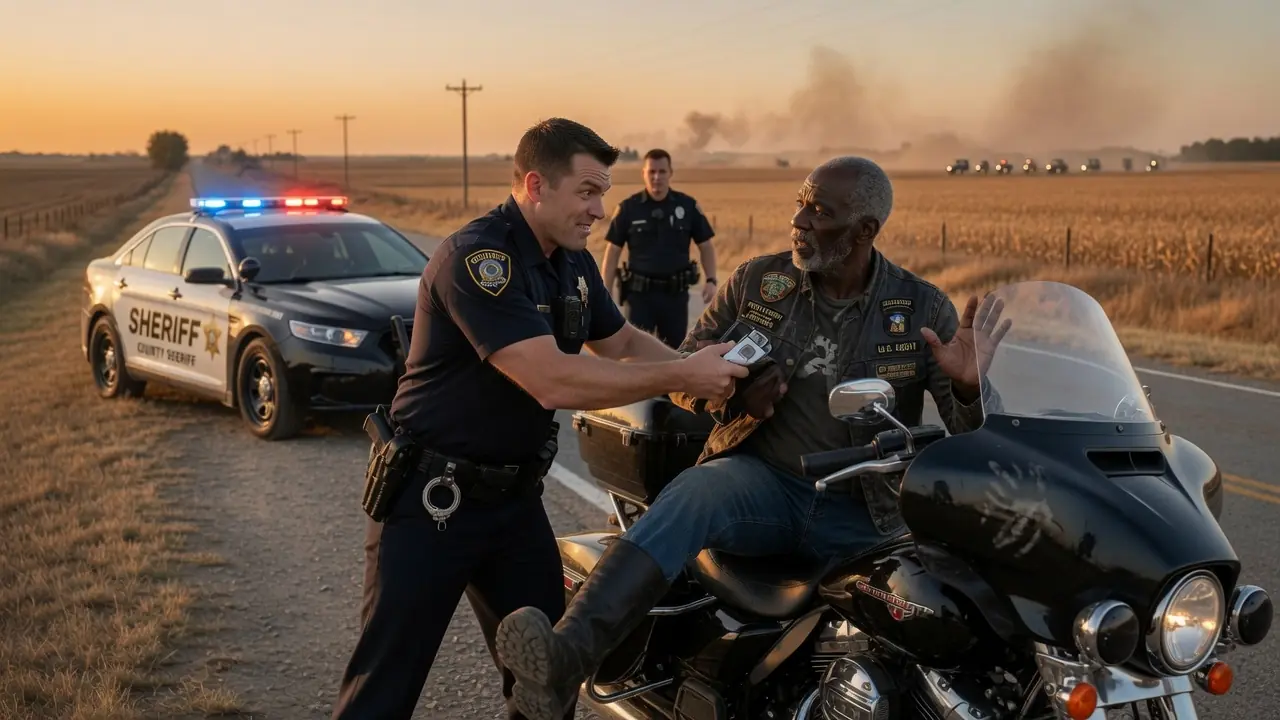
Road crews had removed the center markings two days earlier.
“What lane marking did he cross?”
Ethan looked toward the highway.
There was no line.
He remembered one farther south.
Or believed he did.
At that moment, he was no longer certain.
“The violation occurred before this section.”
“The patrol camera will show it,” Luis said.
Ethan turned toward his partner.
Luis met his eyes.
For years afterward, Ethan would remember that moment.
Not the convoy.
Not the salute.
Not even the revelation about his grandfather.
He would remember the instant his partner decided that truth mattered more than loyalty to him.
General Bennett looked toward Luis.
“Did you observe a violation?”
“No, General.”
Ethan’s jaw tightened.
“You told me he drifted,” Luis continued. “I was watching. He remained within the lane.”
General Bennett turned back to Samuel.
“Were you searched?”
“The motorcycle was.”
“Did you consent?”
“No.”
Ethan stepped forward.
“I was locating the registration.”
Samuel looked at him.
“You found the registration in the first saddlebag.”
General Bennett waited.
Samuel continued.
“He then opened the second.”
The general looked toward the wooden box.
“What was inside?”
Samuel’s eyes remained on Ethan.
“A folded flag. Several service decorations. A bracelet belonging to a soldier from my unit.”
General Bennett’s expression hardened.
“Did you open the box?”
Ethan felt the soldiers watching him.
“Yes.”
“Why?”
“He told me not to.”
Silence followed.
Ethan realized what he had said.
He corrected himself quickly.
“His reaction created concern that the box might contain something relevant to the stop.”
“What concern?”
“He became protective of it.”
Samuel’s mouth tightened.
General Bennett stepped closer.
“Most people become protective when an officer opens private property without permission.”
Ethan looked toward his supervisor’s number on the patrol computer.
For the first time that morning, he considered calling command.
Before he could, another patrol vehicle appeared farther down the road.
The department had already been alerted.
The convoy’s operations officer had contacted dispatch after Samuel failed to reach the base on schedule. A federal ceremonial-security notice connected to his name had triggered an immediate command response.
Ethan had seen the notification only after the search began.
By then, his original accusation had already collapsed.
The motorcycle was registered to Samuel.
The license was valid.
The serial number matched.
There was no theft report.
There had been no traffic violation.
Yet Ethan continued searching because ending the stop would require admitting that he had begun it for reasons he could not defend.
General Bennett approached the wooden box.
She did not touch it.
“That medal inside—is it still there?”
“Yes,” Samuel answered.
Ethan had called it a replica.
The memory made his stomach tighten.
General Bennett looked at him.
“Do you know what the Distinguished Service Cross represents?”
Ethan did not answer.
“It is the Army’s second-highest decoration for valor.”
She looked toward Samuel.
“He received it for actions during an ambush in the A Shau Valley.”
Samuel spoke quietly.
“This isn’t necessary.”
“It became necessary when he suggested you purchased it online.”
Ethan saw Luis close his eyes.
Samuel walked toward the motorcycle and opened the box.
The medal lay beside a folded flag.
Several ribbons rested beneath it.
A silver identification bracelet sat near the corner.
General Bennett pointed toward the medal.
“Command Sergeant Major Grayson crossed exposed ground repeatedly to recover wounded soldiers while under automatic weapons fire.”
“Five times,” Samuel said.
“Six.”
“The sixth man could still walk.”
“You went back for him.”
Samuel closed the box halfway.
“He needed directions.”
The general looked toward Ethan.
“One of those soldiers was Lieutenant Thomas Mercer.”
Ethan froze.
The highway sounds seemed to disappear.
“What name did you say?”
Samuel stopped moving.
General Bennett looked at Ethan’s nameplate.
“Mercer.”
Ethan stared at Samuel.
“My grandfather was Thomas Mercer.”
Samuel studied the young officer’s face.
Something shifted behind his eyes.
“What was his son’s name?”
“David.”
Samuel became very still.
Ethan’s father was David Mercer.
Thomas had rarely spoken about the war, but one story returned at family gatherings.
A young sergeant had crossed a burning field to bring him back.
Thomas remembered being dragged over dirt, hearing bullets strike stones nearby, and watching blood run from the sergeant’s shoulder.
He never knew how they both survived.
“My grandfather said a man named Grayson saved him,” Ethan whispered.
Samuel looked toward the road.
“A lot of men saved one another.”
“He said you returned after everyone else withdrew.”
“We had not withdrawn.”
“He said the grass was burning.”
Samuel’s voice changed.
“It was.”
Ethan looked toward the silver bracelet.
“Is that his?”
Samuel lifted it from the box.
The engraving caught the sunlight.
THOMAS E. MERCER
O POS
CHRISTIAN
Ethan took one step forward.
Samuel’s hand closed around it.
“Don’t.”
Ethan stopped.
“My grandfather lived until I was nineteen.”
“I know.”
“You knew him after the war?”
“He wrote letters.”
Samuel looked at the bracelet.
“We attended several reunions.”
“Why do you have this?”
“Thomas wore it while deployed. He gave it to me at a reunion in 1984.”
“Why?”
Samuel’s eyes moved toward Ethan.
“Because I carried another tag bearing his name for three days while we waited to learn whether he would survive.”
Ethan could not speak.
He remembered his grandfather teaching him to fish.
Repairing an old lawn mower.
Attending his high-school graduation with an oxygen tank beside his chair.
Every memory existed because the man standing near the guardrail had refused to leave Thomas Mercer in that field.
Ethan looked toward the motorcycle.
The open saddlebags.
The medal he had called fake.
The citation book lying on the patrol-car hood.
“I didn’t know.”
Samuel placed the bracelet back inside the box.
“No.”
“If I had known who you were—”
Samuel raised one hand.
“Do not finish that sentence.”
Ethan fell silent.
“You are about to say you would have treated me differently.”
Samuel secured the lid.
“That should frighten you.”
Ethan looked down.
“I made a mistake.”
“You made a conclusion.”
Samuel fastened the leather strap around the box.
“Then when the facts disproved it, you searched for another conclusion.”
“I thought the motorcycle might be stolen.”
“The registration matched.”
“The documents could have been—”
“False?”
Samuel looked toward him.
“Then the military patches might have been false. The medal might have been false. My name might have been false.”
Each sentence stripped another excuse away.
“What evidence would have been enough?”
Ethan had no answer.
Because there had been no answer.
Each piece of evidence confirming Samuel’s story only pushed Ethan to create a new suspicion.
General Bennett watched without interrupting.
Luis stood beside the patrol car, his face filled with shame.
Samuel closed the saddlebag.
“My service should not matter.”
Ethan looked up.
“You saved my grandfather.”
“That should not matter either.”
“How can you say that?”
Samuel stepped toward him.
“Because the next old man you stop may never have worn a uniform.”
His voice remained quiet.
“He may have no medals.”
“No general may know his name.”
“No convoy may appear over the hill.”
Samuel pointed toward the patrol badge on Ethan’s chest.
“The law must still belong to him.”
Captain Rebecca Sloan arrived from the state patrol command office several minutes later.
She separated the officers and reviewed the visible evidence.
Samuel’s license and registration matched.
The motorcycle identification number had not been altered.
No contraband had been found.
No theft report existed.
The dash camera would later prove Samuel maintained a steady course throughout the recorded drive.
Captain Sloan relieved Ethan of field duty pending review.
Luis surrendered his body camera as evidence.
“I should have stopped him sooner,” Luis said.
Sloan looked toward him.
“You will have an opportunity to explain that.”
Samuel overheard.
He approached Luis.
“You disagreed with the stop?”
“Yes.”
“When?”
“Before the lights came on.”
“And when did you say it clearly?”
Luis looked toward the ground.
“When the convoy arrived.”
Samuel nodded.
“That is the part you need to understand.”
Luis’s face tightened.
“I know.”
“Do you?”
Samuel’s voice was not unkind.
“It is easy to become honest after authority changes sides.”
The words followed Luis for years.
Samuel mounted the motorcycle.
General Bennett returned to the black SUV.
The convoy prepared to leave.
Ethan stood beside the patrol car without his citation book.
Before Samuel started the engine, Ethan asked one question.
“What was my grandfather like?”
Samuel looked toward him.
“Before the valley?”
“Yes.”
“Loud.”
Ethan blinked.
“My grandfather?”
“He sang constantly.”
“He couldn’t sing.”
“He did not know that.”
Despite everything, a faint smile touched Ethan’s face.
Samuel continued.
“He also shared his last clean socks with a soldier whose boots had filled with water.”
The smile disappeared into something more painful.
“He was a good man,” Samuel said.
“I know.”
“He would have expected better from you today.”
Ethan lowered his head.
“I know that too.”
Samuel started the Harley.
The convoy followed him toward Fort Redstone.
Hundreds of soldiers waited beside the new rehabilitation center.
They expected Samuel to arrive in a government vehicle.
Instead, the old motorcycle entered first.
The crowd applauded.
Samuel hated the attention.
He parked near the stage, changed into his dress uniform, and stood behind the podium while General Bennett told the story of the center.
The building was designed around principles Samuel had advocated for decades.
Recovery without humiliation.
Treatment without abandonment.
A recognition that invisible wounds remained wounds.
Samuel looked toward the empty highway beyond the base.
Then he began his speech.
He did not mention Ethan.
He spoke about authority.
“When a wounded soldier arrives here,” he said, “our first responsibility is not to decide whether the wound looks serious enough.”
The audience became quiet.
“Our responsibility is to listen before pride convinces us we already understand.”
No one knew the words had been rewritten in the back of the SUV only twenty minutes earlier.
The department investigation lasted ten weeks.
Ethan’s patrol footage proved there had been no traffic violation.
His draft report claimed Samuel moved evasively and appeared unusually protective of the motorcycle.
The body-camera recording showed Samuel complying calmly with every command.
Investigators reopened nine earlier complaints against Ethan.
Several involved people driving vehicles he believed did not fit their appearance.
A teenager in his mother’s luxury SUV.
A mechanic transporting a restored Corvette.
A retired school principal riding a high-value touring motorcycle.
In each encounter, Ethan extended the detention after ownership was verified.
He wrote that the driver’s calm questions appeared rehearsed.
Knowledge of legal rights became suspicious.
Refusal to consent became evasive.
A correct explanation became something to challenge.
Ethan faced termination.
Samuel was asked to submit an impact statement.
He wrote only one paragraph.
Officer Mercer’s behavior was unlawful, but removing one officer without examining the habits that shaped him will protect the department more than the public. Determine whether he is capable of learning. Then determine why his partner believed silence was safer than intervention.
Ethan received a one-year removal from patrol, loss of seniority, and mandatory retraining.
He was assigned to the regional veterans’ transportation office.
At first, he treated the job as humiliation.
He drove elderly former service members to hospitals, benefits hearings, physical therapy, and assisted-living facilities.
Many wore no visible evidence of service.
One former Marine carried groceries in a torn backpack because he had lost his car.
A decorated Army nurse suffered panic attacks when people approached from behind.
A retired pilot struggled to remember his address.
A former infantry officer slept inside a church basement.
Ethan learned how little clothing, money, age, or appearance revealed about a person’s history.
More importantly, he learned that history should not be required for dignity.
Luis served a shorter suspension for failing to intervene.
He later began teaching officers about peer accountability.
His first lesson always included one sentence:
If you wait for a more powerful person to arrive before telling the truth, you are not intervening. You are changing sides.
Near the end of Ethan’s assignment, he visited his grandmother.
He told her what happened.
Everything.
He did not describe Samuel as hostile.
He did not claim confusion.
He did not minimize the search.
His grandmother listened without speaking.
Then she brought a metal box from her bedroom.
Inside were Thomas Mercer’s photographs, letters, and service records.
Ethan found the picture of his grandfather beside Samuel.
On the back were the words:
The man who returned when nobody ordered him.
Ethan held it for a long time.
“Grandpa would be ashamed of me.”
His grandmother sat across from him.
“Yes.”
Ethan looked up.
He had expected comfort.
She gave him none.
“He would also tell you that shame is useless if you only use it to punish yourself.”
“What am I supposed to do?”
“Meet the next person without deciding who they are first.”
That was how Ethan came to stand outside Fort Redstone one year later, waiting with the photograph.
In the present, soldiers began moving toward the anniversary ceremony.
Samuel looked toward the gate.
“They’ll be waiting.”
Ethan nodded.
“Thank you for stopping.”
Samuel put on his gloves.
“I stopped because I wanted the photograph.”
“That’s all?”
Samuel looked at him.
“Were you hoping I would forgive you?”
Ethan considered lying.
“No.”
“Good.”
“I hoped you might believe I changed.”
Samuel mounted the motorcycle.
“That will not be proven by what you say to me.”
“I know.”
“It will be proven by what you do when the next person has no connection to your family.”
Ethan nodded.
Samuel started the engine.
Before pulling away, he looked back.
“You asked why your grandfather wrote that nobody ordered me to return.”
“Yes.”
“Orders had already changed.”
Samuel’s voice was nearly lost beneath the motorcycle.
“The position had become too dangerous. We were told to move back.”
“But you went anyway.”
“I heard your grandfather calling.”
Samuel looked toward the road ahead.
“Sometimes duty begins after the official instruction ends.”
He rode through the gate.
Ethan remained outside until the engine disappeared among the buildings.
Months later, he returned to highway patrol.
His first week passed without incident.
Then he saw an old pickup truck traveling slowly through an expensive lakeside neighborhood.
The truck had rust along the wheel wells.
Furniture was tied beneath a tarp in the bed.
The driver wore stained work clothes.
For one brief second, Ethan felt the old instinct.
The truck did not belong.
The driver looked out of place.
Ethan slowed behind it.
Then he examined the facts.
Valid plate.
No traffic violation.
No theft report.
No unsafe load.
The driver turned into the driveway of a large waterfront house.
Ethan continued past.
No stop.
No confrontation.
No convoy.
Nothing happened.
That was the point.
Years later, recruits watched the highway recording from Samuel’s stop.
The training department ended the video before the military vehicles appeared.
They saw Ethan accuse the old rider of stealing the Harley.
They watched the registration match.
They saw him open the second saddlebag and remove the wooden box.
Then the screen went dark.
The instructor never mentioned Samuel’s rank.
The medal.
The center named after him.
Thomas Mercer.
Or the convoy waiting only minutes away.
“What should Officer Mercer do now?” the instructor asked.
Return the property.
Apologize.
End the stop.
The answer required no military history.
The general’s salute did not make Samuel innocent.
The convoy did not create his rights.
Saving Ethan’s grandfather did not make him more deserving of dignity than another elderly man traveling the same road.
Those facts made the mistake more personal.
They did not make it more wrong.
Samuel Grayson had once crossed a burning field because a wounded soldier needed help.
More than fifty years later, that soldier’s grandson stopped him beside an empty highway and refused to believe the truth printed on his license.
A military convoy eventually appeared over the hill.
But the lesson was never that Ethan had stopped someone important.
It was that he should not have needed an important person, a decorated medal, or a column of military vehicles before choosing to treat an old stranger fairly.