Maya Sterling noticed the patrol car three blocks before it finally turned on its lights.
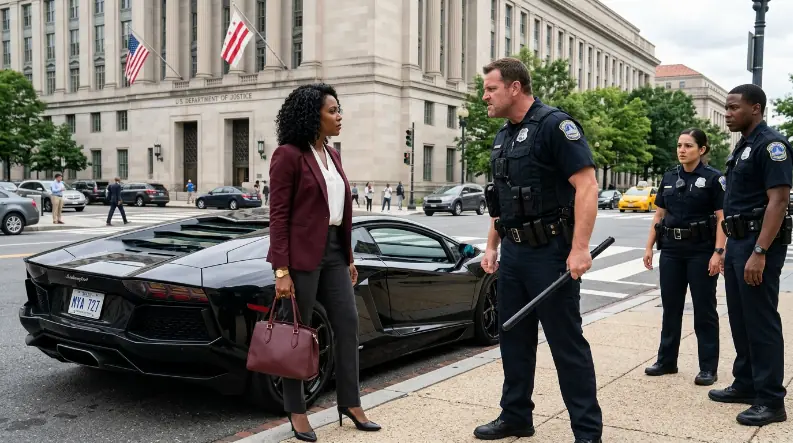
At first, she paid no attention to it. Washington traffic had been miserable all afternoon, and marked cruisers moved through downtown constantly. Maya had already been delayed twenty minutes by construction, another ten by a delivery truck blocking two lanes, and she was running dangerously close to the start of an important meeting. She tightened both hands around the Lamborghini’s steering wheel, checked the navigation screen, and told herself that arriving five minutes late would not destroy civilization. Her father used to say that people revealed what truly mattered to them by the emergencies they invented. Being late was inconvenient. It was not an emergency.
The black Lamborghini, however, had a way of making ordinary things feel less ordinary.
Pedestrians looked at it. Drivers glanced over at red lights. Teenagers sometimes held up phones. Maya had owned the car for years and had mostly stopped noticing the attention, but she understood why it happened. It was loud without trying, low to the ground, polished to a mirror shine, with cream leather inside and an engine that made parking garages sound like concert halls.
Her younger sister Lena called it “a midlife crisis purchased ten years early.”
Her mother called it “your father’s final bad influence.”
Maya simply liked driving it.
She turned left, then right toward the visitor entrance of the Halpern Center, where she was expected upstairs. The patrol car followed.
Maya looked in the mirror again.
Still there.
She entered the marked visitor lane and pulled beneath a sign indicating temporary parking. Before she could shut off the engine, the cruiser swung behind her at an angle, blocking the Lamborghini from backing out.
Blue lights flashed.
Maya stared at them for a second.
Then she slowly placed both hands on the steering wheel.
The officer approached from behind. He was a white man in his early forties, solidly built, with the rigid posture of someone who had already decided the encounter required seriousness. His nameplate read KELLER.
He tapped the glass twice.
“Engine off.”
Maya turned it off.
“Window down.”
She lowered it several inches.
“Officer,” she said calmly, “is there a problem?”
“License and registration.”
No explanation.
Maya reached carefully toward her handbag, removed her driver’s license, then opened the glove compartment for the registration. She passed both through the gap.
Officer Grant Keller studied them.
His eyes moved from the license to Maya.
Then from Maya to the registration.
Then back again.
Maya Sterling.
Arlington, Virginia.
Registration valid.
The name on both documents matched.
Keller looked toward the Lamborghini’s interior.
“Whose car is this really?”
Maya thought she had misunderstood him.
“Excuse me?”
“The car.” Keller tapped the registration against his palm. “Who owns it?”
“My name is on the registration.”
“I can read.”
“Then you already have your answer.”
Keller gave a short laugh.
“Try again.”
Maya’s expression changed.
Only slightly.
She had spent most of her adult life around people who believed confidence could substitute for evidence. Some wore business suits. Some wore uniforms. Some sat behind expensive conference tables. The profession changed. The habit did not.
“My name is Maya Sterling,” she said. “The registration says the vehicle belongs to Maya Sterling. My driver’s license identifies me as Maya Sterling.”
“I know what the paperwork says.”
“Then what exactly is the problem?”
“There are ways to fake paperwork.”
Maya stared at him.
“Did the plate come back stolen?”
Keller ignored the question.
“Where are you going?”
Maya glanced toward the building entrance less than thirty yards away.
“Inside.”
“For what?”
“A meeting.”
“What kind of meeting?”
“One that has nothing to do with whether I legally own this vehicle.”
Keller’s face hardened.
“Step out.”
Maya felt irritation rise through her chest.
She contained it.
“Am I being detained?”
“I’m investigating possible vehicle theft.”
“Based on what?”
“Step out of the car.”
Maya did.
She opened the door slowly, stepped onto the pavement, and closed it behind her.
She wore a burgundy double-breasted blazer over a crisp white blouse, charcoal trousers, black heels, and a gold watch her father had given her years earlier. Her hair was neat, her makeup understated, her posture controlled.
Keller looked her up and down.
Maya noticed.
“What fact suggests this car was stolen?” she asked.
Keller gestured vaguely toward the Lamborghini.
“This doesn’t add up.”
“What doesn’t?”
He looked directly at her.
“You.”
For several seconds, neither spoke.
Cars moved on the street behind them. People entered and exited the nearby buildings. A woman waiting at a bus stop looked toward the encounter, then away.
Maya’s anger sharpened.
Not because she had never encountered prejudice before.
She had.
Not because she needed a stranger to admire her success.
She did not.
What angered her was the assumption embedded inside Keller’s certainty. He did not merely doubt the documents. He seemed to believe she owed him a story that made her ownership understandable to him.
“Explain,” Maya said.
Keller folded his arms.
“You expect me to believe you walked into a dealership and bought this?”
“Yes.”
“With what?”
“My money.”
“What do you do?”
Maya almost laughed.
“Why is that relevant?”
“Because I’m asking.”
“That doesn’t make it relevant.”
Keller took a step closer.
“I decide what’s relevant during my investigation.”
Maya looked at the registration in his hand.
“No. Facts decide what is relevant.”
His jaw tightened.
A second patrol car arrived.
Officer Caleb Monroe stepped out. He looked young, perhaps twenty-six, with the alert nervousness of an officer who had not yet learned how to hide uncertainty behind routine.
Keller walked toward him.
“Possible high-end auto theft,” Keller said. “Driver’s evasive.”
Maya looked at him.
“I’m standing right here.”
“Nobody asked you.”
Monroe glanced toward her, then toward the Lamborghini.
“What came back on the plate?”
Keller hesitated.
“Registered to her.”
Monroe looked at Maya again.
“License match?”
“Yes.”
Monroe’s eyebrows moved almost imperceptibly.
Before he could say anything else, a third patrol car pulled in.
Officer Rachel Diaz stepped out.
She appeared several years older than Monroe and considerably less impressed by Keller’s urgency.
“What do we have?” she asked.
Keller repeated his summary.
“Possible high-end vehicle theft. Story isn’t adding up.”
Diaz looked at the documents.
“Plate stolen?”
“No.”
“Registration mismatch?”
“No.”
“License?”
“Matches.”
Diaz paused.
“Then what’s the discrepancy?”
Keller gave her an irritated look.
“The circumstances.”
Maya folded her arms.
“There is no discrepancy.”
Keller turned toward her.
“Stay out of this.”
“It is my car.”
Diaz took the registration from Keller.
“I’m running it again.”
She returned to her cruiser.
Monroe remained near the rear bumper.
Maya could see him studying the situation.
He looked uncomfortable.
Good, she thought.
Discomfort meant part of him was still listening to the evidence.
Diaz returned moments later.
“Registration is valid,” she said. “No stolen entry. No alert.”
Maya held out her hand.
“Then I assume we’re finished.”
Keller didn’t return her documents.
“Not necessarily.”
Diaz stared at him.
“What else?”
Keller handed Maya’s license to Monroe.
“Run her.”
Monroe did.