Officer Brent Maddox had spent eighteen years learning exactly how much humiliation a badge could hide.
It showed in small things first.
The way he leaned too far into a driver’s window.
The way he made people repeat answers he had already heard.
The way shopkeepers along Market Street suddenly became interested in sweeping their sidewalks whenever his cruiser slowed nearby.
Maddox called it command presence.
Other people had different names for it.
On a bright Tuesday morning in downtown Lakeford, that difference finally mattered.
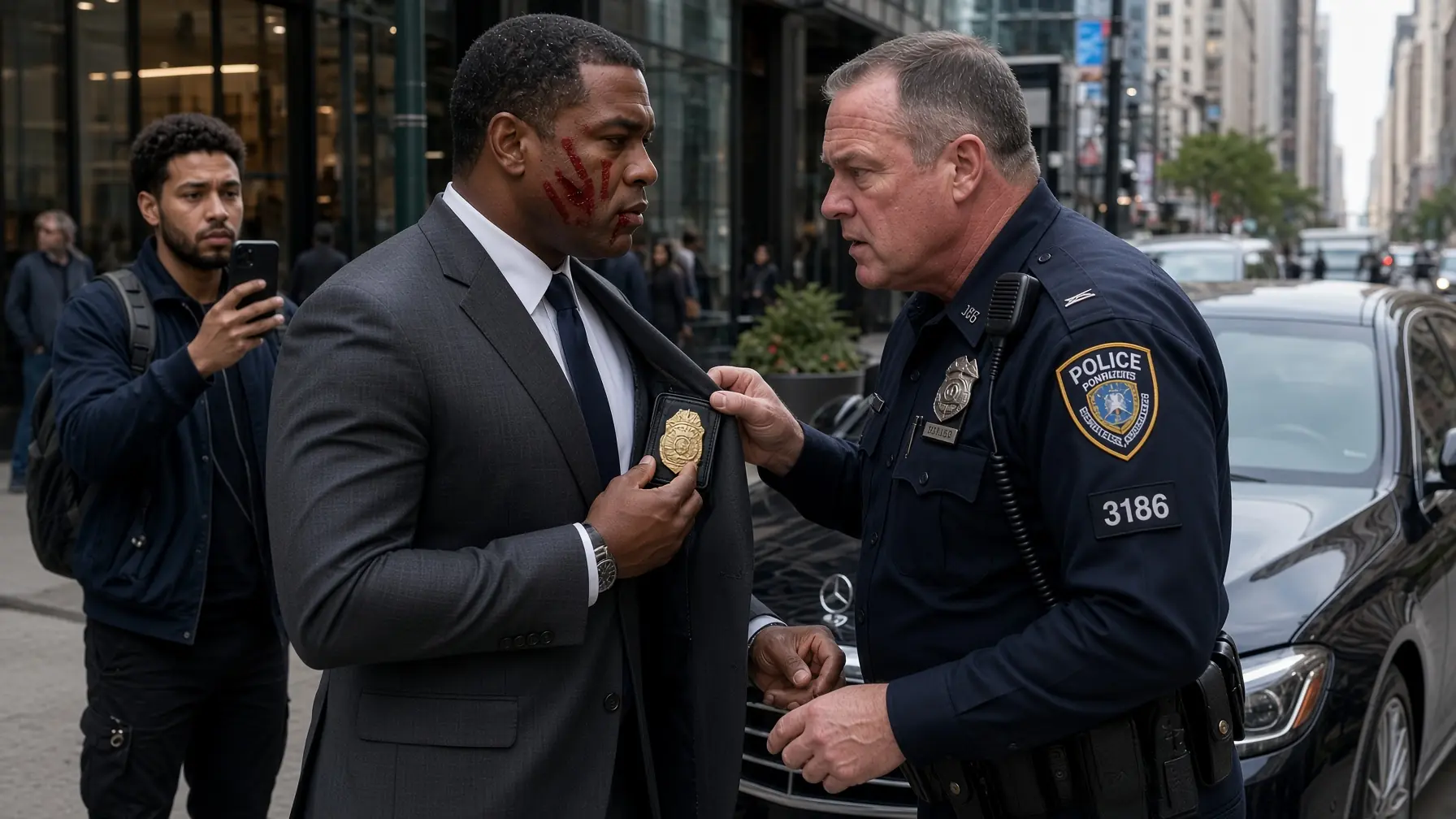
Maddox stood beside a black Mercedes with one hand resting on his duty belt.
The other had just struck a man across the face.
The slap was loud.
Sharp enough to turn heads half a block away.
A bicycle courier locked his brakes.
A woman carrying two coffees stopped so suddenly one lid popped loose.
A city bus hissed at the curb while passengers leaned toward the windows.
The man Maddox had slapped stood beside the sidewalk in a charcoal suit.
Tall.
Black.
Late forties.
His sunglasses lay broken near the gutter.
A thin line of blood appeared at the corner of his mouth.
One side of his face was already turning red.
Maddox looked pleased.
“That’s what happens,” he said, “when people forget who they’re dealing with.”
The sidewalk went quiet.
The man took a folded white handkerchief from his pocket.
Touched it to his lip.
Then looked at Maddox’s badge.
“Officer Brent Maddox.”
His voice remained calm.
“Badge 4271.”
Maddox smiled.
He had heard men speak like that before.
Lawyers.
Professors.
Executives.
Black professionals who believed careful grammar and expensive clothes could somehow place them beyond the reach of someone with a gun, handcuffs, and institutional confidence.
Maddox enjoyed correcting that belief.
“What?”
He stepped closer.
“You memorizing my badge number?”
“I’m identifying the officer who struck me.”
“You think that scares me?”
“No.”
That answer irritated Maddox more than anger would have.
The man did not know his place.
At least, that was what Maddox thought.
What he did not know was that the man standing in front of him was Dr. Gabriel Rowan.
And in less than fifteen minutes, Gabriel Rowan was scheduled to walk into Lakeford Police Headquarters and be sworn in as the city’s new chief of police.
Forty minutes earlier, Gabriel had been standing in front of a hotel mirror.
Room 1408.
Kingsley Hotel.
Downtown Lakeford spread below the window in glass, brick, construction cranes, church steeples, and morning traffic.
On the desk behind him lay a leather credential case.
A briefing binder.
A department organizational chart.
And a photograph of his mother.
She had been seventy-one in the picture.
Standing outside a small Baptist church in Birmingham.
Blue dress.
White shoes.
One hand on Gabriel’s shoulder.
His mother, Evelyn Rowan, had worked thirty-two years as a school cafeteria manager.
She never earned enough to feel secure.
Never had a college degree.
Never held public office.
Yet Gabriel had spent most of his professional life comparing leaders to her and finding them inadequate.
She had a simple definition of authority.
“If you need somebody smaller so you can feel bigger,” she once told him, “then you aren’t leading.”
Gabriel had carried that sentence through twenty-five years of policing.
Patrol.
Investigations.
Command.
Federal reform work.
Graduate school at night.
A doctorate in public administration and police leadership.
He had led a department through a federal consent decree.
Helped rebuild another agency’s disciplinary system after officers were caught falsifying use-of-force reports.
He understood policy.
Politics.
Union contracts.
Civil-service law.
And something less academic.
Institutions rarely collapsed because nobody knew what was wrong.
They collapsed because too many people benefited from describing the wrong thing as normal.
Lakeford had been recruiting a new chief for nearly nine months.
The department was not in crisis because crime had suddenly exploded.
Its deeper problem was legitimacy.
Residents had stopped believing complaints mattered.
Settlement payments had increased.
Body-camera failures clustered around certain officers.
Use-of-force reports repeated suspiciously similar language.
Supervisors closed cases without interviewing civilian witnesses.
And in several neighborhoods, the same officer names appeared again and again.
One was Brent Maddox.
Gabriel had read his file the previous night.
Eighteen years on the force.
Four commendations.
Two lifesaving awards.
Strong arrest numbers.
Also:
Nineteen citizen complaints in the previous fourteen months.
Thirty-seven use-of-force reports in three years.
Five civil claims settled by the city.
Three allegations involving teenagers.
Four body-camera failures during disputed encounters.
Most complaints ended:
Not sustained.
The supervisors used phrases Gabriel knew well.
Decisive.
Old-school.
Street-smart.
Not afraid to take control.
Sometimes those phrases described an excellent officer.
Sometimes they were cushions placed beneath misconduct so nobody had to hear it fall.
Gabriel closed the file at 11:46 the night before.
He told himself he would meet Maddox soon.
He did not expect soon to mean before breakfast.
At 8:11, Gabriel left the Kingsley.
His driver had called out sick.
The transition team offered a replacement.
Gabriel declined.
He wanted twenty quiet minutes before becoming Chief Rowan in public.
The Mercedes belonged to the city motor pool.
Nothing exotic.
A well-maintained executive sedan assigned for transition travel.
Gabriel drove south on Market Street.
Classical guitar played softly through the speakers.
His credential case rested inside his jacket.
His first speech sat unread on the passenger seat.
He had written it three times.
The first version sounded like politics.
The second sounded like consulting.
The third simply said:
The public should not need influence to receive professionalism.
He liked that one.
At 8:26, Gabriel moved slightly across the center line to avoid a pothole large enough to damage a tire.
No traffic beside him.
No dangerous maneuver.
No near collision.
A police cruiser parked outside a coffee shop pulled out immediately.
Lights flashed.
Gabriel looked in the mirror.
Then exhaled.
He pulled over.
Not into an alley.
Not beside a parking structure.
Directly in front of Morales Electronics, a phone-repair shop on Market and Seventh.
Public sidewalk.
Store cameras.
Pedestrians.
Visibility.
Gabriel had learned that habit long before he earned his doctorate.
Brent Maddox had been sitting in Unit 19 drinking coffee.
Dispatch had reminded patrol officers that the new chief was arriving that morning.
Maddox had laughed.
Another reformer.
Another outsider.
Another executive who would spend six months saying community before discovering that police work was complicated.
He had survived four chiefs.
Two mayors.
Three civilian review proposals.
Mandatory bias training.
A body-camera rollout.
Several lawsuits.
One federal review.
Administrations changed.
Maddox remained.
Experience had become confidence.
Confidence had hardened into entitlement.
Then the black Mercedes crossed the lane line.
Maddox smiled.
“Perfect.”
He approached the driver’s window.
“License.”
Gabriel lowered the glass.
Both hands visible on the steering wheel.
“Good morning, Officer.”
“License and registration.”
“Certainly.”
Gabriel paused.
“May I ask the reason for the stop?”
Maddox leaned toward the window.
“I said license.”
“I heard you.”
“Then do what I said.”
Gabriel kept his tone even.
“My wallet is inside my jacket.”
Maddox’s eyes moved toward the suit.
The watch.
The interior of the Mercedes.
Then back to Gabriel’s face.
“What do you do?”
Gabriel almost smiled.
The question had nothing to do with lane position.
“I work in public safety.”
Maddox laughed.
“Public safety?”
“Yes.”
“That one of those consulting jobs?”
“Sometimes.”
Maddox stepped back.
“Out of the vehicle.”
Gabriel looked at him.
“For a lane violation?”
“Out.”
Gabriel understood exactly what was happening.
He could challenge the order.
Could identify himself immediately.
Could open the badge case.
One reveal and the encounter would transform.
Yes, Chief.
Sorry, Chief.
Right away, Chief.
That temptation lasted one second.