Officer Elaine Adams had one hand wrapped around the Xbox and the other gripping the back of Michael Porter’s wheelchair when she radioed for emergency assistance.
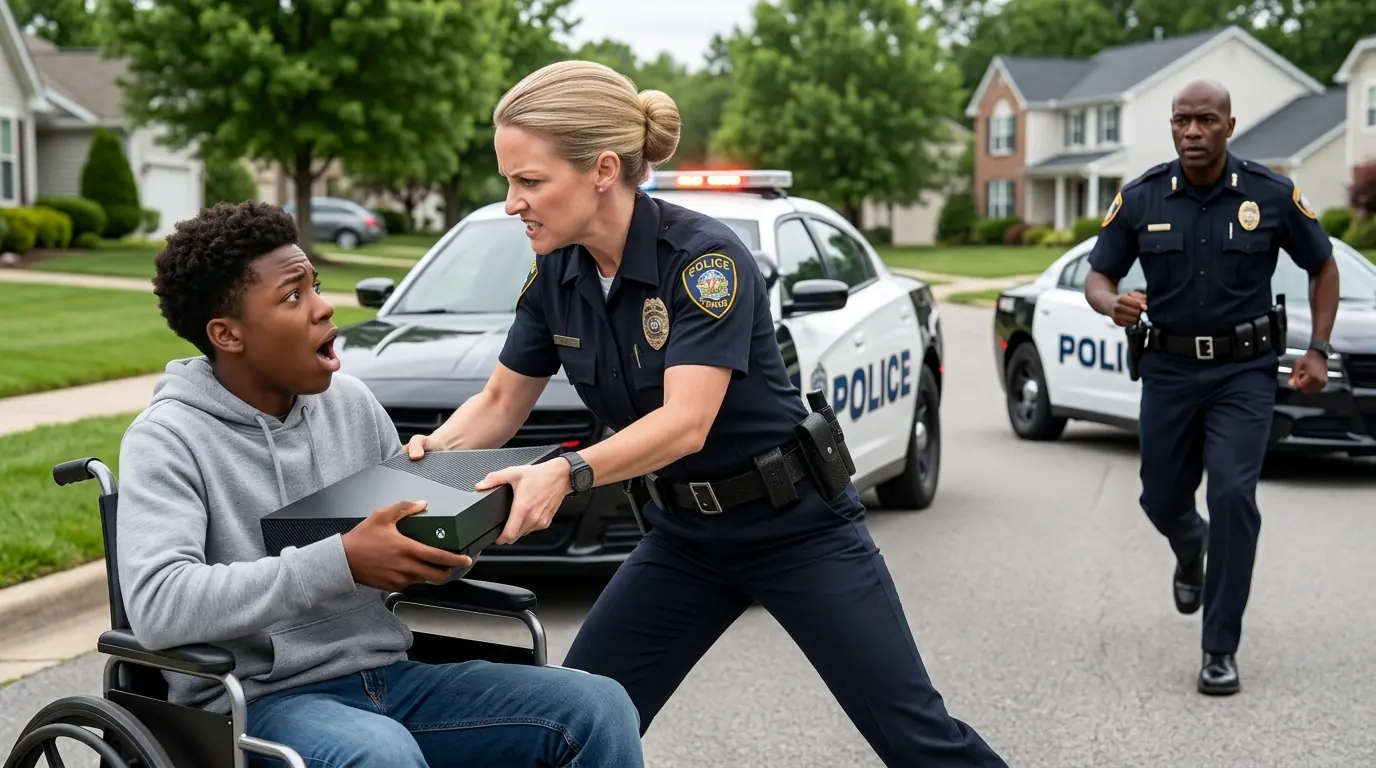
“Dispatch, I need backup at Flamingo and Third,” she said, breathing harder than the fifteen-year-old sitting in front of her. “Male suspect resisting. I’m having trouble controlling him.”
Michael stared up at her in disbelief. His backpack hung from one wheelchair handle. A controller cable trailed from the partially opened case in his lap. One of his gloves had fallen onto the sidewalk during the struggle, and the right wheel of his chair sat crooked against the curb where Adams had tried to pull him backward.
“I’m not resisting,” Michael said. “You’re trying to take my stuff.”
“Stop arguing.”
“I can’t even go anywhere. You’re holding my chair.”
“Keep your hands where I can see them.”
“My hands are on my wheels.”
“Michael, stop.”
The way she said his name made something inside him twist.
Twenty minutes earlier she had not known his name.
Now she said it like she had been dealing with him for years.
A woman standing beside a parked minivan had taken out her phone and started recording. Across the street, an elderly man had stopped sweeping his porch. Two younger kids on bicycles watched from the corner without coming closer.
Michael saw all of them.
That somehow made the humiliation worse.
“Officer, please,” he said. “Call my dad. Call my friend. Call anybody. I told you where I’m going.”
Adams tightened her grip on the Xbox.
“You don’t tell me how to conduct an investigation.”
“I’m fifteen.”
“And?”
“And you stopped me because somebody broke into a house.”
“You matched the description.”
Michael looked down at his wheelchair.
Then back at her.
“How?”
Adams did not answer.
Her radio crackled.
“Unit responding to Flamingo and Third. Thirty seconds out.”
Adams exhaled.
“Good.”
Michael looked toward the intersection.
A dark police SUV came around the corner faster than the other traffic, emergency lights flashing but siren off. It stopped sharply beside Adams’s cruiser.
The driver’s door opened.
A tall Black man in a dark police uniform stepped out.
He looked first at Adams.
Then at the Xbox in her hand.
Then at the wheelchair.
Then at the boy sitting in it.
His face changed.
“Michael?”
Michael’s shoulders dropped.
“Dad?”
Officer Adams went completely still.
But to understand how she ended up standing on a public sidewalk holding a fifteen-year-old boy’s Christmas present while the one person she had desperately called for backup stared at her in disbelief, the afternoon had to begin forty minutes earlier.
Michael Porter had been halfway through algebra homework when his phone rang.
He was sitting at the desk beside his bedroom window, one wheel of his chair locked beneath the edge, headphones resting around his neck while a worksheet covered in equations lay open beside his laptop.
His friend Ara’s name appeared on the screen.
Michael answered.
“What’s up?”
“You doing anything?”
“Homework.”
“That sounds terrible.”
“It is.”
“Come over.”
Michael glanced at the worksheet.
“I’ve still got like six questions.”
Ara immediately replied, “Which means you’ve got six questions you can avoid doing at my house.”
Michael laughed.
“What are we playing?”
“Whatever you bring.”
“You want the Xbox?”
“Yes.”
“You have an Xbox.”
“My controller is broken.”
“You threw it.”
“It slipped.”
“You threw it because I beat you.”
“Are you coming or not?”
Michael looked toward the hallway.
His father would not be home until evening.
His grandmother had left for a medical appointment with Michael’s aunt.
Ara lived less than eight blocks away.
“Give me ten minutes.”
“Bring the second controller.”
“You’re demanding for someone with a broken one.”
Ara laughed.
“See you.”
Michael ended the call and finished the equation he had already started before closing his notebook.
He had been using a wheelchair since he was eight.
A spinal injury from a car accident had changed almost everything about how he moved through the world, but by fifteen the chair had become less a symbol of limitation than simply the machinery of his daily life. Michael could transfer himself, load his chair into an accessible vehicle, navigate school hallways faster than most students walking, and perform wheelies over curbs his father absolutely hated seeing him attempt.
The neighborhood was familiar.
He knew which sidewalks cracked badly enough to catch his front casters, which intersections had ramps too steep to climb easily, which dogs barked without biting, and which corner store owner would let him use the back entrance when delivery boxes blocked the front.
Going eight blocks to Ara’s house did not feel adventurous.
It felt ordinary.
Michael placed the Xbox inside a padded carrying case, tucked two controllers beside it, hooked the bag securely across his lap, and headed outside.
Three blocks away, a security alarm activated at 869 Russell Avenue.
The homeowner was away.
A glass-break sensor triggered first.
Then a rear-door alarm.
A neighbor looking through a kitchen window called 911 and reported seeing someone running through the backyard.
The dispatch operator asked for a description.
The neighbor had seen the person for perhaps four seconds.
“Black guy,” he said. “Young, I think. Dark clothes.”
“How tall?”
“I don’t know. Five-eight? Maybe taller.”
“Any distinguishing clothing?”
“Black sweatshirt. Gray pants, maybe.”
“Direction of travel?”
“Toward Engle.”
Officer Elaine Adams was two blocks away when the call came through.
She had been with the department for eleven years.
She was not inexperienced.
She had handled burglaries, crashes, domestic disputes, overdoses, missing children, and enough false alarms to know that initial descriptions were often unreliable. She had also been reprimanded once for pursuing a burglary suspect without waiting for backup after the man turned out to be armed.
So when dispatch gave her the information, she repeated it carefully.
“Black male, approximately five-eight, dark sweatshirt, gray pants, last seen northbound from Engle.”
“Correct.”
“Any vehicle?”
“Negative.”
“Any stolen property identified?”
“Not at this time.”
Adams turned onto Third Street.
Less than sixty seconds later, she saw Michael.
Black male.
Young.
Dark sweatshirt.
Gray sweatpants.
Moving north.
A rectangular electronics case sat across his lap.
For Adams, those details connected instantly.
Too instantly.
She pulled to the curb.
Michael heard the cruiser stop behind him but did not initially turn around.
Then a voice came from behind.
“Excuse me. Stop right there.”
Michael braked.
He turned.
Adams approached.
“Officer, did I do something?”
“No. We had a report of a robbery nearby. I just need to ask some questions.”
Michael nodded.
“Okay.”
“Do you have identification?”
“No.”
“How old are you?”
“Fifteen.”
“Name?”
“Michael.”
“Last name?”
Michael hesitated.
Something about the encounter had begun feeling different.
“Porter.”
“Where do you live?”
“Russell. Around the corner.”
Adams looked toward the electronics bag.
“Where are you headed?”
“My friend’s house.”
“What’s in there?”