The patrol car rolled across the sidewalk and stopped directly in front of the pregnant woman.
Elena Brooks slowed from a jog to a walk.
Cold morning air burned inside her lungs as she placed one hand beneath the curve of her stomach. At thirty-one weeks pregnant, she no longer moved quickly, but the steady three-mile route helped with the stiffness in her back and the sleeplessness that arrived before dawn.
She had been living in Cedar Grove for less than twelve hours.
Most of her belongings were still inside cardboard boxes. The curtains had not been hung, the refrigerator contained nothing except bottled water, and her late husband’s framed photograph remained wrapped in a blanket beside the kitchen counter because she had not yet found the courage to decide where it belonged.
Elena had hoped the run would quiet her mind before her first day at a new command.
Instead, Officer Ryan Keller opened his door and stepped into her path.
“Ma’am, stop right there.”
Elena stopped.
Keller was in his late twenties, tall and athletic, with a clean uniform and the rigid posture of a man who wanted every person he met to recognize his authority immediately.
His right hand remained near his duty belt.
“What seems to be the problem?” Elena asked.
“We received a report of someone behaving suspiciously in the neighborhood.”
Elena glanced around.
The streets were nearly empty. Large brick homes stood behind trimmed hedges and bare maple trees. Porch lights still glowed in the gray light before sunrise.
“And you believe that person is me?”
“I’m asking the questions.”
The response came too quickly.
Elena studied his nameplate.
KELLER.
She had seen the name in personnel files during the previous week, though she had not yet connected it to a face.
Officer Ryan Keller.
Three years with the department.
High arrest numbers.
Strong physical evaluations.
Two commendations for proactive policing.
Four civilian complaints, all closed without disciplinary findings.
Elena had planned to review those files after meeting the officers in person.
Now one of those officers was standing in front of her.
“What was the suspicious behavior?” she asked.
“A resident saw you looking at houses and checking property numbers.”
“I moved into number forty-two last night. I was making sure I remembered which street led back to it.”
Keller looked toward the homes behind her.
“You live here?”
“Yes.”
“Since when?”
“I just told you.”
His jaw tightened.
“Do you have identification?”
“Not with me.”
“You went running without ID?”
“I have a watch with my emergency information.”
“That isn’t what I asked.”
Elena looked at the patrol car.
The red and blue lights were not activated, but the vehicle blocked the sidewalk and half the driveway beside it.
“Am I being detained?”
Keller’s eyes narrowed.
“Why would you ask that?”
“Because you ordered me to stop and positioned your vehicle so I couldn’t continue.”
“People who have nothing to hide usually cooperate.”
Elena released a slow breath.
The baby moved beneath her ribs.
She placed her palm against the spot.
“I am cooperating. I gave you my name, address, and an explanation. I’m asking whether I am legally required to remain.”
Keller glanced toward her stomach.
“How far along are you?”
“That is not relevant.”
“You’re running alone before six in the morning while heavily pregnant.”
“I’m aware.”
“Where’s your husband?”
The question landed harder than Keller could have known.
Elena’s eyes shifted briefly toward the house at number forty-two.
Eight months earlier, Detective Daniel Brooks had entered a convenience store during an armed robbery while driving home from work. He had been off duty and alone.
He moved two customers behind cover before the gunman fired.
Daniel survived long enough to call Elena.
She had been in a command meeting and missed the first call.
By the time she reached the hospital, he was unconscious.
Their son had begun moving inside her body three days after the funeral.
Elena returned her attention to Keller.
“My husband is dead.”
For a fraction of a second, discomfort appeared in the officer’s face.
Then he covered it with procedure.
“I’m sorry to hear that, but I still need to verify who you are.”
“My name is Elena Brooks. I live at forty-two Hawthorne Lane.”
“What do you do for work?”
“I work for the city.”
“Where?”
“The police department.”
Keller’s expression changed.
Not recognition.
Suspicion.
“What department?”
Elena looked directly at him.
“The one you work for.”
He gave a humorless laugh.
“You expect me to believe you’re a police employee?”
“I did not ask what you believe.”
“Position?”
Elena hesitated.
She could have ended the encounter immediately.
One answer would have done it.
Commander.
Incoming precinct commander.
The officer’s posture would change. His voice would soften. He might apologize, straighten his uniform, and begin explaining that he was only doing his job.
But Elena wanted to know how Ryan Keller treated a woman who could offer him nothing.
Not a superior officer.
Not a connection.
Just a tired pregnant resident in running clothes without a wallet.
“Administrative,” she said.
The answer was technically true.
Keller nodded as if confirming his suspicion.
“Anyone can claim that.”
“You can verify my name through dispatch.”
“I intend to.”
He removed the radio from his shoulder.
“Unit Twelve requesting records check.”
He provided Elena’s name and date of birth after asking her for it twice.
The dispatcher responded that the system showed no warrants and a valid Maryland driver’s license registered to an old address across the city.
Keller looked satisfied.
“You said you lived here.”
“I moved yesterday. My license has not been updated.”
“How convenient.”
Elena looked at her watch.
The stop had lasted four minutes.
Her lower back was beginning to tighten.
“I would like to sit on the low wall beside that driveway.”
“You can sit on the curb.”
“I am pregnant, Officer Keller. Getting down to the curb and standing again is difficult.”
“You were able to run.”
“That is not the same movement.”
He looked at the stone wall, then back at her.
“Stay where I can see your hands.”
Elena felt anger begin moving beneath her composure.
Not because she was being questioned.
Police officers had a duty to investigate legitimate reports.
The problem was the assumption behind every sentence.
Her explanation was treated as deception.
Her medical condition as inconvenience.
Her knowledge of the law as evidence of guilt.
Her request for basic comfort as resistance.
“I would like your supervisor,” she said.
Keller crossed his arms.
“For what?”
“To review the basis for this detention.”
“This is a routine investigation.”
“Then your supervisor should have no difficulty reviewing it.”
He glanced at the patrol car.
“I can call one, but that will take time.”
“I have time.”
“You were just in a hurry to leave.”
“I was in a hurry to finish my run. Now I’m interested in how this ends.”
The sentence made Keller more alert.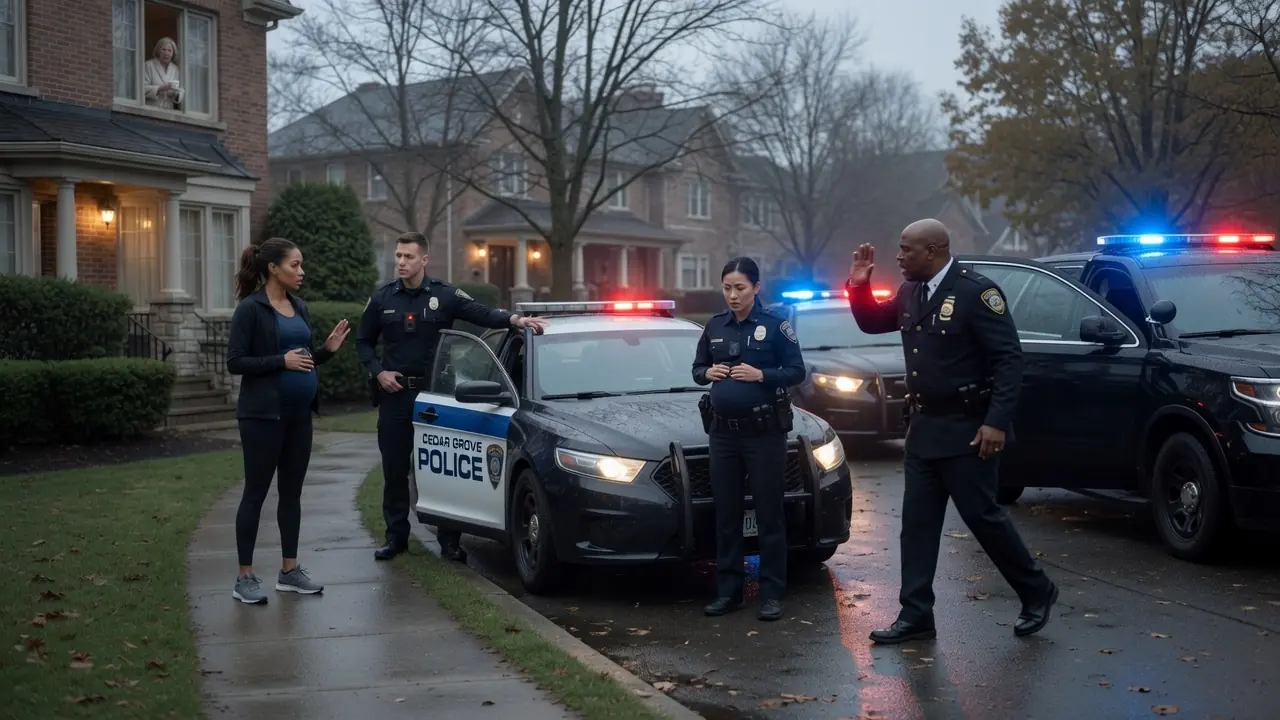
He studied her face as though trying to determine whether she had begun threatening him.
“Are you recording this?”
“My watch records exercise data.”
“That’s not what I asked.”
“The camera on your chest should be recording both of us.”
His hand moved toward the body camera.
The small red light was on.
“Turn around,” he said.
Elena did not move.
“Why?”
“For a quick pat-down.”
“On what grounds?”
“We’ve had multiple burglaries in this area.”
“I am wearing running leggings and a fitted jacket. What weapon do you believe I’m concealing?”
“You’re becoming argumentative.”
“No. I am asking you to explain your authority.”
A curtain shifted inside the nearest house.
An older woman appeared behind the window, holding a coffee cup.
She was probably the person who had called.
Elena looked toward her.
The curtain closed immediately.
Keller stepped closer.
“Turn around and place your hands on the hood.”
Elena’s voice became colder.
“I will not lean my stomach against a patrol car.”
“I didn’t tell you to lean.”
“Then explain exactly what you expect a woman in her third trimester to do.”
His face reddened.
“I expect compliance.”
“There is the problem.”
“What did you say?”
“You’re no longer investigating. You’re trying to win.”
Keller stared at her.
Elena had seen the expression before.
It belonged to officers who interpreted any limit on their authority as a personal humiliation.
He reached toward her elbow.
Elena stepped back.
“Do not touch me.”
“Stop resisting.”
“You have not placed me under arrest.”
“I told you to turn around.”
“And I asked for the legal basis.”
The baby shifted again.
A stronger cramp moved across Elena’s lower abdomen.
She inhaled slowly through her nose.
Keller noticed.
“What’s wrong?”
“Nothing.”
“You look pale.”
“I’m standing in the cold after running while you prolong an unnecessary detention.”
“You’re the one prolonging it.”
Elena checked her watch.
Eight minutes.
A second patrol vehicle turned onto Hawthorne Lane.
It belonged to Officer Maya Chen, who had heard Keller’s request for a supervisor and was closer than the precinct captain.
Chen stepped out and approached carefully.
“What do we have?”
Keller answered before Elena could speak.
“Suspicious person call. Subject claims she moved into number forty-two but has no proof of residence. She’s refusing a pat-down and becoming increasingly confrontational.”
Chen looked at Elena.
The pregnant woman stood in black running clothes with empty hands visible at her sides.
“What was she reported doing?”
“Checking addresses and looking at houses.”
Chen glanced down the street.
“That’s it?”
“We’ve had property crimes in the neighborhood.”
“Not on this block.”
Keller turned toward her.
“I’m handling it.”
“You requested a supervisor.”
“I requested Captain Reed.”
Chen looked at Elena again.
“Ma’am, are you experiencing any medical distress?”
“I’m uncomfortable, not in distress.”
“Would you like to sit in my vehicle?”
“Thank you, but I would prefer the stone wall.”
Chen nodded.
“That’s fine.”
Keller stepped between them.
“She needs to remain where I can observe her.”
Chen’s expression tightened.
“You can observe her from ten feet away.”
Elena sat carefully on the low wall.
The relief in her back was immediate.
Officer Chen remained nearby but did not crowd her.
“What is your name?” Chen asked.
“Elena Brooks.”
Chen’s eyes widened slightly.
Unlike Keller, she had read the internal announcement distributed two days earlier.
The email contained no photograph, but the name was unmistakable.
Commander Elena Brooks.
Former head of Major Crimes.
Incoming commander of the North District.
Chen looked toward Keller.
Then back at Elena.
Before she could speak, Elena gave a small shake of her head.
Not yet.
Chen understood.
Keller did not notice.
He had returned to his patrol car and was typing information into the computer.
The older woman who had been watching from the window now stepped onto her porch.
“Officer,” she called.
Keller walked toward the property line.
“Did you make the report?”
“Yes. I saw her stopping in front of several houses.”
Elena listened.
“Did she enter any property?” Keller asked.
“No.”
“Touch any doors or windows?”
“No.”
“Look inside vehicles?”
“I couldn’t tell.”
“What exactly made you suspicious?”
The woman hesitated.
“She didn’t look like she belonged.”
The sentence remained in the cold morning air.
Elena looked at the expensive homes surrounding them.
Keller did not ask what belonging looked like.
He merely wrote something in his notebook.
Officer Chen did.
“What do you mean by that, ma’am?”
The woman became defensive.
“I’m only trying to protect the neighborhood.”
“Did she do anything illegal?”
“I don’t know. That’s why I called.”
Chen nodded.
Calling was not itself wrong.
Residents were allowed to report concerns.
The danger began when vague discomfort became official suspicion without anyone examining what had created it.
Keller returned.
“The property ownership database doesn’t list you at number forty-two.”
“I’m renting,” Elena said.
“Landlord’s name?”
“Robert Fields.”
“Phone number?”
“It’s stored in the phone inside my house.”
“You expect us to take your word for all of this.”
Elena checked her watch again.
Thirteen minutes.
“I expect you to identify a reasonable, articulable suspicion that I committed or was about to commit a crime.”
Keller looked toward Chen.
“You hearing this?”
“I am,” Chen said.
“She knows exactly what to say.”
“That sometimes happens when people know their rights.”
Keller’s jaw tightened.
A black police SUV turned onto Hawthorne Lane.
Captain Marcus Reed drove faster than the residential speed limit warranted, then braked near the patrol cars.
He stepped out before the engine had fully settled.
Reed was fifty-four, broad-shouldered, and normally unhurried. He had served twenty-eight years in the department and believed most problems became worse when supervisors arrived looking frightened.
That morning, he looked frightened.
He had been halfway to the precinct when dispatch informed him that Officer Keller was detaining a pregnant woman named Elena Brooks on Hawthorne Lane.
Reed knew the address.
He had helped authorize the department’s relocation assistance for the incoming commander.
The stop had lasted fifteen minutes.
Captain Reed walked past Keller without returning his salute.
He stopped before Elena.
She rose slowly from the wall.
“Commander Brooks,” he said. “Are you all right?”
Keller’s face emptied.
The older woman on the porch gripped the railing.
Officer Chen remained silent.
Elena looked at Reed.
“My back hurts. I’m cold. Otherwise, I’m fine.”
Captain Reed turned toward Keller.
The young officer stood rigid beside his patrol car.
“Officer,” Reed said, “meet Commander Elena Brooks.”
Keller’s mouth opened.
No words came.
“Your new district commander,” Reed continued. “The person assuming command of your precinct at eight o’clock this morning.”
The street became completely still.
Keller looked at Elena again.
This time, he saw the tailored authority he had failed to recognize beneath the running clothes.
His posture changed immediately.
“Commander, I—”
Elena raised one hand.
“Am I free to leave?”
“Yes, ma’am.”
“Was I detained?”
Keller swallowed.
“Yes, ma’am.”
“For suspicion of what crime?”
He looked toward his notebook.
“Possible burglary activity.”
“What specific conduct indicated burglary?”
“You were checking house numbers.”
“I was finding my way home.”
“I didn’t know that.”
“I told you.”
Keller’s face reddened.
“The address hadn’t been updated.”
“You had no information contradicting my explanation.”
“The caller said you didn’t belong.”
Captain Reed looked toward the woman on the porch.
She stepped backward.
Elena’s voice remained calm.
“Did the caller describe a crime?”
“No, ma’am.”
“Did you observe a crime?”
“No, ma’am.”
“Did I attempt to flee?”
“No.”
“Did I threaten you?”
“No.”
“Did you order a pregnant woman to place her hands on a patrol car after she explained a service-related medical accommodation?”
Keller hesitated.
“You didn’t tell me it was service-related.”
Elena looked at him.
“My medical condition did not become more legitimate when you learned my rank.”
He lowered his eyes.
“No, ma’am.”
Captain Reed stepped closer.
“Commander, I apologize.”
Elena turned toward him.
“For what part?”
Reed stopped.
The question was not sarcastic.
That made it harder.
“For the conduct of one of my officers.”
“Only one?”
Reed glanced at Chen.
Elena continued.
“Officer Chen arrived and immediately asked whether I needed medical assistance. She questioned the facts rather than assuming the conclusion.”
Chen stood straighter.
“The caller made a vague report. Officer Keller converted discomfort into a criminal investigation. Dispatch found no warrants. I provided a name, date of birth, address, and explanation.”
Elena looked at the captain.
“Yet the stop continued because ending it would have required Officer Keller to admit his first assumption might have been wrong.”
Reed nodded slowly.
“Yes, Commander.”
“Keller’s body-camera recording will be preserved.”
“Yes.”
“Officer Chen’s as well.”
“Yes.”
“The call recording and dispatch history too.”
“Yes.”
Keller looked up.
“Am I suspended?”
Elena met his eyes.
“You are relieved from street duty until I review the complete incident.”
His face tightened.
“I was responding to a resident complaint.”
“You were.”
“I was trying to keep the neighborhood safe.”
“Safety without judgment becomes intimidation.”
He said nothing.
Elena looked toward her new house.
“I need to change clothes before reporting to work.”
Captain Reed gestured toward his vehicle.
“I’ll drive you.”
“My home is twenty yards away.”
Reed almost smiled.
“Of course.”
Elena began walking.
Keller spoke behind her.
“Commander Brooks.”
She stopped.
“I’m sorry.”
Elena looked back.
“I believe you’re sorry about who I turned out to be.”
The officer’s face fell.
She continued.
“Decide whether you’re sorry about how you treated the woman you believed I was.”
Then she went home.
At eight seventeen, Commander Elena Brooks entered the North District precinct wearing a dark-blue uniform.
Her gold commander’s insignia rested at the collar. Her hair had been pulled into a tight knot, and nothing in her posture suggested she had spent the morning being questioned beside her own driveway.
The officers assembled in the briefing room stood as she entered.
Ryan Keller was not among them.
Captain Reed waited near the front.
Elena placed a folder on the lectern.
“I had prepared a speech.”
Several officers shifted.
“It included the usual subjects. Community trust, officer safety, case clearance, accountability, and the privilege of public service.”
She looked around the room.
“I’m no longer giving that speech.”
No one moved.
“At 5:42 this morning, one of our officers detained me while I was jogging near my home.”
Eyes moved toward Captain Reed.
“He did not know who I was.”
Elena paused.
“That is the least important fact in this room.”
A young patrol officer near the back lowered his eyes.
“The officer was not wrong to respond to a call. He was not wrong to ask questions. Police work often begins with incomplete information.”
Her hand rested lightly against the lectern.
“He became wrong when every answer that contradicted his suspicion was treated as further proof of guilt.”
The room remained silent.
“He became wrong when he used confusion to justify control, knowledge of rights to justify escalation, and pregnancy to justify condescension.”
Elena looked toward the rows of uniforms.
“An officer’s character is not measured by how respectfully he treats someone after learning she controls his career.”
Her voice became quieter.
“It is measured before that.”
She dismissed the officers to their assignments.
Then she met privately with Captain Reed.
He closed the office door.
“I should have seen this coming,” he said.
“Why?”
“Keller’s complaints.”
“You signed the closure on two of them.”
Reed looked toward the window.
“The investigations found insufficient evidence.”
“One involved a nurse walking home after a night shift.”
“She matched the general description from a vehicle break-in.”
“Female, dark jacket, carrying a bag.”
Reed did not answer.
“The officer detained her for twenty-two minutes,” Elena continued. “He searched the bag after she said it contained medical equipment.”
“She consented.”
“The body camera shows her asking three times whether she could leave. Keller never answered.”
Reed sat down.
“I reviewed the investigator’s summary.”
“Not the footage.”
“No.”
“Why?”
He rubbed one hand across his face.
“Volume. Staffing. I trusted Internal Affairs.”
“You trusted a conclusion that required nothing from you.”
The sentence hurt because it was true.
Reed had never considered himself part of the problem.
He did not mock residents, fabricate evidence, or tolerate obvious brutality. He believed himself fair.
But he had signed papers without viewing recordings.
He had allowed high arrest numbers to become shorthand for good policing.
He had praised officers for activity without asking whether that activity made the district safer.
“I failed,” he said.
Elena sat across from him.
“Yes.”
Reed looked surprised.
She continued.
“What you do next determines what that failure means.”
The investigation into Keller’s stop expanded.
Elena reviewed all four complaints.
The first involved the nurse.
The second came from a college student who had been questioned while waiting outside his grandmother’s home.
The third involved a delivery driver ordered from his truck and handcuffed because he could not immediately locate the correct building number.
The fourth had been filed by an elderly man with hearing loss who said Keller became aggressive when he failed to follow instructions quickly.
None of the incidents involved an arrest.
No contraband had been found.
No charges had been filed.
Each report described the civilian as uncooperative.
Elena examined the body-camera recordings.
The pattern became clear.
Keller approached people expecting deception.
Every hesitation became suspicion.
Every question became resistance.
Every attempt to preserve dignity became a challenge to his authority.
But Keller had not created the culture alone.
The precinct’s previous commander had rewarded stops, field interviews, citations, and arrests with public praise and preferred assignments.
Officers were never formally ordered to meet quotas.
They did not need to be.
Everyone understood what behavior advanced careers.
Elena suspended the informal performance board displayed inside the roll-call room.
She replaced it with a different review.
Complaints.
De-escalation outcomes.
Repeat calls for service.
Community feedback.
Cases where officers resolved danger without arrest.
Several officers objected.
One sergeant accused her of weakening proactive policing.
Elena invited him into her office.
“Do you believe stopping innocent people without legal cause prevents crime?”
“No.”
“Then legal standards are not an obstacle to police work.”
“They slow officers down.”
“So do seat belts. We use them because speed is not the only measurement that matters.”
The sergeant left unconvinced.
Elena expected that.
Changing policy was easy.
Changing what people admired took longer.
Ryan Keller attended a disciplinary hearing two weeks after the stop.
His police-union representative sat beside him.
Captain Reed attended.
So did Officer Chen.
Elena placed the body-camera transcript on the table.
Keller looked thinner than he had that morning.
“Before we discuss discipline,” Elena said, “tell me why you stopped me.”
“A resident reported suspicious activity.”
“Why did you continue the detention after confirming I had no warrants and lived nearby?”
“I couldn’t confirm the residence.”
“Why did you believe a burglar would provide her real name and date of birth?”
“I didn’t know whether they were real.”
“Dispatch verified them.”
Keller stared at the table.
Elena waited.
Finally, he said, “I thought you were lying.”
“Why?”
“I don’t know.”
“You do.”
He looked toward his representative.
The representative said nothing.
Keller’s voice lowered.
“You acted like you knew more than me.”
“I knew more about my identity and my legal rights.”
“I felt like you were testing me.”
“So you escalated.”
“Yes.”
“Why?”
He took a long breath.
“Because people were watching.”
The honesty changed the room.
Keller continued.
“The caller was watching. Officer Chen arrived. You kept asking questions I should have been able to answer.”
He looked at Elena.
“I didn’t want to look weak.”
Captain Reed lowered his eyes.
Elena leaned back.
“You were willing to frighten and humiliate someone to protect your image.”
“Yes.”
“Have you done that before?”
Keller looked at the four complaint files.
“Yes.”
The union representative shifted.
“You should be careful how you answer.”
Keller shook his head.
“No. I’ve spent two weeks being careful.”
He faced Elena.
“My father was a police officer.”
She waited.
“He was killed during a burglary call when I was fifteen. A woman told him she hadn’t seen anyone, but a man was hiding inside the house.”
His hands tightened.
“I learned that people lie and officers die.”
Elena’s expression did not change.
“That explains fear.”
“I know.”
“It does not justify punishment.”
“I know that now.”
“No. You know your career is threatened. Understanding will require more than fear.”
Keller accepted the words.
The department could have terminated him.
The legal findings supported serious discipline but did not establish criminal conduct. Elena considered the pattern, the dishonesty inside reports, and the possibility of reform.
Keller received a lengthy suspension without pay.
He was removed from patrol and prohibited from making independent stops until completing legal retraining, psychological evaluation, and supervised community assignment.
Some residents called the discipline too weak.
Several officers called it excessive.
Elena refused to allow either reaction to replace the work.
Keller’s community assignment began at the municipal rehabilitation hospital where injured officers, firefighters, veterans, and civilians received long-term treatment.
On his first morning, he was paired with Walter Jenkins, a seventy-six-year-old man recovering from a stroke.
Walter struggled to speak and walked with a metal frame.
Keller approached from behind.
“Sir, I need you to move over here.”
Walter became agitated.
His damaged hand tightened around the frame.
The physical therapist stopped Keller.
“Ask him.”
“I did.”
“No. You issued an order.”
Keller looked toward Walter.
The old man’s eyes were frightened.
Keller crouched slightly.
“Mr. Jenkins, would you like to move to the training platform?”
Walter took several seconds to form the answer.
“No.”
Keller almost corrected him.
Instead, he waited.
Walter pointed toward the window.
“Sun.”
The therapist understood.
The light reflected from the polished floor near the platform, making it difficult for Walter’s damaged vision to judge distance.
They moved the equipment.
Walter completed the exercise.
The lesson stayed with Keller.
People did not always resist authority.
Sometimes they possessed information the person giving orders had failed to ask for.
Months passed.
Keller worked beside patients who required time to answer simple questions.
He learned to stop filling silence with suspicion.
He helped a former firefighter practice entering a simulated apartment after losing part of one leg.
He sat with a retired teacher whose brain injury caused him to repeat the same story every morning.
He met Daniel Brooks’s former partner during a rehabilitation session for an injured shoulder.
The detective recognized his name.
“You’re the officer who stopped Elena.”
Keller braced for anger.
“Yes.”
Daniel’s former partner looked toward the therapy room.
“She’s had a difficult year.”
“I know.”
“No, you know what newspapers printed. You don’t know what it cost her to put on that uniform after Daniel died.”
Keller lowered his eyes.
“I asked where her husband was.”
The detective’s expression tightened.
“Yes.”
“I didn’t know.”
“That sentence follows a lot of damage.”
Keller nodded.
“I’m trying to learn what should come before it.”
The detective studied him.
Then he pointed toward a box of resistance bands.
“Help me with those.”
Five months after the morning stop, Elena went into labor during a community meeting at the precinct.
She finished answering a resident’s question before admitting the contractions were five minutes apart.
Captain Reed drove her to the hospital.
Officer Chen followed with Elena’s overnight bag.
The baby arrived shortly after midnight.
A boy.
Elena named him Daniel James Brooks.
Two days later, a package appeared at the nurses’ station.
Inside was a small pair of running shoes sized for a toddler.
There was no expensive gift.
Only a handwritten note.
Commander Brooks,
The first morning I met you, I believed authority meant making other people prove themselves to me.
You taught me that authority means proving every day that people are safe in my presence.
I am not there yet. I am working on it.
—Ryan Keller
Elena read the note twice.
She placed it inside the hospital bag.
Six months later, Keller returned to limited patrol duty under Officer Chen’s supervision.
On their second week, they received a call about a suspicious elderly man walking through backyards in Cedar Grove.
The caller said he appeared confused and might be looking into homes.
Keller and Chen found him near a fence.
The old man wore slippers and a thin robe despite the cold. Mud covered the knees.
A younger version of Keller would have approached with commands.
Hands visible.
Step away from the property.
Identify yourself.
Instead, he stopped several yards away.
“My name is Ryan,” he said. “Are you cold?”
The man looked toward him.
“My wife is waiting.”
“What’s her name?”
“Margaret.”
Officer Chen checked recent missing-person alerts.
A family three streets away had reported a seventy-nine-year-old man with dementia missing from home. His wife, Margaret, had died twelve years earlier.
Keller removed his jacket.
“Let’s find somewhere warm while we look for her.”
The old man allowed him to come closer.
No handcuffs.
No shouting.
No humiliation.
When the family arrived, the man’s daughter began crying.
She hugged Keller.
He stood awkwardly beneath the embrace.
Officer Chen watched without commenting.
Back at the precinct, Keller completed the report.
Under action taken, he wrote:
LISTENED BEFORE DETERMINING RESPONSE. SUBJECT RETURNED SAFELY TO FAMILY.
Elena read the report the following morning.
She did not praise him publicly.
Growth did not need a ceremony every time it appeared.
She added the case to the precinct’s training archive.
One year after the stop, Elena stood inside the briefing room with her son resting against her shoulder.
Daniel James wore a blue sweater and kept trying to grab the gold insignia on his mother’s collar.
Officers and their families had gathered for Captain Reed’s retirement.
Reed stood near the front in dress uniform.
During his speech, he admitted that the most important lesson of his career had arrived late.
“I believed being a decent person made me a good supervisor,” he said. “It doesn’t.”
The room became quiet.
“A supervisor is responsible not only for the misconduct he orders, but for the patterns he chooses not to examine.”
He looked toward Elena.
“She made me examine them.”
After the ceremony, Keller approached with Officer Chen.
He stopped at a respectful distance.
“Commander.”
“Keller.”
He looked toward the baby.
“He’s grown.”
“That is generally what babies do.”
Chen smiled.
Keller almost did.
Then his expression became serious.
“I wanted to thank you.”
“For suspending you?”
“For not reducing me to my worst fifteen minutes.”
Elena adjusted her son against her shoulder.
“I didn’t ignore them.”
“No.”
“You’ll carry them.”
“I do.”
“That is different from being trapped inside them.”
Keller nodded.
Daniel James reached one hand toward the officer’s silver badge.
Keller looked at Elena for permission.
She stepped closer.
The baby touched the badge, then immediately lost interest and grabbed Keller’s pen instead.
“The badge is less impressive,” Elena said.
Keller looked down at it.
“It should be.”
Years later, the story of Commander Brooks’s first morning became part of North District training.
New officers always focused on the final moment.
The captain arriving.
Keller learning that the pregnant jogger was his new commander.
The stunned expression captured by his body camera.
Elena corrected them every time.
“The revelation is not the lesson,” she said.
She would stand before the class wearing the same gold insignia Keller had failed to recognize.
“If I had been a teacher, nurse, cashier, unemployed mother, or woman visiting a friend, every legal and ethical standard would have remained exactly the same.”
She showed them the first fifteen minutes of footage without revealing her identity.
Officers watched Keller interrupt, accuse, and escalate.
Then Elena stopped the recording before Captain Reed arrived.
“What should happen next?” she asked.
The correct answer was never:
Find out who she is.
The correct answer was:
Recognize that the detention has no lawful basis.
Listen.
Explain.
End it.
Treat the person standing before you as though her dignity does not depend on a captain arriving to confirm it.
Ryan Keller’s mistake was not failing to recognize his new commander.
His mistake was believing respect could wait until recognition.
And Elena Brooks’s first act as commander was not humiliating the officer who had detained her.
It was forcing an entire precinct to examine how easily authority became cruelty when no one questioned the assumptions beneath it.