Officer Daniel Mercer had already decided the black Mercedes did not make sense before he ever spoke to the man standing beside it.
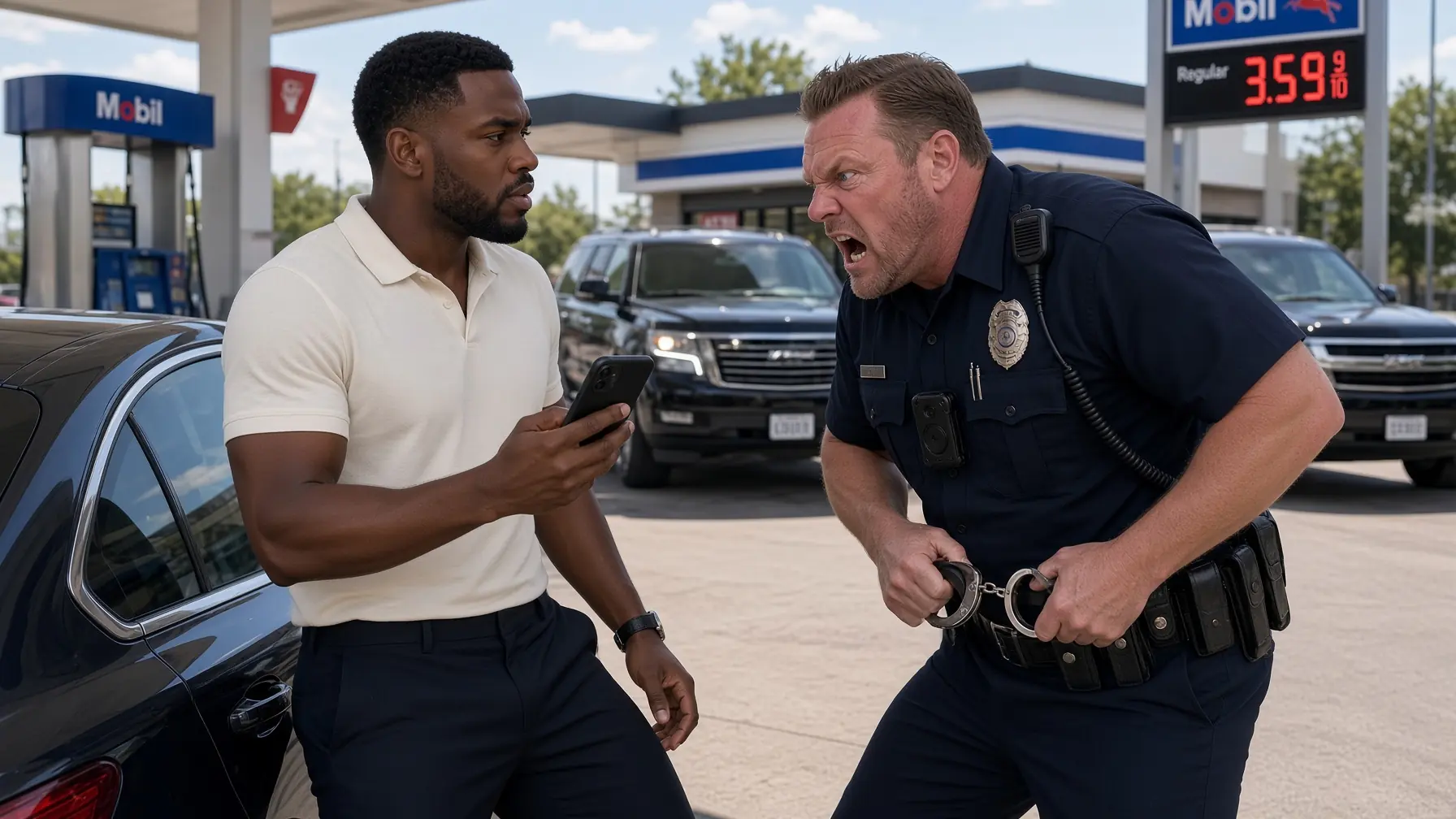
It was 2:38 on a bright Thursday afternoon outside Arlington, Virginia, when Mercer pulled his marked cruiser into a Shell station off Wilson Boulevard. He had not followed the Mercedes there. He had not seen it speeding, weaving, running a light, or making an illegal turn. The sedan was already parked beside pump six with its engine off and the fuel nozzle inserted when Mercer noticed it. What caught his attention first was the plate: white background, unfamiliar lettering, and a format that did not resemble an ordinary Virginia registration. What caught his attention second was the driver.
The man was Black, perhaps thirty, six feet tall, lean, dressed in a navy polo and light gray trousers. A pair of sunglasses rested on top of his head while he watched the pump display climb through fifty dollars. Nothing about him suggested urgency. He was not looking over his shoulder or hiding his face. He was simply buying gasoline in a very expensive Mercedes.
Mercer drove past once.
Then stopped near the convenience-store entrance.
He ran the plate.
The computer returned an unfamiliar government-registration response instead of the normal state motor-vehicle record. Mercer read it twice. The car was associated with a foreign diplomatic mission and had been registered through the U.S. Department of State’s Office of Foreign Missions. The system gave him no stolen-vehicle alert, no wanted-person warning, and no instruction to stop the occupant. It merely directed officers with questions concerning diplomatic status to use an established verification channel.
Mercer did not call that number.
He looked through his windshield instead.
The driver removed the nozzle, replaced it on the pump, and began screwing the fuel cap back into place.
Mercer stepped from his cruiser.
“Hey, buddy.”
The man looked over.
“Afternoon.”
“What are you doing here?”
The question made him pause.
He glanced at the pump.
“Getting gas.”
Mercer walked closer.
“Getting gas.”
“Yes.”
The man’s name was Malik Laurent, although Mercer did not know that yet.
Malik had grown up between Paris, Lyon, Brussels, and Washington. His mother, Amélie Laurent, was French-Senegalese and had spent twenty-five years in France’s diplomatic service. His father, Étienne Laurent, was the current Ambassador of France to the United States. Malik himself was twenty-nine, a French citizen, part of the ambassador’s officially accredited household, and temporarily working with a French cultural-development foundation during his father’s posting.
None of that was obvious from looking at him.
It was not supposed to be.
The Mercedes was an embassy fleet vehicle he had been authorized to use that afternoon because his own car was undergoing maintenance. The unusual plate was not mysterious. It was exactly what the government database had already told Mercer it was: a diplomatic registration.
Malik had just finished lunch with a university administrator in Arlington and was headed back toward Washington for a family event when the low-fuel warning appeared.
He had six minutes before his father’s protection detail expected him at a planned rendezvous point.
Then Officer Mercer walked over.
Mercer pointed toward the rear of the Mercedes.
“I ran that plate.”
Malik nodded.
“Okay.”
“It’s strange.”
Malik looked at the plate.
“No, it isn’t.”
Mercer’s mouth tightened.
“It doesn’t match this state.”
“It isn’t a Virginia plate.”
“That’s my point.”
Malik waited.
Mercer continued. “It’s coming back associated with some foreign government. An embassy or something.”
“Yes.”
“So I’m trying to understand why you’re driving it.”
Malik looked at him for a moment.
“Am I being stopped?”
Mercer glanced around the gas station.
“You were already stopped.”
“That wasn’t what I asked.”
Mercer gave a short laugh.
“See, now we’re making this harder than it needs to be.”
Malik remained beside the fuel door.
“I’m asking whether this is a traffic stop or whether you’re just talking to me.”
“I’m conducting an inquiry.”
“About what?”
“The vehicle.”
“What about it?”
Mercer pointed toward the Mercedes again.
“It’s a ninety-thousand-dollar car with diplomatic plates, and you’re standing here pumping gas into it. I’m checking what’s going on.”
Malik’s expression changed slightly.
“What exactly about me pumping gas makes you think something is going on?”
Mercer exhaled.
“Don’t turn it into that.”
“Into what?”
“You know what I mean.”
“No.”
The officer folded his arms.
“I’m just doing my job.”
Malik nodded.
“Then what part of your job are you doing right now?”
Mercer stared at him.
That was the first moment the conversation stopped being about a license plate.
Questions did something to Mercer. He did not mind people disagreeing with him nearly as much as he minded them requiring him to explain himself. To Mercer, an ordinary citizen being questioned by a police officer had two useful responses: answer or cooperate. Malik seemed intent on creating a third category in which the officer had to justify why the questions were necessary.
Mercer said, “Who owns the car?”
Malik glanced toward the plate.
“You already ran it.”
“I asked you.”
“The registration told you.”
“Is it yours?”
“No.”
“Borrowed?”
“Authorized.”
“By whom?”
Malik picked up the receipt from the pump.
“Officer, if your system tells you the vehicle is lawfully registered to a diplomatic mission and there is no stolen report, what problem are you trying to solve?”
Mercer stepped closer.
“You’re avoiding simple questions.”
“Because they’re personal questions.”
“Whose car is it?”
“The information is in your system.”
“Where are you headed?”
“That isn’t related to the registration.”
“Where are you coming from?”
“Same answer.”
Mercer laughed without humor.
“See what I mean?”
Malik folded the receipt and slid it into his pocket.
“No. I don’t.”
“Most people would just say, ‘Yeah, Officer, it’s my employer’s car. I’m heading home.’ Done.”
“I’m not required to make up an answer just because it makes you comfortable.”
Mercer’s eyebrows rose.
“Make up?”
“You suggested what you wanted me to say.”
“You’re being cute.”
“No.”
Malik opened the driver’s door.
Mercer stepped into the space between him and the door.
“Hold on.”
Malik stopped.
That movement mattered.
Until then, the encounter could still plausibly be described as a voluntary conversation. A police officer could walk up to somebody in a public place and ask questions without automatically creating a detention. A citizen could answer, decline, or walk away unless circumstances changed.
Mercer had just changed them.
Malik looked at the officer blocking the door.
“Am I free to leave?”
Mercer did not answer directly.
“I’m not finished.”
“That sounds like no.”
“I need to figure out what’s going on with this vehicle.”
“You already did.”
“No, I didn’t.”
“You ran the plate.”
“Yes.”
“And?”
“It came back diplomatic.”
“Yes.”
“That doesn’t tell me why you’re in it.”
Malik studied him.
“Why does that matter?”
“Because people steal cars.”
“Is it reported stolen?”
“No.”
“Does the plate match the vehicle?”
“Yes.”
“Does the database show any alert?”
“No.”
“Then what fact makes you suspect I stole it?”
Mercer stared at him.
For perhaps two seconds, he had no answer.
Then his eyes moved over Malik’s clothes, his watch, the Mercedes, and finally back toward his face.
“It doesn’t fit.”
Malik’s expression hardened.
“What doesn’t fit?”
Mercer immediately recognized that he had stepped somewhere dangerous.
He tried to retreat without conceding.
“The situation.”
“What part?”
“A foreign diplomatic vehicle. Different registration. Expensive car. You’re not giving me straight answers.”
Malik nodded slowly.
“So the thing that doesn’t fit is me.”
“I didn’t say that.”
“You said the vehicle’s registration checks out.”
“I said it’s unusual.”
“You said it isn’t stolen.”
“That I know of.”
“You said there’s no alert.”
“Correct.”
“And now you’re standing between me and the car because I don’t fit what you expected to see.”
Mercer pointed at him.
“Don’t put words in my mouth.”
“I’m asking you to explain your own.”
A woman fueling an SUV at the next island had begun watching.
Mercer noticed.
That made him more defensive.
“Let me see some identification.”
Malik did not move.
“For what?”
“Oh, come on.”