The patrol car appeared in Naomi Brooks’s rearview mirror at 9:17 on a humid Thursday night.
At first, she paid it little attention.
The marked cruiser had been parked beneath an overpass near the westbound entrance to Interstate 40, its headlights dimmed and its engine idling. Naomi passed it in a black convertible with the roof raised against the summer humidity, traveling fifty-two miles per hour in a fifty-five-mile zone.
Her seat belt was fastened.
Both headlights worked.
She had stopped fully at the traffic light three blocks earlier.
There had been no lane change, sudden braking, or equipment violation.
Still, the cruiser pulled onto the road behind her.
Naomi glanced at the dashboard, then returned her eyes to the highway.
She was forty-six years old and had spent nearly half her life in law enforcement. She knew the difference between a patrol officer casually traveling in the same direction and one who had selected a vehicle.
The cruiser stayed two car lengths behind her through the first intersection.
At the second, it moved closer.
Naomi kept her speed steady.
Thirty seconds later, red and blue lights burst across the mirrors.
She exhaled once.
Then she activated her turn signal, moved carefully onto the shoulder beneath a streetlamp, and stopped.
The highway was nearly empty.
A row of warehouse roofs stretched beyond the concrete barrier. Farther ahead, the lights of the city shimmered through the humid night.
Naomi turned off the engine.
She lowered the driver’s window halfway.
Then she placed both hands high on the steering wheel and waited.
The officer remained inside the cruiser for almost two minutes.
Through the rearview mirror, Naomi watched him lean over the onboard computer. He appeared to type something, pause, and then type again.
Finally, the driver’s door opened.
The officer who stepped out was tall, broad-shouldered, and perhaps thirty-five. His hair was cut close to the scalp, and his right hand rested near the holster on his belt.
His nameplate read:
T. HARPER
The body camera mounted on his chest showed no active light.
Officer Travis Harper approached slowly from behind, shining a flashlight across the rear seats before directing the beam straight into Naomi’s face.
She narrowed her eyes against the glare.
“License and registration.”
There was no greeting.
No explanation.
Naomi kept her hands visible.
“Good evening, Officer. Why did you stop me?”
Harper leaned slightly closer to the window.
“I said license and registration.”
“I heard you. I’m asking for the reason for the stop.”
“You were weaving.”
Naomi looked toward the road behind him.
“I was not.”
His expression changed immediately.
“You calling me a liar?”
“I’m saying I maintained my lane.”
Harper moved the flashlight across her face again.
“You crossed the center line twice.”
“There is no center line on this section of road.”
The highway consisted of two lanes traveling in the same direction. A concrete divider separated the opposing traffic.
For half a second, Harper looked toward the roadway.
Then his jaw tightened.
“Registration.”
Naomi did not move.
“It’s in the glove compartment.”
“Keep your hands where I can see them.”
“My registration is where you asked me to retrieve it.”
“I didn’t tell you to reach yet.”
Naomi returned both hands to the steering wheel.
Harper stared at her through the window, allowing the silence to become uncomfortable.
Then he said, “Get it. Slowly.”
Naomi opened the glove compartment and removed the registration card.
Her wallet rested inside the center console. She told him before moving toward it.
Harper watched her as though waiting for a mistake.
She handed both documents through the window.
He studied the driver’s license.
“Naomi Brooks.”
“Yes.”
“This your car?”
“The registration confirms that.”
Harper looked at her sharply.
“I asked you a question.”
“Yes. It is my car.”
“Where are you coming from?”
“A meeting.”
“What kind of meeting?”
Naomi held his gaze.
“How is that related to an alleged lane violation?”
Harper gave a short laugh.
“You seem nervous.”
“You’re avoiding basic questions.”
“I answered the questions relevant to the stop.”
He leaned closer.
The flashlight moved across her navy dress, hands, dashboard, and purse on the passenger seat.
“Step out of the vehicle.”
Naomi did not move.
“For what reason?”
“Officer safety.”
“What specific safety concern have I created?”
“You’re being argumentative.”
“Asking for the legal basis of an order is not an argument.”
Harper straightened.
“Out of the car.”
Naomi had heard this tone many times during her career.
She had heard it from officers who were frightened.
From officers who were inexperienced.
And from officers who believed calm questions were challenges to their authority.
She also knew something Harper did not.
Three weeks earlier, Naomi had accepted an appointment as commander of the department’s newly formed Office of Professional Integrity.
Her official first day was Monday.
The unit had been created after years of complaints involving unlawful stops, missing evidence, falsified reports, and unexplained failures inside Internal Affairs.
Naomi had spent Thursday reviewing confidential case files with the state attorney general’s public-corruption division.
The locked briefcase on the rear floorboard contained copies of several active investigations.
Her department credentials were inside her purse.
One sentence could have ended the encounter.
Naomi chose not to say it.
She wanted to see what Harper did when he believed the woman in front of him had no authority.
“Officer Harper,” she said, “is your body camera active?”
His eyes flicked downward.
“It’s recording.”
“The indicator is dark.”
“You know a lot about body cameras?”
“I know enough to see that yours is off.”
His face hardened.
“Are you always this difficult?”
“No. Only when I’m stopped without cause.”
“Out. Now.”
Naomi opened the door slowly.
Harper stepped backward and placed one hand on his weapon.
“Face the car.”
She complied.
“Hands on the roof.”
She placed both palms against the convertible’s roof.
The metal still held warmth from the day.
Harper moved behind her.
“Any weapons?”
“No.”
“Drugs?”
“No.”
“Large amounts of cash?”
“No.”
“What do you do for work?”
Naomi looked straight ahead.
“That is unrelated to the stop.”
“Answer the question.”
“I work in law enforcement.”
Harper paused during the pat-down.
Then he laughed.
“In law enforcement?”
“Yes.”
“Doing what? Filing paperwork?”
Naomi did not answer.Harper continued searching her more aggressively than necessary, pressing along her waist, legs, pockets, and ankles.
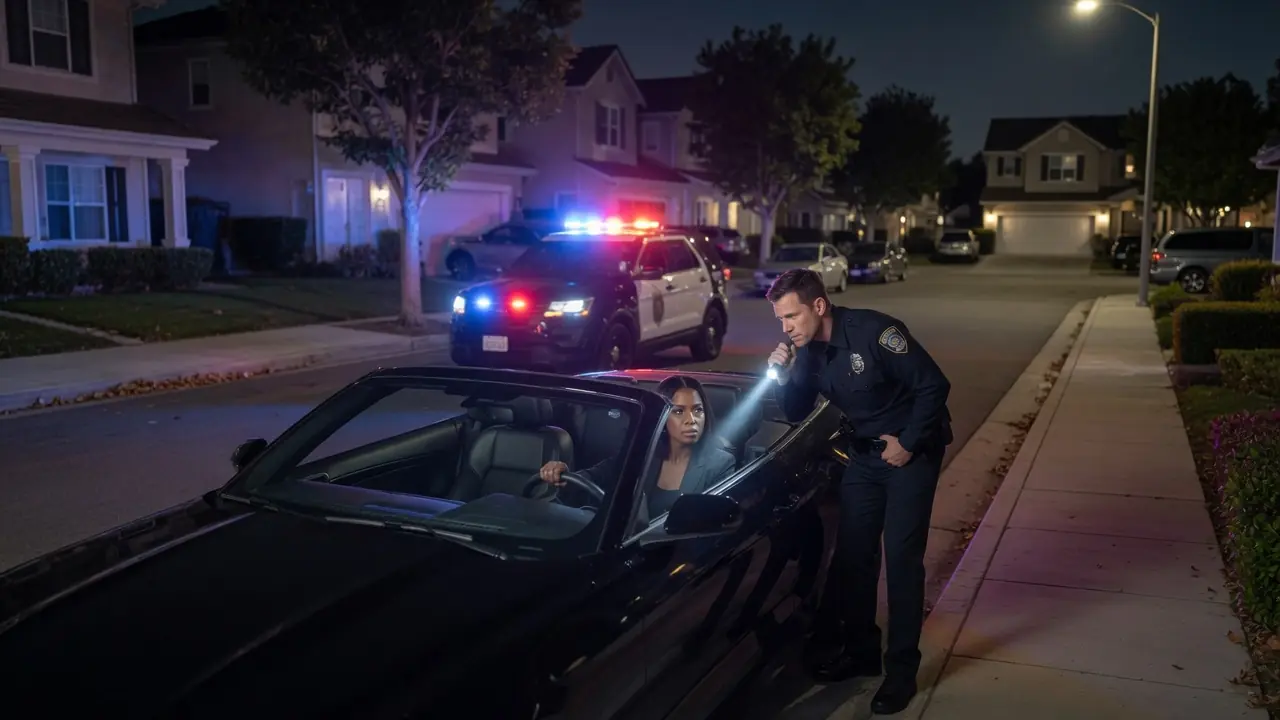
When his hand reached the inner edge of her jacket, Naomi spoke.
“There is professional identification in the breast pocket.”
Harper stopped.
“What kind?”
“You’ll see it if you continue.”
For the first time, uncertainty touched his face.
Then he withdrew his hand.
“Keep your hands where they are.”
He walked around the vehicle and opened the passenger door.
Naomi turned her head slightly.
“I do not consent to a search.”
Harper ignored her.
He shined the flashlight across the floor, beneath the seat, and inside the console.
Then he straightened.
“You smell that?”
“Smell what?”
“Marijuana.”
“There is no marijuana in this vehicle.”
“You telling me what I can smell?”
“I’m telling you what is not inside my car.”
Harper smiled.
“I don’t need consent if I have probable cause.”
The line was practiced.
Naomi had heard officers use it lawfully.
She had also heard it used as a shortcut by officers who believed a claim of odor could transform suspicion into permission.
“There is no marijuana,” she repeated.
Harper looked toward her.
“You think you’re smart.”
“I think you stopped me without cause and are now attempting to manufacture one.”
His expression changed.
“What did you say?”
Before Naomi could answer, a second cruiser arrived.
An older officer stepped out. His nameplate read D. BOYD.
He appeared to be in his late forties, with graying hair and the tired posture of someone nearing the end of a long shift.
“What have you got?” Boyd asked.
Harper answered immediately.
“Possible narcotics transport.”
Naomi looked toward him.
“One minute ago, this was an alleged lane violation.”
Harper pointed at her.
“Don’t talk.”
Boyd looked at the convertible.
“You smell it?”
“Strong odor from the cabin.”
Boyd did not move close enough to confirm it.
He simply nodded.
That small reaction told Naomi something.
Either Boyd trusted Harper completely, or he had participated in this routine before.
Harper opened the rear door and pulled out the locked briefcase.
“What is this?”
“Work material.”
“Open it.”
“No.”
He held the case up.
“You refusing a lawful order?”
“It contains confidential documents.”
“For who?”
“My employer.”
“What kind of employer carries locked papers around at night?”
“The kind handling sensitive information.”
Harper placed the briefcase on the hood.
“Combination.”
“No.”
Boyd moved beside Naomi.
“You should cooperate.”
She looked toward him.
“Officer Boyd, have you independently confirmed the odor Officer Harper claims to smell?”
Boyd did not answer.
“Have you seen drugs?”
“No.”
“Paraphernalia?”
“No.”
“Any sign of impairment?”
“No.”
“Then what lawful basis do you have for supporting this search?”
Boyd glanced toward Harper.
It lasted less than a second.
But Naomi saw it.
Harper saw it too.
“Darren, cuff her.”
Boyd reached for Naomi’s wrist.
She did not resist.
The first handcuff closed.
Then the second.
The metal pressed tightly against the bones of her wrists.
Harper searched the entire vehicle.
The glove compartment.
The console.
The purse.
The space beneath the seats.
The trunk.
Naomi stood under the streetlamp while passing cars slowed to watch.
She had spent decades wearing a badge.
She had commanded crime scenes, testified in murder trials, negotiated with armed suspects, and buried officers she had once supervised.
None of it mattered to Harper.
To him, she was simply a Black woman in an expensive car who had asked too many questions.
He opened the emergency kit in the trunk.
Road flares.
Bandages.
A flashlight.
Gloves.
No contraband.
Harper returned to the locked briefcase.
“Last chance.”
Naomi looked at him.
“No.”
He removed a pry bar from the cruiser.
Boyd shifted uneasily.
“You’re going to break it?”
“If she’s hiding narcotics, yes.”
Naomi spoke calmly.
“Breaking that case will create an additional legal problem.”
Harper laughed.
“You threatening me?”
“No.”
“I’m documenting your decisions.”
“You’re in handcuffs.”
“That does not make your actions disappear.”
Harper wedged the pry bar beneath the first brass latch.
The metal bent.
Then headlights appeared behind the two cruisers.
A dark government SUV slowed and pulled onto the shoulder.
The driver’s door opened.
Deputy Attorney General Elena Price stepped out, still wearing the charcoal suit she had worn at the meeting Naomi left less than thirty minutes earlier.
She saw Naomi in handcuffs.
Then the damaged briefcase.
Her face changed.
“Captain Brooks?”
Harper froze.
Boyd’s color disappeared.
Elena walked closer.
“What is happening?”
Harper straightened.
“Ma’am, stay back. This is an active narcotics investigation.”
Elena looked at the briefcase.
“That case contains sealed state corruption files.”
The pry bar remained in Harper’s hand.
“What?”
“You heard me.”
Elena turned toward Boyd.
“Remove those handcuffs.”
Harper stepped forward.
“Wait. Who are you?”
Elena held out her credentials.
“Deputy Attorney General Elena Price.”
Boyd unlocked the cuffs.
Red circles remained around Naomi’s wrists.
She slowly faced Harper.
He looked from Elena to Naomi, trying to rebuild the confidence that had vanished.
“You should have identified yourself.”
Naomi’s expression remained steady.
“Why?”
“This misunderstanding could have been avoided.”
“No.”
She looked toward the open car doors, the damaged briefcase, and the flashlight still lying across the passenger seat.
“This could have been avoided if you had followed the law.”
Harper’s face reddened.
“I had probable cause.”
“You invented a traffic violation on a road without a center line.”
“You were swerving.”
“The dash camera will show otherwise.”
“You refused to cooperate.”
“I answered lawful questions.”
“I smelled marijuana.”
“There is none in the vehicle.”
“Smell is subjective.”
Naomi nodded.
“That is exactly why corrupt officers find it useful.”
Harper stared at her.
“Captain Naomi Brooks.”
His expression shifted.
“Which division?”
“Professional Integrity.”
The sound of traffic seemed to disappear.
Harper knew the name.
The department-wide notice had been circulated three days earlier.
It announced that a veteran Black police commander from out of state had been hired to lead the new integrity division.
No official photograph had been attached.
Starting Monday, Naomi would oversee Internal Affairs, body-camera compliance, evidence audits, stop data, racial-profiling complaints, and officer discipline.
Harper had just handcuffed the woman appointed to investigate officers like him.
Elena removed her phone.
“I’m calling the state task force.”
Harper stepped closer.
“That isn’t necessary.”
“You attempted to force open confidential evidence.”
“I didn’t know what was inside.”
Naomi looked at him.
“You didn’t know who I was.”
“You didn’t know what was inside the case.”
“You didn’t know who might stop.”
She stepped closer.
“But you knew exactly what you were doing.”
A supervisor arrived minutes later.
Then two more patrol units.
Lieutenant Robert Ross stepped from the lead vehicle and immediately recognized Naomi’s name.
“What happened?”
Harper answered first.
“Routine traffic stop that became complicated.”
Naomi looked at him.
“Is that what you plan to write?”
Ross looked toward Boyd.
“Body cameras?”
Boyd touched his chest.
“Mine is active.”
“Harper?”
“Battery issue.”
Naomi pointed toward the cruiser.
“His dash camera appears active.”
Ross looked at the bent latch on the briefcase.
Then at Naomi’s wrists.
“Officer Harper, surrender your camera, patrol phone, and radio.”
Harper did not move.
“Lieutenant, she refused lawful commands.”
Ross repeated the order.
Harper removed the equipment reluctantly.
An Internal Affairs evidence bag was opened at the roadside.
Naomi looked at the gathered officers.
“Preserve everything.”
The men remained silent.
“Dash camera.”
“Vehicle microphone.”
“Radio traffic.”
“GPS data.”
“Body-camera metadata.”
“Original stop code.”
Harper’s eyes shifted.
That tiny movement told Naomi she had guessed correctly.
Thirty-four minutes after the stop began, someone changed the dispatch classification from unsafe lane movement to suspected impaired driving.
The system recorded the edit.
By sunrise, Naomi was seated inside Conference Room B at police headquarters.
She had not officially started her new position.
That no longer mattered.
Chief Walter Hayes sat at the far end of the table with two deputy chiefs, the Internal Affairs commander, Lieutenant Ross, and attorneys from the city and the state.
The dash-camera footage began.
Naomi’s convertible remained centered inside the lane.
No weaving.
No speeding.
No equipment violation.
Then Harper’s voice came through the cruiser microphone before he activated the emergency lights.
“Black female in a nice car. Let’s see what story she’s got.”
The room became silent.
The dispatcher asked if he had observed a violation.
Harper answered:
“I’ll find one.”
No one moved.
The video continued.
The false center-line claim.
The flashlight in Naomi’s face.
The order to exit.
The invented marijuana odor.
The search.
Officer Boyd’s camera captured the rest.
At one point, while Harper searched the trunk, Boyd leaned closer.
“Nothing in there.”
Harper answered quietly.
“Give me a minute.”
The chief stopped the footage.
“How many complaints does Harper have?”
Internal Affairs Commander Paul Warren opened a file.
“Twenty-nine over thirteen years.”
Naomi looked toward him.
“How many involved racial profiling?”
“Twelve.”
“Unlawful searches?”
“Nine.”
“Fabricated evidence?”
Warren hesitated.
“Two.”
Naomi stared at him.
“Two people accused him of planting evidence?”
“Yes.”
“What happened?”
“Both complaints were unsubstantiated.”
“Were drugs recovered?”
“Yes.”
“Were the drivers convicted?”
“One accepted a plea. The other case was dismissed.”
“Why was it dismissed?”
Warren lowered his eyes.
“Chain-of-custody inconsistency.”
Naomi looked toward Chief Hayes.
“How long have you known about this?”
The chief’s face tightened.
“I knew there were complaints.”
“Did you know the details?”
“Not all of them.”
“You knew enough to assign him to patrol.”
Hayes looked toward Warren.
The Internal Affairs commander shifted.
Naomi closed the file.
“Pull every arrest, search, seizure, and complaint involving Harper and Boyd.”
Warren looked startled.
“That could be hundreds of cases.”
“Then we will review hundreds.”
The audit began that afternoon.
Harper’s department phone contained a private group chat involving eleven officers.
The messages were casual.
That made them worse.
Photographs of Black drivers in luxury vehicles.
Comments about fishing in wealthy neighborhoods.
Jokes about drivers who knew too much law.
One officer wrote:
No consent? Smell weed.
Harper replied:
Works every time.
Another message showed cash spread across a patrol-car hood.
The caption read:
Roadside bonus.
Investigators located the stop.
The official report listed twelve thousand dollars seized as suspected drug proceeds.
The photograph showed nearly twenty-four thousand.
Half the money had disappeared.
The state attorney general obtained search warrants for the officers’ phones, homes, lockers, and financial accounts.
What began as an unlawful traffic stop widened into a corruption investigation across three patrol districts.
The system was simple.
Officers targeted drivers they believed would be easy to intimidate.
Black motorists.
Immigrants.
Young men with prior arrests.
Women traveling alone.
People passing through unfamiliar neighborhoods.
Drivers in older vehicles.
Drivers in expensive vehicles who did not match the officers’ expectations.
A traffic violation was invented.
Sometimes it was weaving.
Sometimes failure to signal.
Sometimes a plate that was difficult to read.
Then came questions unrelated to the stop.
Where are you going?
Where do you work?
Why do you have cash?
Whose car is this?
If the driver objected, the objection became suspicious behavior.
If consent was refused, the officer claimed an odor.
Once the driver was outside, the search began.
Sometimes officers found real contraband.
Sometimes they found cash.
Sometimes they found nothing.
When they found nothing, the report simply stated that the driver was released after investigation.
When they found money, not all of it reached the evidence room.
When they needed drugs to justify a search, substances from previous seizures sometimes reappeared in later cases.
Officers called it balancing the sheet.
Harper was not the architect of the system.
He was simply arrogant enough to expose it.
Lieutenant Ross had approved dozens of questionable reports.
Commander Warren’s Internal Affairs division repeatedly closed complaints without reviewing body-camera metadata, vehicle GPS records, or cash-deposit logs.
An evidence-room supervisor altered weights and property numbers.
A prosecutor accepted plea deals despite missing footage and broken chains of custody.
The corruption reached far beyond a single patrol officer.
Naomi worked fourteen-hour days.
Her temporary house filled with boxes of case files.
She reviewed footage at the kitchen table until after midnight.
She listened to motorists describe what the stops had cost them.
One of the first reopened cases belonged to Terrence Cole.
Terrence had been twenty-three when Harper stopped him outside a convenience store.
The report claimed officers found twelve grams of cocaine beneath his driver’s seat.
Terrence insisted the drugs were planted.
He accepted a plea after prosecutors threatened him with ten years in prison.
He served eighteen months.
He lost his job.
His daughter was placed with her mother’s relatives.
Naomi requested the original evidence bag.
The property number belonged to a separate narcotics case opened three months earlier.
The initials on the seal belonged to Officer Boyd.
Terrence’s conviction was vacated.
He came to headquarters for a meeting.
He sat across from Naomi with both hands folded tightly.
“You gave me my record back,” he said.
“Yes.”
“My daughter is twelve.”
Naomi remained silent.
“She was four when they arrested me.”
“I’m sorry.”
Terrence looked at her.
“You didn’t do it.”
“No.”
“But you wear the same badge.”
Naomi accepted the sentence without defending herself.
“Yes.”
More cases collapsed.
A nurse named Olivia Harris had lost her medical license after officers claimed to find prescription pills inside her vehicle.
The pills were traced to an evidence bag connected to a pharmacy burglary.
A construction worker named Samuel Gaines served three years for possessing a handgun that had previously been stored inside the police property room.
A college student named Devin Ross was beaten after refusing a search.
Harper’s report described him as violently resisting.
The dash-camera microphone recorded Devin asking for a supervisor moments before officers pulled him through the window.
The city had paid small settlements in several cases.
But the officers remained.
Every complaint had been treated as an isolated event.
No one compared the same names.
The same language.
The same camera failures.
The same smell of marijuana that disappeared when laboratory testing began.
Naomi created a pattern-review team.
Complaints were no longer examined separately when the same officer repeatedly appeared.
Search justifications were compared.
Body-camera gaps were mapped.
Cash seizures were matched against bank deposits.
Evidence weights were checked against laboratory records.
The numbers told the story the department had refused to hear.
Harper claimed to smell marijuana in eighty-three percent of his vehicle searches.
Marijuana was found in fewer than nine percent.
His search rate for Black drivers was four times higher than his search rate for white drivers.
Boyd’s camera failed during nineteen of twenty-two disputed searches.
Lieutenant Ross approved every report.
Commander Warren closed nine racial-profiling complaints without interviewing the drivers.
Chief Hayes called Naomi into his office.
“You’re moving too fast.”
She closed the door.
“People went to prison.”
“I know.”
“You had evidence of a pattern.”
“We had allegations.”
“You had data.”
“We didn’t have the resources to review every case this deeply.”
Naomi looked through the window toward the city.
“Then what was Internal Affairs reviewing?”
Hayes lowered his voice.
“You need to understand the pressure on this department.”
“From whom?”
“The union.”
“City Hall.”
“Prosecutors.”
“Crime rates.”
“Public expectations.”
Naomi turned toward him.
“Which pressure required you to ignore planted evidence?”
The chief stood.
“That is not fair.”
“No.”
Her voice stayed calm.
“What happened to those drivers was not fair.”
Hayes walked toward the window.
“I did not know how extensive it was.”
“Did you know enough to suspect?”
He did not answer.
That silence became part of Naomi’s final report.
Two days later, a confidential draft of the findings reached the press.
The city erupted.
News vans surrounded headquarters.
Families demanded that old cases be reopened.
The police union accused Naomi of conducting a political purge.
Harper’s attorney claimed the original traffic stop had been a setup designed to provoke officers.
Naomi responded at a public hearing.
“I was driving home.”
She placed the dash-camera transcript on the table.
“Officer Harper said, ‘I’ll find one,’ before activating his lights.”
She looked toward the cameras.
“He was not trapped.”
“He was recorded.”
The state attorney general convened a grand jury.
Federal civil-rights prosecutors joined the investigation.
Within three months, fourteen officers were indicted.
Harper faced charges for civil-rights violations, falsifying reports, evidence tampering, theft, conspiracy, and obstruction.
Boyd accepted a plea agreement and agreed to testify.
Lieutenant Ross resigned one day before his arrest.
Commander Warren was charged with destroying complaint files and lying to investigators.
Two evidence-room employees pleaded guilty.
A prosecutor was suspended after emails showed that he had knowingly used evidence from officers with repeated integrity problems.
Chief Hayes announced his retirement.
At his final press conference, he said he accepted responsibility for failures that occurred under his leadership.
Naomi watched from her office.
Responsibility sounded much cleaner after retirement papers had been signed.
The department entered a federal consent agreement.
Every major reform Naomi proposed became mandatory.
Patrol body cameras activated automatically when emergency lights turned on.
Manual deactivation generated immediate alerts.
Every consentless vehicle search required written justification and supervisor review.
Officers could no longer rely solely on an alleged marijuana odor without corroborating evidence.
Cash seizures required dual counting on camera.
Evidence transfers required two-person verification.
Stop data was published by race, gender, officer, location, reason, and outcome.
Repeated complaints triggered independent pattern review.
Officers who reported misconduct received legal protection from retaliation.
The largest project was the conviction-integrity review.
Every case involving the indicted officers was reopened.
More than six hundred files were examined.
Eighty-seven convictions were vacated.
Charges were dismissed in dozens more.
The city created a compensation fund for people wrongfully convicted or illegally searched.
Terrence Cole received $3.6 million.
He used part of the money to open an automotive repair shop.
He created a scholarship in his daughter’s name.
Olivia Harris regained her nursing license.
Samuel Gaines received a formal apology from the court that convicted him.
He later said the apology arrived four years too late, but his mother had lived long enough to hear it.
Harper went to trial the following year.
His defense centered on one argument.
He did not know Naomi was a police captain.
The prosecutor allowed him to repeat it several times.
Then she asked, “Would the stop have been lawful if Ms. Brooks were a nurse?”
Harper hesitated.
“No.”
“A teacher?”
“No.”
“A waitress?”
“No.”
“Unemployed?”
“No.”
“Then why does her title matter?”
Harper looked toward the jury.
“It explains why this became such a major case.”
The prosecutor nodded.
“That answer explains the entire department’s failure.”
The jury convicted him.
He received twelve years in federal prison.
Boyd received four years after cooperating.
Ross received seven.
Warren received six.
Other officers received shorter sentences, probation, or permanent bans from law enforcement.
Naomi became the permanent commander of Professional Integrity.
Some officers hated her.
Others quietly thanked her.
One afternoon, a young patrol officer waited outside her office after a training session.
“My partner searches cars the way Harper did,” he said.
“Have you reported him?”
The officer looked down.
“No.”
“Why?”
“He’s popular.”
Naomi waited.
“He’s been here fifteen years.”
“Does seniority make a search lawful?”
“No.”
“What are you afraid of?”
“Being alone.”
Naomi nodded.
“That fear is how corrupt officers recruit people who never intended to become corrupt.”
The young officer filed the report.
The investigation confirmed the allegation.
His partner was removed from patrol.
There was an attempt at retaliation.
The new monitoring system detected it.
The supervisor responsible was disciplined.
The young officer remained.
Two years after the traffic stop, Naomi drove the same highway again.
The streetlamp still stood above the shoulder.
She slowed slightly as she passed the place where Harper had ordered her from the convertible.
For a moment, she remembered the flashlight in her eyes.
The cold handcuffs.
The invented odor.
The pry bar beneath the briefcase latch.
What disturbed Naomi most was not the humiliation.
It was how ordinary the stop had felt.
Harper had not appeared nervous.
He had not struggled to invent the procedure.
He followed a routine.
Ask unrelated questions.
Treat calm disagreement as suspicious.
Claim an odor.
Remove the driver.
Search the car.
Write the report afterward.
The system had worked for years because most drivers had no power to investigate what happened after the stop.
Naomi did.
That did not make her the proper person to receive lawful treatment.
It made her proof that many others had not.
At the next police academy class, recruits watched the full dash-camera recording.
The video ended before Elena Price arrived.
They were not told Naomi’s name or occupation.
The instructor asked a single question.
“Was the stop lawful?”
Some recruits discussed her tone.
Others mentioned the locked briefcase.
One asked what Naomi did for work.
The instructor shook her head.
“That is not relevant.”
They reviewed the facts.
No traffic violation.
No call for service.
No suspect description.
No confirmed odor.
No consent.
No lawful basis for the search.
Eventually, every recruit reached the same conclusion.
The stop was corrupt before anyone learned who sat behind the wheel.
That was the lesson Naomi wanted preserved.
People loved the dramatic version of the story.
A racist officer pulled over a Black woman.
Then he discovered she had been appointed to investigate his own department.
One traffic stop brought down an entire network of corrupt officers.
It sounded like a story about hidden status.
A powerful woman allowing an arrogant man to destroy himself.
Naomi rejected that interpretation.
She did not deserve lawful treatment because she was a captain.
She did not become credible when the deputy attorney general stepped from the SUV.
Her rights did not begin when Harper heard her title.
They existed when the emergency lights appeared behind her.
Before the window lowered.
Before the flashlight entered her face.
Before anyone important arrived.
Harper believed the woman in the convertible was alone.
That belief gave him confidence.
He expected his report to outweigh her word.
He expected supervisors to approve whatever explanation he wrote.
He expected missing footage to be classified as equipment failure.
He expected Internal Affairs to close the complaint.
He expected the system to protect the badge before examining the conduct.
For years, it had.
That night, the system finally failed him.
Not because Naomi shouted.
She never did.
Not because she revealed her credentials.
She waited.
She remained calm and allowed Harper to make each choice clearly enough for the cameras to preserve it.
A false stop.
An invented smell.
An unlawful detention.
A warrantless search.
An attempt to force open confidential evidence.
Then a report changed after the truth became inconvenient.
One officer crossed the line.
Another supported him.
A lieutenant signed the reports.
An Internal Affairs commander buried the complaints.
A police chief accepted the silence.
The traffic stop did not create the corruption.
It opened the door.
Once investigators stepped through, they found years of stolen money, planted evidence, false convictions, missing cameras, buried complaints, and people whose lives had been treated as acceptable losses.
Naomi Brooks had been appointed to clean up the department.
Officer Travis Harper gave her the first piece of evidence before she ever sat behind her new desk.
A pair of flashing lights.
A dark body camera.
And five careless words recorded through a patrol-car microphone.
“I’ll find one.”
In the end, Harper did find something.
Not a traffic violation.
Not drugs.
Not a criminal behind the wheel.
He found the precise moment the department’s corruption could no longer remain hidden.
And by the time he realized who Naomi Brooks was, the cameras had already shown the world exactly who he had been all along.