Officer Ryan Caldwell noticed the old man because he was sitting too quietly.
He was not drinking.
He was not bothering the families near the playground.
He was not arguing, shouting, or approaching strangers.
He sat alone on a wooden bench in Riverside Park with a closed black duffel bag resting beside his polished brown shoes.
For Caldwell, that was enough.
It was a clear Thursday afternoon in late April. Children climbed across the playground while parents stood nearby holding coffee cups and phones. Joggers followed the paved path beside the river, and young leaves moved gently beneath the bright spring sky.
The elderly man wore a dark wool coat over a pale blue dress shirt. A gray flat cap covered most of his short silver hair. His beard was neatly trimmed, and a wooden cane rested between his knees.
His name was Raymond Brooks.
He was seventy-two years old.
To anyone passing through the park, Raymond looked like a grandfather waiting for a family member.
He was actually waiting for a man who had helped steal more than eight million dollars from military widows, wounded veterans, and retirement accounts belonging to city employees.
The duffel bag beside him contained marked currency, copied financial records, and a hidden transmitter.
Three federal surveillance teams watched from vehicles and buildings around the park.
Raymond had spent twenty-eight years with the Federal Bureau of Investigation before retiring. He later returned as a civilian consultant for a joint financial-crimes task force because the suspect trusted older men and refused to meet active agents.
The operation had taken seven months to arrange.
It was supposed to begin in less than four minutes.
Then Officer Caldwell entered the park.
The twenty-six-year-old patrol officer stopped beside the curb and watched Raymond through the windshield.
His uniform was clean.
His body camera was active.
His confidence had grown much faster than his judgment.
Caldwell had been patrolling the Westbrook District for less than two years. His supervisors called him proactive. Command staff liked the number of stops he initiated and the number of field-contact reports he submitted.
Residents who had encountered him used different words.
Aggressive.
Suspicious.
Eager.
Caldwell stepped out of the patrol car and walked toward the bench with one hand resting near his duty belt.
Raymond noticed his pace immediately.
Not hurried.
Not cautious.
Possessive.
The officer approached as though the path, the bench, and everyone standing nearby had become his property the moment he arrived.
Raymond looked toward him.
“Good afternoon, Officer.”
Caldwell stopped directly in front of the bench.
“What’s in the bag?”
Raymond glanced at the duffel.
“Personal property.”
“That wasn’t my question.”
“It was my answer.”
Caldwell studied the old man’s face.
He had expected nervousness.
An apology.
Perhaps the confused compliance of someone intimidated by the uniform.
Raymond showed none of those things.
His hands remained visible on top of the cane.
His breathing stayed steady.
Calm answers disturbed Caldwell because they did not confirm the role he had already assigned to the person in front of him.
“What are you doing here?” the officer asked.
“Sitting in a public park.”
“Waiting for someone?”
“Yes.”
“Who?”
Raymond looked toward the playground.
“That is a private matter.”
Caldwell’s eyes narrowed.
“You have identification?”
“Am I suspected of committing a crime?”
“I asked whether you have identification.”
“And I asked why you require it.”
A woman pushing a stroller slowed on the walking path.
A jogger removed one earbud.
Caldwell noticed the attention.
Instead of becoming more careful, he became more determined not to appear uncertain.
“We received a report about suspicious activity near the playground,” he said.
Raymond looked toward the children.
“What activity?”
“An older man sitting alone and watching families with a large black bag.”
“Who made the report?”
“That information is not relevant.”
“Did the caller describe a crime?”
“I’m conducting an investigation.”
Raymond looked toward the patrol car.
The radio remained quiet.
No dispatcher had spoken.
The surveillance receiver hidden inside his coat monitored both federal and local channels. No suspicious-person call involving Riverside Park had been transmitted that afternoon.
“No one dispatched you here,” Raymond said.
Caldwell stared at him.
“You’ve been listening to my radio?”
“No.”
“Then how would you know?”
“You drove past the park, saw me, turned around, and entered without using the radio.”
Caldwell stepped closer.
“You’ve been watching me?”
“I pay attention to my surroundings.”
“That sounds like an admission.”
“Of what?”
The officer pointed at the duffel bag.
“Open it.”
Raymond’s expression did not change.
“No.”
Caldwell blinked.
“What did you say?”
“You do not have my consent to search the bag.”
The woman with the stroller stopped completely.
A young woman in a baseball cap pulled out her phone and began recording.
Raymond noticed the small red indicator on Caldwell’s body camera.
Good.
His own hidden transmitter was recording too.
“What are you hiding?” Caldwell asked.
“Nothing.”
“Then open it.”
“That is not how consent works.”
Caldwell gave a short, humorless laugh.
“You think being old means you can tell an officer how to do his job?”
“No.”
Raymond looked up at him.
“I think the law tells you how to do it.”
The officer’s hand moved toward the yellow Taser on his belt.
The people nearest the bench became quiet.
Raymond’s fingers tightened slightly around the top of his cane.
Not from fear.
From discipline.
He had spent decades sitting across from armed criminals, corrupt officials, and frightened witnesses. He understood that sudden movement could transform another person’s panic into violence.
“Stand up,” Caldwell ordered.
Raymond looked down at his knees.
“I will need a moment.”
“You need to stand up now.”
“I am seventy-two years old and have an artificial joint.”
Caldwell’s expression showed no sympathy.
“Move.”
Raymond placed one hand against the bench and rose carefully.
The officer watched as though slow movement itself were suspicious.
Raymond stood slightly bent at the waist until his left knee settled beneath him. He kept the cane planted firmly on the ground.
“Step away from the bag.”
“Why?”
“Because I told you to.”
“That is not a legal reason.”
Caldwell removed the Taser.
He aimed it toward Raymond’s chest.
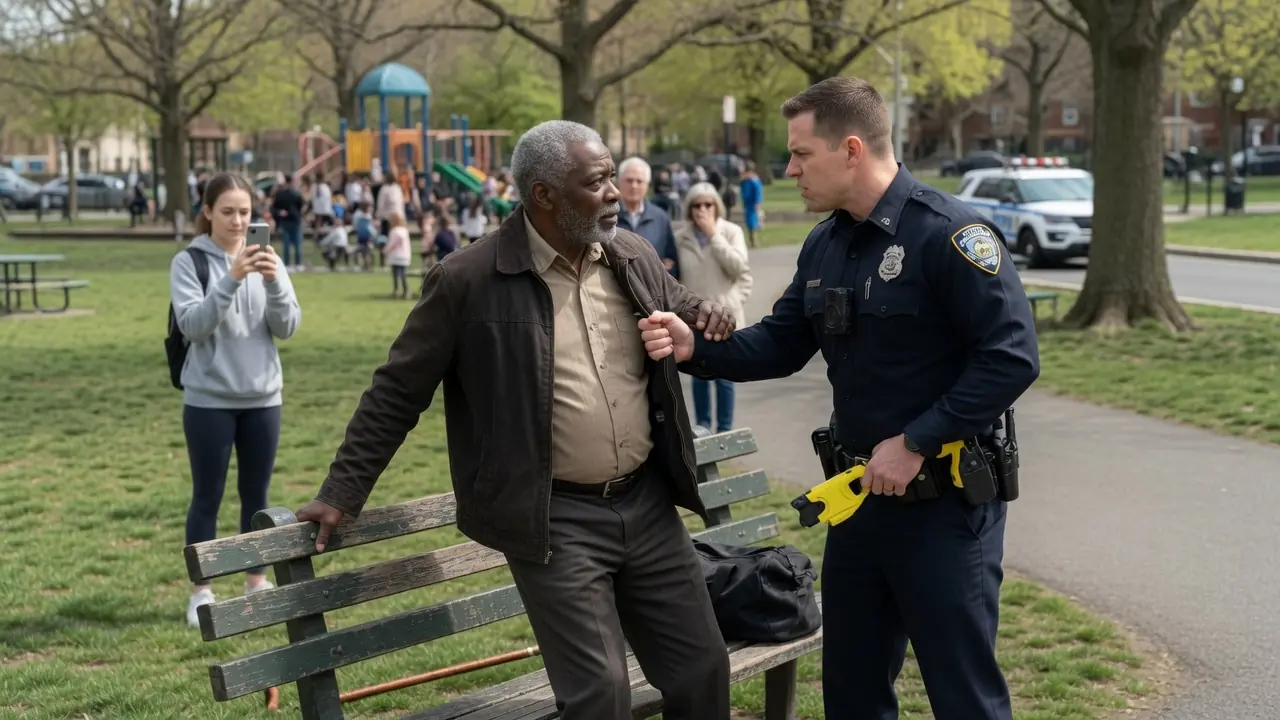
The woman with the stroller gasped.
A father near the playground pulled his daughter behind him.
The young woman recording whispered, “He’s pointing it at an old man.”
Raymond did not move.
“Officer Caldwell,” he said, reading the nameplate, “put the Taser away.”
“You don’t give me orders.”
“No.”
Raymond’s voice remained low.
“I am giving you an opportunity.”
Caldwell pulled his handcuffs free with his other hand.
“Give me the bag or I’ll put you on the ground.”
Raymond’s eyes moved briefly toward the Taser.
A discharge could stop the heart of a man his age.
A fall could fracture his hip or skull.
Yet the officer’s face revealed something more dangerous than fear.
Embarrassment.
People were watching, and Raymond had not performed the obedience Caldwell expected.
“I have committed no crime,” Raymond said.
“You’re being detained.”
“For what offense?”
“Obstruction.”
“Obstruction of what?”
“My investigation.”
“You invented the reason for the investigation.”
Caldwell’s grip tightened.
“Last warning.”
Raymond looked directly at the body camera.
“Make sure your camera catches this part.”
The sentence unsettled the officer.
“What part?”
Raymond slowly released the cane.
It remained standing against his leg.
He moved one hand toward the inside of his coat.
Caldwell raised the Taser higher.
“Hands!”
Raymond stopped.
“My hand is visible.”
“Do not reach inside that coat.”
“You asked what I was doing in this park.”
“I said keep your hands where I can see them.”
Raymond slowly opened the front of his coat with two fingers.
A leather credential wallet hung from a chain around his neck.
He lifted it into view.
The gold seal reflected the afternoon sunlight.
Caldwell stared.
The credential identified Raymond Brooks as a civilian investigative consultant assigned to a joint FBI and Department of Justice task force.
Beneath it was a retired FBI agent identification card bearing the same name and face.
The officer’s smile disappeared.
His Taser began to tremble slightly.
“You’re federal?”
“I was a federal agent before you were born.”
Caldwell lowered the weapon a few inches.
“Why didn’t you say so?”
Raymond looked toward the people recording.
“Why should that have been necessary?”
The officer’s breathing became shallow.
“You were sitting near a playground with a suspicious bag.”
“No.”
Raymond’s voice remained calm.
“I was an elderly man sitting on a public bench with a closed bag.”
“You refused identification.”
“I asked whether I was suspected of a crime.”
“You became argumentative.”
“I answered your questions.”
“You were monitoring me.”
“I observed you.”
Caldwell looked toward the duffel.
“What is this?”
Raymond did not answer immediately.
His eyes moved past the officer toward the far side of the parking lot.
A black sedan had entered two minutes earlier.
The driver was supposed to approach the bench carrying a red folder.
Instead, the man remained inside the car watching Caldwell point a Taser at Raymond.
The sedan’s brake lights brightened.
Raymond touched the transmitter beneath his coat.
“Target is moving.”
Caldwell turned.
The black sedan reversed abruptly.
It struck a parking barrier, corrected, and accelerated toward the north exit.
Two unmarked SUVs entered the lot from opposite directions.
A third vehicle blocked the exit.
Federal agents emerged with weapons drawn.
The driver stopped and raised both hands.
Parents gathered children away from the playground.
Caldwell stood beside the bench holding the open handcuffs and lowered Taser.
Raymond watched the arrest.
Then he looked at the young officer.
“You arrived thirty seconds before the exchange.”
“What exchange?”
“The one you just destroyed.”
Caldwell looked toward the duffel bag.
“What’s inside?”
“Marked currency and financial records.”
“You were buying something?”
“I was meeting a courier.”
The officer’s face became pale.
“I could not have known that.”
Raymond picked up his cane.
“No.”
He planted it carefully against the pavement.
“You keep defending your behavior with what you did not know.”
Caldwell said nothing.
“The question is what you did know.”
Raymond pointed toward the bench.
“You knew I was sitting in a public park.”
“You knew my hands were visible.”
“You knew no crime had been reported.”
“You knew you had no description, no victim, and no emergency call.”
“You knew I was elderly and needed a cane.”
“And you still pointed a Taser at my chest because I would not surrender a bag without a lawful reason.”
The officer looked toward his body camera.
Raymond noticed.
“It is recording.”
Caldwell’s face tightened.
A dark-blue SUV entered the parking lot.
Special Agent in Charge Rebecca Lawson stepped out.
She was fifty-four, with silver beginning to show in her dark hair. Her calm presence carried more authority than Caldwell had shown with a weapon in his hand.
Rebecca surveyed the detained courier.
The federal vehicles.
The bystanders.
Then the patrol officer standing near an elderly man with a Taser and handcuffs.
She approached quickly.
“Raymond, are you hurt?”
“I’m fine.”
She examined his face.
“Did he discharge the weapon?”
“No.”
Rebecca turned toward Caldwell.
“Name?”
“Officer Ryan Caldwell.”
“Department?”
“Westbrook Police.”
“Why were you pointing a Taser at Mr. Brooks?”
Caldwell began speaking too quickly.
“There was suspicious activity near the playground. He refused identification, wouldn’t open the bag, and reached inside his coat.”
Rebecca looked toward Raymond.
“Was there a dispatch call?”
“No.”
She faced Caldwell again.
“Then why did you tell him there was?”
The officer’s face reddened.
“I believed the circumstances justified an investigation.”
“That is not what I asked.”
Caldwell remained silent.
“You invented a caller.”
“I was trying to gain cooperation.”
“You lied to create authority you did not possess.”
“I was trying to keep control of the situation.”
Rebecca looked around the park.
An old man.
A cane.
A closed bag.
Families watching.
“Control of what?”
Caldwell had no answer.
A marked supervisor’s vehicle arrived.
Sergeant Paul Hanley stepped out.
“Caldwell, what happened?”
The younger officer looked relieved.
“I was investigating a suspicious subject. He turned out to be part of a federal operation.”
Hanley noticed Raymond’s credentials.
Then Rebecca.
“I apologize for the interference.”
Raymond watched him.
The sergeant had apologized because Caldwell interrupted federal agents.
Not because the officer threatened an elderly man without cause.
Rebecca noticed too.
“What exactly are you apologizing for, Sergeant?”
Hanley hesitated.
“For compromising the operation.”
“And the unsupported detention?”
“I haven’t reviewed the footage.”
“The officer admitted there was no call.”
Hanley looked toward Caldwell.
“You said someone reported him?”
“I used the language to keep him engaged.”
Hanley closed his eyes briefly.
Rebecca pointed toward the Taser.
“Is threatening an elderly man with a cardiac-impact weapon because he declined a voluntary search consistent with your policy?”
“No.”
“Is arresting him for obstruction after he asks what crime occurred consistent with your policy?”
“No.”
Hanley looked toward the bystanders.
“We should continue this discussion privately.”
The woman in the baseball cap kept her phone raised.
Raymond looked at the sergeant.
“The public is the reason the camera stayed on.”
Hanley ordered Caldwell to holster the Taser.
Then he removed the young officer’s body camera, radio, and patrol phone.
“You are relieved from duty pending investigation.”
Caldwell stared at him.
“Sergeant, I was doing my job.”
“No.”
Raymond’s voice was quiet.
“You were protecting your pride.”
The young officer looked at him.
“You could have told me who you were.”
Raymond leaned slightly against the cane.
“I told you my rights.”
“That isn’t the same.”
“It should have been enough.”
The arrested courier was transported from the park.
The operation had been damaged but not completely destroyed.
The man had carried encrypted account records connecting a financial adviser, two attorneys, and several shell companies to thefts from vulnerable clients.
Because Caldwell appeared, the courier attempted to flee before speaking with Raymond.
He was arrested, but three senior suspects disappeared within hours.
Seven months of careful work had been compromised.
That alone justified a serious investigation.
The body-camera footage revealed a larger problem.
The following morning, Rebecca and Raymond met with Westbrook Police Chief Harold Gaines.
Sergeant Hanley sat across from them inside the department conference room.
Chief Gaines watched Caldwell’s footage twice.
The second viewing stopped when Caldwell raised the Taser and said:
Give me the bag or I’ll put you on the ground.
The chief removed his glasses.
“How many complaints does this officer have?”
Hanley opened the personnel file.
“Seven.”
“In less than two years?”
“Yes.”
“What kind?”
“Improper detention. Unnecessary escalation. Discourtesy. One excessive-force allegation.”
“Findings?”
“Six not sustained. One counseling memo.”
Raymond leaned forward.
“How were they investigated?”
“Internal review.”
“Was body-camera footage available?”
“In five cases.”
“Did the people in those videos behave as I did?”
Hanley looked toward him.
“What do you mean?”
“Calm. Visible hands. Asking what crime occurred. Refusing consent without threatening anyone.”
Hanley opened the first file.
A nineteen-year-old college student had been stopped outside a convenience store after buying water.
Caldwell claimed the student matched a robbery suspect.
The real suspect was approximately forty years old and wore a red coat.
The student wore a white T-shirt and was much shorter.
Caldwell detained him for twenty-eight minutes.
The complaint was closed because Caldwell claimed he acted in good faith.
The second involved a delivery driver parked outside an apartment building.
The man declined a search.
Caldwell placed him in handcuffs and opened the delivery van.
Nothing illegal was found.
The report called the driver evasive.
Another complaint came from a father waiting outside a school for his daughter.
Another involved a nurse walking home after an overnight shift.
One came from a seventy-year-old retired teacher sitting alone inside his car near a public library.
The same phrases appeared in every report.
Appeared nervous.
Avoided questions.
Refused consent.
Officer-safety concern.
Suspicious location.
Raymond closed the file.
“These are not separate incidents.”
Chief Gaines looked at him.
“What are they?”
“One repeated decision.”
The department reviewed every stop Caldwell had conducted.
His camera often activated late.
The opening minutes of several encounters were missing.
Reports mentioned suspicious-person calls that dispatch could not verify.
He threatened people with obstruction thirty-nine times.
Only two were arrested.
Neither charge survived prosecution.
A federal civil-rights analyst examined the stop data.
Caldwell stopped Black residents more than four times as often as population and traffic patterns predicted.
He searched them almost six times as often as white residents.
His contraband recovery rate was lower.
The numbers did not show effective policing.
They showed selection.
Sergeant Hanley had approved most of the reports.
Raymond sat across from him during a second interview.
“Did you recognize the pattern?”
“I noticed Caldwell was aggressive.”
“That was not my question.”
Hanley looked toward the files.
“Yes.”
“Why did nothing happen?”
“He was productive.”
“What does productive mean?”
“Stops. Citations. Searches.”
“Complaints?”
“Every officer receives complaints.”
“Seven in twenty-two months?”
Hanley remained silent.
“He made good numbers,” the sergeant finally said.
“What numbers?”
“Field contacts. Arrests. Weapons recovered.”
“How many of those weapons were lawfully owned and returned without charges?”
Hanley lowered his eyes.
“Several.”
“You knew?”
“I knew enough.”
Raymond leaned back.
“That sentence has protected more misconduct than any written policy ever could.”
The review expanded beyond one officer.
A whiteboard inside the patrol office ranked officers by monthly contacts, searches, and arrests.
Command called it motivation rather than a quota.
Officers who produced numbers received preferred shifts.
Those who resolved situations without enforcement were mocked as social workers.
Young officers learned what behavior brought approval.
Caldwell had entered the department insecure and eager to be respected.
He discovered that aggression created statistics.
Statistics created praise.
Praise felt like competence.
That did not excuse him.
But it explained why supervisors failed to stop him while the pattern was still developing.
The woman who recorded the incident was named Emily Carter.
She provided the original file to investigators.
Her video showed Caldwell approaching with one hand already resting near his Taser.
It showed Raymond seated with both hands on his cane.
It showed the bag closed.
It showed children behind the officer when he aimed the weapon at an elderly man.
An investigator asked Emily why she began recording.
“Because he looked excited.”
“Excited?”
“Not scared.”
She thought for a moment.
“He looked like he wanted the old man to give him a reason.”
The sentence appeared in the final report.
Caldwell’s disciplinary hearing took place six weeks later.
His union attorney sat beside him.
Raymond, Rebecca, Chief Gaines, and Sergeant Hanley attended.
The young officer appeared tired.
His confidence had disappeared.
Rebecca placed the transcript on the table.
“Why did you approach Mr. Brooks?”
“The bag appeared suspicious.”
“Why?”
“It was near a playground.”
“Was it open?”
“No.”
“Did he touch it after you approached?”
“No.”
“Did anyone report criminal activity?”
“No.”
“Why did you claim there was a caller?”
“To gain cooperation.”
“You lied.”
“Yes.”
“Why did you draw the Taser?”
“He would not identify himself or open the bag.”
“Was he legally required to do either?”
“No.”
“Why did you threaten obstruction?”
Caldwell stared at the table.
“I felt I was losing control.”
Raymond spoke.
“Control over what?”
The officer said nothing.
“Over an old man sitting on a bench?”
Caldwell looked toward his attorney.
The attorney advised him to answer only what he knew.
Caldwell shook his head.
“People were watching.”
The room became quiet.
“He kept asking questions,” Caldwell continued. “I kept giving commands, but he didn’t look afraid.”
Raymond studied him.
“That embarrassed you.”
“Yes.”
“So you raised a weapon.”
Caldwell’s voice dropped.
“Yes.”
Chief Gaines asked the final question.
“Would you have acted differently if you had known Mr. Brooks worked with the FBI?”
“Yes.”
Raymond looked toward the chief.
“That answer tells you everything.”
Caldwell was terminated.
Several earlier encounters were referred for prosecutorial review.
Investigators found repeated unlawful detentions, inaccurate reports, and unjustified threats of force.
Two civil-rights lawsuits followed.
Several cases involving Caldwell’s arrests were dismissed.
Sergeant Hanley received a lengthy suspension and was removed from supervisory duty.
The department eliminated its enforcement leaderboard.
Field contacts were no longer treated as proof of performance by themselves.
Supervisors had to review legality, outcomes, complaints, and demographic patterns.
Body cameras automatically activated when patrol doors opened during a dispatched or self-initiated encounter.
The department also began reviewing threatened charges, not only completed arrests.
That revealed how frequently officers used obstruction as a tool of intimidation without intending to defend the charge in court.
Raymond returned to the financial investigation.
The arrested courier eventually cooperated.
Sixteen people were charged.
Most of the stolen money was recovered, though not all of it.
The duffel bag remained sealed inside a federal evidence facility after the case ended.
Raymond kept the small transmitter he had worn beneath his coat.
He began using the Riverside Park audio during police training.
He always stopped the recording before revealing his credential.
Then he gave the recruits only the facts.
An elderly Black man.
A public bench.
A cane.
A closed bag.
No complaint.
No visible crime.
No threatening behavior.
No legal requirement to provide identification.
“What should the officer do next?” Raymond asked.
Some recruits wanted to request identification again.
Others suggested calling backup.
A few wanted to know what was inside the bag.
Raymond shook his head.
“The contents are not evidence until you have a lawful reason to examine them.”
Eventually, the answer became clear.
End the encounter.
The federal credential was never the lesson.
Raymond’s former profession did not create his rights.
During a community meeting, a resident asked why he had not revealed his identity immediately.
“Doing so would have damaged the operation,” Raymond said.
“That was the only reason?”
He considered the question.
“No.”
The room became quiet.
“I spent many years reviewing complaints from people who were treated badly until an officer discovered they had status.”
Raymond rested both hands on his cane.
“I wanted to know whether my credential would change his behavior.”
“Did it?”
“Immediately.”
“What did that tell you?”
“That he understood restraint.”
Raymond’s voice became lower.
“He simply did not believe I deserved it before he knew who I was.”
Ryan Caldwell spent several months blaming the FBI, the department, the bystanders, and the recording.
Then he watched the video without sound.
He saw himself standing over an elderly man.
He saw the cane.
The open hands.
The children nearby.
The Taser aimed at Raymond’s chest.
Without his own voice explaining suspicion and officer safety, the scene looked exactly like what it was.
He had created the danger.
Caldwell entered counseling through a program for former officers.
He found construction work.
One year after the park incident, he wrote Raymond a letter.
It did not ask for forgiveness.
I believed authority meant making people prove they respected me.
When you stayed calm, I treated calmness as defiance because I needed you to be afraid.
I told myself I drew the Taser for safety. The video shows I drew it because people were watching and I felt weak.
I should not have been carrying that weapon that afternoon.
Raymond read the letter once.
Rebecca asked whether he believed it.
“I believe he understands more than he did.”
“Is that enough?”
“No.”
Raymond folded the paper.
“But understanding has to come before change.”
He did not write back.
Caldwell’s redemption, if it came, could not depend on receiving comfort from the man he threatened.
Two years later, Emily Carter attended a police-community meeting at Riverside Park.
The same bench stood beside the river.
Children played nearby.
Families carried backpacks, coolers, and large bags without anyone treating them as evidence.
Emily sat beside Raymond after the meeting.
“I almost didn’t record,” she said.
“Why?”
“I was afraid the officer would come after me.”
“That was possible.”
“I also thought maybe he knew something I didn’t.”
Raymond looked toward the bench.
“Most people assume authority sees facts hidden from everyone else.”
“Did my video help?”
“Yes.”
She appeared surprised by the certainty of his answer.
“It showed the distance between what he later reported and what actually happened.”
Emily looked toward the playground.
“What should people do when they see something like that?”
“Keep a safe distance. Record clearly. State the location and time. Do not interfere physically. Preserve the original file.”
“And if an officer orders them to stop?”
“Stay calm. Know the law.”
Raymond smiled faintly.
“And make sure the camera catches that part.”
Years later, the Riverside Park encounter remained part of federal and local police training.
The video always ended at the same moment.
Caldwell’s Taser pointed toward Raymond.
The handcuffs open.
The old man standing with one hand near his coat.
The credential had not yet appeared.
Recruits had to evaluate the officer’s conduct without knowing whether Raymond was important.
That was the entire purpose.
Officer Ryan Caldwell believed an elderly Black man sitting alone in a park needed to justify his presence.
He believed a closed bag was suspicious because of the person sitting beside it.
He treated refusal as guilt.
Questions as defiance.
Calmness as danger.
Then Raymond revealed a federal credential.
But the credential did not make Caldwell’s behavior wrong.
It only made the system unable to ignore it.
Raymond Brooks had entered the park to help expose a criminal network stealing from vulnerable people.
Instead, a young officer exposed another kind of wrongdoing.
The moment public safety became personal pride.
The moment a request became a command.
The moment uncertainty became suspicion.
The moment an armed officer felt threatened because an old man refused to perform fear for him.
The financial network was dismantled.
The department changed its policies.
The officer lost his badge.
Yet Raymond remembered the encounter for a quieter reason.
For several minutes, Ryan Caldwell believed no one important was sitting on that bench.
And during those minutes, he showed the entire park exactly how he treated a man he believed did not matter.