The front porch camera did not blink.
It captured the badge number.
It captured the raised voice.
It captured the exact moment Officer Nolan Price decided that an elderly woman standing inside her own doorway needed to prove she belonged there.
That recording would eventually cost the city of Memphis $5.2 million, end two careers, expose a pattern hidden inside the police department, and change how every welfare check in the city was conducted.
But at 8:16 on a humid Tuesday morning, Officer Price believed he was dealing with nothing more than a confused old woman who did not understand authority.
Her name was Eleanor Whitfield.
She was seventy-six years old, five feet three inches tall, and dressed in a pale blue robe over a white nightgown. Her silver hair had been combed carefully despite the early hour, and a pair of reading glasses hung from a chain around her neck.
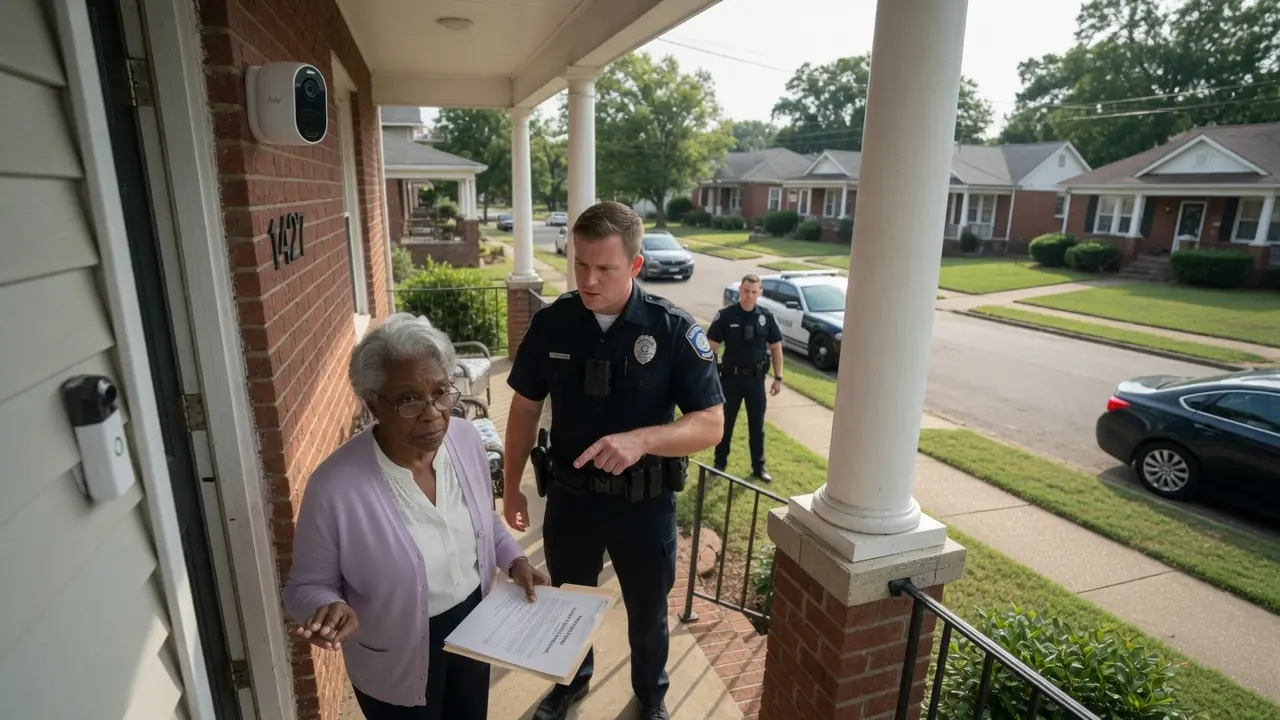
She stood behind the partially opened front door of a red-brick home in Midtown Memphis.
The house had belonged to her family for forty-three years.
A brass number beside the door read 2418.
The same number appeared on the mailbox, the curb, the city tax record, and the driver’s license inside Eleanor’s purse.
Officer Price shined his flashlight into the hallway behind her.
“Step outside.”
Eleanor did not move.
“Why?”
“We received a welfare call.”
“About whom?”
“You.”
She looked past him toward the patrol car parked at an angle across her driveway.
A second officer, Maya Benton, stood near the hood, writing something in a notebook.
Eleanor looked back at Price.
“Who called?”
“That isn’t important.”
“It is important to me.”
Price’s jaw tightened.
“Ma’am, step outside so we can verify that you are safe.”
“I am standing in my own doorway speaking to you.”
“That does not verify anything.”
Eleanor’s eyes narrowed slightly.
“What exactly are you trying to verify?”
“That you live here.”
The words hung between them.
Inside the house, the grandfather clock continued ticking.
A ceiling fan turned slowly above the living room.
Somewhere in the backyard, a cardinal called from the fence.
Eleanor looked toward the small black camera mounted beside the porch light.
Its blue indicator remained on.
Then she looked at the officer again.
“You came to my house for a welfare check and now you want me to prove I live here?”
Price shifted his weight.
“We have had reports of unauthorized occupants in this neighborhood.”
“Unauthorized occupants?”
“People entering vacant homes.”
“This home is not vacant.”
“That is what we are determining.”
Eleanor kept one hand on the edge of the door.
“What would satisfy you?”
“Identification.”
“My identification is inside.”
“Then retrieve it.”
“You just ordered me outside.”
Price stepped closer.
“Do not play games with me.”
Officer Benton looked up from the patrol car.
“Price.”
He ignored her.
Eleanor’s voice remained calm.
“I am not playing a game.”
“Then cooperate.”
“I asked you a reasonable question.”
“And I gave you a lawful command.”
Eleanor studied him.
“No, Officer. You gave me an order.”
Price’s eyes changed.
He was thirty-four, broad-shouldered, with a short military haircut and a reputation among younger officers for being decisive.
He called it control.
Others called it something else when he was not in the room.
Price had worked patrol for eleven years. During that time, he learned which residents complained, which neighborhoods generated attention, and which encounters supervisors rarely questioned.
Eleanor Whitfield looked harmless.
Alone.
Dressed in a robe.
The kind of person who would become frightened before becoming difficult.
Price placed one hand near the holster on his belt.
“Step out of the residence.”
Eleanor looked toward his hand.
“Are you threatening me?”
“I am giving you instructions.”
“Based on what suspicion?”
“We are investigating possible unlawful entry.”
“Into my own home.”
“You have not proven that.”
Officer Benton approached from the driveway.
“Nolan, dispatch confirmed the caller reported possible confusion, not a burglary.”
Price turned slightly.
“I heard the call.”
“The neighbor said she had not seen Ms. Whitfield collect her newspaper.”
Eleanor looked toward the driveway.
The newspaper rested beneath a flowerpot beside the front steps.
“I brought it in yesterday.”
Benton glanced toward it.
Price did not.
He raised his voice.
“Ma’am, this is the final time I’m going to ask.”
Eleanor’s expression remained steady.
“What happens if I decline?”
Price reached toward the door.
Eleanor pulled it closer to her body.
“Do not enter my home.”
“You are obstructing a welfare check.”
“I am alive, responsive, and refusing entry.”
“We need to inspect the residence.”
“No.”
Price pushed his boot against the bottom of the door before she could close it.
The impact made Eleanor stumble backward.
Officer Benton stepped forward.
“Price, stop.”
He pressed the door wider.
“Hands where I can see them.”
Eleanor recovered her balance.
Both hands were visible.
One trembled slightly.
“You forced your way into my house.”
Price entered the hallway.
“I am ensuring there is no one else here.”
“You do not have permission.”
“Sit down.”
“This is my home.”
“Sit down now.”
The porch camera captured everything through the open doorway.
The angle did not show the entire hallway, but it captured Eleanor’s face and Price’s upper body.
It also captured the sound of a framed photograph falling from a side table when Price brushed against it.
The glass shattered.
Eleanor looked down.
The photograph showed her late husband, Charles, in a Navy uniform, standing beside a much younger Eleanor outside the same house.
Price followed her gaze.
“Leave it.”
“That was my husband.”
“I said leave it.”
Eleanor bent slightly.
Price seized her wrist.
She gasped.
Officer Benton entered behind him.
“Let her go.”
“She is not following commands.”
“She is seventy-six years old.”
“That doesn’t mean she can’t interfere.”
Eleanor looked directly at Benton.
“Officer, I am asking you to remove him from my home.”
Benton hesitated.
Price tightened his grip.
“We need identification.”
“My purse is on the kitchen table.”
“Then show us.”
“You are holding my arm.”
Price released her.
A red mark remained around her wrist.
Eleanor walked slowly toward the kitchen.
Both officers followed.
The house was immaculate.
Family photographs covered one wall.
Books filled built-in shelves.
A framed certificate from the Tennessee Bar Association hung beside the doorway to a small study.
Price noticed none of it.
Eleanor lifted her purse from the table.
Before she could open it, he took it from her.
“You do not have consent to search that.”
“I’m retrieving identification.”
He opened the purse.
Inside were a wallet, medication, keys, a folded handkerchief, and a small leather card case.
Price removed the wallet.
Eleanor’s driver’s license showed the address.
2418 Linden Avenue.
He looked at it.
Then toward her.
“Why didn’t you show this at the door?”
“Because I was inside my home and had not committed a crime.”
Price examined the date of birth.
“You live alone?”
“Yes.”
“Any family nearby?”
“That is not relevant.”
“It is relevant to a welfare check.”
“My niece lives ten minutes away.”
“Name?”
Eleanor stared at him.
“You have confirmed my identity.”
“Name?”
“Angela Reed.”
Price wrote it down.
Benton remained near the doorway.
Her discomfort had become obvious.
“Can we leave now?” she asked quietly.
Price looked around.
“Not yet.”
Eleanor’s voice sharpened.
“You have no right to search my house.”
“We are not searching.”
“You are standing in my kitchen after forcing your way through the door.”
Price walked toward the study.
“What’s in there?”
“My private office.”
He reached for the handle.
Eleanor stepped in front of him.
“No.”
“Move.”
“No.”
Price looked down at her.
“Are you hiding someone?”
Eleanor almost laughed.
“Officer, you have verified that I own this residence.”
“I verified the address on one identification card.”
“The deed is in that office.”
“Then show it to me.”
“You do not need my deed.”
“Move.”
Eleanor remained between him and the door.
Price placed a hand against her shoulder.
Benton spoke more firmly.
“Nolan, that’s enough.”
He pushed Eleanor aside.
Not hard enough to knock her down.
Hard enough to make her strike the corner of the wall.
Her glasses fell from the chain.
The porch camera did not capture the impact.
But the microphone captured the sound.
And it captured Eleanor’s breath leaving her body.
Benton moved immediately.
“What are you doing?”
Price opened the study door.
Inside, shelves held legal books, archived case files, photographs, and framed newspaper articles.
A large portrait hung behind the desk.
It showed Eleanor wearing a black judicial robe.
Price stopped.
The name beneath the portrait was engraved on a brass plate.
HONORABLE ELEANOR J. WHITFIELD
UNITED STATES DISTRICT COURT
WESTERN DISTRICT OF TENNESSEE
Officer Benton saw it too.
The room became silent.
Price looked from the portrait to the old woman leaning against the wall.
“You were a judge?”
Eleanor held one hand against her ribs.
“For twenty-eight years.”
Benton’s face lost color.
Price recovered quickly.
“That doesn’t change the situation.”
“No,” Eleanor said.
Her voice had become colder.
“It changes your understanding of it.”
Price looked at the legal shelves.
Then at several photographs.
Eleanor standing beside two presidents.
Eleanor speaking at a federal courthouse dedication.
Eleanor receiving an award from the Department of Justice.
A photograph of her husband in uniform.
Another of her swearing in a class of federal law clerks.
Price stepped backward.
“We responded to a legitimate call.”
“You entered without a warrant.”
“We had exigent circumstances.”
“No.”
“You appeared confused.”
“I asked questions.”
“You refused to cooperate.”
“I refused an unlawful entry.”
Price turned toward Benton.
“Call the supervisor.”
Benton already had her radio in hand.
“Supervisor requested.”
Eleanor straightened slowly.
“Do not touch anything else.”
Price’s confidence had begun to crack.
He walked back toward the kitchen.
Eleanor followed at a distance.
“What was the caller’s name?” she asked.
“We can’t disclose that.”
“You will in the report.”
Price looked toward her.
“It may have been anonymous.”
“It was not.”
Benton glanced at him.
“How do you know?”
Eleanor looked toward the porch.
“My neighbor, Mrs. Warren, called my niece yesterday because I forgot to take the newspaper in.”
She paused.
Price said nothing.
“So either dispatch failed to update the call, or someone changed its nature before you arrived.”
Benton lowered her radio slightly.
Eleanor continued.
“What exactly did dispatch tell you?”
Price answered.
“Possible elderly person in distress.”
Benton shook her head.
“The screen said welfare verification. No response to neighbor contact.”
Eleanor looked toward her.
“You are wearing a body camera.”
“Yes, ma’am.”
“Is it active?”
Benton touched the unit on her chest.
“Yes.”
Eleanor looked at Price.
His camera indicator was dark.
“Yours is not.”
Price looked down.
“It malfunctioned.”
“When?”
“I don’t know.”
Benton’s expression changed.
“It was working at roll call.”
Price turned.
“Stay out of this.”
“I’m already in it.”
A supervisor arrived eight minutes later.
Sergeant Daniel Morris stepped into the house and immediately recognized Eleanor.
“Judge Whitfield.”
Price closed his eyes for half a second.
Morris removed his cap.
“Ma’am, are you injured?”
“My wrist and ribs hurt.”
The sergeant looked at Price.
“What happened?”
Price spoke first.
“She was uncooperative during a welfare check. We entered to verify there were no additional persons or threats inside.”
Morris looked toward Benton.
“Officer?”
Benton hesitated.
Then she answered.
“He put his foot in the door after she refused entry.”
Price’s head turned sharply.
“She was attempting to close the door.”
“She was entitled to.”
Morris looked at Eleanor’s wrist.
The red mark had darkened.
“Did he restrain you?”
“He grabbed me.”
“Did she strike you?” Morris asked Price.
“No.”
“Threaten you?”
“No.”
“Display a weapon?”
“No.”
“Did dispatch report a crime?”
“No.”
Morris’s voice lowered.
“Then why are you inside?”
Price did not answer.
Eleanor looked toward the camera beside the porch.
“The recording will answer that.”
Morris followed her gaze.
Price looked at it for the first time.
The small blue light remained on.
Eleanor’s niece arrived before the officers left.
Angela Reed was forty-six and worked as a civil-rights attorney.
She entered the house carrying a phone and a look Price would later remember.
Not panic.
Recognition.
She had spent her career meeting people after encounters like this.
Now she found one inside her aunt’s home.
“What happened?”
Eleanor pointed toward the broken photograph.
Angela looked at the red mark on her wrist.
Then at Price.
“Did you enter without consent?”
Price said nothing.
Sergeant Morris stepped between them.
“Ms. Reed, we are beginning an internal review.”
“You’re beginning a review before you’ve even left the house?”
“We are documenting everything.”
Angela lifted her phone.
“So am I.”
She photographed the doorway, the broken frame, Eleanor’s wrist, and the mark on the wall.
Then she asked for every officer’s name and badge number.
Price gave his reluctantly.
Before leaving, Sergeant Morris apologized.
Eleanor looked at him.
“Do not apologize until you know whether this is an individual failure or a departmental practice.”
Morris paused.
“What do you mean?”
“You will understand when you review the calls.”
The porch footage was copied before sunset.
Angela sent it to an independent digital-evidence firm.
The file contained a continuous recording beginning fifteen minutes before police arrived.
There was no break.
No editing.
No missing sound.
It showed Eleanor opening the door calmly.
It showed Price shining a flashlight into her face despite the morning light.
It recorded him demanding proof that she lived there.
It showed his boot preventing the door from closing.
Most importantly, it captured the words he spoke while entering.
“People like you always say it’s their house.”
Price denied saying it.
The audio was enhanced.
The sentence became unmistakable.
Angela asked her aunt what he meant.
Eleanor did not answer immediately.
She had spent nearly three decades interpreting language in courtrooms.
She understood that some statements carried meaning precisely because the speaker avoided saying everything.
“He believed I was an old Black woman in a house too valuable to belong to me,” she finally said.
The department placed Price on administrative leave.
Its first public statement called the event a misunderstanding during a good-faith welfare check.
Then the porch video reached a Memphis television station.
Within six hours, it had been viewed more than two million times.
The image of Eleanor standing in her doorway spread nationally.
So did the moment Price ordered her to prove she belonged there.
The department released a second statement.
This one promised transparency.
Eleanor had seen enough institutional statements to recognize the language of delay.
Angela filed a civil-rights complaint in federal court.
She alleged unlawful entry, unreasonable seizure, excessive force, racial discrimination, failure to supervise, and deliberate indifference to repeated constitutional violations.
The city attorney offered to settle quickly.
Two hundred fifty thousand dollars.
Eleanor rejected it.
Then five hundred thousand.
She rejected that too.
Angela looked at her.
“Most people would take that.”
“I am not most people.”
“You could avoid months of litigation.”
Eleanor opened a folder.
“Read this.”
Inside were records she had requested from the city.
Complaints against Officer Nolan Price.
Twenty-seven in eleven years.
Nine involved entries into homes during welfare checks or disturbance calls.
Six involved elderly residents.
Four claimed Price demanded identification from people standing inside their own property.
Three described him blocking doors with his foot.
Only one complaint had been sustained.
The discipline was a written warning.
Angela read the files.
“This is a pattern.”
“Yes.”
“Internal affairs knew.”
“Yes.”
“Supervisors knew.”
“Yes.”
Eleanor closed the folder.
“This is no longer about my doorway.”
The lawsuit expanded.
Through discovery, Angela obtained dispatch recordings, body-camera audits, internal emails, and training materials.
The findings were worse than expected.
Memphis officers received limited guidance on welfare checks.
The policy allowed entry only with consent, a warrant, or an objectively reasonable belief that someone inside faced immediate danger.
But officers were trained informally to gain control first and explain later.
Supervisors praised officers who cleared calls quickly.
Residents who questioned instructions were often labeled uncooperative.
Complaints involving forced entry were regularly classified as communication failures rather than constitutional violations.
Price’s body camera had not malfunctioned.
System data showed he manually deactivated it forty seconds before reaching Eleanor’s porch.
He reactivated it only after Sergeant Morris arrived.
That was not the first time.
In eighteen previous incidents, Price’s camera lost power or stopped recording shortly before a disputed search or entry.
The department never conducted a technical review.
Benton’s footage provided the interior evidence.
It showed Price taking Eleanor’s purse.
Opening it without permission.
Pushing her aside.
Entering the study.
It also recorded Benton objecting several times.
But it showed something else too.
For the first six minutes, she complied with Price’s instructions.
She remained silent while he escalated.
She did not stop him at the door.
The department initially praised her for cooperating with the investigation.
Eleanor did not.
During Benton’s deposition, Angela asked a simple question.
“When did you first know Officer Price was acting unlawfully?”
Benton looked toward the court reporter.
“When he put his foot in the door.”
“How much time passed before you physically intervened?”
“I did not physically intervene.”
“Why?”
“He was senior to me.”
“Was rank a legal justification?”
“No.”
“Were you afraid of him?”
Benton hesitated.
“Yes.”
“More afraid than Mrs. Whitfield?”
The room became quiet.
Benton lowered her eyes.
“No.”
Eleanor watched from across the table.
She did not dislike the young officer.
That made the testimony more important.
Corrupt systems did not survive only because of aggressive people.
They survived because decent people remained cautious at the wrong moment.
The city attempted to have the case dismissed.
The federal judge denied the motion.
His written opinion stated that no reasonable officer could believe an articulate homeowner answering the door created an emergency justifying forced entry.
The case moved toward trial.
Then another family contacted Angela.
An eighty-one-year-old man named George Talley had experienced almost the same encounter two years earlier.
Police responded after a delivery driver saw him sleeping in a chair and believed he was unconscious.
Price entered through an unlocked back door without knocking.
George woke to an officer standing over him with a hand on his weapon.
When George complained, Price arrested him for obstruction.
The charge was dismissed.
Internal affairs cleared Price.
More residents came forward.
A widow questioned in her own bedroom.
A disabled veteran ordered outside in freezing weather.
A grandmother handcuffed after refusing to let officers search for a grandson who did not live with her.
Different addresses.
Different calls.
The same language.
Step outside.
Prove you live here.
Stop being difficult.
The city’s risk-management department calculated that trial exposure could exceed ten million dollars.
Settlement negotiations resumed.
This time, Eleanor demanded more than money.
A new welfare-check policy.
Mandatory body-camera activation before approaching a residence.
Automatic supervisor review whenever entry occurred without a warrant.
Specialized training for contacts involving elderly and disabled residents.
A requirement that officers clearly state whether participation was voluntary.
Independent review of complaints involving homes.
Discipline for officers who disabled cameras without documented cause.
The city resisted the independent oversight provision.
Eleanor stood.
“Then we will let a jury watch the recording.”
The city returned two days later.
The final settlement totaled $5.2 million.
A portion compensated Eleanor for injury and violation of her rights.
Another portion funded independent policy monitoring, public reporting, and training.
The agreement required the department to review every welfare-check entry from the previous five years.
Officer Price was terminated.
The state revoked his certification after concluding that he had made false statements during the investigation.
Sergeant Morris received discipline for failing to identify the earlier pattern under his command.
Several internal-affairs supervisors were reassigned.
Officer Benton received a suspension for failure to intervene.
She accepted it without appeal.
Months later, she requested a meeting with Eleanor.
They sat in the same living room where the photograph had shattered.
Charles Whitfield’s picture had been repaired, though a thin crack remained visible in one corner of the glass.
Benton looked at it.
“I should have stopped him at the door.”
“Yes.”
“I told myself I was trying to calm him down.”
“You were trying to avoid becoming his next problem.”
Benton nodded.
“I’m sorry.”
Eleanor studied her.
“What will you do with that apology?”
Benton looked confused.
“Ma’am?”
“An apology is only useful if it changes the next moment.”
Benton sat straighter.
“I transferred to training.”
Eleanor waited.
“I teach recruits intervention responsibility.”
“Do you tell them about my house?”
“Every class.”
“Do you tell them who I was?”
Benton hesitated.
“I say you were a retired federal judge.”
Eleanor shook her head.
“Then you are teaching the wrong lesson.”
Benton listened.
“The entry was not unlawful because I had once worn a robe.”
Eleanor pointed toward the front door.
“It was unlawful when I was simply an old woman inside her home.”
Benton nodded slowly.
“I understand.”
“Then teach that.”
The new welfare-check policy took effect the following spring.
Officers were required to begin with an introduction, the reason for the call, and a clear explanation that residents were not required to step outside unless lawful grounds existed.
Entering a home required consent, a warrant, or specific facts indicating immediate danger.
General concern was not enough.
Silence was not enough.
Age was not enough.
Confusion could not be assumed merely because someone questioned an officer.
Every warrantless entry triggered automatic supervisory review.
The department created a specialized community response team that paired officers with medical and social-service professionals for many noncriminal calls.
The number of forced entries during welfare checks dropped sharply.
Complaints fell too.
Two years after the incident, Eleanor spoke to a class of police recruits.
She stood behind a podium at the academy.
The porch footage played on a large screen behind her.
The recruits watched Price order her outside.
They watched his boot enter the doorway.
They heard the picture frame break.
When the video ended, the room was silent.
Eleanor looked at the young officers.
“What did he see when I opened the door?”
No one answered.
She called on a recruit in the front row.
“An elderly resident.”
“What else?”
“A Black woman.”
“What else?”
The recruit hesitated.
“Someone he believed would comply.”
Eleanor nodded.
“That is the answer.”
She walked from behind the podium.
“Officer Price did not lose his career because he failed to recognize a federal judge.”
She looked across the room.
“He lost it because he believed recognition was required before respect.”
A recruit raised his hand.
“What should he have done?”
Eleanor smiled faintly.
“Introduced himself.”
A few recruits looked surprised.
“Explained why he was there.”
She continued.
“Asked whether I needed assistance.”
“And when I said no, observed whether any fact suggested immediate danger.”
“Did any?”
“No.”
“Then he should have left.”
Another recruit asked, “What if the caller was genuinely worried?”
“Concern does not erase the Constitution.”
Eleanor’s voice remained calm.
“You may investigate.”
“You may ask questions.”
“You may request cooperation.”
“But you do not turn a welfare check into a home search because a resident refuses to surrender dignity.”
After the lecture, one recruit remained behind.
His grandmother lived alone.
He admitted he had always assumed officers could enter a house during a welfare call if they felt something was wrong.
Eleanor handed him a printed copy of the new policy.
“Feelings begin investigations.”
She tapped the page.
“Facts justify intrusion.”
The repaired photograph of Charles remained in Eleanor’s hallway.
She chose not to replace the cracked glass.
Visitors sometimes asked why.
“It reminds me that damage does not disappear simply because someone pays for it,” she said.
The city’s settlement funded a legal clinic for elderly homeowners facing unlawful searches, deed fraud, predatory liens, and housing discrimination.
Eleanor served on its board.
She donated a large portion of her personal award to the clinic.
Angela objected.
“You already spent months fighting for this.”
“I fought for accountability.”
“You were still injured.”
Eleanor looked toward the front door.
“I have enough.”
The clinic opened inside a restored building three blocks from the federal courthouse where Eleanor once presided.
Its first client was an eighty-three-year-old woman whose property had been placed into foreclosure over a fee she never owed.
Its second was a veteran threatened with eviction after refusing an illegal inspection.
Its third was George Talley.
The man Officer Price had arrested inside his own home.
With Eleanor’s help, George reopened his civil claim.
The city settled.
The police department reviewed Price’s earlier arrests and dismissed several remaining charges connected to questionable home entries.
For years, Price insisted he had been punished because Eleanor was powerful.
He said anyone else would have been ignored.
On that point, he was partly correct.
Someone else might have been ignored.
That was precisely why Eleanor refused the first settlement.
The front porch camera did more than capture an officer making a mistake.
It preserved a method.
The assumption that authority expanded when residents looked vulnerable.
The belief that hesitation meant guilt.
The idea that asking questions was resistance.
Eleanor’s title did not create the violation.
It prevented the violation from disappearing.
On the third anniversary of the incident, Eleanor stood on the same porch at sunrise.
The neighborhood was quiet.
The newspaper rested near the steps.
She walked outside, picked it up, and looked toward the camera.
Its blue light remained on.
The front gate opened normally.
No police car blocked the driveway.
No flashlight crossed her face.
No one demanded proof that the house behind her was hers.
The settlement amount appeared in headlines.
The ruined career became a warning.
The policy changes became department statistics.
But Eleanor remembered the smallest moment.
Officer Price looking at her driver’s license.
Seeing the matching address.
Then continuing anyway.
That was when the encounter stopped being about uncertainty.
He had the answer.
He simply did not like what it required him to accept.
A woman in a robe.
An expensive home.
A calm refusal.
A person who knew the difference between a lawful request and an order spoken loudly enough to imitate one.
People later told the story as though Price had made the mistake of confronting the wrong old woman.
Eleanor corrected them every time.
“There is no right old woman for that treatment.”
She did not need to be a retired judge.
She did not need photographs with presidents.
She did not need a niece who practiced civil-rights law.
She did not need a camera.
The threshold of her home should have been enough.
The front porch footage never lied.
It showed a badge.
A boot in a doorway.
An elderly woman refusing to surrender the rights she had spent a lifetime defending from the bench.
And one officer learning, far too late, that a person does not have to step outside her own house simply because authority has forgotten where its power ends.