A disabled veteran was humiliated during a traffic stop, mocked by a cop who saw only weakness instead of courage. Officer Dalton's arrogance turned a simple ticket into a public disgrace that spread across the town overnight. But when hundreds of bikers rode in silent unity to demand respect, the power shifted in a way no one expected. And what happened next proved that true justice can roar, yet still know when to idle. The sun was sinking low over Willow Creek, painting the small town streets in soft gold and copper.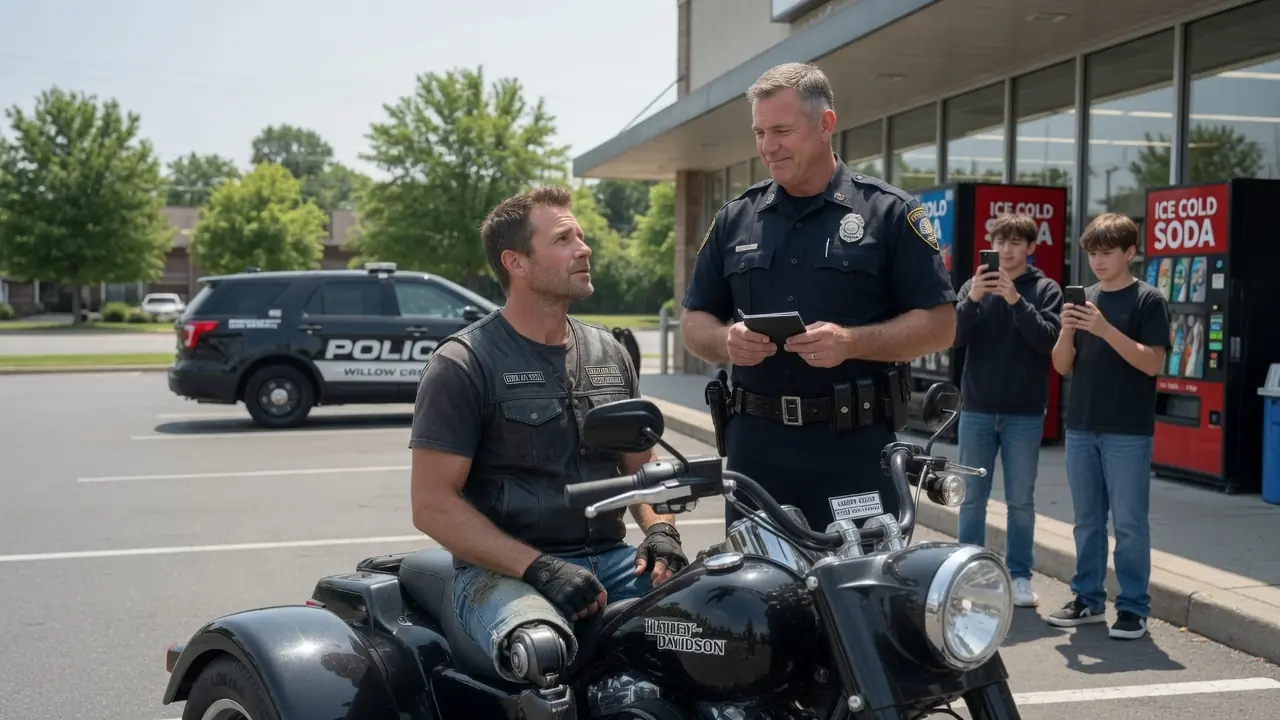
The air carried that familiar summer hum, cicadas in the trees, kids laughing over melting ice cream, and somewhere the faint growl of a Harley trike rolling steady down Main Street. At the handlebars was Evan Reed, 37, former Army mechanic and father of one. His trike wasn't just a machine. It was freedom rebuilt from fragments. After the blast overseas that took his left leg, he'd spent months learning to walk again, then longer learning to ride again.
He'd crafted this bike himself, hand controls custom fitted, balance perfected on three wheels instead of two. Every ride reminded him that he was still whole, still capable. That night he wasn't speeding or showing off, just cruising home from a veterans meet up. Leather vest flapping lightly in the warm air, a calm smile under his helmet. Then came the flash, red and blue lights slicing across the mirror.
He slowed immediately, pulled into the grocery store parking lot, a place bright with neon signs and evening chatter. A busker wrestled a harmonica tune on the corner. Teenagers leaned against the soda machine, phones already ready for whatever was about to happen. Officer Mark Dalton stepped out of his cruiser. Late 40s, broad-shouldered, a man who carried authority like armor.
His body cam blinked to life. "License and registration," he said sharply, then smirked, "and maybe a hearing test for that tractor you call a motorcycle. " Evan blinked, confused but polite. "Sir, the trike's within the legal decibel limit. " Dalton cut him off with a dismissive gesture. "Save it. That thing's a disturbance.
And what's this? " He pointed at the hand controls near the throttle. "Cute setup. So, that's how you pretend, huh? " The word landed like a blow. Pretend. Evan felt the sting rush straight to his throat.
My leg. " Dalton gave a loud sigh, loud enough for the small crowd to hear. "Of course," he said, rolling his eyes, "always an excuse. " He reached for the handlebars like he was moving a toy off the curb. The trike tilted. Evan tried to steady it, but his prosthetic foot slipped on the painted line. He caught himself on the fender, the metal biting into his palm.
Around them, gasps, whispers, and a few uneasy laughs. Someone lifted a phone higher, recording. Dalton's smirk deepened, the kind that wasn't born from joy but control. Into his body cam, he said flatly, "Sir, if you can't control your vehicle, maybe you shouldn't be on the road. Evan looked up at him, eyes steady but burning, and said nothing.
His hand stayed tight on the grips, not from fear, from anger restrained. The silence that followed wasn't empty. It was heavy, filled with everything that couldn't be said without losing dignity. As Dalton walked back to his cruiser, he told himself he'd done his job. Another noisy biker, another ticket.
He didn't notice the faces in the crowd, the mother shaking her head, the busker stopping mid-song, the teenager lowering his phone with a frown. He didn't notice that this stop, this small humiliating moment, was about to set off something far bigger than either man imagined. The road home felt longer than usual. Evan rode in silence, the hum of his trike steady beneath him, but every echo of laughter from that grocery lot followed close behind. The body-cam lights, the stares, that single word, pretend, looped in his mind like a scratched record he couldn't turn off.
When he reached his small house on Maple Street, porch light glowing warm against the dark, he took a breath before stepping inside. His daughter, Mia, was at the kitchen island, pencil between her fingers, solving fractions with the kind of focus that made him proud every time he saw it. She looked up the moment she heard his uneven step. "Hey, Dad," she said with a grin. Then her eyes caught the scrape on his leg brace.
"What happened? " Evan forced a smile, trying to smooth the edge from his voice. "Just a long day, little mix-up with a police officer. That's all. " Mia frowned. "Did you fall? " "Just a small slip," he said. "I'm okay. " He reached for a soda, cracked it open, and leaned against the counter.
He didn't tell her about the laughter. He didn't tell her how the officer's face had burned into his thoughts, or how he'd felt every pair of eyes in that parking lot judging him. He didn't tell her how humiliation could sting more sharply than pain ever had. After she went to bed, Evan sat at the kitchen table with the lights dimmed, listening to the house settle. His prosthetic rested against the chair leg, the faint whir of its joint the only sound.
The silence wasn't peaceful. It was heavy, stretching longer than the hours themselves. At midnight, his phone buzzed. A message from a friend. Man, you're trending.
Check this. He opened the link. The video played, shaky, phone-recorded, but clear enough. The crowd, the stumble, the officer's smirk. He watched it once, then again.
Each replay felt like reopening a wound. Comments rolled beneath it like a flood he couldn't stop. Some were kind. That poor guy. Others weren't.
Shouldn't be riding if he can't stand. Fake sympathy for another biker breaking the law. And then the one that broke something in him. So that's how they pretend. He closed the app.
The glow of the screen reflected in his glass of water, cold and untouched. His phone buzzed again. This time a text from the garage where he worked part-time, fixing engines. Hey, sorry, man. One of the regulars canceled his appointment.
Said he didn't know you were that guy. I'll try to fix it. Evan stared at the message until it blurred. The room felt smaller, his chest tighter. He rubbed his leg where the prosthetic met skin.
The socket always pinched when he was angry. Tonight, it felt like it was closing in. Meanwhile, Officer Mark Dalton sat at his own kitchen table across town. The glow of the TV casting tired light across an untouched cup of coffee. He'd seen the same video hours earlier, sent by a colleague with a half-joking text, "You made the internet. " He'd watched it three times.
Once as an officer, once as a critic, and once as a man who didn't like what he saw. He told himself he'd done his job, that the biker was out of line, that he'd followed procedure. But the still frame of that stumble replayed in his head. The sound of the crowd reacting. The moment his own smirk flashed on the body cam.
Dalton muted the TV, rubbing his temples. "He looked so angry, that vet," he thought, "so humiliated. " He tried to replace the guilt with logic. "Noise complaints have doubled this month. I'm keeping the streets safe. My brother died because one of them didn't care. " The thoughts circled like excuses worn too thin to hold weight.
He took a sip of cold coffee and set the mug down too hard, the sound sharp in the empty room. "If I let one special case slide," he said to no one, "I let order slide. " But when he clicked the video again, his eyes stopped on the moment the trike tilted and the man's leg skidded across the painted line. Not dramatic, not staged, just raw human struggle. For a second, he saw not a biker, not a problem, but a man trying not to fall. He looked away.
Outside, the town was quiet, unaware that a single night, a single small act of mockery, had already set two men on paths that would soon collide again. The morning light over Willow Creek came quiet and clean, as if unaware that the town had gone viral overnight. But while most people were just pouring their first cup of coffee, the video of the grocery lot was already racing across feeds, shared, debated, dissected. By 6:00 a.m. it had crossed county lines. By 6:30 a.m. it reached a private chat group of the Iron Lanterns, a veteran-founded riding club known for charity runs and community outreach.
Their leader, Lena Brooks, sat on her porch scrolling through comments, her jaw tightening with each new one. She'd met Evan Reed two years earlier at a fundraiser ride for wounded veterans. She remembered his quiet humor, his stubborn resilience, and the way he never accepted pity. At 6:40 a.m. she called him. "Evan, I saw the video," she said.
Her tone wasn't pitying. It was precise, steady, like someone ready to fix something broken. He sighed. "Then you saw enough. " "I saw too much," she replied. "We're not doing torches and pitchforks.
We're doing policy and presence. You in? " He hesitated. The last thing he wanted was to fuel more anger. "Lena, I don't want a war. I just want respect back. " "That's exactly what we're fighting for," she said.
"Not revenge, dignity. " She laid out the plan, a peaceful stand ride. No noise, no revving, no chaos, just a circle of riders showing up as witnesses demanding action, not fury. Their message would be simple and lawful. Mandatory disability sensitivity training for all local officers. A fair review of noise enforcement policies that too often targeted bikers arbitrarily.
And a public apology, not behind the desk, but face-to-face, right where it happened. Evan listened in silence. Hope was dangerous. It had disappointed him before, but something in her conviction cut through the exhaustion. By noon, the movement had grown beyond her expectations.
Notifications stacked like dominoes, messages, posts, calls. Veterans associations reposted the plan. A group of retired firefighters offered to help with crowd safety. Even a few active-duty officers quietly liked the announcement under burner accounts. Then came a call from Roy Hadley, a retired highway patrol captain respected in three states.
He'd lost a trooper years earlier to a reckless chase, and since then, he'd made it his mission to rebuild trust between riders and law enforcement. "I heard what happened," he told Lena. "If you're going to stand, do it right. I'll talk to dispatch. We show up lawful, or we don't show up at all. " His words became the motto of the day.
That evening, Evan scrolled through his phone again. The online noise hadn't stopped. If anything, it had sharpened. One message cut deep. "Crawl if you can't ride. " He almost deleted the entire thread, almost decided not to go.
The old voice in his head whispered that he didn't matter enough to fight back, that maybe silence was safer. But then, Mia came into the room, her hair messy from sleep, her eyes too wise for ten. She noticed him holding his prosthetic leg, his thumb tracing the metal edge like it was something fragile. "Dad," she said softly, "if they see you, maybe the next kid won't laugh. " Evan froze. In that small voice, there wasn't anger, only clarity.
He looked up, nodded slowly, and said, "Then we ride. " That moment wasn't loud or cinematic. It was quiet, but it carried more weight than thunder. It was the instant hope began to turn from a feeling into an action. The next morning broke bright and cool, a soft haze lifting off the asphalt of Sycamore Street. For a few brief moments, everything felt normal until the first low rumble rolled through the air.
It started faint, like thunder in the distance. Then it grew, steady, rhythmic, layered, until it became a single living heartbeat of steel and purpose. By 8:58 a.m., Officer Mark Dalton stepped out onto his porch, a mug of half-cold coffee in his hand, wearing a wrinkled T-shirt that suddenly felt far too thin for what he was seeing. Down the street, chrome and leather shimmered like a river. Bikers, dozens, then hundreds, were arriving in quiet formation.
Helmets on, flags folded against the wind, no chaos, no blaring horns, no defiance, just presence. It wasn't a blockade, it was an embrace, disciplined, respectful, powerful. The kind that made even silence sound loud. Neighbors came out in robes and slippers, drawn by the vibration in the ground. Someone's dog began to howl, half in confusion, half in awe.
Curtains lifted, cameras appeared, and yet the riders didn't play to them. They simply arrived, one after another, until three hundred motorcycles stood along the street in perfect order. At the front of the formation was Roy Hadley, the retired patrol captain, yellow vest over his denim jacket. His palms faced forward, calm but commanding. Patrol cars idled quietly at the far end of the block.
The police chief already briefed, already waiting to see if peace would hold. Lena Brooks killed her engine, the hum fading like a held breath, and stepped up onto the curb with a small microphone clipped to her jacket. Her voice carried, steady and clear. "Officer Dalton," she began, "we're not here to ruin your morning. We're here because something went wrong in the town we all care about.
This isn't a protest, it's a reset. " Her tone wasn't angry, it was firm, almost kind. The kind that leaves no room for denial, but still offers dignity. Then, through the sea of chrome, Evan Reed appeared. He wasn't in armor or leather this time, just jeans, a clean jacket, and steady eyes. His trike rolled up the driveway slowly, engine low and patient.
Beside him walked Mia, holding a handmade sign in both hands. The letters were uneven, but bold. "Respect is a safety feature. " The crowd hushed. What filled the silence wasn't intimidation, it was reverence. One man, one child, sunlight glinting off brushed steel.
Dalton's jaw tightened. His heart hammered in a rhythm that didn't match the engines. He wasn't facing an enemy, he was facing a mirror. The body cam footage had been replaying in his head all week, but seeing Evan now, upright, calm, and unbroken, made the regret real. He took a slow breath, stepped off his porch, and walked down the short path toward them.
"I... " He stopped. His voice caught, the words refusing to come out rehearsed. This needed to be human, not official. "Mr. Reed, I was wrong. " He let the air hang, then he said it again, stronger. "I was wrong to mock you, wrong to assume.
I let my job and my past make me cruel. I thought I was protecting order, but all I did was add to someone else's pain. I'm sorry. Evan studied him for a long moment. Around them, even the engines seemed to hold still.
The apology didn't erase what had happened, but it acknowledged it, and that was the first real repair. Then, through the police chief, who had been standing near one of the patrol cars, stepped forward. His tone was official, but resolute. Effective immediately, all Willow Creek officers will complete disability awareness and veteran interaction training. Noise enforcement will be standardized.
No more judgment calls. Officer Dalton will attend and help teach the first session, and the body cam recording will be used for education with his consent. Dalton nodded, his throat tight. And he added, "I'll cover the cost of Mr. Reed's citation. I'll also donate a month of overtime pay to the Adaptive Riders Fund. " There was no applause, just stillness.
Respect. Lena glanced toward Evan, a quiet question in her eyes. Evan reached down, resting his hand lightly on his trike's fender. Then he looked up at Dalton. "You don't have to like motorcycles," he said evenly, "but you have to see the people on them. " He looked at Mia's sign, then back to Dalton.
"Apology accepted. " For a long moment, no one spoke. Then, one by one, engines began to turn over. The deep, steady sound filled the street like a hymn, a chorus without words, powerful, but peaceful. The riders didn't surround Dalton to trap them. They surrounded them to remind them.
They rode alongside Evan and Mia as the pair led the slow procession down Sycamore Street. three hundred Harleys moving in unity, sunlight flickering off metal like sparks of reconciliation. The message was unmistakable. A boundary had been drawn, but a bridge had also been built. The story didn't end with the rumble of engines fading into the horizon. That morning became a beginning, one that changed how Willow Creek saw itself.
Within a week, the police department's training room filled to capacity. Uniforms and civilian clothes shared the same space. Officers, dispatchers, a city attorney, and half a dozen riders who brought adaptive equipment to demonstrate how people like Evan kept freedom alive on the road. The projector screen glowed pale blue as Officer Mark Dalton stood at the front, shoulders squared, a remote in his hand. On the screen froze a still frame from his own body cam, the moment that had nearly defined him forever.
He pressed play, but there was no sound, just the images. The stumble, the crowd, the quiet cruelty he'd once ignored. When the clip ended, he didn't justify it. He didn't apologize again. He simply said, "Listen to what's missing.
That silence between my words, that's where empathy should have been. " The room stayed still. Then he spoke about what he'd learned, how authority without compassion becomes blindness, and how easy it is to confuse control for justice. He didn't ask for forgiveness. He asked the rookies to do better. Across town, the small auto garage where Evan worked had its own surprise waiting.
A familiar customer pulled up in an old pickup that coughed more than it drove. It was the same man who'd canceled his last appointment after seeing the viral clip. The man held his cap in his hands. "My boy watched that video," he said quietly. "He asked me if I'd laugh if it was him.
I didn't have an answer. So, I figured it's time I try to be the kind of man who would. " Evan nodded wordless and rolled up his sleeves. Sometimes forgiveness doesn't come in speeches. It comes in the sound of a socket wrench and the smell of engine oil. Meanwhile, Lena Brooks and Roy Hadley kept the promise they'd made that morning.
The stand ride became an annual event, part rally, part reflection. They called it respect is a safety feature. Half of it was a bike blessing, the other half a workshop on policy, inclusion, and road safety. Evan helped every year, not as a symbol, but as a mentor. On quiet Sundays, he taught new amputee riders to take their first throttle twist on a sunlit lot, steady, confident, unafraid of painted lines anymore.
And Mia, now with her father's calm determination, learned to change oil and adjust mirrors. At school, she started speaking up in meetings about accessibility and fairness. Her voice, clear and sure, carried the same courage her father had shown that morning on Sycamore Street. As for Mark Dalton, he kept a single photo on his dashboard. A little girl holding a cardboard sign that read, "Respect is a safety feature," framed by a sea of polished motorcycles.
On hard days, when the radio crackled with tension or the weight of old grief began to press down again, he touched the edge of that photo and breathed. He'd remember what those three hundred engines had taught him when they filled his street without choking it. That power can become mercy when guided by respect. That justice doesn't always roar.
It sometimes hums steady and patient. And that a town stays whole when strangers show up for one another then quietly go home changed. The video that started it all still floats around online but it's rarely shared by itself anymore. Usually it's posted side by side with a second clip.
A classroom, a prosthetic leg resting beside a custom throttle kit, an officer and a biker standing together in front of a room full of recruits. They co-teach what they now call the pause that saves face. At the end of that clip a line always appears in the comments written by different people in different ways but meaning the same thing every time. Turns out justice can roar and still know when to idle.