What you are about to hear is the story of a man who said almost nothing, did almost nothing, and by doing so destroyed everything Officer Brett Langdon had spent 12 years building. Langdon thought he had pulled over a nobody. He was wrong in a way that not even his worst nightmare could have prepared him for.
The suburb of Clearwater Heights sits 17 miles outside of Fort Meade, Maryland, tucked behind a corridor of oak trees and manicured culde-sacs, where federal employees, defense contractors, and career intelligence officials quietly live out their domestic lives far from the classified world they inhabit during daylight hours.
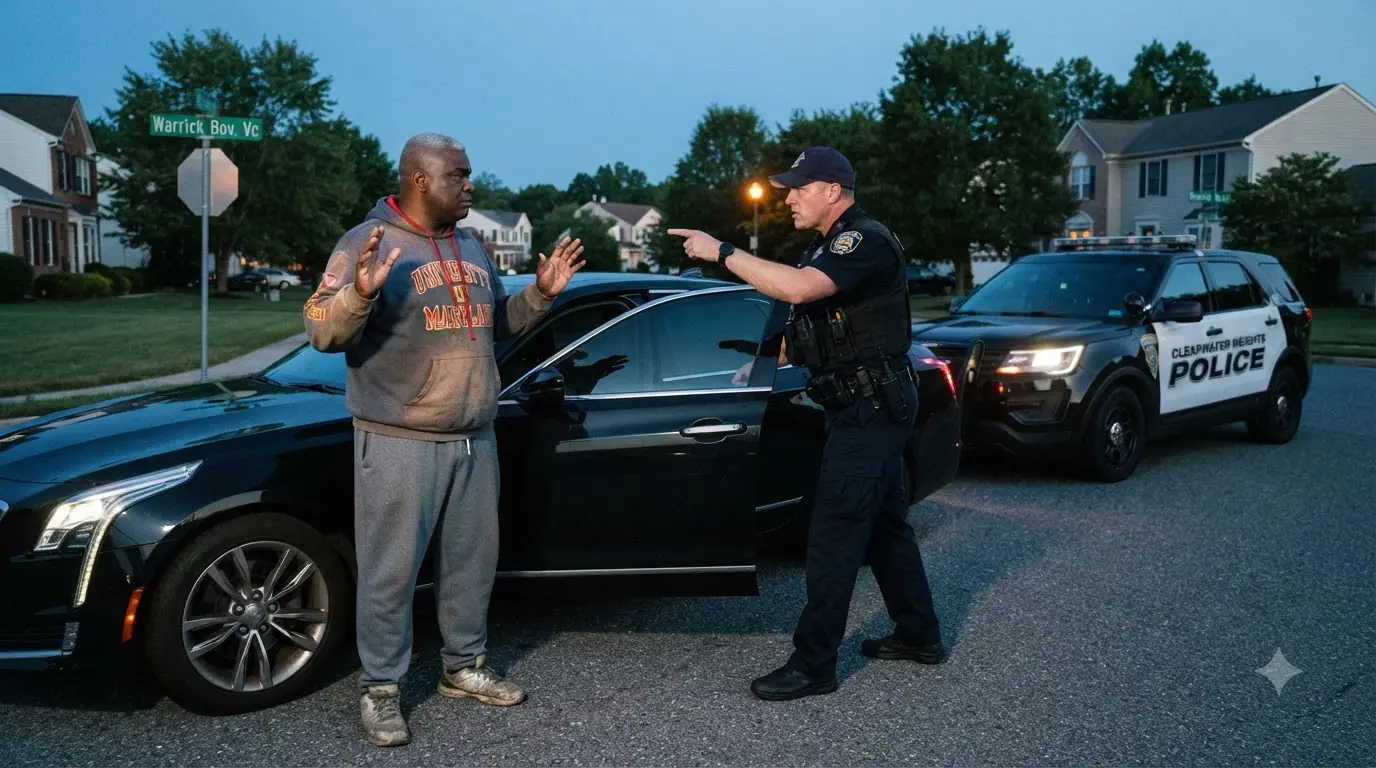
It is the kind of neighborhood where the cars are expensive, the lawns are immaculate, and the residents have learned over long careers to be invisible by design. On the night of March 4th, Nathaniel Cole Prescott was driving home through those familiar streets, in a way he had done approximately 4,000 times before.
Nathaniel was 54 with a close-cropped silver fade and the broad, unhurried build of a man who still ran 5 miles before sunrise every morning out of habit rather than vanity. He was wearing a faded University of Maryland hoodie, gray sweatpants, and a pair of worn sneakers.
He had left his credentials, his NSA access badge, and his official government vehicle at the Fort Meade complex that evening because the night briefing had run nearly 4 hours over schedule, and the agency car pool had already closed.
He had called a car from the federal motorpool dispatch, and been assigned a black Cadillac CT6, one of the pool's unmarked civilian registered vehicles. He was simply a tired man going home. What Nathaniel was not, though no one outside a classified directory could have easily confirmed it, was an ordinary commuter.
He was the deputy director of signals intelligence at the National Security Agency, responsible for overseeing the agency's domestic cyber threat monitoring infrastructure. He held a top secret sensitive compartmented information clearance that fewer than 3,000 individuals in the federal government possessed at his level. He had briefed three presidents. He did not advertise any of this.
He never had. Men like Nathaniel understood that the most effective kind of power was the kind you never had to announce. None of that mattered to officer Brett Langdon. Langdon was 34 months out of a disciplinary review that had nearly cost him his badge after a use of force complaint filed by a black teenager in the Clearwater Heights Commercial District.
The complaint had been sustained but quietly buried under a procedural technicality arranged by the county's fraternal order of police liaison. Langdon had read that outcome as permission. He had been running traffic enforcement in Clearwater Heights for the past 3 months. A deployment that his sergeant had privately hoped would calm him down by isolating him from foot patrol incidents.
It had not calmed him down. It had simply given him a different arena. Langdon was parked in the shadow of a closed dry cleaning business on Warrick Boulevard when the Cadillac CT6 rolled past at exactly 11:22 p.m. His eyes followed it the way a cat's eyes follow movement automatic and predatory. He saw the vehicle's make, saw the tinted windows, saw the black driver visible for a fraction of a second under the amber wash of a street lamp.