The patrol cruiser appeared at the end of Elmwood Drive at 7:14 on a Tuesday morning, moving slowly through Hawthorne Estates beneath oak trees just beginning to release their autumn leaves. Fifty-eight-year-old Nathaniel Brooks sat on the wraparound porch of the house he and his wife had purchased three weeks earlier, wearing a navy robe over striped pajamas with leather slippers on his feet, black coffee beside him, and a folded newspaper resting across one knee. He had spent enough of his life around police officers, prosecutors, defendants, witnesses, jurors, lawyers, and frightened families to recognize the precise moment a patrol car stopped moving like transportation and started moving like suspicion. When the brake lights came on directly in front of his property, Nathaniel lowered the newspaper and waited.
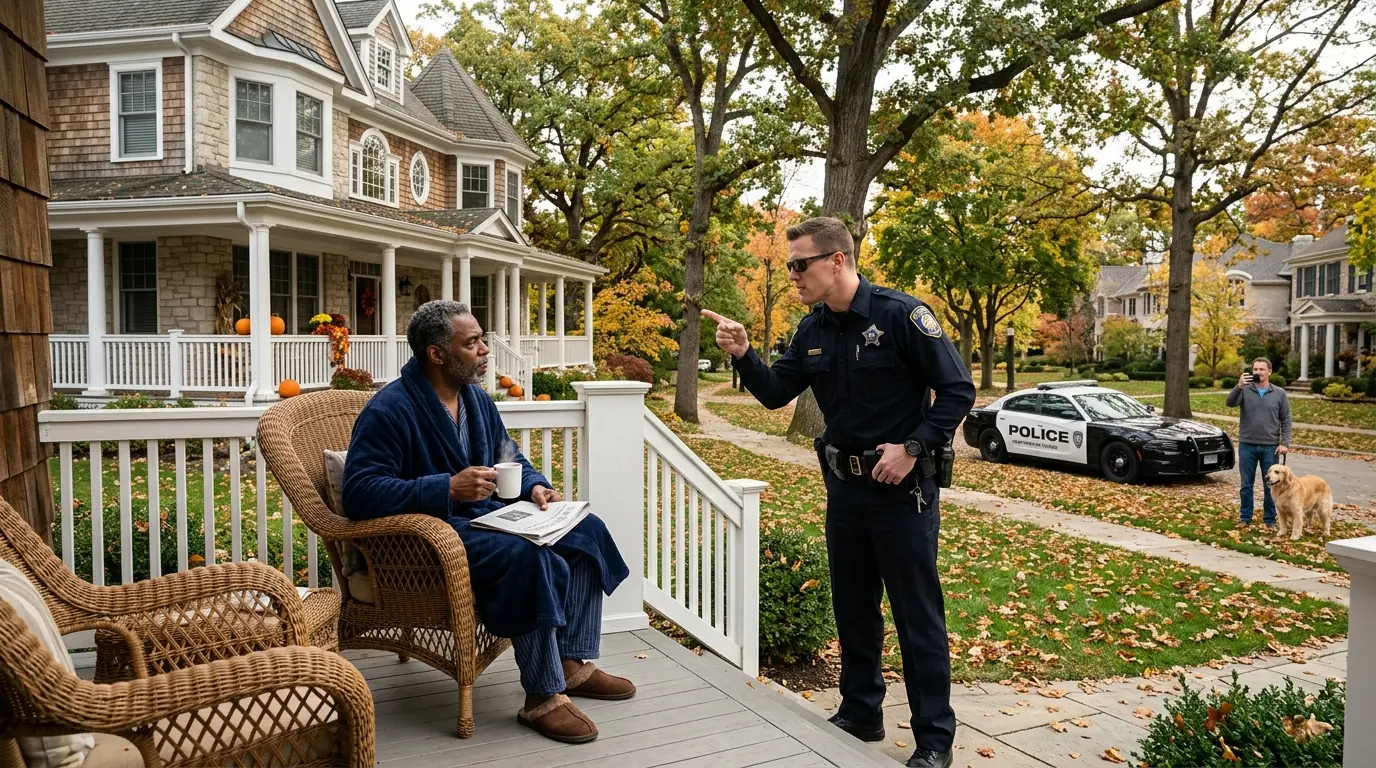
Hawthorne Estates occupied a quiet corner of the affluent northern suburbs outside Chicago, where stone facades, broad lawns, private landscaping crews, and detached three-car garages made disorder look almost contractual. Nathaniel and Camille Brooks had bought their colonial-style house after years of living closer to the city, telling each other they wanted fewer sirens, more trees, and enough porch space to drink coffee before the day began asking questions of them. Inside, half their books remained in labeled moving boxes, three framed photographs still leaned against a dining-room wall waiting to be hung, and the kitchen contained exactly one drawer Camille could reliably find without opening four others first. The porch had become Nathaniel’s finished room before anything else in the house was finished.
Three weeks earlier, he had taken the oath as a United States Magistrate Judge in the Northern District of Illinois after twenty years in criminal defense and nearly a decade on the Illinois state bench. The appointment did not make him a Supreme Court justice, a celebrity, or a man capable of commanding federal agencies with a phone call, despite what newspapers sometimes implied when they wrote about federal judges. It meant long days handling preliminary criminal matters, search-warrant applications, detention hearings, discovery disputes, civil referrals, settlement conferences, and the enormous volume of ordinary federal litigation that rarely produced dramatic headlines. Nathaniel liked the work because law became most interesting to him where power encountered procedure.
He had built that philosophy long before anybody called him Judge Brooks. Nathaniel grew up on Chicago’s South Side in a household where his father drove a city bus, his mother worked nights as a respiratory therapist, and every adult child knew precisely how many hours of work were hidden inside a mortgage payment. His father taught him to be polite during police encounters not because politeness guaranteed fairness, but because coming home safely mattered more than winning an argument beside the road. Law school later gave Nathaniel sophisticated language for principles his parents had taught in simpler terms: power needed reasons, authority needed limits, and dignity did not require permission.
Camille had known him for thirty-one years and understood that Nathaniel’s courtroom calm was partly discipline and partly disguise. At fifty-five she had already lived several professional lives of her own, first as a corporate litigator, then as general counsel for a regional health-care company, and later as a board member for philanthropic organizations focused on housing, education, and youth legal services. People meeting the couple sometimes assumed Nathaniel was the more formidable lawyer because he had become a judge, an assumption Camille found useful enough that she rarely corrected it immediately. Their private arguments had taught Nathaniel that the most dangerous sentence in marriage was Camille saying, “I’m not angry, I just want to understand your reasoning.”
The cruiser stopped at the curb instead of continuing past. Officer Ryan Caldwell remained behind the wheel for several seconds while Nathaniel watched him look toward the house, then down at something inside the vehicle, then back toward the porch. Caldwell was thirty-six, white, broad-shouldered, seven years into his career with the Hawthorne Township Police Department, and known among supervisors as an energetic officer who generated unusually high numbers of traffic stops and field interviews. His evaluations repeatedly used words such as proactive, assertive, productive, and confident, while several colleagues privately used another word that never appeared in personnel files: relentless.
Caldwell stepped from the cruiser wearing dark sunglasses despite the weak morning sun and rested one hand near the radio clipped high on his vest. He did not begin by approaching the front door, ringing the bell, or asking whether everything was all right, but instead stopped at the walkway and studied Nathaniel as though the man in pajamas had been entered into evidence before the conversation began. “Morning,” Caldwell called, the word technically polite but carrying none of the ease usually found in a neighborhood greeting. Nathaniel answered, “Good morning, officer,” and remained seated.
Caldwell walked up the path. “You live here?” he asked, glancing toward the open newspaper, coffee, robe, and slippers as though none of them offered useful context. Nathaniel folded the paper once and set it on the side table before answering, “I do.” Caldwell’s mouth tightened into a faint smile that told Nathaniel the officer did not believe him.
“Interesting,” Caldwell said, climbing the first porch step. “I patrol this area most mornings, and I’ve never seen you before.” Nathaniel replied that he and his wife had moved into the house three weeks earlier and that the moving trucks, contractor vans, delivery crews, temporary real-estate sign, and considerable number of cardboard boxes probably explained the sudden appearance of new residents. Caldwell stared at him for a moment before saying, “Got identification?”
Nathaniel looked down at his robe. “My wallet is inside the house, officer.” Caldwell nodded toward the front door and said, “Then go get it.” Nathaniel could already feel the legal structure of the encounter forming beneath ordinary language, but experience had taught him that knowing the law and using the law well were not the same skill. “Before I do anything further,” he said, “may I ask why you need identification from me?”
Caldwell shifted his weight. “We’ve had property crime around here, packages disappearing, people checking doors, houses being scoped out.” Nathaniel glanced across his own porch at the steaming coffee, newspaper, wicker furniture, and the slippers on his feet. “Did somebody report suspicious activity at this address this morning?” he asked.
Caldwell answered, “I’m asking the questions.” Nathaniel nodded once and said, “Then I’ll make mine simpler: am I currently detained?” The officer’s jaw tightened almost imperceptibly. “I’m conducting an investigation.”
Nathaniel had heard the sentence thousands of times in courtrooms. An investigation could be completely legitimate, but the word itself did not manufacture grounds to detain whoever happened to be nearby. He decided not to lecture Caldwell because roadside constitutional seminars rarely improved either safety or judgment. “I am willing to answer reasonable questions,” Nathaniel said, “but I’m not going inside my home to retrieve documents for an officer who has not told me what crime he reasonably suspects me of committing.”
Caldwell took another step onto the porch. “You’re making this difficult.” Nathaniel answered, “I’m sitting in a chair.” The officer stared at him long enough that the air seemed to tighten between them.
Across the street, Peter Lawson had just begun walking his golden retriever when he noticed the cruiser. Peter was a retired architect who had introduced himself to Nathaniel two days after the Brookses moved in by bringing a bottle of wine Camille later discovered cost more than most people spent on groceries for a week. He stopped near his mailbox because the sight of a uniformed officer questioning his new neighbor on the porch seemed unusual without being obviously alarming yet. His dog sat automatically beside him and watched both men.
Caldwell asked Nathaniel his name. Nathaniel gave it. The officer asked whether Nathaniel owned the property, and Nathaniel said the home was jointly owned by himself and Camille. Caldwell then asked where Camille was, which struck Nathaniel as an odd escalation for a supposed package-theft inquiry. “Inside,” he answered.
“Call her out.” Nathaniel looked toward him. “Why?” Caldwell replied, “To verify you.”
Nathaniel felt irritation move through him but kept his hands resting visibly on the chair arms. “You are welcome to verify property records, vehicle registrations associated with this address, recent utility activation, or any other lawful information available to you,” he said. “I am not summoning my wife from inside the house because you have decided her word would make my presence on my own porch more believable than mine.” Caldwell’s cheeks reddened.
“Stand up,” the officer ordered. Nathaniel remained seated. “For what purpose?”
“I gave you an order.” Nathaniel answered, “I heard it.”
“Then stand.” Nathaniel looked toward the street and noticed Peter Lawson now holding his phone loosely at his side.
Nathaniel returned his attention to Caldwell. “Officer, if you have a safety reason for wanting me to stand, tell me and I’ll consider the instruction in that context.” Caldwell said, “The reason is I told you.” Nathaniel replied, “That is authority describing itself, not a reason.”
The sentence landed badly. Caldwell unclipped his shoulder microphone and requested another unit for what he called an “uncooperative subject at 442 Elmwood.” Nathaniel repeated the address silently because he wanted to remember every detail while his body remained calm. He could already imagine hearing the dispatch recording months later in a room where the word uncooperative would sound much more consequential than it did on a quiet porch.
Nathaniel also knew he could potentially change Caldwell’s behavior by introducing his title. He could say he was a federal magistrate judge, ask for a supervisor, mention the courthouse, perhaps even watch the officer’s posture shift before the sentence finished. The idea tempted him because indignity has a way of making status feel like a weapon even to people who know better. Then another thought replaced it.
If Caldwell needed to know Nathaniel was a federal judge before respecting the limits of the encounter, then saying it too early would answer the wrong question. The teenager delivering groceries on the next street would not have that title, nor would the landscaper arriving before sunrise, the home-health aide entering through a side door, or the Black college student visiting wealthy relatives for the weekend. Nathaniel did not need to deliberately create danger to prove a principle, but he also refused to purchase basic treatment by presenting credentials unrelated to sitting on his own porch. He decided to remain exactly what Caldwell already knew him to be: a resident saying he lived there.
A second cruiser turned onto Elmwood several minutes later and stopped behind Caldwell’s car. Officer Ethan Pierce stepped out, younger by almost a decade, with an expression that looked less certain than his partner’s. Caldwell met him near the base of the porch and spoke quietly enough that Nathaniel caught only fragments: suspicious male, new property, refuses identification, possibly casing house. Pierce looked up at Nathaniel.
Nathaniel watched the younger officer take in details Caldwell seemed to have converted into irrelevance. Coffee still steamed on the table, a newspaper lay folded beside it, the front door was partly visible behind him, and a pair of delivery boxes bearing the Brooks name remained stacked near a column from the previous evening. Pierce glanced at one shipping label, then toward Caldwell. “Did dispatch run the resident name?” he asked.
Caldwell answered, “We’re getting there.” Pierce looked confused. “We have a name?” Caldwell lowered his voice further.
Nathaniel could not hear the reply. Pierce went back to his cruiser and used the mobile terminal. Less than two minutes later he walked toward Caldwell again.
“The assessor database shows Nathaniel and Camille Brooks recorded on the property,” Pierce said quietly. Caldwell looked toward Nathaniel. “When was it updated?”
Pierce answered, “Transfer recorded last month.” Caldwell asked whether that proved the man on the porch was Nathaniel Brooks.
“No,” Pierce said, “but it lines up.” Caldwell’s mouth tightened.
Nathaniel saw the exact moment information that should have reduced suspicion instead irritated the officer. It was a phenomenon he had observed in prosecutors, defense lawyers, witnesses, judges, detectives, jurors, and himself: once somebody invested pride in an interpretation, corrective facts could feel less like assistance than defeat. Good legal systems tried to force people through that discomfort by making evidence more important than ego. On Elmwood Drive there was no courtroom yet.
Caldwell climbed the remaining porch step. “I’m going to ask you one more time to produce identification.” Nathaniel answered, “You have my name, and your partner appears to have confirmed that people with my name own this property.” Caldwell said, “That does not prove you’re one of them.”
“What fact makes you suspect that I am not?” Nathaniel asked. Caldwell replied, “You’re avoiding a very easy request.” Nathaniel said, “Refusing to prove innocence is not evidence of guilt.”
Pierce shifted behind Caldwell. “Ryan, maybe we can just have dispatch check DMV photo or registered vehicles.” Caldwell turned sharply.
“I’ve got it.” Pierce raised both hands slightly.
“Okay.”
Nathaniel looked at the younger officer. The important thing was not that Pierce disagreed; the important thing would be what he did if disagreement became necessary. Nathaniel had seen too many institutional failures built from people who privately recognized something was wrong and publicly behaved as though recognition created no obligation. Silence could be personally understandable and still professionally consequential.
Caldwell pointed toward Nathaniel’s front door. “Go inside and get the wallet.” Nathaniel answered, “No.” The officer took another step.
“Then stand up.” Nathaniel said, “I do not consent to being detained based on what you have articulated.”
Caldwell reached toward him. Nathaniel’s body reacted before thought, not by fighting but by becoming completely still. “Do not touch me unless you are detaining or arresting me,” he said.
Caldwell grabbed his right forearm. “Then you’re detained.” Nathaniel asked, “For what crime?”
“Stand up.” Nathaniel rose because physical resistance on the porch would create a danger more immediate than the legal argument.
His coffee mug fell when Caldwell pulled him forward. It struck the porch boards, broke near the chair leg, and sent black coffee across the pale wood in a spreading stain. Nathaniel stared at the pieces for a fraction of a second because Camille had bought that mug in Addis Ababa during a trip ten years earlier and would be irrationally angry about its destruction. Then Caldwell twisted his arm behind his back.
Nathaniel said, “I am not resisting.” Caldwell replied, “Stop tensing.”
“I’m standing exactly where you put me.” Caldwell pulled the other arm back.
Steel cuffs closed around Nathaniel’s wrists. Pierce said, “Ryan, do we need cuffs?” Caldwell answered, “He refused lawful commands.”
Nathaniel breathed in through his nose and let the air out slowly. The cuffs were tight enough to hurt but not yet so tight that he could not feel his fingers. “Officer Caldwell,” he said, making sure to use the name visible above the badge, “please identify the specific offense supporting this detention.” Caldwell replied, “Obstruction and failure to identify.”
Nathaniel almost corrected him automatically. Years on the bench had trained him to separate inaccurate legal conclusions into parts, test each element, and ask what evidence actually supported them. He stopped himself because the purpose of the moment was no longer to persuade Caldwell. “I am physically complying,” he said instead, “and I want that statement preserved.”
Peter Lawson raised his phone. Caldwell noticed.
“Sir, step back,” he called across the yard. Peter answered, “I’m on my own property.”
Caldwell said, “You’re interfering.” Peter replied, “I haven’t moved.”
Nathaniel almost laughed despite the circumstances. The similarity was too precise.
Pierce walked toward Peter instead of escalating. “You can record from there,” he said, “just please don’t approach.” Peter nodded.
“Wasn’t planning to.”
That simple exchange became important later. Pierce had shown he knew how to distinguish observation from interference. The question would become why he had not applied the same discipline sooner.
Caldwell marched Nathaniel down the porch steps. One slipper nearly came off, forcing Nathaniel to shorten his stride while his arms remained restrained behind him. Peter’s phone captured the entire walk from the house to the cruiser. The video also captured Caldwell saying something quiet enough that Nathaniel heard it but Peter’s microphone barely did.
“You don’t belong here,” Caldwell muttered. Nathaniel turned his head slightly.
“What did you say?” Caldwell pushed him forward.
“Keep moving.”
Pierce looked toward Caldwell. He had heard it too.
Nathaniel was placed in the rear seat of the cruiser. The hard molded plastic forced his cuffed arms into an awkward angle that immediately increased pressure in his shoulders. Caldwell closed the door.
For the first time that morning, Nathaniel was physically separated from his home by locked police glass. He watched his own porch through a wire partition, coffee soaking into the boards, newspaper lifting at one corner in the breeze, and Peter still filming from across the street. The scene looked ordinary enough that the absurdity of his position became almost difficult to comprehend.
Pierce stood outside Caldwell’s cruiser. “Run his name fully,” he said.
“I’m doing that.”
“Ryan, assessor matches.”
“I know.”
“His answer matches.”
“I know.”
“So what are we still doing?”
Caldwell turned toward him. “You want to run the stop?”
Pierce looked away.
“No.”
That moment remained on Caldwell’s external microphone. It would later bother Pierce more than almost anything else.
Inside the cruiser, Nathaniel leaned forward as far as the restraints allowed. “Officer Pierce,” he called through the partially open front window.
Pierce turned.
“I would like a supervisor.”
Caldwell opened the driver’s door. “You don’t get to run the scene from my back seat.”
Nathaniel met his eyes. “I’m requesting supervisory review before you transport me.”
“For obstruction?”
“For whatever you believe you have.”
Caldwell stared.
Nathaniel continued, “Sergeant Maria Delgado should be supervising this sector this morning unless your rotation changed.”
Caldwell froze.
Pierce looked sharply toward Nathaniel.
“How do you know Delgado?” Caldwell asked.
Nathaniel answered, “I know several people who work in this county.”
That was true without revealing why. Judge orientation after his federal appointment had included courthouse security meetings with local, county, state, and federal law-enforcement representatives, and Delgado had attended one of them.
Caldwell’s suspicion finally acquired a small crack. “You law enforcement?” he asked.
“No.”
“Lawyer?”
Nathaniel smiled faintly.
“I asked for Sergeant Delgado.”
Caldwell slammed the door.
He keyed the radio and requested the supervisor. Dispatch acknowledged. Nathaniel listened to the exchange and understood something had changed, but not enough.
The front door opened before Delgado arrived. Camille stepped onto the porch wearing a charcoal robe over exercise clothes, glasses pushed into her silver-streaked hair, and an expression Nathaniel had seen only twice in their marriage. She noticed the broken mug first, then the patrol cars, then Peter Lawson across the street. Finally she saw Nathaniel through the rear window.
For half a second Camille stopped moving. Nathaniel watched fear cross her face before anger replaced it. She walked down the steps.
“What happened?” she demanded.
Caldwell moved toward her. “Ma’am, please stay on the porch.”
Camille looked at him.
“This is my house.”
“We have a subject detained.”
“You have my husband in your cruiser.”
Caldwell’s face changed.
“Your husband?”
Camille stared.
“Yes, officer, that Black man in pajamas sitting in the back of your car is my husband.”
Pierce closed his eyes briefly.
Caldwell asked, “Can you verify his identity?”
Camille laughed once, without humor.
“You want me to verify the man you took from the porch of the house we own?”
“Yes, ma’am.”
“After he told you his name?”
“He refused identification.”
Camille looked toward Pierce. “Did you verify the property ownership?”
Pierce hesitated.
“Yes.”
“Did his name match?”
“Yes.”
Camille turned back toward Caldwell.
“Then what exactly are you verifying now?”
Caldwell answered, “Whether he is who he says.”
Camille’s voice became quieter.
“Would you be requiring this if the person in that chair had been Peter Lawson?”
Across the street Peter lowered his phone slightly.
Caldwell said, “Race has nothing to do with this.”
Camille replied, “Then tell me what does.”
No answer came.
Camille turned and walked back toward the house. Caldwell called after her.
“Ma’am, stop.”
She ignored him.
He took one step toward the porch before Pierce said, “Ryan.”
Caldwell stopped.
Thirty seconds later Camille returned carrying Nathaniel’s leather wallet. She did not rush.
She walked directly to Pierce.
“You appear to be the one still listening.”
Pierce accepted the wallet.
Camille opened it herself and pointed first to the Illinois driver’s license.
Nathaniel Brooks.
442 Elmwood Drive.
The address matched the property.
Pierce looked toward Caldwell.
“We’re done.”
Caldwell took the wallet.
Behind the license sat a federal judiciary credential.
He pulled it partly free.
His face changed.
Camille noticed.
“What?”
Caldwell said nothing.
Pierce leaned closer.
The credential identified Nathaniel Brooks as a United States Magistrate Judge for the Northern District of Illinois.
Pierce whispered, “Oh, no.”
Camille’s eyes hardened.
“Now you believe he lives here?”
Caldwell returned the credential into the wallet.
“I need the sergeant.”
Camille laughed bitterly.
“You needed the sergeant before you learned his job.”
A supervisor SUV turned onto Elmwood. Sergeant Maria Delgado arrived without siren, parked behind the cruisers, and stepped out already looking toward the gathering neighbors. She was fifty-one, Latina, with twenty-two years in policing and the habit of approaching chaotic scenes more slowly as everyone else became faster. Dispatch had told her only that an officer had detained an uncooperative suspected trespasser or burglar at a recently sold home.
Delgado reached Caldwell first. “Start from the beginning.”
Caldwell said, “Observed suspicious subject on porch of newly sold residence, refused identification, became argumentative, resisted lawful commands.”
Delgado looked toward the porch.
“Was there a burglary call?”
“No.”
“Alarm?”
“No.”
“Witness complaint?”
“No.”
“Open door or broken window?”
“No.”
“Property damage?”
“No.”
She turned toward Pierce.
“What did dispatch or records show?”
Pierce answered, “Property is owned by Nathaniel and Camille Brooks, transfer recorded last month.”
Delgado looked back at Caldwell.
“The detained man’s name?”
“Nathaniel Brooks.”
The sergeant’s expression changed before anybody mentioned the judicial credential.
“Why is he still in cuffs?”
Caldwell said, “I couldn’t independently verify identity.”
Delgado pointed toward Camille.
“Who is she?”
“Wife.”