“A suit like that doesn’t make a man like you belong here.”
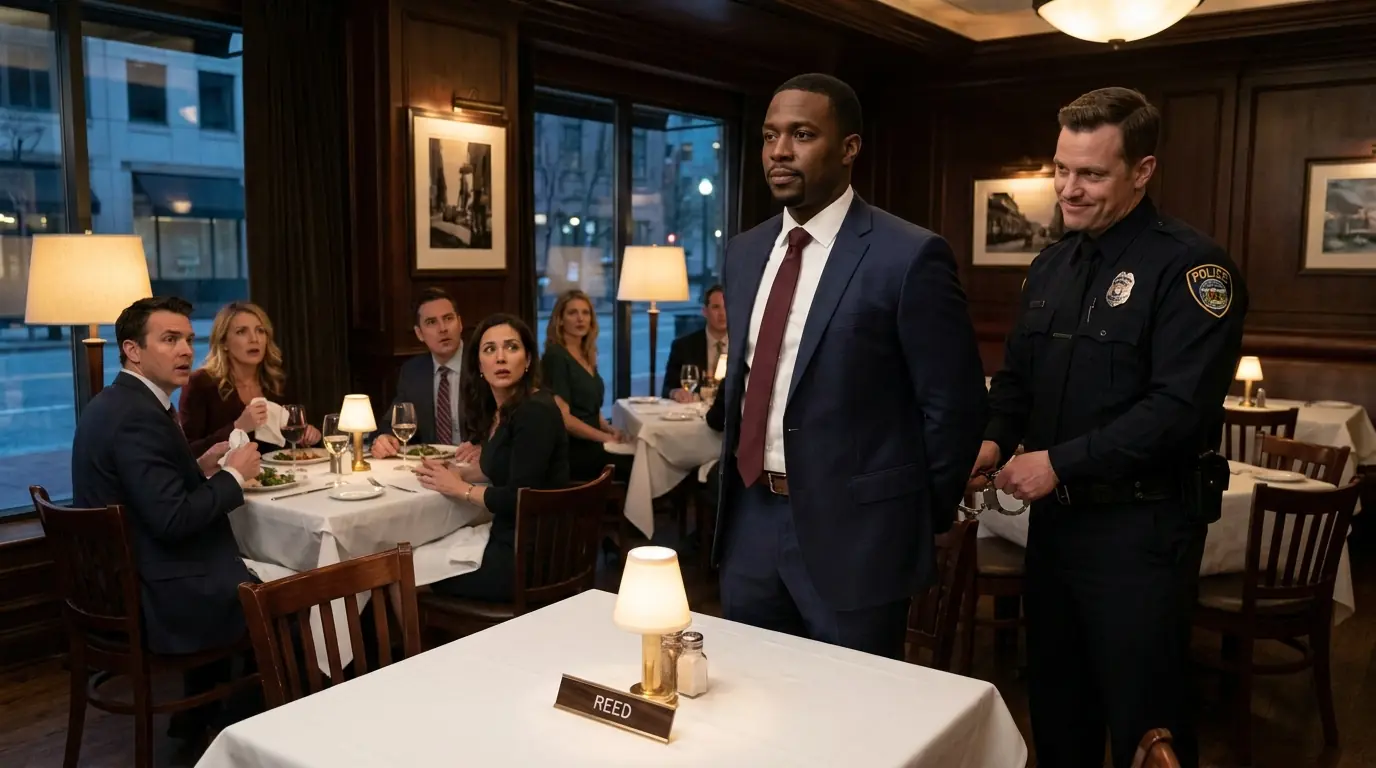
Officer Grant Nolan twisted Marcus Reed’s right arm behind his back.
The handcuff closed around one wrist with a metallic click.
All around the dining room, conversations stopped.
Marcus stood beside a white-clothed table in a tailored navy suit, his burgundy tie still perfectly straight despite Nolan pulling him away from his chair.
A glass of untouched red wine sat beside his plate.
His dinner companion had already been moved aside.
Two nearby diners were holding up phones.
Marcus did not struggle.
He simply turned his head as far as Nolan’s grip allowed.
“Call your captain before those cuffs close.”
Nolan laughed.
“Nobody at my precinct answers to you.”
He reached for Marcus’s other wrist.
Marcus’s face remained calm.
“That isn’t what I said.”
Nolan tightened his grip.
Then his radio exploded with static.
“Unit Four-Twelve. Grant, answer immediately.”
Nolan paused.
The voice was urgent.
His captain.
He pressed the radio button with one hand.
“Nolan.”
Captain Laura Bennett came through so loudly that several diners heard every word.
“Release Director Reed. Now.”
Nolan stopped breathing.
Marcus slowly looked toward him.
The radio continued.
“Federal agents are securing the precinct. Do not bring anyone there. Repeat, release Director Reed and preserve your bodycam.”
Nolan’s face drained of color.
Marcus looked at the half-closed second cuff.
Then at the officer.
Nolan whispered:
“Director?”
Marcus’s eyes hardened.
“Now they’ll answer to me.”
Three days earlier, Marcus Reed had been standing inside a windowless federal conference room in Baltimore looking at photographs of police evidence bags.
Not restaurant menus.
Not expensive suits.
Evidence bags.
Some carried correct seals.
Some had been reopened.
Some contained cash amounts that did not match seizure reports.
Others belonged to cases that had quietly collapsed after supposedly incriminating evidence became unusable.
Marcus stared at the wall.
At fifty-two, he had spent twenty-seven years in law enforcement.
The first nine were local.
The next eighteen were federal.
He began as a patrol officer in Richmond, Virginia, during an era when older officers still taught younger ones that command presence meant never letting civilians see uncertainty.
Marcus learned quickly that confidence and certainty were not the same thing.
One kept people calm.
The other got officers into trouble.
He later joined the FBI.
Financial crimes first.
Then public corruption.
By his late forties, Marcus was supervising complex investigations involving government contracting, evidence theft, bribery, and civil-rights violations.
Two years earlier, he had been appointed director of a temporary interagency Public Integrity Operations Group created by the U.S. Attorney’s Office and FBI field leadership to coordinate several overlapping investigations.
The title sounded more impressive than the job felt.
Most days Marcus dealt with spreadsheets.
Subpoenas.
Recorded interviews.
Chain-of-custody logs.
Agents arguing over jurisdiction.
Prosecutors telling investigators that suspicion was not evidence.
He liked that last part.
Marcus believed suspicion should have to work for a living.
The current investigation involved the Westbrook Police Department.
Specifically, the department’s Central Precinct.
For almost eleven months, federal investigators had been quietly examining allegations that several officers were skimming cash from narcotics seizures, falsifying portions of arrest reports, and pressuring low-level defendants into abandoning property claims.
Not every officer was involved.
That mattered.
There were eighty-six officers assigned to Central Precinct across multiple shifts.
Most appeared to have nothing to do with the misconduct.
A small group did.
Marcus’s team believed one of them was Sergeant Paul Henley.
Another was Detective Mark Sloan.
There were others.
No arrest operation had been scheduled yet.
Until an evidence technician named Rebecca Cho agreed to cooperate.
She gave investigators something they had lacked.
A record.