The first thing Malcolm Carter bought after his son came home from the hospital was a bottle of cheap honey-lemon cough syrup and a pack of throat lozenges from a corner store with bars on the windows.
It should have been nothing. A father walking to a store, buying medicine for his sick boy, and coming home before the ice in the water glass had even melted. But nothing had been simple in Malcolm Carter's life for a long time. Not prison. Not fatherhood. Not forgiveness. Not even the walk from his trailer to the pharmacy two blocks away.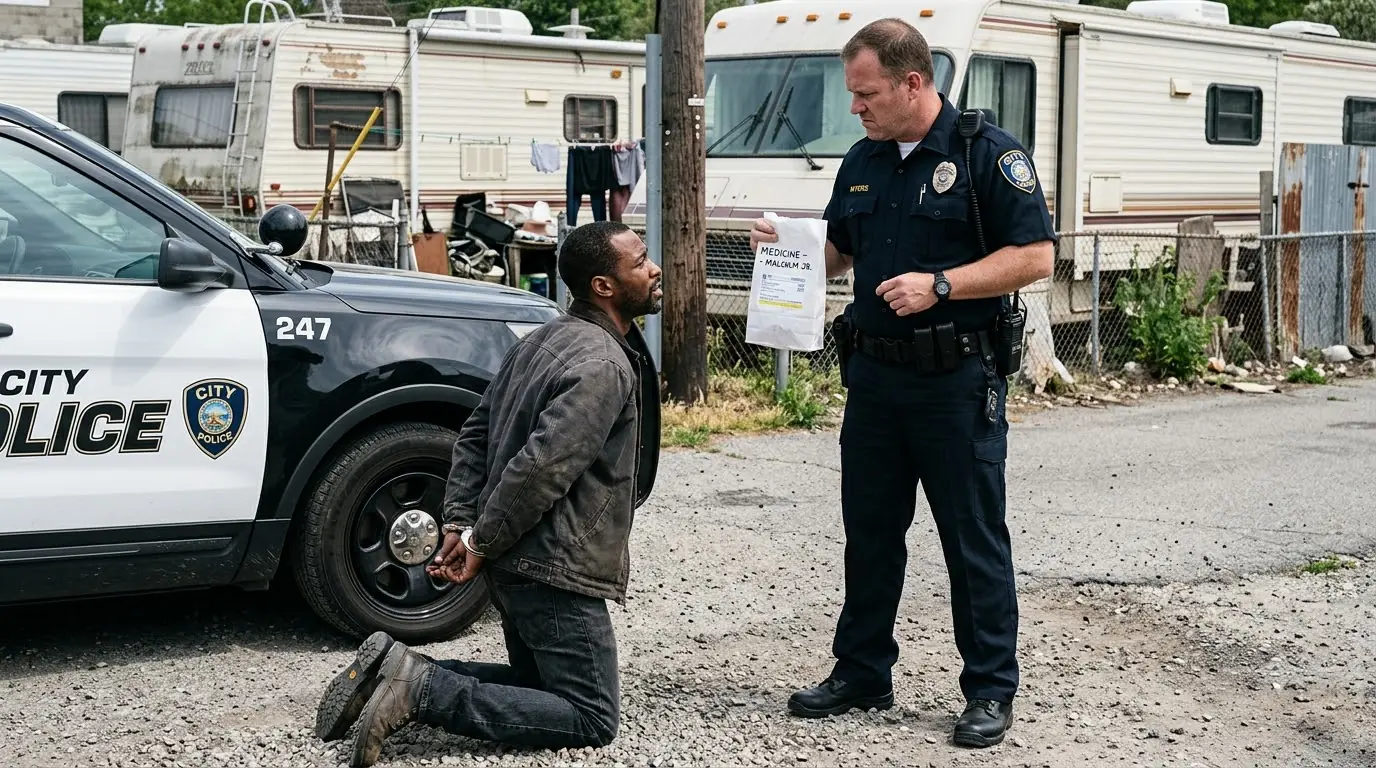
James was fifteen, but the illness had made him look younger on bad days. His shoulders had narrowed under the loose gray sweatshirt, and his face had the stillness of a child who had learned to save energy even for blinking. The doctors called it throat cancer with the careful tone of people trained not to let fear show in their eyes. They said surgery could give him a real chance, maybe even a future that was bigger than hospital rooms and plastic cups of water, but the cost sat between Malcolm and hope like a locked steel door.
Malcolm had been out of prison for only eleven days.
Five years earlier, he had made the choice that broke his family. He had carried drugs for men who called him brother until police lights appeared in the rearview mirror. Those same men disappeared before court, before sentencing, before his son had to sit in a visitation room and pretend not to cry through scratched glass. Malcolm never called himself innocent. He had done wrong. He had known it even then. What he had not known was how long a boy could remember the sound of a door closing behind his father.
Now he was back in the same dusty RV park on the south edge of Bakersfield, California, sharing a thirty-two-foot trailer with a sick child, a folding table, a borrowed recliner, and a promise that felt too large for the walls. He had a construction job starting before sunrise every morning. Cash under the table at first, then payroll if the foreman decided he could trust him. It was honest work, hard work, the kind that split the skin on his palms and made sleep come like a fall.
That morning, James sat propped against two pillows on the narrow bed at the rear of the trailer. His throat had been hurting since dawn. He tried to hide it because boys at fifteen still believe pain can be made smaller by silence, but every swallow made his whole face tighten.
Malcolm noticed.
He noticed everything now.
For five years, he had been noticing too late.
"Hey, bud," Malcolm said, sitting on the edge of the bed. "How you feeling?"
James gave a small shrug. "My throat's scratchy."
"The doctor said that might happen after the treatment."
"Yeah, I know." James tried to smile and failed. "But it really hurts today."
Malcolm reached for the cup on the crate beside the bed and helped him drink. James took two careful swallows, then leaned back and closed his eyes.
"I'm really glad you're home, Dad," he said.
Those words did what prison never could. They made Malcolm feel small.
He looked down at his hands. They were big hands, scarred across the knuckles, rough already from a week of hauling lumber and mixing concrete. Hands that had once carried the wrong things. Hands that had signed prison forms. Hands that had pressed against cold glass while James sat on the other side in clothes his aunt had bought from a thrift store.
"I'm glad I'm home too," Malcolm said. Then his voice changed. "But listen to me. I'm sorry I wasn't here. I should have been. Every boy needs his father."
James opened his eyes. "It wasn't your fault you got arrested. Those guys snitched on you. They should've had your back."
Malcolm shook his head. "No. Don't say that. Dealing drugs was illegal. I chose it. I can't blame nobody but myself."
The boy looked away, embarrassed by the weight in the room.
Malcolm touched his shoulder gently. "Prison taught me a few things. Not the way people think. It didn't make me hard. I was already hard in all the wrong places. It taught me that life will test you. It will tempt you. It will hand you the easy way and make the right way look impossible. But you still have to choose what kind of man you're going to be, no matter the consequences."
James stared at him. "You really believe that?"
"I have to. Otherwise those five years were just wasted time."
The boy's eyes softened. "I love you, Dad."
Malcolm swallowed. "I love you too, son."
James coughed then, a rough sound that seemed too big for his thin body. Malcolm stood quickly.
"All right," he said. "I'm heading to the store. I'll get cough medicine, lozenges, and maybe some of those popsicles you like. The blue ones."
"Those taste fake."
"You still eat them."
"Yeah, because I'm sick, not stupid."
At the door, he paused. On the wall beside the tiny kitchen was a picture James had taped there years ago. It showed a red 1969 Corvette Stingray, the kind Malcolm's father had owned for six months before losing it to debt and bad luck. Malcolm had talked about that car for as long as James could remember. In prison, he had drawn it from memory on the backs of envelopes. After getting out, he had started a coffee can labeled Corvette, though there were only forty-three dollars inside it.
"Still saving for that car?" James asked from the bed, catching the direction of his gaze.
Malcolm smiled. "One day."
"It costs like a hundred thousand dollars."
"A man can dream."
"You said it reminds you of Grandpa."
"It does." Malcolm touched the picture lightly. "But dreams can wait. Right now, your surgery can't."
James looked down. "We can't afford it."
"Not yet."
"Dad."
"Not yet," Malcolm repeated. "I'm working. I'm saving. I'm going to figure it out."
That was what fathers said when they had no plan strong enough to carry the truth.
Outside, the afternoon heat had settled over the RV park like a dirty blanket. Dogs barked behind chain-link fences. A woman in curlers smoked on a plastic chair. Somewhere, a radio played old soul music through static. Malcolm walked fast because James was waiting and because every minute away from his son still felt stolen.
The corner store sat past the old auto body shop, across from a vacant lot where weeds grew through cracked asphalt. Malcolm bought the cough syrup, lozenges, two blue popsicles, a bottle of water, and a small bag of oranges because the doctor had said vitamins mattered. The clerk put everything in a white paper bag and gave Malcolm a look that stayed too long on his prison tattoos before sliding him the receipt.
Malcolm ignored it.
He had become good at ignoring looks.
He had not become used to them.
As he stepped back onto the sidewalk, a black sedan rolled slowly along the curb half a block away. Two men stood near the mouth of an alley beside a boarded-up laundromat. Malcolm saw them without really seeing them. Men in hoodies. One holding a white paper bag like his own. The other glancing up and down the street with too much quickness in his eyes.
He knew the shape of a deal when he saw one.
He looked away.
That was another lesson prison had taught him. You do not stare at trouble unless you want trouble to recognize you.
Across the street, in an unmarked police car, Officer Daniel Myers watched the exchange from behind tinted glass. He was thirty-six, broad through the shoulders, with a square jaw and ten years on the Kern County force. His partner, Officer Luis Cruz, sat beside him with a camera pressed to his chest, waiting for Myers to give the word.
They had been following a small street-level drug ring for two weeks. The dealer in the alley, a thin man named Kelvin Pryce, had sold fentanyl-laced pills three times to an undercover informant. Today was supposed to be the clean grab. Pryce, the buyer, the product, the money. Easy paperwork. Clear arrest.
Then Malcolm came out of the store with a white paper bag in his hand.
At the same moment, Pryce's buyer saw Cruz's reflection in a car window and bolted.
Everything happened at once.
Pryce shoved his own white paper bag into the arms of the nearest moving body as he ran. That body was Malcolm.
Malcolm stumbled as the man slammed into him shoulder-first.
"Watch it," Malcolm snapped, grabbing the bag before it fell.
The man did not answer. He sprinted toward the alley. Cruz burst from the unmarked car and chased him.
Myers came from the other side, weapon drawn, eyes locked on Malcolm.
"Stop!" he shouted. "Hands where I can see them!"
Malcolm froze.
He knew that voice. Not that officer, not personally, but the command itself. The kind that arrived already convinced.
"Officer, I live right there," Malcolm said, nodding toward the RV park. "I just came from the store."
"Turn around. Hands on your head."
"I'm telling you, you got the wrong man."
"Turn around before I put you on the ground."
Malcolm raised his hands slowly. "Okay. I'm turning around. Don't shoot."
"On your knees."
"What am I being arrested for?"
"You know what you did. On your knees."
Malcolm lowered himself to the hot pavement. His knee hit a pebble and pain shot up his leg. Myers yanked his left wrist behind him, then the right, cuffing him so tight the metal bit skin.
"I didn't buy drugs," Malcolm said. "The guy bumped into me."
"Sure he did."
"The bag is medicine for my son. He's sick."
Myers laughed without humor. "Medicine. Is that what they're calling it now?"
He snatched the white bag from Malcolm's hand, opened it, and his face shifted. Inside were small plastic-wrapped packets, not cough syrup, not lozenges, not popsicles. Pills. Powder. Cash folded with a rubber band.
Malcolm stared at it in horror.
"That isn't mine," he said. "The man who hit me had a white bag too. He must have switched it. My son's medicine was in the other bag."
Myers leaned close enough that Malcolm could smell coffee on his breath. "You have to do better than that."
"I'm telling you the truth."
"You people always are."
Malcolm went still.
There it was. Not suspicion. Not procedure. The thing underneath.
Myers stood and spoke into his radio. "Dispatch, this is Myers. One in custody. Possible narcotics purchase. Suspect fled eastbound, Cruz in pursuit. Send backup."
"Officer," Malcolm said, forcing his voice to stay calm, "my son has cancer. He's fifteen. He's waiting for me. Please. Call the store. Check the cameras. Talk to the clerk."
Myers looked down at him with something colder than impatience. "Your son, huh? Probably raising another little dealer."
Malcolm's jaw tightened. "Don't talk about my child."
"Or what?" Myers crouched again. "You going to teach me about fatherhood? You just got out, didn't you? I can smell prison on men like you."
Malcolm's blood went hot. "I made mistakes. I'm not making one now."
Myers picked up the bag and shook it once. "This is enough to put you away for a long time. Maybe twenty-five if the prosecutor feels ambitious. That means your sick kid grows up alone. Or doesn't grow up at all."
Malcolm looked at him.
Myers smiled.
"That bothers you? Good. Maybe it should. Nothing teaches a lesson like consequences."
"I thought your job was to serve and protect people," Malcolm said.
Myers's face hardened. "People. That's the key word."
Malcolm understood the rest without needing him to say it.
Still, Myers said it.
A slur fell out of his mouth so easily that it sounded practiced.
The world seemed to narrow. Malcolm heard traffic. A dog barking far away. The faint sound of Cruz shouting somewhere behind the laundromat. His wrists burned in the cuffs. James's face rose in his mind, pale against the trailer pillow, trying not to cough because he did not want to worry his father.
Malcolm closed his eyes.
He had promised his son the right way mattered.
Right now, the wrong way had a badge and a gun.
Then Myers made a sound.
It was small at first, like a cough caught in the throat. Malcolm opened his eyes and saw the officer stagger.
Myers looked confused. He took one step back, then another. His hand went to his chest. His pupils seemed too small in the afternoon glare.
"Hey," Malcolm said. "Officer?"
Myers tried to answer, but his knees buckled. He collapsed beside the curb, the narcotics bag falling open near his hand. White powder dusted the edge of his glove where one packet had torn.
Malcolm knew enough from the streets to understand before Myers did.
Fentanyl.
Exposure. Overdose. Maybe the powder had gotten on his glove. Maybe he had touched his face. Maybe panic made the situation worse. It did not matter. Myers was on the ground, breathing shallow, lips beginning to pale.
For one bright, terrible second, Malcolm did nothing.
The man had humiliated him. Threatened him. Mocked his son. Put him in cuffs. Dragged every ugly assumption out into the daylight and stood proudly inside it.
Nobody would blame Malcolm for staying still.
He could say he was handcuffed.
He could say he tried.
He could let the officer learn what helplessness felt like.
Then James's voice came back to him.
I will, Dad.
Do the right thing, no matter the consequences.
Malcolm rolled onto his side and pushed himself up as far as the cuffs allowed.
"Hey!" he shouted toward the alley. "Officer down! He needs Narcan! Somebody help!"
No one answered.
Myers's radio crackled uselessly on his shoulder. Cruz was still chasing the fleeing suspect. Backup had not arrived. The street, which had seemed full of eyes moments before, suddenly felt deserted.
Malcolm crawled toward Myers, dragging his cuffed hands behind him. The cuffs twisted his shoulders and tore skin from his wrist, but he kept moving.
"Myers," he said sharply. "Can you hear me?"
The officer's eyes fluttered. His breathing was wrong. Slow. Wet.
Malcolm searched him awkwardly, shoulder screaming as he tried to reach around with bound hands. He found the small pouch on the officer's vest. Emergency kit. Zipper. Too far.
"Come on," Malcolm muttered. "Come on."
He hooked the zipper tab between two fingers and pulled. The pouch opened. A Narcan nasal spray fell halfway out, then stuck beneath Myers's radio cord.
Malcolm cursed. He could touch it but not grip it well enough.
"Keys," he said, looking at Myers's belt. "Where are the keys?"
Myers barely moved.
Malcolm twisted until pain lit his shoulder. He found the handcuff key ring at the officer's belt and dragged it free, nearly dropping it twice. His fingers shook. He had one chance to angle the key into the tiny lock behind his own wrist.
James's voice again.
Do the right thing.
The key slipped.
Malcolm tried again.
It turned.
The cuff opened on one wrist. He freed the other, grabbed the Narcan, tilted Myers's head, and sprayed it into one nostril. Then he rolled the officer onto his side, cleared his airway, and shouted again for help.
"Breathe, man. Come on. Breathe."
For a few seconds, nothing happened.
Then Myers gasped.
It was not a clean breath. It sounded like a man being dragged back through water. But it was breath.
Malcolm sat back on the pavement, chest heaving. His wrists bled in thin red lines where the cuffs had cut him. The narcotics bag lay open near the curb. The medicine for James was gone somewhere with the real dealer or the fleeing buyer. The sun beat down on both of them.
Myers's eyes opened slowly.
For a moment, he did not know where he was.
Then he saw Malcolm.
Fear flashed first. Then confusion. Then memory.
Malcolm picked up the open handcuffs and held them out.
"I figured you might want these back on me," he said.
Myers stared at the cuffs like they belonged to another life.
He swallowed hard. "I'm not arresting the man who just saved my life."
Neither of them spoke for several seconds.
Sirens grew louder in the distance.
Myers pushed himself up on one elbow, still weak, still shaken. "You were telling the truth," he said.
"Yeah."
"The whole time."
"Yeah."
Myers looked at the torn packet, then down at his own glove. His face changed as understanding landed fully. "The guy switched the bag."
"Tried telling you."
The officer's mouth opened, but no words came. Then he looked at Malcolm's wrists. The blood. The bruising. The place where Malcolm's knee had scraped raw against the pavement.
"I said things," Myers whispered.
Malcolm looked away. "You did."
"About your son."
"You did."
Myers lowered his head. "I'm sorry."
Malcolm laughed once, without joy. "Sorry don't get my medicine back. Sorry don't pay for surgery. Sorry don't erase what you thought when you looked at me."
The truth hit harder than anger would have.
Myers nodded slowly. "You're right."
Backup arrived then, two cruisers and an ambulance. Cruz came running from the alley, breathing hard, with the real buyer in cuffs and Malcolm's white paper store bag in his hand. The buyer had dropped it during the chase. Inside were the cough syrup, lozenges, two half-melted blue popsicles, water, oranges, and a receipt with the time stamped clearly.
Everything Malcolm had said was true.
Cruz saw Myers sitting on the ground and Malcolm free beside him. "What happened?"
Myers answered before Malcolm could.
"I was wrong," he said. "He saved my life."
The paramedics checked Myers first because overdose does not wait for pride. One asked Malcolm if he needed treatment. He almost said no. Then he looked at his wrists and thought of James watching him lie about pain the same way James lied about his throat.
"Yeah," Malcolm said. "I think I do."
They cleaned the cuts and wrapped them. Cruz took Malcolm's statement. Myers gave his own, every ugly detail included, not polished, not softened. Malcolm listened for the lie that would protect the badge. It did not come.
When the paramedics loaded Myers into the ambulance for observation, he caught Malcolm's sleeve.
"Wait," Myers said.
Malcolm turned.
"What's your son's name?"
"James."
"What's wrong with him?"
Malcolm hesitated. He did not owe the man anything, least of all his son's pain.
But the day had already cracked open.
"Throat cancer," he said. "Doctor says surgery could save him. I can't afford it yet."
Myers closed his eyes.
The ambulance doors shut before he spoke again.
Malcolm went home with the medicine in one hand and wrapped wrists he tried to hide in his sleeves. James saw anyway.
"Dad," he said, pushing himself up. "What happened?"
"Long story."
"Police?"
Malcolm stopped.
The boy knew too much about silence.
"Yeah," Malcolm said. "Police."
James's face tightened. "Are you going back?"
The fear in that question nearly broke Malcolm.
He sat beside him and put the medicine on the crate. "No. I'm not going back."
"Promise?"
Malcolm had learned not to spend promises carelessly. But this one he could give.
"Promise."
James looked at the bandages. "Did they hurt you?"
"A little."
"Did you do something?"
"I did the right thing."
The boy studied him for a long time. Then he nodded as if that was all he needed.
They drank water together and ate the two blue popsicles from the bag. They had melted around the edges and refrozen badly in the trailer's tiny freezer, but James said they were perfect. Malcolm let him have the bigger one.
That night, Malcolm barely slept. He kept seeing Myers on the pavement, lips pale, breath fading. He kept hearing the insult. He kept feeling the key turn in the handcuffs. Every time he closed his eyes, the easy way and the right way stood in front of him like two roads.
The next morning, someone knocked on the trailer door.
Malcolm expected the landlord or the foreman or maybe Cruz with more paperwork.
It was Officer Myers.
He stood outside in plain clothes, holding his hat in both hands though he was not wearing one. Without the uniform, he looked smaller. Not weak, exactly. Just human in a way Malcolm had not seen the day before.
"I know I don't deserve to be here," Myers said.
Malcolm blocked the doorway with his body. "Then why are you?"
"Because I need to say it where your son can hear me too, if you'll allow that."
James called weakly from the back, "I can hear everything anyway."
Malcolm almost smiled despite himself. He stepped aside.
The trailer was too small for awkwardness, so Myers stood near the table while James watched from the bed.
"I'm Officer Daniel Myers," he said. "Yesterday, I accused your father of something he didn't do. I ignored him when he told the truth. I judged him before I knew him. I said cruel things about you and about him. Then I overdosed after touching the drugs from the real suspect, and your father saved my life when he had every reason not to."
James stared at him.
"You were mean to my dad?"
Myers nodded. "Yes."
"Like really mean?"
"Yes."
"And he saved you anyway?"
Myers looked at Malcolm. "Yes."
James's eyes moved to his father. There was pride there, but also sadness, because children understand more than adults hope they do.
"Dad said prison taught him to do right," James said.
Myers swallowed. "Then your dad learned a lesson some of us still haven't."
He reached into his jacket and pulled out an envelope. Malcolm's expression hardened immediately.
"No," Malcolm said. "I don't want hush money."
"It isn't hush money. I already filed my report. All of it. I turned in my body camera footage too. Internal affairs is opening a review. I don't know what happens to my job, and after yesterday, I don't get to decide what I deserve."
He placed the envelope on the table.
"This is money I saved for a car. A 1971 Corvette Stingray. I've wanted it since I was a kid because my father had one. It was my dream."
Malcolm looked at the envelope but did not touch it.
Myers continued. "I called the hospital this morning. I spoke to the billing office. It isn't enough for everything, but it's enough to schedule the surgery deposit and start the charity review for the rest. I also know a construction company owner who hires men with records if they show up and work. Real payroll. Benefits after ninety days. I can make that call."
Malcolm's voice was low. "Why?"
Myers looked at James.
"Because your son's life matters more than my car. Because your father saved mine. Because sorry is useless if it doesn't cost anything."
The trailer went quiet.
James looked at Malcolm. "Dad."
"No," Malcolm said softly. "We can't take his dream."
James's voice cracked. "You said dreams can wait."
That did it.
Malcolm turned away for a second, pressing two fingers to his eyes. When he faced Myers again, there was no forgiveness in his expression yet. Only exhaustion, caution, and the first fragile edge of something like possibility.
"If I take this," Malcolm said, "you don't get to use us to feel better about yourself."
"I know."
"You don't get to tell this story like you're the hero."
"I'm not."
"And you don't ever talk to another man the way you talked to me. Not with a badge, not without one."
Myers nodded. "I won't."
Malcolm picked up the envelope.
"Then make the call."
The surgery happened nineteen days later.
For those nineteen days, Malcolm worked every hour he could. Myers made the call to the construction company, and the foreman, a hard-eyed woman named Elena Ruiz, hired Malcolm after one conversation and two references from men who had seen him show up before dawn. Payroll. Real taxes. Real pay stubs. A chance at an apartment someday with a bedroom for James and a door that closed properly.
Myers visited the hospital once before the surgery and asked permission before entering the room. James made him bring a milkshake. Malcolm told him that was unnecessary. James said justice required chocolate. Myers brought two.
Internal affairs moved slower than guilt but faster than Malcolm expected. Myers was suspended pending review. His body camera had recorded enough. His language. His assumptions. His failure to listen. His unlawful detention. The fact that the man he had abused saved his life did not erase what came before. Myers accepted the suspension without appeal. Later, he would keep his job only after mandatory discipline, demotion, months of retraining, and an agreement to speak in bias and de-escalation classes using his own failure as the lesson. It was not redemption wrapped in a bow. It was accountability with a long road attached.
Malcolm did not attend those hearings.
He had more important rooms to sit in.
On the morning of James's operation, the hospital hallway smelled like antiseptic and burnt coffee. Malcolm sat with both hands clasped so tight his knuckles ached. He wore his best shirt, the one without paint on the sleeves. James had been brave until the nurse came to wheel him back. Then his face changed, and for one second he looked five years old again.
"Dad?"
Malcolm stood and leaned close. "I'm right here."
"What if it doesn't work?"
The honest answer was too large for the hallway.
Malcolm put his hand over James's. "Then I'll still be right here. But we're going to believe it works until the doctor tells us different."
James nodded, tears caught but not falling.
"You did the right thing," he whispered.
Malcolm kissed his forehead. "So will you."
The surgery lasted six hours.
Malcolm lived entire years in those six hours.
He thought of prison. He thought of all the nights James had needed him and found only an empty chair. He thought of Myers on the pavement. He thought of the Corvette picture taped to the trailer wall and the envelope on the table. He thought of how strange grace was, how it sometimes arrived through the hands of a person who had done harm and was finally willing to pay for it.
When the surgeon came out, Malcolm stood so quickly the chair scraped the floor.
The doctor pulled down his mask.
"It went well," he said.
Malcolm did not hear the rest at first. He heard only those three words. It went well. The locked steel door opened a crack, and light came through.
James recovered slowly. There was pain. There were setbacks. There were nights when Malcolm slept upright in a hospital chair because James was afraid to wake alone. There were bills still, forms still, follow-up scans still. Healing did not arrive like thunder. It arrived in swallow tests, soft food, physical therapy, quiet mornings, and the first time James laughed without grabbing his throat.
Two months later, they moved out of the RV park.
The apartment was small, but it had clean carpet, a working air conditioner, and a bedroom where James taped the Corvette picture above his desk. Malcolm had tried to throw it away, thinking the dream was over. James stopped him.
"No," he said. "We're keeping it."
"Why?"
"Because you taught me dreams can wait, not die."
Malcolm left the picture where it was.
Myers did not become family. Real life was not that neat. But he came by sometimes with groceries or paperwork, always calling first, always asking if it was all right. He and Malcolm built something careful between them, not friendship at first, not forgiveness exactly, but a bridge made from actions repeated long enough to mean something.
One Saturday, months after the surgery, James asked Myers the question everyone else had avoided.
"Do you still want the car?"
Myers looked at the Corvette picture on the wall. "Yeah. Sometimes."
"Do you regret giving the money?"
Myers shook his head. "No."
"Not even a little?"
Myers smiled sadly. "A car sits in a garage. You get to sit here and annoy your dad. I made the better investment."
James grinned. His voice was still rough from surgery, but it was stronger every week. "I am pretty annoying."
"Champion level," Malcolm said from the kitchen.
James laughed. It filled the apartment like music.
Years later, when people in town told the story, they always wanted to make it simple. A bad cop learned a lesson. A father saved his enemy. A sick boy survived. A dream car became surgery money. All of that was true, but none of it was simple.
The truth was harder and better.
Malcolm Carter had been a man who made terrible choices and then chose to become more than his worst day. Daniel Myers had been a man who let bias wear a badge and then had to decide whether shame would make him defensive or honest. James had been a boy trapped between fear and hope, watching adults prove whether their promises meant anything when the cost arrived.
The world did not change because one officer apologized.
It changed because one father, handcuffed and humiliated on hot pavement, remembered what he had told his son. Life will test you. Life will tempt you. You can take the easy way out, or you can do the right thing, no matter the consequences.
Malcolm did the right thing.
Then he had to keep doing it.
So did Myers.
So did everyone who heard the story and recognized the dangerous comfort of judging a person before knowing his truth.
On the first anniversary of James's surgery, Malcolm drove him past a classic car lot after a checkup. In the back row, dusty beneath the summer sun, sat an old red Corvette Stingray. It was not perfect. The paint needed work, and one headlight stuck halfway open like it had survived a fight. James pointed at it through the window.
"Dad."
"I see it."
"One day?"
Malcolm pulled into the lot and parked, just to look.
They stood beside the car for a long time. James ran one hand carefully along the fender, smiling with the kind of joy that does not need ownership to be real. Malcolm looked at his son standing in the sun, alive, breathing, healing, and understood something his father never got to teach him.
Some dreams are vehicles.
Some dreams are sacrifices.
And some dreams bring you to the place where you finally become the man your child believed you could be.
Malcolm did not buy the Corvette that day.
He bought James lunch instead.
On the drive home, James fell asleep in the passenger seat with his head against the window, the way healthy boys do after too much food and too much sun. Malcolm drove carefully, both hands on the wheel, past the corner store, past the alley, past the place where the easy way and the right way had once stood waiting for him on the same strip of pavement.
He kept going.