Officer Mateo Suarez entered Mason’s Diner expecting to find two men planning a robbery. That was already the first problem. Dispatch had told him only that a waitress reported two customers looking at photographs of a bank, drawing on printed plans with markers, and repeatedly using words such as vault, cameras, and south entrance. Nobody had threatened anyone, nobody had displayed a weapon, and nobody had attempted to leave without paying. Still, by the time Suarez crossed the checkerboard floor toward the rear booth, his posture suggested he believed the interesting part of the investigation was already finished. “Afternoon, gentlemen,” he said, stopping beside two Black men seated across from each other. “I’m Officer Suarez. I need to see some identification.”
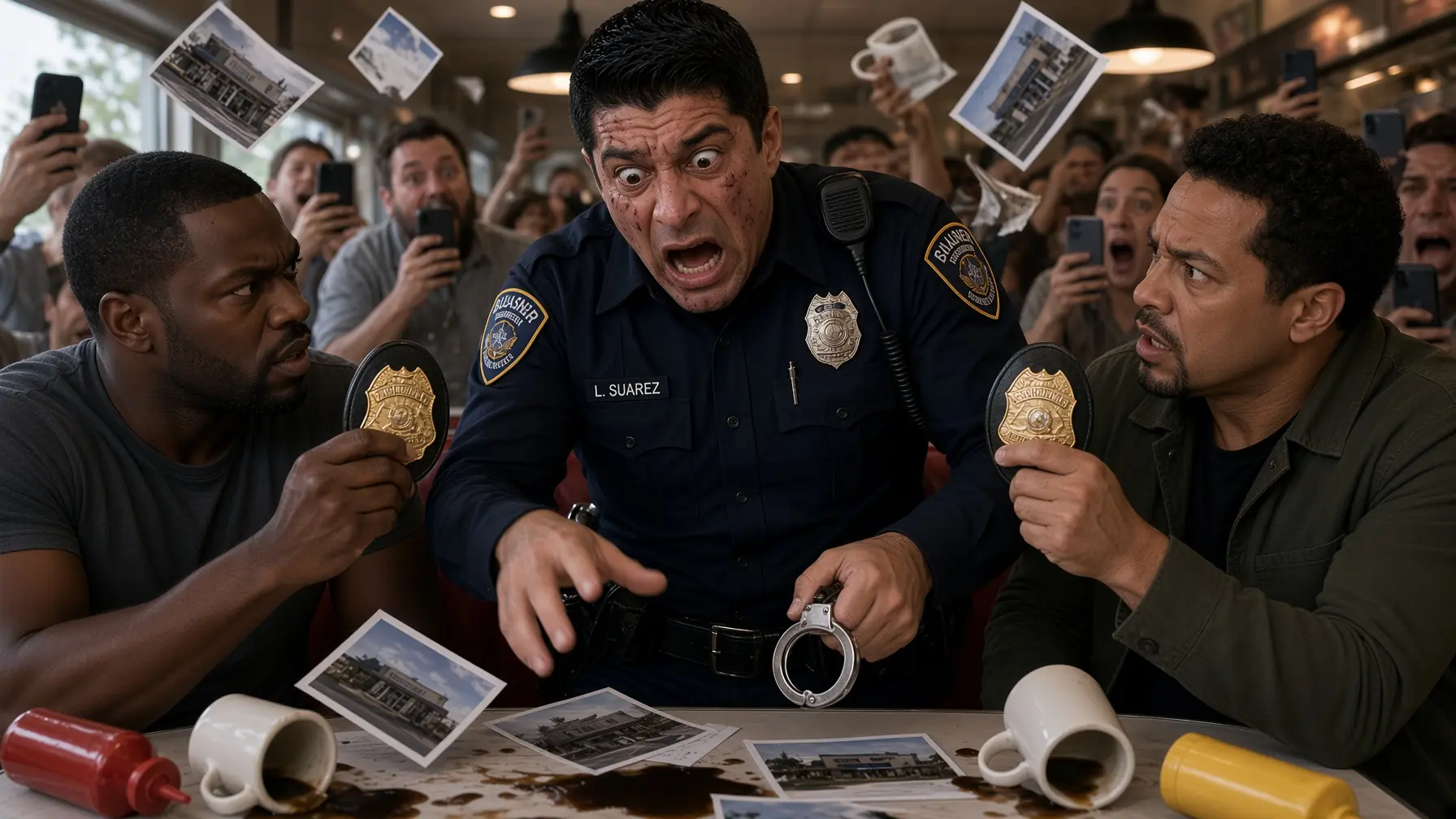
The younger-looking man by the window did not reach for his wallet. He was forty-one, though the close-cropped beard and gray hoodie made him look several years younger. A plate of eggs sat cooling in front of him beside a black coffee, three colored markers, and a printed aerial photograph of First Commonwealth Bank three blocks away. Across from him sat another Black man, slightly heavier, perhaps forty-five, wearing a faded navy jacket over a white T-shirt. Between them was a rough sketch showing parking-lot entrances, a rear service alley, camera positions, and two handwritten times circled in red. To Suarez, the table looked terrible.
The man by the window looked up. “Why do you need our IDs?”
Suarez nodded toward the paperwork. “A waitress called us. Said you guys have been talking about a bank, looking over plans, marking entrances. Some customers got uncomfortable.” He glanced from one man to the other. “I’m checking it out. If I can get identification from both of you, we can figure out what’s going on and get everybody on their way.”
The larger man leaned back. “What crime do you believe we committed?”
Suarez’s jaw tightened slightly. “I didn’t say you committed a crime.”
“Then are we detained?”
“I’m investigating a call.”
“That wasn’t the question.”
The men were Detectives Elijah Graham and Marcus Nolan of the Baybridge Police Department’s Major Crimes Division, and neither intended to tell Suarez that yet. For seven weeks, they had been working with a joint bank-robbery task force investigating a four-man crew suspected of hitting two armored-cash pickups and planning a third robbery at First Commonwealth. The papers on the table were real operational materials, stripped of names and sensitive source information but detailed enough to help them rehearse positions before meeting a confidential informant later that afternoon. Mason’s Diner had been selected precisely because members of the robbery crew used the adjacent auto shop, and the task force wanted Graham and Nolan to look like men discussing criminal business in a place where being overheard might actually strengthen their cover.
The waitress had overheard exactly what they wanted the wrong people to overhear. Unfortunately, she had called the right kind of people for the wrong reason. Her name was Becky Harmon, thirty-six, and she had served Graham coffee twice without incident before noticing the photographs. She heard Marcus say, “If they move at 2:15, we need somebody on the south exit,” and later heard Elijah reply, “The vault corridor isn’t the problem. Cameras are.” The fragments sounded alarming without context. Becky told her manager, the manager told her to call police if she genuinely believed something dangerous was happening, and five minutes later Officer Suarez was standing beside the booth.
Suarez had done nothing wrong by coming inside. Police could investigate suspicious reports, ask voluntary questions, and try to understand ambiguous conduct. Graham knew that better than nearly anyone in the room. What mattered was what happened next: whether a voluntary conversation remained voluntary, and whether Suarez developed actual facts supporting a detention before he began acting as though identification were mandatory. That distinction was why Graham kept his voice almost boringly calm. “Officer, we’re willing to answer whether anyone here is in danger. Nobody is. We’re eating breakfast and discussing business.”
“What kind of business?”
Graham looked at him.
“Private.”
Suarez laughed once. “You’re sitting in a public restaurant with pictures of a bank.”
“That doesn’t make the conversation yours.”
“It becomes my business when somebody calls the police.”
Marcus folded his arms. “The call gives you a reason to come talk. It doesn’t automatically give you a crime.”
Suarez looked at him. “You a lawyer?”
“No.”
“Then don’t lecture me about my job.”
Marcus’s eyes shifted toward Graham. That look had meaning between them. It said: This is getting worse. Graham returned an almost invisible nod that meant: Stay in character.
At a booth twenty feet away, Special Agent Daniel Cross of the FBI’s violent-crime squad pretended to read sports news on his phone. Cross was not there to supervise Graham or Nolan. He was backup for the undercover operation and had been instructed not to acknowledge them unless the investigation was in danger. He watched Suarez approach and initially considered the interruption merely inconvenient. A patrol officer checking a suspicious-person call did not automatically threaten the operation. If Graham and Nolan could talk him down without producing credentials, the cover might survive.
Then Suarez reached for the aerial photograph.
Marcus put one finger on it first.
“Please don’t touch our property.”
Suarez stopped.
The table became very quiet.
“I’m trying to see what you’re looking at.”
“You can see it from there.”
“You’ve got a bank marked up like a football playbook.”
Marcus nodded. “That’s what it looks like.”
“What does that mean?”
“It means it looks like a bank marked up like a football playbook.”
Suarez stared at him. “You think this is funny?”
“No.”
Graham spoke before Marcus could continue. “Officer Suarez, nobody is threatening anyone. Nobody has a weapon out. Nobody is attempting to enter the bank. If the waitress misunderstood something, you can tell her there’s no emergency.”
Suarez pointed toward the papers. “Then explain the plans.”
Graham said, “I’m not discussing them.”
That answer changed Suarez’s posture. He moved from beside the booth to the aisle, partly blocking the easiest exit. “Okay. Then let’s start with identification.”
Graham watched the movement.
“Are we being detained now?”
Suarez exhaled. “I don’t know why you guys keep making this difficult.”
Marcus said, “Because you keep avoiding that question.”
“I’m investigating.”
“Are we free to leave?”
Suarez hesitated.
That hesitation mattered more than his next sentence.
“Just give me your IDs first.”
Graham’s voice remained polite. “If this is voluntary, we decline. If it isn’t voluntary, tell us the basis.”
Several diners had begun watching. Becky stood near the counter with both hands wrapped around a coffee pot she had not poured from in several minutes. She had expected police to ask the men what they were doing, perhaps look at the papers, and leave. Instead, every answer seemed to produce another demand. She caught the manager’s eye and mouthed, “Should I say something?” He shook his head.
Suarez tapped the edge of the table. “Here’s what I’ve got. Two guys sitting in a booth with pictures of a bank, talking about cameras and a vault, refusing to explain what they’re doing, refusing ID. That’s enough for me to figure out who you are.”
Graham said, “Some of that may justify asking questions. Refusing voluntary questions doesn’t automatically add suspicion.”
Suarez’s eyes narrowed. “There it is again.”
“What?”
“The legal talk.”
Graham almost smiled. “You asked why.”
“No, I asked for identification.”
Marcus pushed his coffee away. “What happens if we don’t give it?”
Suarez answered too quickly.
“Then maybe we take this somewhere else.”
The room changed.
Cross lowered his phone.
Graham saw the reflection of the FBI agent in the diner window but did not turn toward him. If Suarez merely requested identification, the detectives could refuse or cooperate depending on strategy. If Suarez formally detained them based on reasonable suspicion, the legal analysis would become more complicated. The call contained specific details. Photos of a bank and words about vaults could legitimately justify further investigation, especially if the reporting witness could explain exactly what she heard. Graham was not interested in manufacturing a constitutional violation simply because the interruption annoyed him.
So he gave Suarez a way to do the job correctly.
“Officer, before this becomes something bigger, talk to the waitress.”
“I already know what she said.”
“You know what dispatch summarized.”
Suarez frowned.
Graham continued. “Ask her exactly what she personally heard. Ask whether we threatened anybody, talked about weapons, said we intended to rob a bank, tried to recruit anyone, or did anything besides sit here with papers.”
Suarez said nothing.
“That matters.”
“You telling me how to investigate now?”
“I’m suggesting you verify the complaint before turning it into something the witness never actually said.”
Marcus added, “That sounds pretty normal to me.”
Suarez ignored him. “What’s your name?”
Graham smiled faintly. “Still asking?”
“Yes.”
“Still declining.”
Suarez pulled out his radio and requested another unit.
Cross’s thumb stopped scrolling.
This was not yet catastrophic. Uniformed backup did not automatically expose undercover officers. But more police cars outside Mason’s would attract attention, and the crew they were watching had an associate working across the street at Henson Automotive. Graham knew that if anyone from the shop saw him and Marcus surrounded by patrol officers, their cover might be finished.
He looked at Suarez.
“We don’t need another unit.”
“You don’t decide that.”
“No.”
Graham’s voice softened.
“But I’d strongly recommend you slow down.”
Suarez laughed. “Why? You somebody important?”
Graham looked at him for a moment.
“No.”
That was exactly how he wanted to be treated.
Not as somebody important.
As somebody whose status did not determine the rules.
The second patrol officer arrived four minutes later. Officer Rachel Kim entered through the front door, took in the scene, then approached Suarez without immediately speaking to the men. “What do we have?”
“Possible robbery planning.”
Kim looked toward the table.
“Based on?”
“Waitress called. They’ve got bank plans, marked entrances, talking about vaults and cameras. Won’t give ID.”
Kim nodded toward Becky.
“You talked to the witness?”
“I got the call.”
“That wasn’t my question.”
Suarez looked irritated.
Kim walked toward Becky.
Graham watched carefully.
This was what should have happened first.
Becky appeared nervous when Kim introduced herself. “I just thought it sounded strange.”
“What exactly did you hear?”
“The taller one said something about two fifteen and a south exit. Then the other guy said something about the vault corridor and cameras.”
“Did either say they intended to rob the bank?”
“No.”
“Mention guns?”
“No.”
“Threaten anybody?”
“No.”
“Show weapons?”
“No.”
“Ask you to help?”
“No.”
“Did you hear anything about stealing money?”
Becky thought.
“Not exactly.”