Ma'am, what are you doing out here right now? I'm watering my garden. I live here. I need proof you belong at this residence. My identification is inside.
Hands where I can see them. Officer Tyler Chen had no idea what he just walked into. In the next 47 minutes, he would lose his badge. He would lose his freedom and he would cost taxpayers $8.5 million. All because he could not believe a woman owned a home in this neighborhood.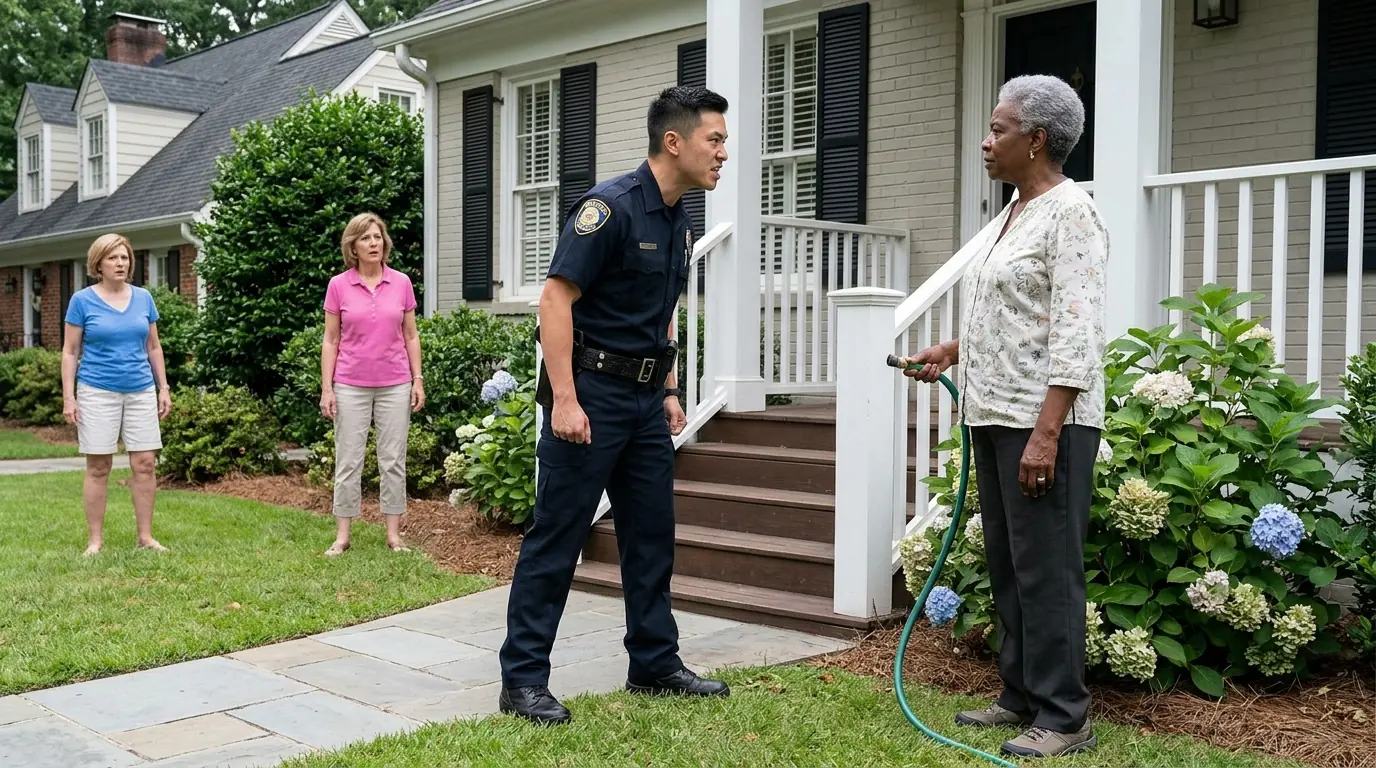
The woman he was handcuffing, the Honorable Margaret Williams, a retired judge. She spent 28 years on the bench. She sentenced criminals exactly like him. She ruled on over 4,000 cases. She trained prosecutors.
She wrote the handbook on civil rights violations. And she lived in that house for 25 years. Three neighbors ran out screaming that she was a retired judge. Chen ignored every single one of them. And his body camera, it recorded everything.
Before I continue, let me ask you something. Have you ever been treated unfairly by someone in power? Drop your answer in the comments. But officer Chen had no idea who he just put in handcuffs. Margaret Williams was 67 years old.
She was a retired superior court judge. She served on the bench for 28 years. During that time, she handled over 4,000 criminal and civil cases. She got her law degree from Howard University in 1981. Before becoming a judge, she worked as a prosecutor for 7 years.
She knew the law inside and out. Here is what makes this even more shocking. Judge Williams wrote the training manual on civil rights violations for the state bar association. She lectured at police academies. She taught officers about the fourth amendment, the same amendment Chen was about to violate.
Lawyers called her the constitution judge. She had personally sentenced dozens of officers for misconduct. Her personal life was simple. She was a widow. She bought her home in 1999.
She was one of the first homeowners in Brookwood Hills. Everyone in the neighborhood knew her. She hosted community events. She was loved. That Tuesday afternoon in May, Judge Williams was just watering her flowers, the same flowers she planted with her late husband years ago.
He worked for Brookwood Hills Police Department, but before that, he worked at two other departments. Both let him go quietly. Here is the part that matters. In six years, Chen had 14 formal complaints against him. 11 of those complaints involved black residents in affluent neighborhoods. This was not a mistake.
This was a pattern. In 2019, Chen stopped a black real estate agent. The agent was showing a house to a client. Chen detained him for 45 minutes. The agent filed a complaint.
Nothing happened. In 2021, Chen questioned a family at a park. They were having their own child's birthday party. Witnesses said Chen made racial comments. He got a written warning.
That was it. In 2023, Chen demanded ID from a contractor. The man was working on a home renovation. The homeowner complained. Again, no discipline.
Internal affairs had flagged Chen's complaint pattern. His supervisor recommended bias training. Chen never completed it. The police union blocked two attempts to punish him. Chen believed he could do whatever he wanted.
He had gotten away with it 14 times. He assumed the 15th time would be no different. He was wrong. Let me know in the comments. Should departments fire officers with this many complaints?
It was Tuesday, May 14th. The time was 3:07 p.m. Judge Williams lived at 847 Magnolia Drive in Brookwood Hills. This was an upscale neighborhood. The average home cost around $890,000. The streets had tall trees and nice lawns.
American flags hung from porches. Her house was a beautiful colonial style home. It had a wraparound porch. Her garden was perfect. She took pride in it.
That afternoon was quiet. Sprinklers ran on nearby lawns. School buses had just dropped off children. It was a normal Tuesday. Three neighbors were outside.
Carol Patterson was gardening three houses down. David Kim was washing his car across the street. Robert Johnson was walking his dog nearby. Judge Williams stood in her front yard. She held a garden hose.
She watered her prize hydrangeas. Then a patrol car appeared. It slowed down. It stopped. Officer Chen sat in his car for 47 seconds.
He watched her. Then he got out. His hand moved toward his weapon. He turned on his body camera at 3:08 p.m. No one had called about anything suspicious. There was no crime reported.
Chen started this on his own. His first words to her, "Ma'am, what are you doing here? " In any other situation, this might have ended with an apology, but Chen had already made up his mind. "If stories like this matter to you, hit that subscribe button now. " Chen walked toward Judge Williams.
His tone was aggressive from the start. "What are you doing here? " he asked again. I live here, she said calmly. I'm watering my garden.
I'm going to need to see some ID. Of course. Let me go inside and get it. She turned toward her door. Chen stepped in front of her.
You're not going anywhere. Officer, my ID is inside my house. That's not your house. Judge Williams stayed calm. This is important.
After 28 years as a judge, she knew how to handle conflict. I've lived here for 25 years, she said. Chen did not believe her. That's what they all say. Officer, why am I being questioned?
Chen lied. He said there was a suspicious activity report, but his body camera proved later that no such call ever existed. If you don't show ID, I'm charging you with failure to identify. Chen said, I've told you my name three times. Then the neighbors got involved.
Carol Patterson ran over from her yard. Officer, that's Judge Williams. She's lived here longer than any of us. David Kim crossed the street. What's going on, Margaret?
Are you okay? Robert Johnson walked up with his dog. I've known her 20 years. She's a retired judge. Three witnesses, three people confirming who she was.
Chan ignored all of them. This doesn't concern you, he said. Step back, officer. We're telling you the truth, Carol said. One more word and you're all getting obstruction charges.
The neighbors went quiet, but they did not leave. Then Chen grabbed Judge Williams by the arm. He pushed her against the porch railing. He put handcuffs on her. She was still holding the garden hose.
You're making a terrible mistake, officer, she said quietly. The only mistake here is you not cooperating. A 67-year-old woman handcuffed in her own yard for watering flowers. Type wrong in the comments if you think this was wrong. Judge Williams stood in handcuffs.
Her wrists hurt, but she stayed calm. She had been in courtrooms for 28 years. She knew panic would not help. She spoke clearly. Officer, I am a retired superior court judge.
I know my rights and your body camera is recording a federal civil rights violation right now. Chen laughed. Sure you are. And I'm the president. He did not believe her.
He did not want to believe her. He had already decided she was a criminal, but the neighbors had not given up. Carol Patterson pulled out her phone. She started recording. David Kim called 911.
He reported an officer arresting an innocent woman. Robert Johnson started live streaming on social media. The truth was being documented from every angle. Carol stepped closer with her phone. This is unbelievable.
She's a judge. I've been to her house for dinner. This is her home. David spoke to the 911 operator. The officer won't listen.
She owns this house. I helped her move furniture in 20 years ago. Robert shouted from his phone, "Judge Williams married my daughter. She is family to this neighborhood. Three neighbors, three pieces of evidence, three voices telling the truth.
" Chen did not care. Robert ran to Judge Williams porch. He grabbed documents, utility bills, property tax records. He brought them to Chen. Look at these, Robert said.
Her name is on everything. Chen refused to look. Anyone can fake papers. These are official documents. I'm not taking orders from civilians.
Chen called for backup. He requested transport for a trespassing suspect. Judge Williams had one more thing to say. She spoke slowly and clearly. She wanted his body camera to catch every word.
Officer Chen, badge number 4471. I am formally telling you that you are violating my Fourth Amendment rights. You have no probable cause. You have no warrant. You have multiple witnesses confirming my identity.
This arrest is unlawful. Do you understand what I am telling you? The Fourth Amendment protects people from being arrested without good reason. Chen had no reason. He just had assumptions.
Chen smiled. Ma'am, you can tell it to the judge. She looked him in the eye. I am a judge. He did not respond.
He put her in the back of his patrol car. By now, the evidence against Chen was overwhelming. His own body camera showed everything. Three neighbors had recordings. Documents sat untouched on the porch.
He had every chance to walk away. He chose to continue. This is what happens when someone in power refuses to admit they are wrong. Let me know what you think. Was Chen arrogant or just bad at his job.
Comment below. 10 minutes later, backup arrived. Sergeant Diana Morrison pulled up at 3:31 p.m. She was an 18-year veteran of the force. She saw the scene immediately. Multiple civilians shouting, phones recording everywhere. A woman in handcuffs in the back of a patrol car.
Morrison knew something was wrong. She approached Chen first. What do we have here? Trespassing suspect, Chen said, refused to show ID. Wouldn't cooperate.
Morrison looked around. Three neighbors were still there. All of them were upset. She walked over to them. She listened.
Carol Patterson spoke first. That woman is Judge Margaret Williams. She has lived here for 25 years. She was watering her flowers. David Kim nodded.
I've known her for two decades. That is her house. Robert Johnson pulled out his phone. He showed Morrison photos from community events. In every photo, Judge Williams stood in her own backyard.
Morrison went back to the patrol car. She looked at Chen's body camera footage on her portable device. She watched the whole thing. The footage showed everything. Judge Williams stated her name four times.
She offered to get her ID. Chen blocked her. She stayed calm the entire time. Three neighbors confirmed her identity. Chen ignored them all.
Then Morrison checked with dispatch. She asked one simple question. Was there a call about suspicious activity on Magnolia Drive? The answer came back. No, there was no call for service.
Chen had lied. He made up the suspicious activity report. His own department had proof. Morrison walked to the patrol car. She opened the back door.
Judge Williams, I am so sorry, she said. This should never have happened. She removed the handcuffs herself. Judge Williams stepped out. Her wrists had red marks from the cuffs.
She had been in the back of that car for 12 minutes. Morrison turned to Chen. You're on administrative leave. effective immediately. Chen protested. Sarge, you're taking her word over mine.
Morrison did not hesitate. I'm taking the evidence over your word, Chen. Go home now. This was a small moment of relief. One supervisor did the right thing.
She looked at the facts. She made the right call. Morrison personally walked Judge Williams to her front door. She gave her a business card and an incident number. She explained how to file a formal complaint.
The neighbors surrounded Judge Williams with support. Carol hugged her. David brought her water. Robert stayed close. Chen drove away.
His career was over. He just did not know it yet. If you believe good cops should call out bad cops, hit subscribe. We need more stories like Sergeant Morrison. The arrest lasted 47 minutes.
The aftermath lasted months. Remember those three neighbors with their phones? They did not just record, they shared. By 4:15 p.m., Robert Johnson's live stream had 2,400 viewers. By 5:00 p.m., Carol Patterson's video was on Facebook.
It had 47,000 views. By 700 p.m., local news station WKXT led their evening broadcast with the story. By 10:00 p.m., the hashtag justice forjudge Williams was trending locally. By midnight, 2.3 million people had seen the videos across all platforms. The numbers kept climbing.
On Facebook, the videos reached 1.8 million views with 89,000 shares. On Twitter, the hashtag got 4.2 million impressions. Retired Judge Arrested trended nationally. On TikTok, reaction videos hit 10 million combined views. On YouTube, news clips reached 6 million views in three days.
People were angry. One comment read, "He arrested a judge for watering her flowers in her own yard. " Another said, "This is exactly what we mean when we talk about racial profiling in everyday life. " A third wrote, "28 years on the bench and she still can't garden in peace. Legal experts went on every news channel.
They all said the same thing. This is a textbook Fourth Amendment violation. Local news covered it. National News covered it. CNN ran the story.
So did MSNBC, Fox News, The Washington Post, and the New York Times. The police department released a statement. It said, "Chen was on administrative leave, pending investigation. " 2 days later, the police chief held a press conference. He said, "This conduct does not represent our values.
" Chen deleted all his social media accounts. His lawyer released a statement claiming Chen followed protocol. That statement backfired. People got even angrier. 3 days later, something unusual happened. The police union refused to defend Officer Chen.
They said his actions were indefensible. Then the FBI announced they were opening a civil rights investigation. This story was shared millions of times. Share it if you think others should see this. Comment below with your reaction.
The legal process moved fast and it hit Chen hard. Federal prosecutors filed charges first. They charged Chen with deprivation of rights under color of law. This is a federal crime. It means using your government power to violate someone's rights.
State prosecutors added more charges. false arrest, assault, filing a false police report. But wait, the investigation found something bigger. The FBI looked into Chen's history. They found those 14 previous complaints. They found his text messages to other officers.
The messages contained racial jokes. They found proof he never completed bias training even though he signed papers saying he did. They found that his previous departments transferred him out instead of firing him. Chen was not just a bad cop on one day. He was a pattern.
The trial happened eight months later. The prosecutor told the jury he saw a black woman in a nice neighborhood and decided she did not belong. Chen's lawyer tried to argue good faith. He said Chen genuinely believed he was doing his job. The jury did not buy it.
They took only 4 hours to decide. Guilty on all charges. Here is what that means. Let me break down the sentence. Federal civil rights violations, 15 years in prison.
State charges for false arrest and assault, 17 years. Those sentences run one after the other. That is 32 years total. The judge at sentencing said, "You swore an oath to protect. Instead, you terrorized.
" Chen will be 66 years old when he gets out. The same age Judge Williams was when he arrested her, but the criminal case was only half of it. Judge Williams filed a civil lawsuit. She sued under section 1983. This is a law that lets people sue government workers who violate their rights.
She claimed false arrest, assault, civil rights violations, and emotional distress. The city tried to settle early. Judge Williams said no. She wanted her day in court. The jury awarded her $8.5 million.
That included $3.5 million in regular damages and 5 million in punitive damages. Punitive damages punished the city for letting Chen's pattern continue for years. But there were more consequences. Chen was permanently decertified. That means he can never work as a police officer again anywhere.
The police chief resigned under pressure. The department is now under a federal consent decree for 5 years. That means federal monitors will watch everything they do. Two supervisors who ignored Chen's complaints were demoted. One arrest, one bad officer, millions of dollars, multiple careers destroyed, all because Chen could not believe a woman owned her own home.
After the verdict, Judge Williams held a press conference. She stood on the courthouse steps. She spoke to the cameras. "I spent 28 years upholding the law," she said. "I never thought I would become a victim of those sworn to enforce it.
" She paused. I still flinch when I see a patrol car slow down on my street, my garden, the flowers I planted with my husband. I could not bring myself to water them for months. The emotional damage was real, even for someone as strong as Judge Williams. But she had something important to say.
I've sentenced officers before. I knew the law protected me, but most people don't have my resources or my knowledge. If this happened to me, a retired judge in broad daylight with three witnesses. Imagine what happens when there are no cameras, no witnesses, no credentials. She looked directly at the cameras.
Document everything. The cameras saved me. Know your rights. You do not have to accept abuse. There are good officers out there, but the system must stop protecting the bad ones.
She had a message for law enforcement, too. Implicit bias is not just a training module. It is a choice you make every time you approach a citizen. Your assumptions can destroy lives, including your own. Judge Williams wants change.
Real change. Mandatory bias training with real accountability. Civilian oversight with real authority. pattern tracking across all departments. Her final words were powerful. I spent my career believing in the system.
Now I am fighting to make sure the system believes in all of us. This case is not just about one bad cop. Americans are 2.5 times more likely to be stopped by police with no legal reason. Only 1% of officers with multiple complaints face serious discipline. Judge Williams won because she had expertise, witnesses, and resources.
Most victims have none of those things. Chen's body camera footage is now used in police academies. It teaches new officers what not to do. That is something positive that came from this. But we still need national tracking of problem officers.
We still need real consequences for departments that ignore complaints. So, let me ask you, should it take being a retired judge to be believed in your own front yard? Should it take three witnesses with phones to prove you belong in your own home? Should it take 14 ignored complaints before an officer faces consequences? Because if we do not track patterns, if we do not demand accountability, if we do not believe people when they say, "I live here.
" Then we are just waiting for the next Officer Chen. We are waiting for the next Margaret Williams. Except next time, maybe there will not be three neighbors. Maybe there will not be a body camera. Maybe the victim will not be a judge who knows her rights.
Comment below if you think 32 years was the right sentence or if you think it should have been more or less. I want to hear your opinion. If you think stories like this matter, hit that subscribe button. We are going to keep exposing these cases. We are going to keep demanding accountability.
We are going to keep fighting for justice. This is not just about one cop who could not believe a woman owned a nice house. It is about all of us.
It is about the assumptions we tolerate. It is about the patterns we ignore. See you in the next one.