The officer stepped in front of Alana Brooks before she reached the courtroom doors, and for one short second, everyone in the courthouse hallway seemed to forget how to breathe.
Alana stopped with one hand wrapped around the handle of her black leather briefcase. She did not stumble. She did not apologize. She did not look around for someone to rescue her. She simply lifted her eyes to the uniformed man blocking her path and waited for him to explain himself.
"Put the case down," Officer Grant Miller said.
His voice was firm enough to turn heads near the security checkpoint. A woman holding a folder against her chest slowed her steps. Two attorneys standing by the elevator stopped mid-conversation. A court deputy at the end of the hall looked up from his desk.
Alana glanced at the courtroom door behind Miller. Department of Public Integrity v. Ralston County Police Department was printed on the schedule outside Courtroom Three. The hearing was supposed to begin in eleven minutes. She had been assigned to testify, not as a witness to drama, but as an independent compliance investigator carrying material the court itself had ordered preserved.
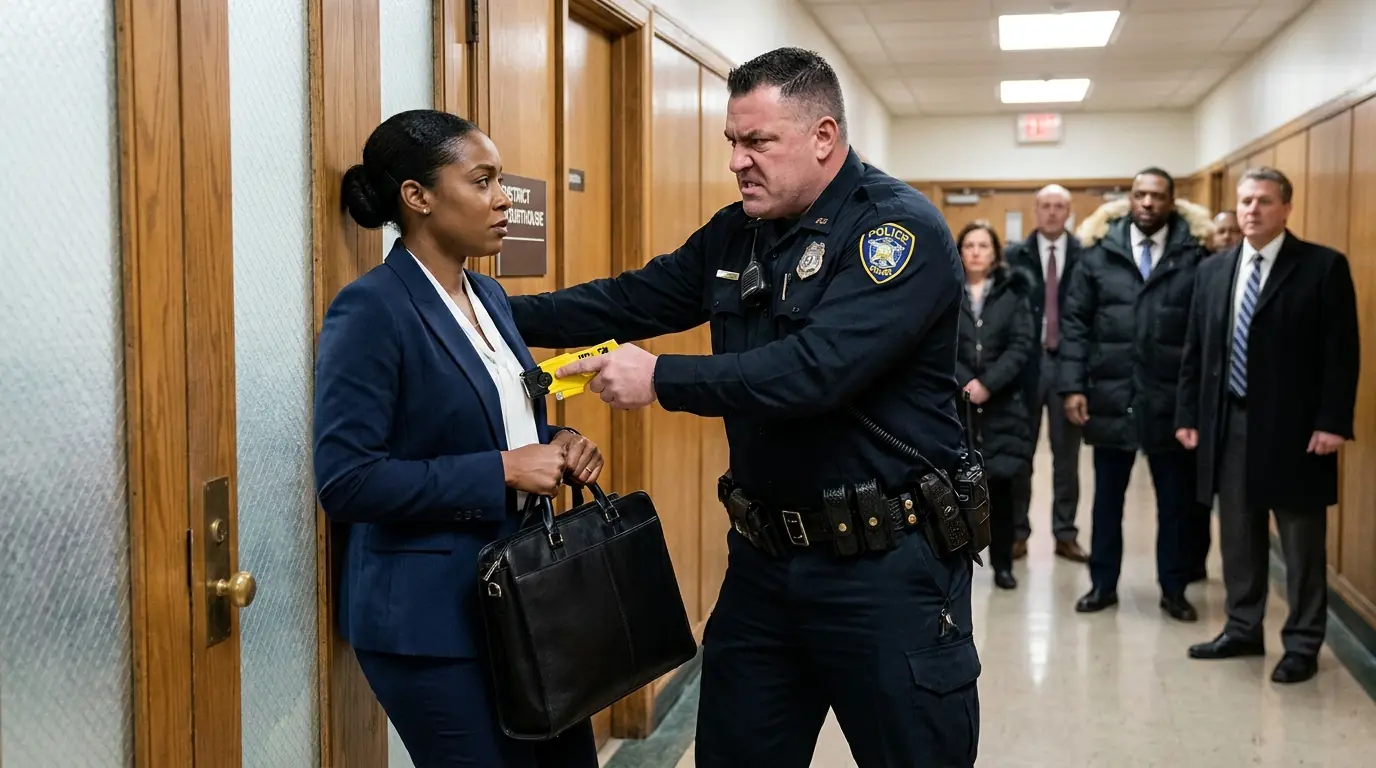
"Why?" she asked.
Miller's jaw tightened. "Because I told you to."
Alana looked at his badge, then back at his face. She was thirty-six years old, Black, neatly dressed in a navy suit, with her hair pinned in a low twist at the back of her head. Her expression remained composed, but the stillness in her eyes was not weakness. It was calculation.
"Officer," she said, "what is your legal authority to take my property?"
The hallway went quieter.
Miller's mouth flattened. He had expected compliance. He had expected confusion, maybe fear, maybe anger he could point to later as justification. What he had not expected was a woman standing in a courthouse hallway asking him to name the law.
"You don't need to know that," he said.
"Yes," Alana replied. "I do."
He stepped closer. "This is connected to a police investigation."
"Then you can identify which part of my briefcase is evidence and under what authority you intend to seize it."
A young paralegal near the wall raised her phone halfway, then lowered it when Miller shot her a look. Alana saw the movement, but she did not acknowledge it. She had learned long ago that attention could be a trap. The more people watched, the more careful she had to become.
Miller spoke through his teeth. "Ma'am, don't make this difficult."
"I'm not making it difficult. I'm asking a question."
"Turn around."
"For what?"
"You're being detained."
"Under what charge?"
"Obstruction."
Alana let the word sit between them.
"Obstruction of what?"
The question landed harder than a shout would have.
Miller's face reddened slightly. "Interfering with an active investigation."
"By walking into the courtroom where I was ordered to appear?"
"By refusing a lawful order."
"You still haven't explained what makes the order lawful."
For the first time, Miller glanced over his shoulder toward the courtroom doors. It was a small movement, almost nothing, but Alana saw it. He was not simply stopping her. He was trying to stop her before she crossed that threshold.
That difference mattered.
Alana had spent fourteen years reading patterns other people tried to hide. She had worked compliance cases involving missing funds, doctored logs, destroyed emails, altered personnel files, and agencies that used procedural language to bury uncomfortable facts. People lied in many ways. Some lied with words. Some lied by moving faster than questions could catch up.
Officer Miller was moving too fast.
He reached toward her wrist.
"Put your hands behind your back."
A gasp came from someone behind her.
Alana did not step back. She did not pull away. She lowered her voice instead.
"If you arrest me," she said, "you should be prepared to explain to the judge why you knew what was inside this briefcase before you ever opened it."
Miller froze.
It lasted less than a second, but it was enough.
The courtroom doors opened.
Judge Evelyn Carter stepped into the hallway in a black robe, her silver hair cut neatly around her jaw, her eyes sharp behind thin glasses. She had heard enough of the commotion to leave the bench before the hearing even began. Behind her, the courtroom gallery had gone silent.
"What is happening here?" she asked.
Miller straightened so quickly he almost looked younger. "Your Honor, this woman is interfering with an active police investigation."
"This woman has a name," Alana said calmly. "Alana Brooks. I am scheduled to appear before this court this morning."
Judge Carter's eyes moved from Miller to Alana's briefcase. "Officer, what lawful order did she refuse?"
"I ordered her to surrender the case."
"Why?"
"It contains police property."
Alana's eyebrows lifted, but she said nothing.
Judge Carter noticed.
"Police property?" the judge repeated.
Miller shifted. "Potentially restricted material."
"Potentially?"
"Material connected to an internal investigation."
"So it is police property, restricted material, or evidence connected to an internal investigation?"
Miller's throat moved. "Those things can overlap, Your Honor."
"They can," Judge Carter said. "But each requires a different legal justification. Which one are you relying on right now?"
The hallway became painfully quiet.
Alana watched Miller search for an answer he should have already had. The first rule of improper pressure was simple. People who had authority could name it. People borrowing authority from fear usually could not.
"Your Honor," Miller said, "I received information from the department."
"What information?"
"I'm not authorized to discuss an active investigation in open court."
"Then you should have obtained the proper order before trying to seize property from a court-appointed investigator at the courtroom door."
Miller looked at Alana again, and this time the irritation in his face was mixed with something colder. Warning.
Alana recognized that look. She had seen it in offices with frosted glass. In conference rooms after someone realized she had found the missing page. In police stations where supervisors smiled politely while telling her files had been misplaced. It was the look people gave when they wanted her to understand that truth had a cost.
She had paid that cost before.
Three weeks earlier, Judge Carter had appointed her as an independent compliance investigator after months of troubling testimony about the Ralston County Police Department. Evidence had disappeared from storage. Body camera footage had been mislabeled. Arrest reports had been edited after filing. Internal complaints had vanished from the system. The department insisted the problems were clerical.
Judge Carter did not believe in coincidences that repeated themselves.
Alana had been given access to audit trails, chain-of-custody logs, evidence-room entries, disciplinary records, and preserved digital files. Her assignment had been simple on paper and dangerous in practice: determine whether the department had altered or destroyed evidence in cases involving excessive force complaints, wrongful arrests, and retaliatory charges.
By the second week, she knew the problem was not clerical.
By the third week, someone else knew she knew.
It began with missing emails. Then came a warning from a clerk who refused to leave her name. After that, Alana found an envelope under her windshield wiper containing one printed sentence.
Stop digging before you get buried.
She photographed it, bagged it, logged it, and kept digging.
The briefcase she carried that morning contained three things. A sealed chain-of-custody packet. A set of printed audit reports. And an encrypted drive with a recording that should not have existed.
The recording had been preserved automatically by a courthouse evidence transfer system after a detective accidentally routed a call through a monitored departmental line. On it, Officer Grant Miller's voice could be heard receiving instructions from someone above him.
Get the file before she reaches the judge.
Make the arrest look routine.
If she asks questions, call it obstruction.
Alana had not planned to play the recording in the hallway. She had planned to submit it properly inside Courtroom Three.
Miller had changed the schedule.
Judge Carter took one step closer. "Officer Miller, how did you know Ms. Brooks had anything in her briefcase relevant to this case?"
Miller blinked. "I was informed she might be carrying restricted records."
"By whom?"
"A supervisor."
"Name the supervisor."
"I can't do that in public."
"You attempted to arrest a court-appointed investigator in public. We are past your comfort level."
A few people in the gallery murmured. Judge Carter turned her head slightly, and the sound died at once.
Alana spoke. "Your Honor, may I ask a clarifying question?"
"You may."
Alana faced Miller. "Officer, earlier you said I was notified this week. Who notified me?"
Miller's expression tightened. "The department did."
"Which person?"
"That's irrelevant."
"No officer, detective, administrator, or attorney from Ralston County Police contacted me this week. No written notice was sent to my office. No subpoena was issued. No warrant was presented. No order was served. So when you say I ignored notice, I need to know who supposedly gave it."
Miller did not answer.
Judge Carter's voice cooled. "Officer?"
"I don't have that information in front of me."
"Yet you have enough information to seize her briefcase."
Miller's hand flexed at his side.
Alana knew the next move before he made it. People who lost the argument often tried to regain control through motion. A step forward. A raised voice. A hand on an elbow. Something physical enough to make thinking stop.
"Just hand over the recording," Miller snapped.
The sentence cracked the hallway open.
Alana held his gaze.
"The recording?"
Miller's face changed.
Judge Carter turned toward him very slowly. "Ms. Brooks never mentioned a recording."
The court deputy near the wall stood up.
Miller swallowed. "I meant documents."
"No," Alana said. "You said recording."