For seven years, Michael Grant had worked very hard to become forgettable.
He wore faded jeans, loose flannel shirts, and work boots purchased from the same hardware store as everyone else in Cedar Ridge, Pennsylvania. He drove an eight-year-old pickup with a dent near the rear bumper and spent Saturday mornings mowing his lawn before the heat settled over the neighborhood.
To most people, Michael was simply the quiet widower living in the small ranch house at the end of Briarwood Court.
He worked from home as a security consultant.
He attended neighborhood meetings only when necessary.
He helped elderly residents clear snow from their driveways but left before anyone could thank him properly.
His sixteen-year-old daughter, Lily, was the only person who understood how deliberately ordinary their life had been constructed.
Michael had once belonged to a world in which doors opened with explosives and decisions had to be made before the sound of gunfire reached the brain.
Fourteen years in the military had taught him how to enter buildings, evaluate threats, control frightened people, and survive the consequences of imperfect information.
His final assignment had placed him in command of a small special-operations team whose existence was not discussed outside restricted rooms.
He had left that life after a roadside explosion killed two men under his command and nearly took him with them.
Michael returned home with a damaged shoulder, several scars, and a strong desire never to prove anything to anyone again.
Then the Hastings family moved into the house beside his.
And their son decided Michael’s silence meant weakness.
The Hastings estate occupied nearly three acres at the edge of Briarwood Court.
The previous owners had been an elderly couple who maintained apple trees and hosted summer picnics for the neighborhood.
Carter Hastings removed the trees during his first week.
In their place came a stone patio, an outdoor kitchen, security cameras, and a driveway large enough to display his collection of vehicles.
Carter was forty-nine and had built a fortune purchasing distressed transportation companies, selling their assets, and dismissing most of their workers before moving on to the next acquisition.
He spoke loudly, laughed louder, and treated every conversation as a contest he had already won.
His son, Bryce, had inherited the volume without earning any of the achievements that had financed it.
Bryce was nineteen.
He stood slightly over six feet and had transformed his body through weight training, supplements, and several years at a commercial martial-arts academy called Dominion Combat.
His social media pages were filled with photographs of trophies, training videos, and captions about discipline written by someone who had never needed much of it.
Dominion awarded belts through tournaments governed by strict rules.
Bryce had learned how to score points against competitors wearing protective equipment.
He had also learned to perform.
Every strike came with a shout.
Every kick was thrown high enough for spectators to admire.
His punches were powerful but announced themselves through large movements of his shoulders.
Michael noticed these things without intending to.
Habit did not disappear simply because a man no longer needed it.
Every afternoon, Bryce attacked a heavy bag hanging from an oak tree near the property line. He threw spinning kicks that carried him past the target and wide punches that left his jaw completely exposed.
Michael occasionally watched from his porch while drinking coffee.
He never commented.
The young man was not his responsibility.
Then Bryce began searching for people who could not ignore him.
He confronted delivery drivers for stopping too near the Hastings driveway.
He blocked younger teenagers riding bicycles along the sidewalk.
He shouted at a gardener for allowing grass clippings to land near Carter’s imported SUV.
Each incident followed the same pattern.
Bryce chose someone who needed to leave more than he needed to win.
Then he mistook their withdrawal for fear.
Michael disliked what he saw.
He still stayed out of it.
His restraint ended on a hot afternoon in July.
Lily was washing Michael’s truck in the driveway.
Music played quietly through the open windows while she scrubbed dried mud from one wheel.
Bryce crossed the property line without speaking.
He wore training shorts and no shirt. A black belt embroidered with his name had been tied unnecessarily around his waist.
Lily stopped washing the truck.
“Can I help you?”
Bryce reached through the open driver’s window and twisted the radio knob until it broke off in his hand.
“My head hurts,” he said. “Turn it down.”
Lily stared at the broken plastic in his palm.
“You could have asked.”
“I just did.”
Michael had been reading on the porch.
He closed the book and stood.
He did not run.
Running could be interpreted as panic, and panic often fed aggressive people.
He walked down the driveway with his hands relaxed at his sides.
“Is there a problem?”
Bryce turned.
Up close, he saw a forty-three-year-old man wearing a loose gray shirt and faded jeans.
Michael was lean rather than visibly muscular. His posture appeared relaxed, and his right shoulder sat slightly lower than the left because of an old injury.
Bryce smiled.
“Your daughter’s music was annoying.”
Michael looked at the broken radio control.
“So you damaged my truck.”
“It’s a ten-dollar knob.”
“That doesn’t answer the question.”
Bryce moved closer.
“Are you trying to make something out of this?”
“No.”
Michael’s voice remained level.
“I’m telling you to return to your property.”
Bryce entered his personal space.
Michael smelled cologne and artificial fruit from a pre-workout drink.
“You should be careful how you speak to people,” Bryce said.
Michael looked at the bridge of his nose rather than directly into his eyes. The technique allowed him to monitor Bryce’s shoulders, hands, and feet without participating in the childish contest of staring.
“Bryce, you entered my property and frightened my daughter.”
“I didn’t touch her.”
“You will keep it that way.”
The smile left Bryce’s face.
“You threatening me?”
“I am establishing a boundary.”
“That sounds like a threat.”
“It sounds like one because you are accustomed to ignoring boundaries until someone makes the consequence clear.”
Lily stood behind her father.
Bryce looked at her, then back at Michael.
“You think you’re tough because you’re standing in front of your kid?”
Michael took one slow step forward.
He did not raise his voice.
“If you cross this property line again to intimidate her, the conversation will be different.”
For the first time, Bryce’s body hesitated before his pride caught up.
He laughed dismissively.
“Whatever, old man.”
He dropped the broken knob onto the driveway and walked away.
Michael watched until Bryce reached his own lawn.
Lily exhaled.
“Dad, he scares me.”
Michael turned immediately.
“Has he done anything else?”
“He watches when my friends come over. Sometimes he follows us to the corner in his car.”
“How long?”
“A couple of weeks.”
“Why didn’t you tell me?”
“I thought you’d do exactly what you just did.”
Michael looked toward the Hastings house.
“What did I just do?”
“You got that look.”
“What look?”
“The one that says you’ve already decided how many exits there are.”
Michael almost smiled.
She knew him too well.
“I’m not going to fight a teenager.”
“He wants you to.”
“That makes one of us.”
Michael installed an additional camera overlooking the driveway.
He documented the broken radio control and sent Carter Hastings a polite email asking that Bryce remain off his property.
Carter responded with three sentences.
The first accused Lily of playing music at an unreasonable volume.
The second described the damaged control as an accident.
The third warned Michael against harassing his son.
Michael saved the exchange.
He hoped the written boundary would end the matter.
Instead, Bryce interpreted the email as further evidence that Michael was afraid to confront him physically.
Two weeks later, Lily invited three classmates to study on the back patio.
Bryce brought two friends from Dominion Combat into his yard and began training beside the property line.
At first, they ignored the girls.
Then Bryce moved closer.
He struck the branches of a lilac bush planted by Michael’s late wife.
Each kick broke another piece.
Whenever one of Lily’s friends looked up, Bryce winked or blew a kiss.
Lily sent her father a message from the patio.
He’s doing it again. Please come outside.
Michael read the words in his office.
Anger arrived immediately.
Training placed it inside a smaller, colder space.
He walked outside.
“Bryce.”
The young man continued striking the branches.
“Stop damaging the bush.”
Bryce lowered his leg.
His friends watched from lawn chairs.
“The branches are over our property.”
“They are eighteen inches inside mine.”
“You measure everything?”
“Only when I suspect I’ll need evidence later.”
One of Bryce’s friends stopped smiling.
Michael pointed toward the Hastings patio.
“Move your training away from my daughter and her friends.”
Bryce walked to the boundary.
“You embarrassing me in front of my boys?”
“No.”
“You calling me a creep?”
“I’m telling you to stop behaving like one.”
Bryce’s face reddened.
He stepped across the property line and grabbed Michael’s shirt near the collar.
“I could fold you in half.”
Michael’s body reacted before anger could make the decision.
His left hand trapped Bryce’s wrist against his chest.
His right thumb pressed into the nerve along the young man’s forearm while his hips shifted slightly.
Bryce’s elbow rotated upward.
His knees collapsed.
One second he stood over Michael.
The next he was kneeling in the grass, unable to move without increasing the pain.
Michael applied no more pressure than necessary.
“Release my shirt.”
Bryce gasped.
Michael waited.
The fist opened.
He released the hold immediately and stepped back.
Bryce fell forward, catching himself with both hands.
Michael raised his voice just enough for the friends to hear.
“Careful. The ground is uneven.”
Bryce scrambled up.
Shock came before humiliation.
“You tripped me.”
“No.”
“You used some cheap move.”
“You grabbed me.”
Bryce looked toward his friends.
Neither knew what to say.
The entire encounter had happened too quickly for them to understand.
Michael turned toward the patio.
“Lily, take everyone inside.”
Bryce’s voice followed him.
“You’re dead, old man.”
Michael stopped but did not turn around.
“That sentence is being recorded.”
He pointed toward the camera mounted beneath the roof.
Bryce looked up.
The small red light was visible.
Michael continued into the house.
Carter arrived twenty minutes later.
He struck the front door hard enough to shake the frame.
Michael opened it but remained behind the threshold.
Carter stood on the porch with Bryce behind him.
“My son says you assaulted him.”
“Your son entered my property and grabbed my shirt.”
“He says you twisted his arm.”
“I removed his hand.”
“You threw him down.”
“Your cameras should show what happened.”
Carter stepped closer.
“Bryce is a champion fighter. He doesn’t fall because some office worker touches his wrist.”
Michael noticed that Carter had already chosen the story he preferred.
“The video from my camera will be preserved.”
Carter pushed one finger against Michael’s chest.
“You ever place your hands on him again, I’ll sue you until your daughter has to leave school and you’re living in your truck.”
Michael looked down at the finger.
“Remove your hand.”
Carter smiled.
“What are you going to do?”
“Nothing, if you remove it.”
Something in Michael’s voice reached the part of Carter not controlled by pride.
He stepped back.
“You stay away from my family.”
“Your family came to my door.”
Carter walked away.
Bryce remained for a moment.
“You got lucky.”
Michael looked at him.
“That belief is going to hurt you.”
He closed the door.
Lily had been standing in the hallway.
“Why didn’t you call the police?”
“I’m filing a report online.”
“Will that stop them?”
“Probably not.”
She looked frightened.
Michael regretted his honesty.
He placed both hands on her shoulders.
“Listen to me. You will not be alone outside for a while. You tell me whenever you leave. You do not engage with Bryce, even if he insults you.”
“What if he follows me?”
“Call me and go somewhere public.”
“What are you going to do?”
“Keep this from becoming the fight he wants.”
Lily looked toward the closed door.
“And if you can’t?”
Michael’s answer took longer.
“Then I’ll end it without letting him decide what that means.”
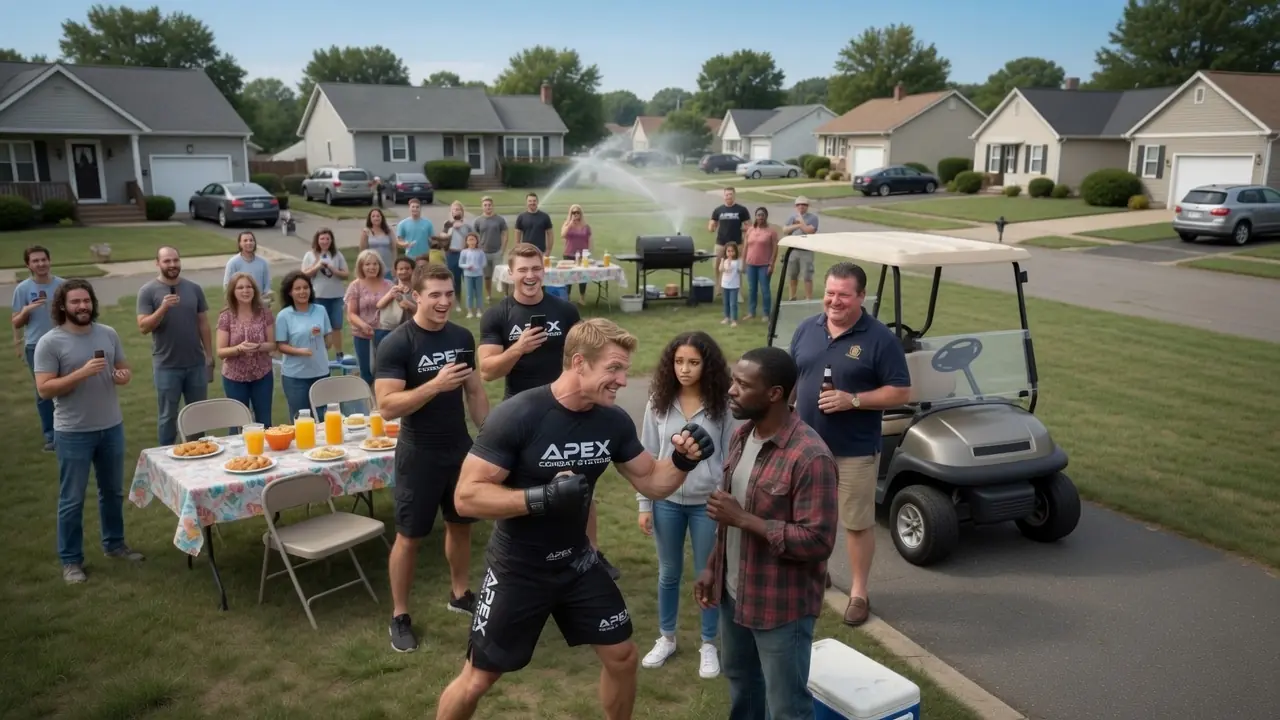
The Cedar Ridge Labor Day barbecue had taken place every year since before Michael moved into the neighborhood.
Families arranged tables and grills around the circular end of Briarwood Court. Children ran through sprinklers while adults carried folding chairs into the street.
Michael considered staying home.
Lily asked to attend.
She had already spent weeks changing her routines because of Bryce.
Michael refused to let the Hastings family take the neighborhood from her too.
He joined several residents near a cooler, speaking with Arthur Mitchell, a retired accountant who lived across the street.
Lily sat with friends along the curb.
For the first hour, everything remained peaceful.
Then Carter arrived in a golf cart carrying a cooler of imported beer.
Bryce walked behind him dressed in a Dominion Combat shirt and grappling shorts.
Three young men from the academy followed.
Bryce carried a large gym bag.
Michael saw it and understood immediately.
Arthur noticed the change in his face.
“What is it?”
“Move the children away from the center.”
“Why?”
“Please.”
Arthur had known Michael long enough not to ask twice.
He began directing families toward the tables.
Bryce dropped the bag several feet from Michael.
“Hey, Mike.”
Michael continued holding his plate.
“Bryce.”
“You never finished what you started.”
“I did not start anything.”
Bryce opened the bag and removed two pairs of sparring gloves.
He threw one pair at Michael’s feet.
The gloves struck the asphalt.
“Put them on.”
Conversation around the street faded.
Michael looked at Carter.
The father stood beside the golf cart smiling.
This had been discussed beforehand.
Perhaps encouraged.
“Bryce,” said neighborhood president Paul Jensen, “this is not the place.”
Bryce did not look away from Michael.
“He attacked me last week.”
“You entered his yard,” Arthur said.
“Stay out of it.”
Bryce tightened the straps on his gloves.
“You embarrassed me in front of my friends. Now we do this where everyone can see.”
Michael placed his plate on the cooler.
“No.”
Bryce smiled.
“You scared?”
“No.”
“Then put on the gloves.”
“I’m refusing because fighting at a family barbecue is ridiculous.”
Bryce turned toward Lily.
“Your dad talks a lot for a coward.”
Lily stood.
Michael looked at her and slowly shook his head.
Bryce continued.
“I’m going to knock him out in front of you.”
Michael’s expression changed.
It was slight.
Only Lily recognized it.
The father who helped with homework and complained about grocery prices disappeared behind the stillness of someone she had seen only twice before.
“Bryce,” Michael said, “you have threatened me in front of witnesses.”
The young man bounced lightly on his feet.
“Then defend yourself.”
“If you attack me, I will stop you.”
Carter laughed.
“Listen to this guy. Stop talking and fight.”
Michael removed his flannel overshirt.
He handed it to Lily.
“Stay beside Arthur.”
“Dad—”
“Please.”
She took the shirt.
Michael stepped onto the grass at the center of the court.
He did not touch the gloves.
Bryce followed.
“You need protection for those hands, old man.”
“The gloves are for your hands, not my face.”
The answer confused him.
Bryce raised his guard.
Michael stood at an angle with his hands relaxed near chest level.
To the neighbors, he appeared unprepared.
To the instructor watching from inside one of Bryce’s friends, Michael’s posture would have looked very different.
His weight remained balanced.
His elbows protected the center line.
His chin lowered slightly.
Nothing extended far enough to be grabbed.
“Rules?” Bryce asked.
Michael looked at him.
“You stop when I tell you.”
Bryce laughed.
“That’s your rule?”
“When you can’t continue safely, stay down.”
“After I break your jaw, I’ll remember that.”
Bryce attacked before anyone signaled the beginning.
He opened with a fast jab followed by a wide right hand.
The combination looked impressive.
Michael saw the right shoulder load before the first punch was fully extended.
He moved inside the arc rather than backward.
Bryce’s fist passed over his shoulder.
Michael placed one hand against the young man’s upper arm and another against his chest, redirecting his momentum.
Bryce stumbled past him.
He nearly fell onto the street.
The neighbors remained silent.
Bryce turned quickly.
“Lucky.”
Michael said nothing.
The absence of reaction made the humiliation worse.
Bryce launched a spinning kick.
The movement required him to turn his back.
Michael closed the distance before the leg extended, hooked the supporting ankle, and placed one open hand against Bryce’s shoulder blade.
Bryce hit the grass hard.
Air left his lungs in a shocked grunt.
Michael stepped away immediately.
“You’re down.”
Bryce rolled onto his side, trying to breathe.
“We’re done.”
Carter shouted from the edge of the crowd.
“Get up! Stop playing with him!”
Bryce’s face turned red.
He climbed to his feet.
His controlled technique had disappeared.
Michael saw panic narrowing his eyes.
“Stay down,” he warned.
Bryce charged.
He lowered his head and attempted to wrap both arms around Michael’s waist.
Michael dropped his hips and widened his stance.
The tackle stopped.
Bryce pulled upward with all his strength.
Michael barely moved.
He slid one arm over Bryce’s shoulder, controlled the head and upper body, and shifted his weight.
Bryce’s knees struck the ground.
Michael guided him facedown without slamming him.
His forearm controlled the shoulder rather than the neck. One knee settled beside Bryce’s hip, preventing him from rolling.
Bryce fought wildly.
“Stop moving,” Michael said.
“Get off me!”
“Stop.”
Bryce attempted to rise.
Michael increased the pressure slightly.
Pain and exhaustion finally overcame pride.
“Say you’re finished.”
“Go to hell.”
Michael remained calm.
“You are no longer protecting yourself. You are only trying not to look defeated.”
Bryce’s movements weakened.
“Tap the ground.”
Carter continued shouting.
“Break his leg, Bryce!”
The words did something unexpected.
Bryce stopped struggling.
For the first time, he seemed to hear his father from outside the rage.
He looked toward Carter.
The man was not worried about his safety.
He was worried about losing.
Bryce slapped the grass three times.
Michael released him immediately.
He stepped back with both hands visible.
Bryce rolled onto his back, breathing hard.
The entire exchange had lasted less than a minute.
Michael had not thrown a punch.
No one applauded.
That mattered to him.
This was not a victory.
It was a preventable failure witnessed by a street full of families.
Carter threw his beer onto the pavement and marched forward.
“You assaulted my son!”
Michael turned.
“Stop where you are.”
“You think you’re some kind of tough guy?”
“Take another step and I will consider you part of the threat.”
The voice was not loud.
It carried across the cul-de-sac anyway.
Carter stopped.
For one brief moment, instinct recognized what ego had missed.
The quiet neighbor was not excited.
He was not angry.
He was prepared.
Carter pointed toward him.
“You’re going to prison.”
“Call the police.”
“I’ll take your house.”
“Call them.”
“I know the mayor.”
Michael looked toward Arthur.
“Has anyone recorded the full encounter?”
A teenager raised his phone.
“I did.”
Another neighbor lifted hers.
“Me too.”
Carter’s expression changed.
The first police cruiser arrived eight minutes later.
Sergeant Ellen Price and Officer Mateo Ruiz separated the parties.
Carter attempted to control the conversation through volume.
“This lunatic attacked my son without warning!”
Arthur stepped forward.
“That is false.”
Carter turned on him.
“You stay out of this.”
“I watched your son throw gloves at Michael and threaten him.”
Several neighbors agreed.
Sergeant Price collected the videos.
One recording began before Bryce entered the center of the grass. It captured the threats, the thrown gloves, the first punch, and every movement afterward.
Price watched it twice.
She then looked at Bryce.
“Do you need medical attention?”
He sat on the grass holding his ribs.
“No.”
“Were you struck?”
Bryce hesitated.
“No.”
“Did Mr. Grant initiate physical contact?”
“No.”
Carter stepped between them.
“He manipulated him. Those were military moves or something illegal.”
Price looked at Michael.
“Do you have military training?”
“Yes.”
“What kind?”
“Enough to avoid answering that in the middle of the street.”
“That’s fair.”
Carter stared.
Price continued.
“The footage shows your son attacking repeatedly. Mr. Grant used restraint and released him when he surrendered.”
“My son is nineteen. He’s practically a child.”
Bryce looked humiliated by the statement.
Price turned toward Carter.
“He is legally an adult.”
She then addressed Michael.
“Do you wish to file a complaint?”
Michael looked at Lily.
Bryce had threatened him, damaged property, harassed his daughter, and crossed the property line several times.
“Yes.”
Carter’s mouth opened.
Michael continued.
“I also have security footage from previous incidents.”
Bryce looked toward him.
For the first time, the young man appeared frightened rather than angry.
Price instructed both families to remain apart while reports were completed.
Bryce was issued a citation for disorderly conduct and referred for review on assault charges. Because no serious injury occurred and Michael had not requested immediate arrest, he was released to leave with his father.
Carter gripped his son’s arm.
“This is not over.”
Michael answered quietly.
“It should have ended when you taught him that losing face was more dangerous than hurting people.”
Carter pulled Bryce toward the golf cart.
The neighbors watched them go.
Lily hugged her father after the police left.
“You said you wouldn’t fight him.”
“I didn’t want to.”
“You knew you could beat him.”
“That wasn’t the question.”
“What was?”
“Whether I could stop him without becoming the person he accused me of being.”
She looked toward the damaged grass.
“Were you afraid?”
“Yes.”
“You didn’t look afraid.”
“Fear doesn’t always look like panic.”
“What did yours look like?”
Michael placed an arm around her.
“Counting where everyone was standing. Making sure there were no weapons. Watching whether Carter joined in. Knowing exactly how much pressure I could use without injuring Bryce.”
Lily was quiet.
“That sounds worse than panic.”
“It usually is.”
The barbecue slowly resumed, though nobody completely relaxed.
Michael helped repair a table knocked over during the confrontation.
Then he carried food inside and washed grass from his hands.
The scars across his knuckles became briefly visible beneath the water.
He had spent years building a life in which Lily never needed to know exactly what those hands had done.
Bryce had not destroyed that life.
But he had forced part of it into the sunlight.
Michael resented him for that more than for the challenge itself.
Carter attempted to retaliate.
He hired a private investigator and began searching Michael’s employment history.
The public record described Michael as the founder of Grant Strategic Risk, a modest consulting company specializing in physical security and logistics analysis.
What the investigator could not access were the restricted contracts connecting Grant Strategic Risk to federal infrastructure programs.
Michael’s company did not perform raids or covert operations.
It examined freight networks, data centers, energy facilities, and transportation companies seeking government contracts involving sensitive material.
Carter’s company, Hastings Transit Group, happened to be bidding for one such contract.
Michael had not been assigned to the review.
After learning about the personal conflict, he formally recused himself.
That decision protected both the process and his company.
Carter did the opposite.
He contacted several political acquaintances and accused Michael of being violent, unstable, and unfit to conduct federal work.
He also threatened to withdraw his company’s bid unless Michael was removed.
The complaint reached the procurement integrity office.
Officials reviewed the police report and videos.
They found no misconduct by Michael.
They did, however, become concerned that Carter was attempting to influence a federal contracting process through personal pressure.
Hastings Transit’s bid received an independent review.
Auditors discovered undisclosed safety violations at two subsidiary companies, incomplete driver records, and inaccurate insurance certifications.
The contract was not awarded to Carter.
Michael played no role in that decision.
When a former commanding officer called to explain what had happened, Michael answered simply.
“He did not lose the contract because of me.”
“No,” the officer said. “He drew attention to a file that could not survive attention.”
That distinction mattered.
Carter had not been ruined by a powerful enemy.
He had exposed weaknesses his confidence had previously kept hidden.
Dominion Combat also reviewed the neighborhood video.
Its owner, Daniel Vargas, had spent thirty years teaching martial arts.
He invited Bryce and Carter to a private meeting.
Bryce expected a temporary suspension.
Instead, Vargas placed the young man’s black belt on the table.
“You used training to frighten people.”
“He humiliated me,” Bryce said.
“You challenged a neighbor at a family event.”
“He assaulted me before that.”
“The earlier security footage shows you grabbing his clothing on his property.”
Carter leaned forward.
“My son paid your academy thousands of dollars.”
Vargas looked at him.
“You paid for instruction.”
He turned back to Bryce.
“A belt is not permission to dominate weaker people.”
“I’m not weak.”
“This is not about your physical strength.”
Vargas placed one finger on the belt.
“You lost control when your techniques failed. You continued attacking after being warned to stop. You listened to your father telling you to break a man’s legs.”
Bryce looked toward Carter.
The father’s expression demanded defiance.
For the first time, Bryce did not provide it.
Vargas continued.
“You are suspended indefinitely. You may return only after counseling, community service, and evidence that you understand why this happened.”
Carter stood.
“We’re done with this fake school.”
He reached for the belt.
Vargas placed his hand over it.
“This remains here.”
Bryce said nothing as they left.
The criminal complaint did not produce a dramatic prison sentence.
Bryce accepted responsibility for disorderly conduct and harassment. The assault charge was resolved through a diversion agreement because he had no previous criminal record and Michael had not been injured.
He was required to complete anger-management treatment, perform community service, and obey a no-contact order protecting Michael and Lily.
Some neighbors believed the outcome was too mild.
Michael did not.
He had seen young men destroyed by consequences that arrived before they had any chance to understand themselves.
He did not need Bryce’s life ruined.
He needed the threat to end.
Carter refused to accept responsibility.
His transport company lost investors after the failed federal bid and the discovery of safety problems.
He blamed Michael publicly.
Then auditors, insurers, and lenders began asking questions unrelated to the neighborhood incident.
Within months, Carter sold several assets and placed the Cedar Ridge estate on the market.
The heavy bag remained unused near the oak tree.
Bryce rarely appeared outside.
One cold afternoon in November, Michael found him standing alone near the property line.
The no-contact order had expired weeks earlier, but Bryce did not cross.
Michael continued gathering fallen branches.
“You could have hurt me,” Bryce said.
Michael stopped.
“Yes.”
“Why didn’t you?”
“Because stopping you was enough.”
Bryce looked toward the grass where the fight occurred.
“My dad says you destroyed our company.”
“I had no role in the contract review.”
“He says you made people investigate us.”
“Your father contacted them.”
Bryce’s jaw tightened.
“He was trying to protect me.”
“Was he?”
Bryce looked at him.
Michael set down the branch.
“At the barbecue, when you were on the ground, did he tell you to stop?”
“No.”
“What did he tell you?”
Bryce said nothing.
“He told you to break my legs.”
“He was angry.”
“So were you.”
Michael stepped closer but remained on his side of the boundary.
“People reveal what they value when control begins slipping away.”
“What is that supposed to mean?”
“Your father valued winning more than your safety.”
Bryce looked toward the Hastings house.
“You don’t know him.”
“No.”
Michael picked up the branch again.
“But I heard him.”
Bryce rubbed his wrist where Michael had applied the compliance hold months earlier.
“How did you do it?”
“The fight?”
“All of it.”
“You announced everything before you moved.”
“I’m faster than you.”
“Probably.”
“I’m stronger.”
“Definitely.”
“Then why couldn’t I touch you?”
“Because you were performing.”
Bryce frowned.
Michael continued.
“You wanted the crowd to see a fighter. I was watching your balance.”
“So you think my training is useless?”
“No. I think you used it for the wrong purpose.”
Bryce looked down.
“Vargas says I can come back if I complete counseling.”
“That sounds reasonable.”
“My friends think I’m a joke.”
“You challenged a neighbor at a barbecue while wearing competition gear.”
Bryce almost smiled despite himself.
“That sounds bad when you say it.”
“It looked worse.”
Silence passed between them.
“What would you do?” Bryce asked.
“In your position?”
“Yes.”
“Stop blaming the person who exposed the problem.”
Bryce looked toward the house again.
The moving company was scheduled to arrive the following morning.
“My father will never forgive me for tapping.”
Michael considered the words.
“You didn’t surrender to me.”
“It felt like it.”
“You stopped a situation that had become unsafe.”
Bryce looked unconvinced.
“That is what disciplined people do,” Michael said.
He carried the branches toward his garage.
Before entering, he turned.
“The strongest decision you made that day was the one your father hated.”
The Hastings family left Cedar Ridge before the first snow.
Carter did not say goodbye.
Bryce stood beside the moving truck while workers loaded the final boxes.
Lily watched from the window.
“Do you think he’ll change?” she asked.
Michael joined her.
“I don’t know.”
“You talked to him.”
“I answered a question.”
“Same thing for you.”
Michael smiled slightly.
The truck drove away.
The estate remained empty through winter.
The neighborhood became quiet again.
Delivery drivers no longer looked nervously toward the large stone house.
Children returned to riding bicycles along the sidewalk.
Lily began washing the truck with music playing through the repaired radio.
Michael kept the additional cameras installed.
Peace did not require forgetting what had threatened it.
Six months later, a letter arrived without a return address.
Michael opened it at the kitchen table.
The handwriting was uneven.
Mr. Grant,
I finished the counseling program. I also completed two hundred hours at a youth center where I was supposed to teach fitness classes. Mostly I cleaned mats and carried boxes. That was probably better for me.
Coach Vargas let me return to Dominion, but I started again as a white belt. My father says I humiliated the family by accepting that. We do not speak much.
You told me I was performing instead of fighting. You were right. I think I was performing most of my life.
I am sorry for frightening Lily. I am sorry I damaged your property and challenged you in front of the neighborhood. I know writing this does not require you to forgive me.
Thank you for not hurting me more than you needed to.
Bryce Hastings
Michael read it twice.
Lily entered the kitchen.
“What is that?”
He handed it to her.
She read silently.
“Do you believe him?”
“I believe he wrote it.”
“That isn’t what I asked.”
“No.”
Michael folded the letter.
“I believe people can change. Whether he has changed will be shown by what he does when nobody from Cedar Ridge is watching.”
“Are you going to answer?”
“Yes.”
“What will you say?”
Michael looked toward the quiet street beyond the window.
“The truth.”
He took out a sheet of paper.
Bryce,
Your apology belongs first to the people you frightened when you believed they could not challenge you. Start there.
Beginning again as a white belt is not humiliation. It may be the first honest rank you have earned.
Strength is not proven by what you can do to another person. It is proven by how much control you retain when pride tells you to do damage.
Keep training. More importantly, keep listening.
Michael Grant
He placed the letter in an envelope.
Lily watched him.
“That’s all?”
“That’s enough.”
“You don’t want him to know what you used to do?”
“No.”
“He’ll probably spend his whole life wondering.”
“That may help him.”
Michael returned to his ordinary routines.
He mowed the lawn.
He repaired the lilac bushes Bryce had damaged.
He completed risk assessments from the home office and occasionally traveled to inspect facilities whose locations Lily was not allowed to know.
At neighborhood gatherings, people treated him differently for several months.
Some asked whether he had been in the military.
Others repeated exaggerated versions of the barbecue fight.
Michael corrected them whenever possible.
“I did not knock him unconscious.”
“I did not break anything.”
“No, I was not an assassin.”
Eventually, the story became less interesting.
That pleased him.
Arthur once asked whether Michael regretted accepting the challenge.
“Yes.”
“You stopped him.”
“I also allowed a nineteen-year-old to choose the setting.”
“What else could you have done?”
“Called police before the barbecue. Requested a restraining order after the first threat. Kept Lily home.”
“She shouldn’t have needed to hide.”
“No.”
Michael looked toward the common lawn.
“But when protecting someone, being morally right is not always the same as choosing the safest option.”
Arthur considered that.
“Would you do it differently?”
“I hope I never have to find out.”
A year after the confrontation, Cedar Ridge held another Labor Day barbecue.
The Hastings estate had been purchased by a family with two young children and a quiet golden retriever.
A new swing hung from the oak tree where Bryce’s heavy bag once remained.
Michael stood near the grill while Lily prepared to leave for college.
She had been accepted into a nursing program two hours away.
“You know you don’t have to inspect the campus security system yourself,” she said.
“I am only walking around.”
“With a notebook.”
“I enjoy notebooks.”
“You interviewed the residence director.”
“She seemed competent.”
Lily laughed.
Then her expression softened.
“I’m going to be okay.”
“I know.”
“You don’t sound like you know.”
Michael looked across the street at children playing beneath the sprinklers.
“For most of my life, protecting people meant controlling the ground around them.”
“And now?”
“Now I have to let you leave it.”
She hugged him.
“That might be the hardest fight you’ve ever had.”
“It is already going badly.”
Music played from a portable speaker.
Neighbors carried food between tables.
No one shouted.
No gloves landed at anyone’s feet.
The peace was ordinary.
That was what made it valuable.
Michael once believed strength was measured by the ability to enter danger and dominate it.
Age taught him something quieter.
Sometimes strength meant refusing a fight.
Sometimes it meant using only enough force to stop one.
Sometimes it meant allowing a frightened young man to stand again after he had tried to humiliate you.
And sometimes it meant building a life so peaceful that no one looking from the outside would ever guess what it had taken to earn it.
Michael raised his coffee toward the late-summer sun.
Then he returned to the grill before the burgers burned.
Nobody at the barbecue watched him move.
Nobody needed to.
That was exactly the life he had wanted.