The first punch missed by less than an inch.
Private Cole Barrett felt the air move around his glove as the old man’s silver head slipped calmly to one side. There had been no frantic ducking, no stumble, and no fearful recoil.
Just one small movement.
Effortless.
Precise.
Cole pulled his fist back and stared.
Around the combat mat, nearly forty soldiers had gone silent.
A minute earlier, several of them had been laughing.
Now no one was.
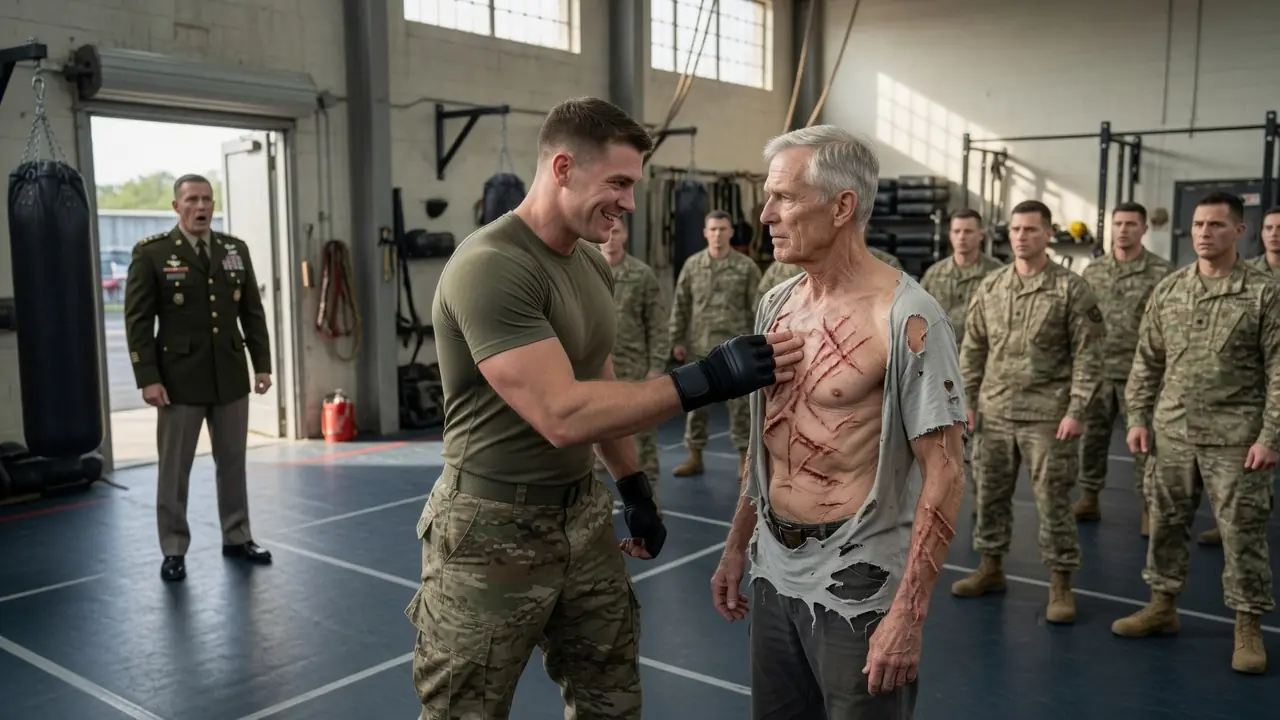
The elderly stranger stood in front of Cole with his hands relaxed near his chest. He wore an old gray T-shirt, dark work pants, and brown combat boots that had been repaired so many times that the original leather was barely visible beneath the stitching.
He was narrow through the shoulders and almost eighty pounds lighter than Cole.
He should have looked helpless.
Instead, he looked patient.
That disturbed Cole more than fear would have.
“You missed,” the old man said.
Cole’s jaw tightened.
“I wasn’t trying to hurt you.”
“Then why did you throw it?”
A few soldiers shifted uncomfortably around the mat.
Sergeant Luis Vega stood near the edge of the circle, already regretting the decision that had allowed the confrontation to continue.
“One controlled exchange,” he had said.
No full-power strikes.
No attacks to the head.
The moment he ordered them to stop, it would end.
Cole had agreed.
The old man had said nothing.
Now Cole’s face burned as the watching soldiers waited to see what he would do next.
He had spent the previous month defeating every opponent assigned to him.
At twenty-four, he was six feet four inches tall and weighed two hundred and thirty pounds. His shoulders stretched the fabric of his olive training shirt, and his black sparring gloves covered hands powerful enough to shake a heavy bag from its ceiling chain.
He held the fastest obstacle-course time in his platoon.
He was the strongest man in the gym.
Everyone knew it because Cole reminded them whenever the opportunity arose.
The old stranger had made him miss with one movement.
Cole stepped forward again.
This time, he did not throw a testing jab.
He drove a hard right hand toward the man’s ribs.
The old man shifted his rear foot.
Cole’s glove passed through empty space.
Two fingers touched the exposed side beneath his raised arm.
Not hard enough to hurt.
Only enough to mark the opening.
“That would have stopped your breathing,” the stranger said.
Cole slapped the hand away.
“Do it properly.”
Sergeant Vega moved closer.
“Barrett, control yourself.”
Cole barely heard him.
The soldiers were no longer looking at him with admiration. They were studying the old man.
Cole could feel the room changing sides.
He hated that feeling.
He had always believed respect belonged to the strongest person present.
And until that morning, that person had always been him.
He lowered his stance.
The stranger observed the change without reacting.
Cole charged.
He threw a left hook and drove his shoulder forward, intending to knock the old man from the mat even if the punch missed.
The stranger stepped inside the hook.
One hand redirected Cole’s wrist.
The other made brief contact with his elbow.
Then the old man turned his hips.
Cole’s momentum carried him past.
His right knee struck the mat.
One hand slapped down to prevent his face from following.
A sharp sound moved through the watching soldiers.
Not laughter.
Surprise.
Cole rose immediately.
The old man remained behind him.
He had not thrown a punch.
Cole turned.
“You got lucky.”
The stranger tilted his head.
“Then try again.”
Vega stepped between them.
“That is enough.”
Cole pushed past him.
“No.”
The sergeant grabbed Cole’s arm.
Cole tore it free.
The moment he did, Vega understood that the controlled demonstration had ended.
Cole was no longer sparring.
He was trying to recover his pride.
“Private Barrett, stand down!”
Cole charged before Vega could stop him.
The old man waited until the final moment.
Then he lowered his center of gravity, caught Cole’s forward arm, and swept one boot behind his ankle.
The gym ceiling spun above Cole.
His back struck the mat hard enough to force all the air from his lungs.
Before he could recover, the old man knelt beside him.
A forearm rested lightly across Cole’s chest.
Two fingers touched the side of his neck.
Cole understood the position immediately.
With slightly more pressure, the stranger could control his breathing.
A different movement could damage the artery beneath those fingers.
The old man looked down at him.
“Strength without discipline is only danger wearing a uniform.”
Then he released Cole and stood.
No one spoke.
From the entrance to the gym came a quiet voice.
“Where did you learn that transition?”
The old man froze.
Every soldier turned.
Major General Adrian Knox stood in the doorway beside Captain Robert Hayes and two members of the command staff.
General Knox had served nearly forty years. He had commanded infantry units, advised overseas operations, and developed a reputation for remembering the name of every soldier killed under his authority.
He was not looking at Cole.
His eyes were fixed on the pale scar beneath the old man’s collarbone.
The stranger picked up the faded field jacket he had removed before stepping onto the mat.
General Knox crossed the floor.
“Sir,” Vega began, “I can explain what happened.”
Knox raised one hand without looking at him.
The gym remained silent.
The general stopped several feet from the elderly man.
His expression had changed from command authority to disbelief.
Then he spoke two words no one else in the room understood.
“Night Watcher.”
The old man’s gray eyes narrowed.
“I have not heard that name in many years.”
Knox took another step.
“I was told you died.”
“So were the men trying to kill me.”
The general looked at the scar near the man’s chest.
“March 3, 1984. Panjshir.”
The old man pulled on his jacket.
“You remember more than is healthy.”
“I remember the man who carried me out of a burning compound.”
Cole slowly pushed himself onto one knee.
Around him, the soldiers stared at the quiet visitor they had mistaken for a harmless civilian.
General Knox’s voice became softer.
“Colonel Elias Mercer.”
The old man gave the smallest nod.
“Retired.”
Captain Hayes looked between them.
“General, who is he?”
Knox did not answer immediately.
His attention remained on Mercer.
“What brought you here?”
“I was invited.”
“That is not what I asked.”
Mercer’s eyes moved toward the far wall.
A memorial display stood between equipment racks, partly hidden by padded shields.
Bronze plaques carried the names of soldiers who had trained at Fort Briarwood and later died in service.
Near the bottom was one name.
MASTER SERGEANT AARON MERCER
1989–2020
Elias Mercer looked at it.
“My grandson trained in this building.”
The atmosphere changed again.
Captain Hayes stepped forward.
“Aaron Mercer was your grandson?”
“Yes.”
“He instructed here for nearly five years.”
“I know.”
Aaron Mercer had died during an overseas convoy attack after pulling two wounded soldiers from a burning vehicle. He had returned for a third man when a secondary explosion struck.
His actions were taught in leadership classes at Fort Briarwood.
Cole knew the story.
More than that, Aaron Mercer had been one of Cole’s first instructors.
He had corrected Cole’s footwork during basic combatives training.
He had stayed after hours to help slower recruits master techniques that stronger soldiers learned quickly.
He rarely shouted.
He never humiliated a struggling trainee.
Cole remembered something Aaron used to say.
A powerful soldier controls a fight.
A disciplined soldier controls himself.
Until that moment, Cole had never wondered who taught him those words.
Elias reached inside his jacket and removed a worn unit patch.
“My daughter could not attend tomorrow’s remembrance ceremony,” he said. “She asked me to place this beneath Aaron’s name.”
He walked toward the memorial wall.
The soldiers moved out of his path without being ordered.
Cole remained on one knee beside the mat.
His humiliation had disappeared.
Something heavier had replaced it.
The confrontation had begun less than ten minutes earlier.
Fort Briarwood had opened several training facilities to retired service members participating in a military heritage weekend.
Most of the visitors remained behind a marked line while recruits completed the final week of hand-to-hand combat assessment.
Cole had just thrown another soldier onto the mat when he noticed Elias standing closer than the other guests.
The old man wore no medals.
No veteran’s cap.
Nothing identified him as a former officer.
To Cole, he looked like someone who had wandered away from a retirement-home tour.
“You lost, sir?” Cole called.
Elias had glanced around.
“No.”
“This section is for active personnel.”
“I can see that.”
Several recruits smiled.
Cole walked toward him.
“You came to watch real soldiers train?”
Elias looked at the name tape on Cole’s chest.
“I came to see whether the training had changed.”
Cole opened his arms.
“Well?”
Elias studied his stance.
Cole’s feet were spread too far apart.
His shoulders remained unnecessarily tense.
His chin was high because he was accustomed to other people lowering theirs.
“The equipment is better,” Elias said.
The soldiers waited.
Cole leaned forward.
“What about the soldiers?”
“That depends on the soldier.”
The smiles vanished.
Cole moved close enough that Elias could smell the rubber of his gloves.
“You should be careful how you speak in here.”
“Why?”
“Because you are surrounded by men trained to fight.”
Elias looked around the gym.
“I have stood among them before.”
Cole laughed.
“Of course you have.”
Elias turned away.
Cole placed one hand on his shoulder.
“We are not finished.”
Elias looked down at the glove.
“Remove it.”
The quiet command irritated Cole more than an insult would have.
“Or what?”
“Or you will learn something your instructors should have taught you already.”
Cole shoved him.
Elias stumbled backward onto the mat but recovered immediately.
Several soldiers laughed.
Sergeant Vega had heard the disturbance and crossed the room.
Before he arrived, Cole raised one fist.
“You are too old to stand in my training hall.”
“Your training hall?”
The laughter that followed belonged to the old man’s question, not to Cole.
Cole mistook it for encouragement.
“One punch,” he said. “That is all it would take.”
Vega ordered him to step back.
Then Elias removed his jacket.
Scars became visible beneath the gray shirt.
A long surgical line ran from his collarbone to the center of his chest. Burn marks curved beneath one arm. A small circular scar rested just below his heart.
Cole had seen the scars.
He had ignored their meaning.
“Scars do not make you dangerous,” he said.
Elias stepped onto the mat.
“No.”
He raised his hands.
“Surviving what caused them did.”
At the memorial wall, Elias pressed Aaron’s old patch beneath the plaque.
His fingers remained there for several seconds.
General Knox stood beside him.
“I attended Aaron’s funeral,” the general said.
“I remember.”
“He saved three soldiers.”
“He saved two. He died reaching the third.”
“He reached him.”
Elias looked at Knox.
“What?”
“The third soldier survived. Aaron shielded him from the secondary blast.”
The old man’s face changed.
His daughter had been told only that Aaron died attempting the rescue.
Official reports had remained vague because of the location and operation.
“He lived?” Elias asked.
“Yes.”
Knox’s voice softened.
“He has a wife and a little boy now. He sends a letter to Aaron’s mother every year.”
Elias closed his eyes.
For one moment, the celebrated colonel, the man who had crossed fire carrying wounded soldiers, looked like any grandfather receiving a piece of his grandson back.
Then he opened his eyes and regained control.
“Thank you.”
General Knox looked toward Cole.
The private had risen but remained near the mat.
“What happened here?” Knox asked.
Sergeant Vega answered.
“Private Barrett confronted Colonel Mercer, sir.”
“Confronted him how?”
“He challenged the colonel to a controlled exchange.”
Elias interrupted.
“He challenged an old civilian he believed did not belong.”
Knox’s eyes settled on Cole.
“Did you put your hands on him?”
Cole swallowed.
“Yes, sir.”
“Before you knew who he was?”
“Yes, sir.”
“Did he threaten you?”
“No, sir.”
“Did he interfere with training?”
“No, sir.”
“Then why?”
Cole looked toward the floor.
“I thought he was disrespecting me.”
“How?”
“He questioned the soldiers.”
“He answered your question.”
“Yes, sir.”
General Knox moved closer.
“How long have you served?”
“Eleven months.”
“And in eleven months, you decided this building belonged more to you than to someone who served before your parents were born.”
Cole had no defense.
“No, sir.”
“That is exactly what you decided.”
Knox turned toward the gathered soldiers.
“Confidence is necessary. Physical strength is valuable. Aggression can save lives when it is directed toward the correct threat.”
He looked at Cole again.
“Arrogance makes a soldier dangerous to everyone standing beside him.”
Cole’s face burned.
This time, not because he had lost.
Because the general’s words were true.
Captain Hayes stepped toward Elias.
“Sir, if I may ask, what operation was the general referring to?”
Elias shook his head.
“It does not belong in this room.”
Knox answered anyway.
“Not all of it remains classified.”
Elias looked at him.
The general faced the soldiers.
“In 1984, my reconnaissance team was attached to an operation in Afghanistan that officially involved no American personnel.”
The room remained still.
“Our position was compromised before sunrise. Communications failed. Eleven men were trapped inside a stone compound while a much larger force closed around us.”
Knox paused.
“Four men died during the first attack. The structure caught fire. Headquarters considered the position unrecoverable.”
He pointed toward Elias.
“Colonel Mercer entered alone.”
Captain Hayes frowned.
“Without a team?”
“His local guide was killed during the approach.”
Knox continued.
“Mercer had already been shot beneath the collarbone. He had burns along his ribs and shrapnel lodged near the heart.”
The soldiers looked again at the marks beneath Elias’s shirt.
“He carried two wounded men down the mountain,” Knox said. “Then he returned.”
Cole stared at the old man.
Knox’s voice tightened.
“He brought three more out.”
“Why was he called Night Watcher?” one recruit asked.
Elias looked toward the general, but Knox answered.
“Because once Colonel Mercer was assigned to protect a position, no one under his watch was left behind.”
Elias’s expression hardened.
“Enough.”
Knox stopped.
The command in the single word still carried the force of rank.
For an instant, the gym saw the man he had once been.
Then Elias looked at Cole.
“Who trained you when you arrived here?”
Cole knew what he meant.
“Master Sergeant Aaron Mercer, sir.”
“Did he teach you to humiliate weaker soldiers?”
“No, sir.”
“To touch civilians without cause?”
“No, sir.”
“To use size as proof of character?”
“No, sir.”
Elias moved closer.
“Then you knew my grandson’s words but learned none of their meaning.”
The statement struck Cole harder than the fall.
“I am sorry.”
“Yes.”
The direct response surprised him.
Cole had expected the old man to dismiss the apology and tell him everything was fine.
Elias did neither.
“I disrespected you,” Cole continued.
“Yes.”
“I put my hands on you.”
“Yes.”
“I judged you because of your age.”
“You judged me because judgment was easier than curiosity.”
Cole lowered his head.
“Yes, sir.”
Elias studied him.
“You are embarrassed.”
Cole looked up.
“I deserve to be.”
“Embarrassment is not understanding.”
“What should I do?”
General Knox was about to speak, but Elias raised one hand.
“Tomorrow morning, report to the rehabilitation hospital beyond the east gate.”
Cole frowned.
“Sir?”
“Injured service members train there three days each week. Some are learning to walk with prosthetic legs. Others are recovering from strokes, spinal injuries, burns, or traumatic brain injuries.”
“What will I do there?”
“Whatever they need.”
General Knox nodded.
“You will report at seven every morning for thirty days.”
“Yes, sir.”
Elias turned back toward the memorial wall.
Cole hesitated.
“Colonel Mercer?”
The old man looked over his shoulder.
“Could you actually have taken one of my punches?”
A faint smile appeared.
“No.”
Several soldiers exchanged glances.
Elias finished.
“I would have made certain you never landed it.”
The next morning, Cole reported to Briarwood Veterans Rehabilitation Center expecting punishment.
He found a lesson far more difficult than physical training.
His first assignment involved assisting a seventy-year-old Vietnam veteran named Harold Price in moving from a wheelchair to a padded platform.
Cole placed both arms beneath Harold’s shoulders and prepared to lift him.
A therapist stopped him.
“He does not need you to carry him.”
Cole looked at the veteran’s weak legs.
“He cannot stand alone.”
“He is not alone.”
The therapist positioned Cole behind the wheelchair.
“Stay close enough to catch him. Let him do the work.”
The task took nine minutes.
Harold’s arms shook.
His damaged left leg barely responded.
Twice, Cole instinctively reached forward.
Twice, the therapist stopped him.
Finally, Harold stood for three seconds.
Then five.
When he sat again, sweat covered his forehead.
Cole had once completed a twelve-mile ruck march with forty pounds on his back and considered himself tough.
Watching Harold stand for five seconds changed his understanding of effort.
Over the following weeks, Cole worked beside injured veterans whose bodies no longer obeyed them as they once had.
A former captain practiced closing his fingers around a drinking cup.
A young sergeant with two prosthetic legs fell repeatedly between parallel bars.
A medic who had survived a stroke spent twenty minutes forming one complete sentence.
None wanted Cole’s pity.
They wanted patience.
They wanted someone close enough to catch them without stealing the achievement.
One morning, Cole watched the young sergeant fall against his safety harness.
He immediately reached forward.
The sergeant raised one hand.
“Do not lift me.”
“You fell.”
“I know.”
“Let me help.”
“You are helping.”
The man used the bars to push himself upright.
“Help is not always doing the hard part for someone.”
Cole stepped back.
The sergeant stood again.
Across the room, Elias Mercer sat against the wall.
He had begun visiting twice each week.
He did not offer instruction.
He watched.
For the first month, Cole avoided sitting near him.
Then one morning, he carried two cups of coffee across the rehabilitation room.
He offered one to Elias.
The old man accepted it.
“I understand more now,” Cole said.
Elias watched Harold Price take four steps with a walker.
“How much more?”
“Enough to know I did not understand anything that day.”
“That is a beginning.”
Cole sat beside him.
“Why did you not tell me who you were?”
“You never asked.”
“I asked if you had trained.”
“No. You told me I did not belong.”
Cole took a breath.
“A uniform gives a person authority,” Elias said. “It does not give him character.”
They watched the double amputee reach the end of the parallel bars.
Cole asked, “Were you really going to fight me?”
“No.”
“You stepped onto the mat.”
“I was going to let you show the room who you were.”
“And if General Knox had not arrived?”
Elias sipped the coffee.
“You would still have ended on your back.”
Cole laughed quietly.
After a moment, Elias did too.
Thirty days passed.
Cole continued volunteering.
The order had ended, but the work had not.
His behavior in the combat gym changed.
He remained competitive.
He still trained harder than most of his unit.
But he stopped measuring strength only by who fell first.
When a smaller soldier struggled, Cole stayed after practice to help.
When two recruits became angry during sparring, he stepped between them before pride became violence.
Sergeant Vega noticed.
Captain Hayes noticed.
The younger soldiers who once admired Cole’s arrogance began respecting his restraint.
Several months later, Cole found a sealed envelope inside his locker.
The handwriting was uneven but careful.
Private Barrett,
My grandfather told me what happened in the gym.
He also told me you report to the rehabilitation center even though no one requires it anymore.
My husband believed soldiers should be judged by what they did after someone showed them they were wrong.
Aaron would have expected you to learn.
Do not make his confidence in soldiers look foolish.
Rachel Mercer
Cole folded the letter and placed it inside his training manual.
He carried it when his unit deployed the following year.
The convoy attack happened shortly after sunrise on a narrow road overseas.
An explosive device disabled the lead vehicle.
Gunfire followed from a damaged building beyond the road.
Cole’s first instinct was to move toward the shooters.
Then he saw Private Evan Shaw trapped beside the burning vehicle.
Evan was nineteen years old and weighed barely one hundred and fifty pounds.
Months earlier, Cole might have dismissed him as too small for combat.
Now he saw a soldier bleeding beside a fire.
Cole crossed the exposed road.
Rounds struck the dirt around him.
He dragged Evan behind the remains of a concrete wall.
A second explosion threw both men sideways.
Cole covered Evan with his body.
Shrapnel entered Cole’s side.
Fire burned across his shoulder.
He remained conscious long enough to pull the younger soldier farther from the wreckage.
Both men survived.
During recovery, Cole received another letter.
The handwriting was firm but old.
Barrett,
General Knox told me what you did.
He said you controlled your hands when it mattered.
Aaron would have been proud.
Do not confuse one good act with becoming a good man. That work continues every morning.
Elias Mercer
Cole kept the letter for the rest of his life.
Years later, Sergeant First Class Cole Barrett stood inside the same combat gym at Fort Briarwood.
The equipment had changed.
New mats covered the floor.
The memorial wall carried additional names.
A new class of soldiers gathered around the training area with the same mixture of confidence, fear, and inexperience Cole remembered from his own youth.
One recruit towered over the others.
He laughed when paired with a smaller soldier.
Cole stopped the exercise.
“You believe size decides what someone can survive?”
The recruit shrugged.
“It helps, Sergeant.”
“It does.”
Cole walked toward the memorial wall.
Aaron Mercer’s patch remained beneath glass.
Beside his plaque was another.
COLONEL ELIAS MERCER
1946–2025
NIGHT WATCHER
Most details of Elias’s service remained classified.
The lesson did not.
Cole faced the recruits.
“The strongest man I ever challenged was sixty-eight years old.”
Several soldiers smiled.
Cole did not.
“I shoved him because I thought age had already defeated him.”
The room became quieter.
“He put me on my back twice without throwing a punch.”
One recruit raised his hand.
“What technique did he use?”
Cole stepped onto the mat.
“The one most soldiers learn too late.”
“What is it?”
“Discipline.”
He looked toward the largest recruit.
“Strength gives you choices.”
Then he looked at the smallest.
“Discipline decides whether anyone around you is safe when you make them.”
Morning light entered through the high windows.
Heavy bags moved softly on their chains.
The soldiers prepared to begin again.
Years earlier, Cole Barrett had looked at Elias Mercer and seen everything time had taken from him.
The old man’s speed.
His muscle.
His rank.
His youth.
Cole later understood that true strength was revealed by what time had left behind.
Judgment.
Patience.
Control.
Memory.
And the quiet certainty of a man who had survived enough violence to know that the most dangerous fighter in any room was rarely the one who needed everyone else to fear him.